
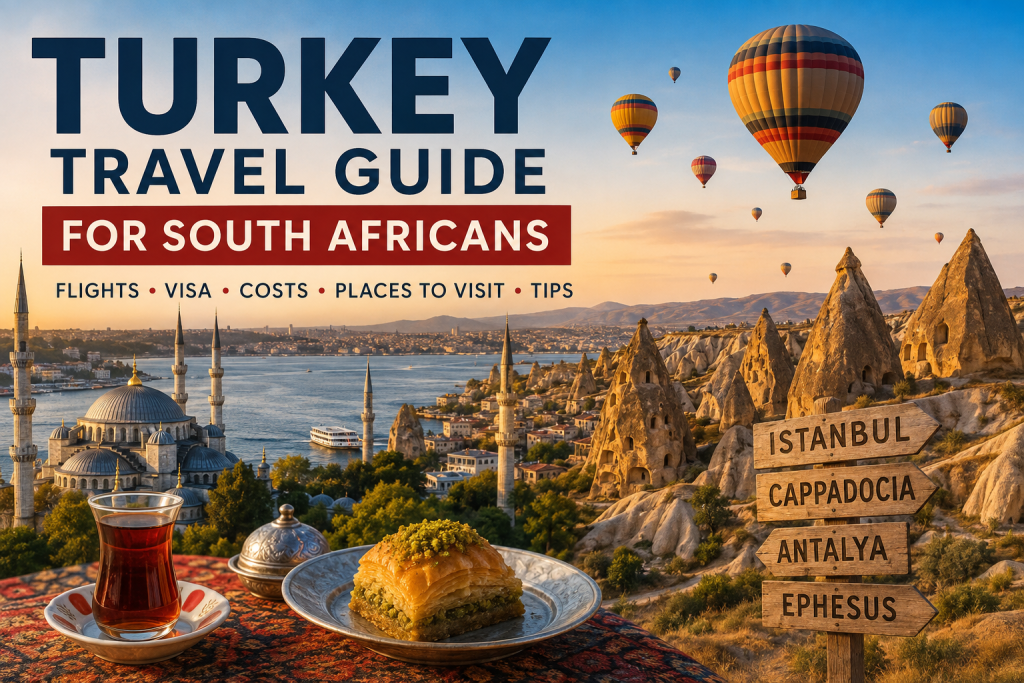
Turkey Travel Guide for South Africans: Flights, Visa, Costs & Things to Do
Turkey is one of those destinations that offers an unusual combination of history, culture, food, beaches and spectacular scenery.
For South African travellers, it can also be an attractive option for an overseas holiday because you can experience both European and Middle Eastern influences in a single country.
From the historic streets of Istanbul to the Mediterranean coastline, ancient ruins, mountain landscapes and famous hot-air balloons of Cappadocia, Turkey offers enough variety for anything from a short city break to a much longer holiday.
If you’re considering travelling from South Africa to Turkey, there are several things worth planning before you book.
You’ll need to consider flights, visas, accommodation, transport, travel insurance, mobile connectivity and your overall budget.
This guide covers the essentials to help you start planning your Turkish adventure.
Why visit Turkey?
Turkey has something to offer a surprisingly wide range of travellers.
You can spend a few days exploring historic sites in Istanbul, relax beside the Mediterranean, visit ancient ruins, explore traditional markets or experience the unusual landscapes of Cappadocia.
Some of the biggest attractions include:
- Istanbul
- Cappadocia
- Antalya
- Bodrum
- Izmir
- Ephesus
- Pamukkale
- The Turkish Riviera
- The Aegean coast
The country’s variety is one of its biggest advantages.
A holiday in Turkey doesn’t have to be exclusively about sightseeing. You can combine history, food, shopping, beaches and outdoor experiences in the same trip.
Is Turkey suitable for South African travellers?
Turkey can be an excellent choice for South Africans looking for an international holiday with plenty to see and do.
Turkey is one of the more affordable international destinations for travellers earning South African rands. It is also a destination that you will want to return to over and over again. Once you have walked the streets of Istanbul, your heart will always remain there.
However, it is important to plan your trip around the areas you actually want to visit.
Turkey is a large country, and travelling between destinations can take considerable time.
For a first visit, concentrating on Istanbul and one additional region may be more enjoyable than trying to see the entire country.
For example:
Istanbul + Cappadocia
or
Istanbul + Antalya
can provide a good combination of sightseeing and relaxation.
Do South Africans need a visa for Turkey?
Yes. South African ordinary passport holders require a visa to enter Türkiye. However, the Turkish e-Visa is extremely simple to apply for.
The Turkish Ministry of Foreign Affairs currently states that ordinary South African passport holders can obtain a one-month single-entry e-Visa through the official e-Visa system, while South African official passport holders have different visa arrangements.
The Turkish Consulate General in Cape Town also confirms that South African ordinary passport holders can obtain an e-Visa online.
Visa requirements can change, so travellers should always check the official Turkish government information before booking or travelling.
The official Turkish e-Visa system also states that the passport must remain valid for at least 60 days beyond the permitted duration of stay associated with the visa or visa exemption.
Important
Be particularly careful when searching for a Turkish e-Visa online.
Some websites appear to offer visa services but are not the official government portal. The Turkish Consulate in Cape Town specifically warns applicants about scam websites.
The Official Turkish e-Visa Website
When is the best time to visit Turkey?
Turkey has a varied climate, so the best time depends heavily on what you want to do.
Spring: March to May
Spring can be an excellent time for sightseeing.
Temperatures are generally more comfortable than during the hottest summer months, making it easier to spend long days exploring cities and historic sites.
Spring can be particularly appealing if your trip focuses on:
- Istanbul
- Historical attractions
- Walking tours
- Cultural sightseeing
- Outdoor activities
Summer: June to August
Summer is popular with beach holidaymakers.
The Mediterranean and Aegean coastlines can be particularly attractive during this period.
However, some inland areas can become very hot, particularly during the middle of summer.
Summer is therefore a good choice if your priority is:
beaches + swimming + coastal resorts
but less appealing if you dislike hot weather and plan to spend most of your time walking around cities.
Autumn: September to November
Autumn can be an excellent compromise.
The weather is often more comfortable for sightseeing while coastal areas can remain pleasant.
September and October can be particularly appealing for travellers wanting to combine sightseeing with some beach time.
Winter: December to February
Winter is a very different experience.
Istanbul can be cold and wet, while some parts of Turkey receive significant snowfall.
However, winter can be attractive if you’re interested in:
- Skiing
- Snow-covered scenery
- Fewer tourists
- Lower-season travel
Cappadocia can also have a very different atmosphere during winter.
How much does a trip to Turkey cost?
The cost of a Turkish holiday depends enormously on your travel style.
Your biggest expenses are likely to include:
- International flights
- Accommodation
- Domestic transport
- Food
- Attractions
- Travel insurance
- Mobile data
- Visa costs where applicable
- Shopping
- Tours and activities
A budget-conscious traveller can approach Turkey very differently from someone looking for a luxury holiday.
Budget travel
You might choose:
- More affordable accommodation
- Public transport
- Local restaurants
- Fewer paid attractions
- Self-guided sightseeing
Mid-range travel
You might choose:
- Comfortable hotels
- Restaurant meals
- Organised tours
- Domestic flights between destinations
- Some premium experiences
Luxury travel
You could include:
- High-end hotels
- Private transfers
- Fine dining
- Private tours
- Premium experiences
When calculating your budget, don’t only consider the price of the hotel and flights.
Allow for the smaller expenses that accumulate throughout a holiday.
How to find flights from South Africa to Turkey
For most South African travellers, the journey will begin with an international flight from one of the country’s major airports.
Depending on your itinerary and airline, you may travel directly or connect through another international hub.
When comparing flights, don’t look only at the advertised fare.
Consider:
- Total journey time
- Number of connections
- Baggage allowance
- Departure airport
- Arrival airport
- Connection times
- Change/refund conditions
- Meal inclusions
- Seat selection
- Total price
A slightly more expensive flight can sometimes represent better value if it significantly reduces travel time or includes baggage.
Turkish Airlines travels directly from South Africa to Istanbul. There are a number of other airlines that also fly to Istanbul, but they are not direct flights.
Should you book your flights early?
There’s no single rule that guarantees the cheapest airfare.
However, if your travel dates are fixed, it makes sense to start comparing prices well in advance.
Rather than checking only one airline, compare several options.
Also consider whether flying from Johannesburg, Cape Town or another South African airport produces the best overall itinerary.
If you’re travelling from another South African city, include the cost and inconvenience of getting to your international departure airport.
Where should you stay in Turkey?
Your choice of accommodation depends on your itinerary.
For a first trip, Istanbul is usually the obvious starting point.
However, Turkey offers accommodation ranging from budget hostels and guesthouses to luxury resorts.
Consider:
- Location
- Transport connections
- Reviews
- Room size
- Breakfast
- Air conditioning
- Wi-Fi
- Cancellation policy
- Distance from attractions
A cheaper hotel can become less attractive if you’re spending large amounts of time and money travelling to and from the main attractions.
For a first-time visitor, I would suggest accommodation on the European side. The public transport system is incredible so you will easily navigate your way around the main tourist attractions.
Istanbul: the best starting point for many visitors
Istanbul is one of the most fascinating cities in the country.
It is also unusual because it spans two continents, with the Bosphorus separating its European and Asian sides.
For a first visit, allow enough time to explore the city rather than treating it simply as a stopover.
Popular attractions include:
- Hagia Sophia
- The Blue Mosque
- Topkapı Palace
- Grand Bazaar
- Spice Bazaar
- Bosphorus
- Galata Tower
- Basilica Cistern
- Dolmabahçe Palace
How long should you spend in Istanbul?
For a first visit, five days would be a minimum and gives you considerably more time to experience the city than trying to fit everything into a weekend.
Four or five days allows time for:
- Neighbourhood exploration
- Bosphorus cruises
- Shopping
- Turkish food
- Museums
- The Asian side of Istanbul
- Relaxing without rushing
We’ll cover Istanbul in greater detail in a separate Kila destination guide.
Cappadocia: a completely different Turkey
Cappadocia is famous for its unusual rock formations, underground cities and hot-air balloon experiences.
The landscape is very different from Istanbul, which makes it an excellent second destination for travellers wanting to experience more than the country’s largest city.
Popular activities include:
- Hot-air balloon rides
- Valley walks
- Underground cities
- Cave churches
- Scenic viewpoints
- Cave hotels
Cappadocia is particularly photogenic, but remember that weather can affect outdoor activities.
If a hot-air balloon experience is an important part of your trip, don’t schedule it for the final morning of your holiday. Giving yourself some flexibility is sensible.
Antalya and the Turkish coast
If you want to combine sightseeing with a beach holiday, Antalya and the surrounding Mediterranean coastline deserve consideration.
The region offers:
- Beaches
- Resorts
- Restaurants
- Historic sites
- Boat trips
- Water activities
- Day trips
This can be a particularly good option for travellers who don’t want their entire holiday to consist of museums and sightseeing.
Ephesus and Turkey’s ancient history
Turkey has an extraordinary collection of ancient archaeological sites.
Ephesus is one of the best-known.
The ancient city provides an opportunity to see the remains of a major classical-era settlement, including impressive architecture and public buildings.
If you’re interested in history, archaeology and ancient civilisations, Turkey offers considerably more than Istanbul.
Pamukkale
Pamukkale is another unusual destination.
Its famous white mineral terraces create a landscape unlike almost anywhere else.
The site is also associated with the ancient city of Hierapolis.
Pamukkale can be visited as part of a wider itinerary through western Turkey.
Getting around Turkey
Turkey has an extensive transport network.
Depending on your itinerary, you may use:
- Domestic flights
- Intercity buses
- Trains
- Taxis
- Ferries
- Metro systems
- Trams
For longer distances, flying can save considerable time.
For shorter journeys, buses and trains may be more practical.
In Istanbul, public transport can be particularly useful because traffic can be heavy.
Should you rent a car?
For a first visit concentrated around Istanbul, renting a car is usually unnecessary.
Public transport, taxis and organised excursions can make getting around easier.
A rental car becomes more useful if you’re planning a road trip through less urban areas or want greater flexibility along the coast.
Before renting, check:
- Driving licence requirements
- Insurance
- Deposit requirements
- Fuel policy
- Mileage restrictions
- Vehicle condition
- Local driving rules
What should South Africans know about money in Turkey?
Turkey uses the Turkish lira.
Exchange rates can fluctuate, so it is worth checking the exchange rate close to your departure date rather than relying on an old conversion.
Before travelling, check with your bank regarding:
- International card transactions
- Foreign transaction fees
- ATM fees
- Daily withdrawal limits
- Card security
It can also be useful to have a small amount of local currency available, particularly for situations where cards aren’t accepted.
Cards or cash?
A combination is generally sensible.
Cards can be convenient in hotels, restaurants, shops and larger businesses.
Cash can still be useful for smaller purchases, markets and certain local businesses.
Don’t carry all your travel money in cash.
Mobile data and eSIMs in Turkey
Staying connected while travelling has become much easier with eSIM technology.
Depending on your phone and provider, you may be able to purchase an international or Turkey-specific eSIM before leaving South Africa.
This can allow you to access mobile data without relying entirely on your South African SIM’s international roaming service.
When comparing eSIM options, check:
- Turkey coverage
- Data allowance
- Validity period
- Network access
- Hotspot support
- Activation requirements
- Whether your phone supports eSIM
Do you need travel insurance for Turkey?
Travel insurance is worth considering for an international holiday.
Unexpected medical treatment, cancelled flights, lost luggage or travel disruptions can become expensive.
When comparing travel insurance, look at:
- Emergency medical cover
- Evacuation and repatriation
- Cancellation cover
- Baggage cover
- Travel delays
- Personal liability
- Exclusions
- Excesses
- Existing medical conditions
Don’t choose a policy solely because it is the cheapest.
The cheapest policy may provide significantly less cover.
What should you eat in Turkey?
Food is one of the highlights of travelling through Turkey.
You don’t need to visit expensive restaurants to experience good Turkish food.
Look out for:
- Kebabs
- Pide
- Lahmacun
- Meze
- Börek
- Simit
- Turkish breakfast
- Baklava
- Turkish delight
- Fresh seafood
- Turkish coffee
- Çay (tea)
Food varies considerably between regions, so trying local specialities can be part of the travel experience.
Turkish markets and shopping
Turkey is a fascinating destination for shoppers.
Istanbul’s Grand Bazaar and Spice Bazaar are particularly famous.
You can find:
- Textiles
- Ceramics
- Jewellery
- Spices
- Tea
- Leather goods
- Lamps
- Traditional crafts
- Souvenirs
When shopping in markets, compare prices and quality rather than buying the first item you see.
What should you pack for Turkey?
Your packing list should depend on the season and regions you’re visiting.
Useful items can include:
- Comfortable walking shoes
- Lightweight clothing
- A jacket or layers
- Sun protection
- Universal travel adapter
- Portable power bank
- Copies of important travel documents
- Prescription medication
- Travel-sized toiletries
If you’re visiting religious sites, modest clothing that covers shoulders and knees can be useful.
A comfortable pair of walking shoes is particularly important in Istanbul and other historic destinations where you may spend much of the day on foot.
Bear in mind that Istanbul has many hills and stairways that you will be encountering while on your sightseeing walks.
Respect local customs
Turkey is a modern, diverse country, but visitors should still be respectful of local customs.
When visiting mosques and religious sites:
- Dress appropriately
- Follow instructions
- Remove shoes where required
- Be respectful when people are praying
- Follow photography restrictions
A little cultural awareness can make your trip more enjoyable and help you avoid uncomfortable situations.
Is Turkey expensive for South Africans?
The answer depends on your travel style.
Turkey can accommodate different budgets, but the total cost of a holiday is strongly influenced by your flights, accommodation and activities.
One of the best ways to control costs is to decide what matters most to you.
If sightseeing is your priority, you might spend more on accommodation in a central location and less on luxury facilities.
If relaxing at a resort is the main purpose of your trip, accommodation becomes a much larger part of the budget.
How to plan a Turkey holiday from South Africa
A useful planning sequence is:
1. Choose your travel dates
Consider the weather, school holidays and your preferred activities.
2. Decide which regions you want to visit
Don’t try to cover the whole country during a short trip.
3. Compare flights
Look at total travel time and the complete fare.
4. Research accommodation
Consider location as well as price.
5. Check visa requirements
Make sure your passport and visa arrangements are in order before departure.
6. Arrange travel insurance
Don’t leave this until the last minute.
7. Sort out mobile connectivity
Decide whether an eSIM, roaming or another option suits you.
8. Plan your major activities
Book popular experiences where advance reservations are appropriate.
9. Allow some flexibility
Trying to schedule every hour of a holiday can make travelling stressful.
How many days do you need in Turkey?
For a first trip, 7–10 days can provide enough time for a worthwhile introduction to the country.
For example:
7 days
Istanbul + Cappadocia
10 days
Istanbul + Cappadocia + Antalya
14 days
You could explore a broader combination of Istanbul, Cappadocia, the Aegean or Mediterranean coast and historical sites.
The more destinations you add, however, the more time you’ll spend travelling between them.
A sample 10-day Turkey itinerary
Days 1–4: Istanbul
Explore the historic centre, markets, palaces and Bosphorus.
Days 5–6: Cappadocia
Experience the unique landscapes and explore the valleys and underground cities.
Days 7–10: Antalya
Finish the trip with some relaxation along the Mediterranean coast.
This is only an example.
Your ideal itinerary depends on whether your priority is history, food, beaches, shopping, photography, nightlife or outdoor activities.
Before you book your Turkey holiday
Use this checklist:
- Check your passport validity
- Check the latest Turkish visa requirements
- Apply through the official e-Visa system if eligible
- Compare flights
- Compare accommodation
- Plan your destinations
- Arrange travel insurance
- Check mobile/eSIM options
- Check your bank’s international transaction fees
- Research transport between destinations
- Check major attractions that require advance booking
- Check the weather for your travel dates
- Make copies of important travel documents
South African travellers should also remember that SARS introduced an online traveller declaration requirement from 1 July 2026 for travellers entering or leaving South Africa. This is separate from Turkey’s entry requirements, but it is worth checking before your departure and return journey.
Final thoughts
Turkey offers South African travellers an unusually broad choice of experiences.
You can explore centuries of history in Istanbul, watch hot-air balloons rise over Cappadocia, relax on Mediterranean beaches, discover ancient ruins or simply spend your holiday eating excellent food and exploring local markets.
The key is not trying to do everything.
Choose the regions that interest you most, allow enough time to experience them properly and compare the major costs before booking.
For most travellers, the biggest decisions will be flights, accommodation, itinerary and travel dates. Once those are sorted, smaller details such as mobile connectivity, insurance and local transport become much easier to organise.
Turkey can be an excellent destination for a South African holiday — but good planning can make the difference between an expensive, exhausting trip and a memorable one.