
Planning an international trip involves plenty of decisions. Flights, accommodation, passports, visas, spending money and transport can all require careful planning.
One important decision that is easy to leave until the last minute is travel insurance.
Travel insurance can vary significantly between policies, and the cheapest option is not always the one that provides the protection you may actually need. Cover levels, exclusions, excesses and conditions can differ, which makes it important to understand what you are buying before you travel.
In Kila’s Travel section, we aim to help South African travellers make better decisions when planning trips, comparing travel services and preparing for international travel.
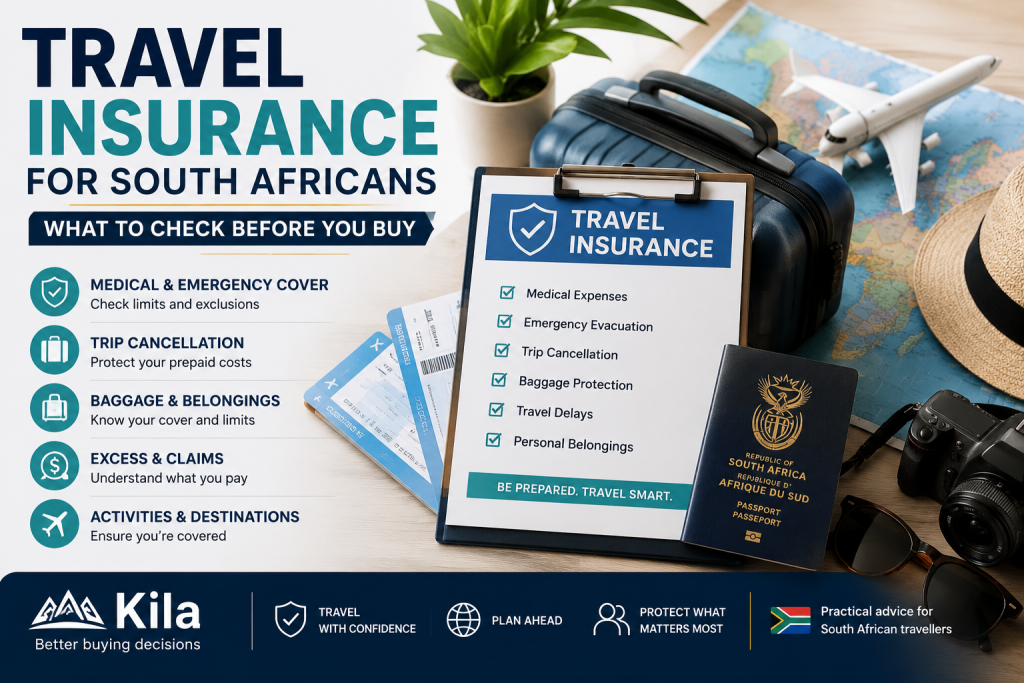
Here are some of the most important things to check before buying travel insurance.
1. Check the medical and emergency cover
Medical expenses can be extremely expensive in some countries.
A policy may include emergency medical cover, but it is important to check exactly what is covered and whether some limits or conditions apply.
Consider questions such as:
- What is the maximum medical cover available?
- Does the policy cover emergency hospital treatment?
- Are emergency medical evacuations included?
- Is repatriation covered where applicable?
- Are there restrictions based on where you are travelling?
Don’t simply assume that every travel insurance policy provides the same level of medical protection.
The destination can also make a difference. Medical treatment costs can vary dramatically between countries, so consider whether the cover is appropriate for the type of trip you are taking.
2. Understand cover for cancellations and interruptions
Trips can be expensive, particularly when flights, accommodation, tours and other bookings have already been paid for.
Travel insurance may provide certain cover where a trip has to be cancelled or interrupted for reasons specified in the policy.
However, the important words are “specified in the policy.”
Not every reason for cancelling a holiday will necessarily qualify.
Before purchasing, check:
- Which cancellation reasons are covered?
- Are there limits on the amount that can be claimed?
- What supporting documentation may be required?
- Are bookings refundable through the airline or accommodation provider first?
- Are there exclusions that could affect a claim?
This is one area where reading the policy wording can be particularly important.
3. Look at baggage and personal belongings cover
Lost, delayed or damaged baggage can cause considerable inconvenience when travelling.
Check whether your policy includes cover for baggage and personal belongings and, importantly, what limits apply.
Consider:
- The maximum amount payable overall.
- Limits for individual items.
- Whether electronics have special restrictions.
- What happens if baggage is delayed.
- Whether valuables must be kept with you.
- Situations in which belongings may not be covered.
For example, a policy may provide baggage cover, but the limit for a specific high-value item could be considerably lower than its replacement cost.
4. Check the excess you may have to pay
The excess is an important part of comparing insurance policies.
A lower-priced policy with a high excess may not necessarily represent better value than a more comprehensive policy with different conditions.
When comparing options, don’t only compare the premium.
Also ask:
If I need to make a claim, what amount could I have to pay myself?
Understanding this before you travel can help avoid unpleasant surprises later.
5. Declare relevant information honestly
Insurance policies may contain conditions relating to the information provided when purchasing cover.
It is important to answer questions accurately and disclose information where required.
Don’t assume that something is automatically covered simply because you have purchased travel insurance.
If you are uncertain about a particular condition or whether a situation is covered, check the policy documentation or ask the insurer or provider before buying.
6. Check whether your activities are covered
A relaxing beach holiday and an adventure-focused holiday can involve very different risks.
Some activities may have specific conditions, limitations or exclusions.
Before buying cover, consider what you actually plan to do during your trip.
This could include activities such as:
- skiing or snowboarding
- scuba diving
- adventure sports
- mountain activities
- organised sporting events
- motorcycling or scooter use
Don’t wait until after booking a holiday activity to discover that it falls outside the terms of your travel insurance.
7. Consider your destination carefully
Travel requirements and risks can differ from one destination to another.
When comparing travel insurance, consider:
- your destination
- how long you will be travelling
- the countries you will visit
- whether you are travelling through multiple countries
- the purpose of your trip
- the activities you plan to undertake
A policy suitable for a short holiday may not necessarily be suitable for a lengthy international trip involving several countries.
8. Don’t confuse airline or card benefits with comprehensive travel insurance
Some travellers may receive certain travel-related benefits through an airline booking, bank account or credit card.
These benefits can be useful, but you should check exactly what they include before relying on them as your only protection.
Ask:
- Is travel insurance actually included?
- What type of cover is provided?
- Are there monetary limits?
- Are there exclusions?
- Does the benefit apply automatically?
- Do I need to activate or register for the cover?
Having some protection does not necessarily mean that you have cover appropriate for your particular trip.
9. Compare policies based on value, not only price
It is tempting to choose the cheapest policy.
But travel insurance should be compared according to what you receive for the price.
A useful comparison could include:
| What to Compare | Why It Matters |
|---|---|
| Medical cover | Emergency treatment can be costly |
| Cancellation cover | Helps protect certain prepaid travel costs |
| Baggage cover | Limits may vary considerably |
| Excess | Affects what you could pay when claiming |
| Destination cover | Policies may differ by region |
| Activities | Some activities may have restrictions |
| Policy exclusions | Important situations may not be covered |
The best policy is not necessarily the most expensive or the cheapest.
It is the one that offers cover appropriate to your trip, destination and circumstances.
10. Read the exclusions before you buy
This may be one of the least exciting parts of buying travel insurance, but it is also one of the most important.
Every policy will have conditions and exclusions.
Rather than assuming you are covered for everything, spend time checking what is specifically excluded or restricted.
Pay particular attention to:
- pre-existing conditions where relevant
- alcohol or substance-related incidents
- unattended belongings
- high-risk activities
- travel against official advice
- missed flights under certain circumstances
- items above specified value limits
- situations that were known before purchasing the policy
You don’t need to become an insurance expert, but you should have a reasonable understanding of what you are paying for.
When should you buy travel insurance?
Ideally, travel insurance should be considered as part of your overall trip planning rather than as something purchased on the day before departure.
Depending on the policy, some benefits may relate to events occurring before you actually leave on your trip, particularly where cancellation cover is involved.
For this reason, check when different sections of cover begin and under what conditions they apply.
Buying early doesn’t remove the need to read the terms carefully, but it gives you more time to compare options and understand what you are purchasing.
A simple checklist before buying travel insurance
Before making your decision, ask yourself:
✓ Where am I travelling?
Check that your destination is covered.
✓ How long will I be away?
Make sure the policy period is suitable.
✓ What activities am I planning?
Check whether they are included.
✓ What medical cover is available?
Look at the limits and conditions.
✓ What cancellation protection is included?
Understand what events qualify.
✓ What is the baggage cover?
Check overall and individual-item limits.
✓ What excess applies?
Know what you may have to contribute towards a claim.
✓ What are the important exclusions?
Don’t assume every situation is covered.
Where can South Africans compare travel insurance?
There are different insurers and travel providers offering travel insurance products to South African travellers.
Travel insurance: the bottom line
Travel insurance is not something to choose purely because it is the cheapest option available.
Before buying, take a few minutes to consider where you are going, what you are doing, what you have already paid for and what level of protection you may need.
The most useful policy will depend on the individual trip.
Comparing cover, checking limits and reading important exclusions before you buy can help you make a better-informed decision.
A little preparation before departure can be far easier than trying to understand your policy after something has gone wrong.
P.S
Before choosing travel insurance, it also helps to make sure the rest of your trip is properly planned. See our guide on how to plan an international trip from South Africa.