
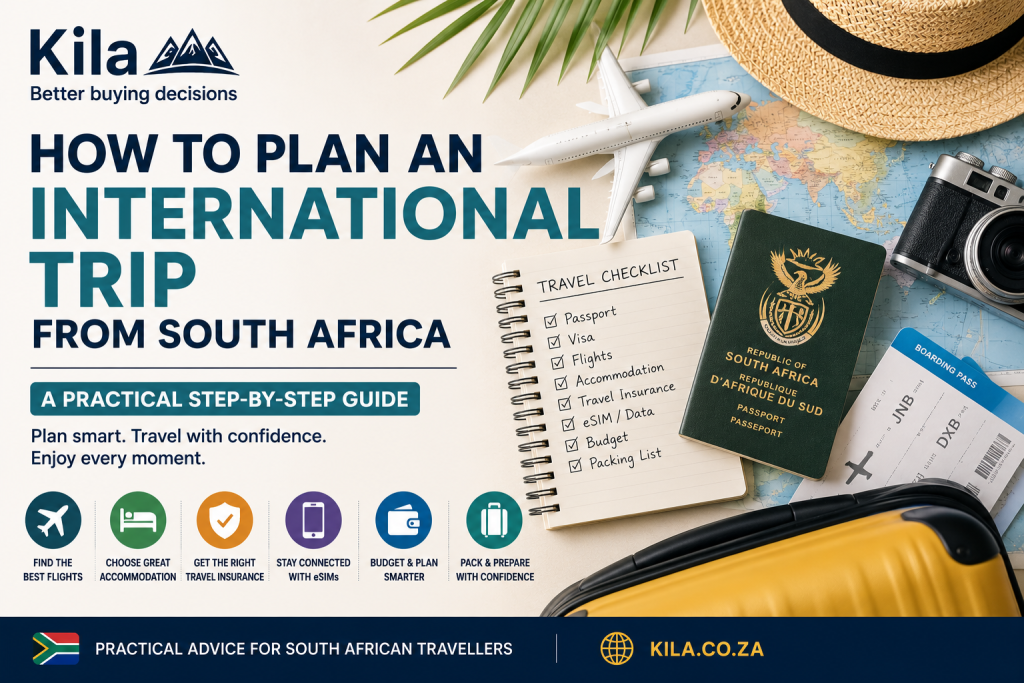
Planning an international holiday can be exciting, but there is a lot more involved than simply choosing a destination and booking a flight.
You need to consider when to travel, where to stay, passport and visa requirements, flights, travel insurance, mobile connectivity, transport and your overall budget.
A little preparation before you leave can prevent expensive surprises later.
If you’re looking for more practical advice, our Travel section brings together guides and information designed specifically for South African travellers.
This guide takes you through the main stages of planning an international trip, from choosing your destination to preparing for the journey home.
1. Decide What Type of Trip You Want
Before looking at flights, think about what you actually want from the holiday.
Are you looking for:
- A relaxing beach holiday?
- A city break?
- A cultural experience?
- Adventure and outdoor activities?
- A family holiday?
- A road trip?
- A combination of several destinations?
- A relatively inexpensive getaway?
Your answer will influence almost every other decision.
For example, a two-week European city holiday requires a very different approach from a week at a beach resort.
It is also worth considering how much time you actually have.
If you only have seven days available, spending a large portion of that time travelling between multiple destinations may not be the best use of your holiday.
2. Choose Your Destination Carefully
Once you know what sort of trip you want, start researching possible destinations.
Don’t look only at the headline cost of getting there.
A destination with cheap flights can become expensive if accommodation, food and local transport are costly.
Consider the total cost of the trip, including:
- Flights
- Accommodation
- Airport transfers
- Local transport
- Food
- Attractions and activities
- Travel insurance
- Mobile data
- Visa costs, where applicable
- Foreign exchange costs
- Emergency funds
This gives you a much better idea of whether a destination is genuinely affordable.
Think about the exchange rate too
For South Africans, exchange rates can make a substantial difference to the cost of an overseas holiday.
Rather than simply converting the flight price into rand, try to estimate what an average day at the destination will cost.
For example:
Accommodation + meals + transport + activities = approximate daily spending
You can then multiply that by the number of days you’ll be away.
3. Check Your Passport
Your passport should be one of the first things you check.
Don’t wait until you’ve found a great flight deal before discovering that your passport needs to be renewed.
Check:
- Expiry date
- Remaining validity
- Available blank pages
- Whether your destination has specific passport-validity requirements
Different countries can have different entry requirements, so never assume that having a valid South African passport automatically means you can enter.
4. Check Visa and Entry Requirements
This is one of the most important parts of international travel planning.
Some destinations allow South African passport holders to enter without obtaining a visa in advance.
Others may require:
- A visa application
- An electronic travel authorisation
- A visa on arrival
- Proof of onward travel
- Proof of accommodation
- Proof of sufficient funds
- Other documentation
Requirements can change, so check the official government or embassy information for your destination before booking a non-refundable trip.
Don’t rely solely on an old blog post or something posted on social media.
5. Work Out When to Travel
Travel dates can have a major effect on your overall cost.
Before choosing dates, consider:
Peak season
Popular destinations can be considerably more expensive during their busiest periods.
Shoulder season
Travelling just before or after peak season can sometimes provide a useful balance between weather, availability and price.
Local weather
South Africa’s summer may coincide with winter in the northern hemisphere.
That means you need to consider the destination’s climate rather than simply thinking about the season at home.
School holidays
If you’re travelling with children, school holidays may influence your options and prices.
6. Compare Flights Before Booking
Once you have a destination and approximate dates, you can start looking at flights.
Don’t automatically choose the cheapest headline fare.
Check what is actually included.
A low-cost ticket may have restrictions relating to:
- Checked luggage
- Cabin baggage
- Seat selection
- Changes
- Cancellations
- Meals
- Connections
A slightly more expensive ticket can sometimes represent better overall value.
Direct vs connecting flights
A direct flight is usually more convenient, but a connecting flight can sometimes be considerably cheaper.
Consider how much your time is worth.
Saving money isn’t necessarily worthwhile if it adds many hours to your journey or requires an inconvenient overnight connection.
For example:
Compare flights before booking:
Use a reputable flight search and booking service to compare available routes, dates and fares before making your decision.
7. Compare Accommodation
Accommodation can be one of the biggest expenses on an international holiday.
Don’t compare hotels based solely on the nightly rate.
Look at the total cost.
Check whether the advertised price includes:
- Taxes
- Breakfast
- Resort fees
- Cleaning fees
- Wi-Fi
- Parking
- Airport transfers
- Other mandatory charges
Location is equally important.
A cheap hotel far outside the main area may require expensive transport every day.
Sometimes paying slightly more for accommodation in a convenient location can actually reduce your overall holiday cost.
8. Don’t Forget Travel Insurance
Travel insurance is easy to overlook when you’re concentrating on flights and accommodation.
It can nevertheless be an important part of an international travel plan.
Depending on the policy, travel insurance may provide cover for things such as:
- Medical expenses
- Trip cancellation
- Travel delays
- Lost or delayed luggage
- Emergency assistance
- Other specified travel-related problems
Policies differ substantially, so don’t choose one simply because it is the cheapest.
Look carefully at:
- Cover limits
- Exclusions
- Excesses
- Pre-existing conditions
- Cancellation conditions
- Destination restrictions
- Activities covered
9. Plan How You’ll Stay Connected
Mobile connectivity is another consideration that is easy to leave until the last minute.
Depending on your destination and phone, you may have several options:
- South African roaming
- A local SIM card
- An international SIM
- An eSIM
For many travellers, an eSIM can be particularly convenient because it may allow you to arrange mobile data before leaving South Africa.
However, compatibility varies.
Before buying an e-SIM, check:
- Whether your phone supports eSIM
- Whether the phone is network-unlocked
- Which countries are covered
- How much data is included
- How long the package lasts
- Whether calls and SMS are included
- Whether the service allows hotspot use
10. Plan Your Airport Transfer
Getting from the airport to your accommodation is something worth arranging before you arrive.
Depending on the destination, options may include:
- Airport train
- Public bus
- Taxi
- Ride-hailing service
- Hotel transfer
- Rental car
- Private transfer
Research this before leaving.
Arriving in an unfamiliar country after a long flight is not the ideal time to discover that your hotel is difficult to reach.
Also check whether your arrival time affects your options.
A transport service that operates during the day may not be available when you arrive late at night.
11. Work Out a Realistic Holiday Budget
Create a budget before you book.
A simple structure could look like this:
| Expense | Estimated Cost |
|---|---|
| Flights | R_____ |
| Accommodation | R_____ |
| Travel insurance | R_____ |
| Visa/entry requirements | R_____ |
| Airport transfers | R_____ |
| Local transport | R_____ |
| Food | R_____ |
| Activities | R_____ |
| Mobile data/eSIM | R_____ |
| Shopping | R_____ |
| Emergency reserve | R_____ |
| Estimated total | R_____ |
Don’t forget the emergency reserve.
Unexpected expenses can happen even on a carefully planned trip.
Having some additional money available can make dealing with an unexpected problem considerably less stressful.
12. Think About How You’ll Pay Overseas
Before travelling, consider how you will access your money.
You may use:
- Bank cards
- Credit cards
- Debit cards
- Cash
- Travel money services
Check with your bank about international transaction fees and make sure you understand how your cards work overseas.
It is also sensible not to rely entirely on one payment method.
Having a backup option can be useful if a card is lost, blocked or temporarily unavailable.
13. Make Copies of Important Documents
Keep copies of important travel documents.
These may include:
- Passport
- Visa or travel authorisation
- Flight confirmations
- Accommodation bookings
- Travel insurance
- Important contact information
- Emergency contact details
Keep the copies somewhere separate from the originals.
Digital copies can also be useful, but don’t rely exclusively on your phone.
14. Don’t Overpack
One of the easiest ways to make travelling more difficult is to take too much stuff.
Before packing, check the baggage allowance for your flight.
Think carefully about what you actually need.
Remember that you’ll probably have access to shops and basic services at your destination.
For many trips, a smaller and more manageable suitcase can make airports, transfers and public transport considerably easier.
15. Research the Destination Before You Leave
You don’t need to plan every minute of your holiday.
In fact, leaving some free time can make a trip more enjoyable.
But research the basics.
Find out:
- What currency is used
- What language is commonly spoken
- How public transport works
- Which areas are convenient for tourists
- What local customs you should know
- How the weather is likely to be
- What major attractions you want to visit
- Whether attractions require advance booking
Having a basic understanding before you arrive can save time and reduce unnecessary stress.
16. Create a Simple Pre-Departure Checklist
A few days before leaving, work through a checklist.
Documents
☐ Passport
☐ Visa or travel authorisation, if required
☐ Flight confirmation
☐ Accommodation confirmation
☐ Travel insurance
☐ Copies of important documents
Money
☐ Bank cards
☐ Emergency payment method
☐ Some local currency if appropriate
☐ Bank notified if necessary
Technology
☐ Phone
☐ Charger
☐ Power adapter
☐ Power bank
☐ eSIM/mobile data arranged
Luggage
☐ Clothing
☐ Toiletries
☐ Medication and essentials
☐ Travel documents
☐ Valuables
Before leaving home
☐ Check flight status
☐ Confirm airport transfer
☐ Check in online if available
☐ Check weather at destination
☐ Make sure someone has your itinerary/contact details
17. Leave Some Room for the Unexpected
Even the best-planned holiday won’t go exactly according to plan.
Flights can be delayed.
Weather can change.
Restaurants can be closed.
Transport can be disrupted.
You might discover somewhere you want to spend an extra afternoon.
Good travel planning isn’t about controlling every minute of the trip.
It’s about taking care of the important things beforehand so that you have the freedom to enjoy the experience when you’re there.
A Simple International Travel Planning Timeline
Here’s a useful way to approach the planning process.
Several months before departure
- Choose your destination
- Research the best time to visit
- Check passport requirements
- Investigate visa requirements
- Set a budget
- Start comparing flights and accommodation
Once you’ve decided to travel
- Book flights
- Book accommodation
- Arrange travel insurance
- Arrange visas or required authorisations
- Research airport transfers
A few weeks before departure
- Arrange your eSIM or mobile solution
- Confirm bookings
- Research local transport
- Check currency and payment options
- Start preparing your packing list
A few days before departure
- Check flight status
- Complete online check-in
- Organise documents
- Charge devices
- Confirm transfers
- Check the weather
- Review your itinerary
Final Thoughts
Planning an international holiday from South Africa doesn’t have to be complicated.
The most important thing is to look beyond the headline price of a flight or hotel and consider the complete cost and practical requirements of the trip.
Start with the destination, establish a realistic budget, check your passport and entry requirements, compare flights and accommodation, arrange appropriate travel insurance and make sure you’ll be able to stay connected.
Then give yourself enough flexibility to actually enjoy the holiday.
At Kila, our aim is simple: help South African consumers make better buying and planning decisions without unnecessary hype.
Whether you’re comparing a flight, accommodation, travel insurance or an eSIM, the goal should always be the same:
Understand what you’re buying, compare your options and choose what represents the best value for you.