
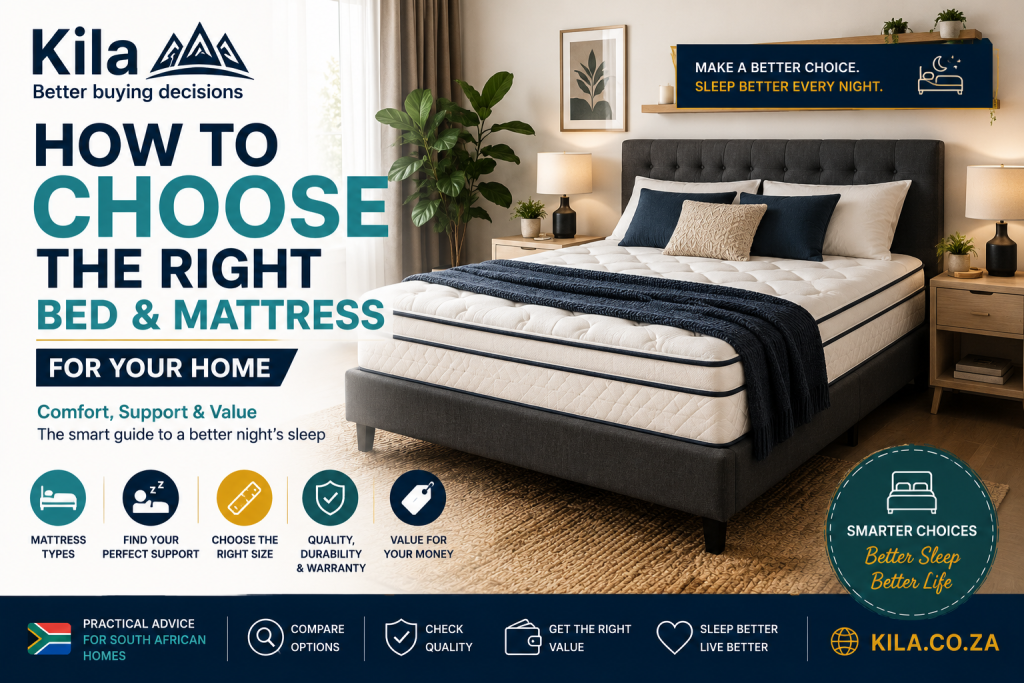
A bed is one of the most important purchases you make for your home. Unlike many pieces of furniture, it is something you use every day, often for several years.
That makes choosing a bed and mattress about more than simply finding something that looks good in the bedroom.
The right combination needs to fit your available space, suit your sleeping preferences, provide the support and comfort you want, and offer good value for the money.
Kila’s Home & Living section is designed to help South African consumers make more informed choices about the products they buy for their homes. When it comes to a bed and mattress, a little research before you buy can make a significant difference.
So what should you actually look for?
Start with the mattress, not the bed frame
It is tempting to start shopping by looking at attractive bed frames.
However, the mattress is arguably the more important part of the purchase.
A beautiful bed frame won’t compensate for a mattress that you don’t find comfortable.
Before choosing a frame, think about:
- The mattress size you need
- The type of mattress you prefer
- Your preferred firmness
- The available bedroom space
- Who will be using the bed
- Your budget
Once you have established those requirements, you can select a bed frame that accommodates the mattress and suits the room.
What type of mattress should you choose?
There is no single mattress type that is perfect for everyone.
Different constructions have different characteristics, and personal preference plays a significant role.
Some of the common types include:
Innerspring mattresses
These use a system of metal springs to provide support.
Depending on their construction, innerspring mattresses can offer a more traditional sleeping experience and good airflow through the mattress.
They are available in a wide range of designs and price points.
Pocket-sprung mattresses
Pocket springs are individually contained rather than being connected as one large spring system.
This construction can allow the springs to respond more independently to movement.
That can be worth considering if two people sharing a bed have different sleeping preferences.
Memory foam mattresses
Memory foam is designed to respond to body weight and pressure.
It can provide a different feel from traditional spring mattresses and is often chosen by people who prefer a more moulded sensation.
However, foam mattresses can feel quite different from one another, so don’t assume that every memory foam mattress will have the same characteristics.
Hybrid mattresses
Hybrid mattresses combine different materials, commonly springs with one or more layers of foam.
The intention is generally to combine characteristics of different mattress constructions.
Hybrids can therefore be worth considering if you’re unsure whether you prefer an entirely foam or traditional spring mattress.
How firm should your mattress be?
Firmness is one of the most important decisions you’ll make.
Unfortunately, there is no universally correct firmness level.
A mattress described as “medium” by one manufacturer may not feel exactly the same as a medium mattress from another.
Your preferred sleeping position can be a useful starting point.
If you sleep on your side
You may prefer a mattress that provides enough cushioning around pressure points while still providing adequate support.
A mattress that feels excessively firm may not be comfortable for some side sleepers.
If you sleep on your back
You may prefer a balance between cushioning and support.
The aim is generally to find a mattress that feels supportive without being uncomfortably hard.
If you sleep on your stomach
A mattress with sufficient support can be particularly important because you don’t want to feel as though you’re sinking excessively into the mattress.
If you change positions during the night
Consider a mattress that provides a reasonable compromise rather than one designed specifically around one sleeping position.
Don’t confuse firmness with support
These two terms are sometimes used interchangeably, but they’re not necessarily the same thing.
A very firm mattress isn’t automatically a better-supporting mattress.
Likewise, a softer mattress isn’t automatically lacking in support.
When testing a mattress, consider how it feels overall rather than simply asking whether it is “hard” or “soft”.
The goal is to find a combination of comfort and support that suits you.
What mattress size should you buy?
The size of your bedroom should be considered alongside the size of the mattress.
Common bed sizes include:
- Single
- Three-quarter
- Double
- Queen
- King
- Super King
Exact dimensions can vary, so check the manufacturer’s measurements rather than relying only on the name of the size.
This becomes particularly important when replacing an existing mattress.
Measure your existing bed base before ordering a replacement mattress.
A mattress that is described as the same nominal size may not necessarily have exactly the dimensions you expected.
Don’t forget about the bedroom itself
A larger bed can sound appealing until you discover that it makes the bedroom difficult to use.
Before buying, measure:
- The bedroom
- Doorways
- Passageways
- Staircases
- The space around the existing bed
- Wardrobe and cupboard doors
- Windows and other obstructions
Also consider how you will actually get the new bed into the house.
A mattress or bed frame that fits perfectly in the bedroom is not particularly useful if it cannot get through the front door or around a staircase.
Should you buy the bed and mattress together?
Not necessarily.
There are advantages to buying a complete bed-and-mattress package, particularly if the components are designed to work together.
However, buying separately can give you considerably more choice.
For example, you may prefer:
Bed frame:
A particular design and material.
Mattress:
A completely different manufacturer and construction.
This can also make it easier to compare prices.
The important thing is to ensure that the mattress is compatible with the bed base.
The bed base matters too
The mattress isn’t working in isolation.
The base underneath it can affect how the bed feels and how the mattress is supported.
Depending on the design, you might encounter:
- Slatted bases
- Solid bases
- Divan-style bases
- Platform beds
- Adjustable bases
Always check the mattress manufacturer’s requirements before putting it onto a particular base.
Some mattresses have specific requirements concerning spacing between slats or the type of support underneath them.
What about an adjustable bed?
Adjustable beds allow the position of the sleeping surface to be changed.
They can be considerably more expensive than conventional beds, so whether the additional functionality is worthwhile depends on your requirements and budget.
If you’re considering an adjustable base, make sure the mattress is specifically compatible with it.
Don’t assume that every mattress can be used on an adjustable mechanism.
How important is the mattress warranty?
A mattress is a relatively significant purchase, so it’s worth understanding the warranty before buying.
Don’t simply look at the number of years advertised.
Check what the warranty actually covers.
Look for information about:
- Manufacturing defects
- Sagging or deformation
- The warranty period
- Exclusions
- Required bed-base specifications
- Proof of purchase
- Whether the warranty is transferable
A long warranty can sound impressive, but the actual terms are more important than the headline number.
Don’t buy based on the warranty alone
A lengthy warranty doesn’t automatically mean that a mattress is better quality.
Consider the entire proposition:
Construction + comfort + support + materials + warranty + price
A mattress should be comfortable and appropriate for your needs first.
The warranty is an additional consideration.
Should you test a mattress before buying?
If you have the opportunity to do so, testing a mattress can be useful.
However, lying on a showroom mattress for a few minutes isn’t necessarily the same as sleeping on it for several nights.
If buying online, look carefully at the retailer’s return or trial policy.
Find out:
- How long the trial period lasts
- Whether the mattress must be returned in its original packaging
- Who pays for collection
- Whether there are return fees
- What condition the mattress must be in
- Whether a refund or replacement is offered
These details can be more important than an impressive advertising claim about the mattress itself.
Don’t ignore your partner’s preferences
If two people are sharing a bed, choosing a mattress becomes slightly more complicated.
One person might prefer a firmer mattress while the other prefers something softer.
One person may move considerably during the night while the other is a light sleeper.
In this situation, consider:
- Motion isolation
- Mattress construction
- Individual sleeping preferences
- Whether different firmness options are available
- Whether the manufacturer offers a trial period
A mattress that suits one person perfectly isn’t necessarily ideal for two people.
How much should you spend?
This is where comparison shopping becomes particularly useful.
There is no magic price at which a mattress suddenly becomes “good”.
Instead, establish your budget and compare products within that range.
When comparing two mattresses, look beyond the price tag.
Consider:
What materials are used?
What type of construction does it have?
What size are you buying?
What warranty is provided?
Is there a trial period?
What does delivery cost?
What does the return policy say?
A cheaper mattress isn’t necessarily better value if it doesn’t meet your requirements.
Likewise, paying substantially more doesn’t automatically guarantee a better night’s sleep.
Be careful with mattress marketing claims
Mattress advertising can contain a lot of impressive-sounding terminology.
You may encounter claims involving:
- Premium materials
- Advanced support
- Luxury comfort
- Orthopaedic design
- Cooling technology
- Pressure relief
- Hotel-quality comfort
These descriptions can be useful, but don’t allow marketing language to replace actual specifications.
Look for measurable information where possible.
For example:
What materials are actually used?
How thick is the mattress?
What type of springs does it contain?
What is the warranty?
What are the dimensions?
What is the return policy?
Those details make it easier to compare products objectively.
What about an “orthopaedic” mattress?
The word “orthopaedic” is commonly used in mattress marketing, but it shouldn’t automatically be interpreted as meaning that a particular mattress is medically recommended for you.
If you have a specific medical or physical concern relating to sleep, it’s better to obtain appropriate professional advice rather than choosing a mattress solely because it carries a particular marketing label.
For ordinary mattress shopping, concentrate on the mattress’s actual construction, comfort, support and suitability for your preferences.
How long should a mattress last?
There isn’t a single lifespan that applies to every mattress.
Durability depends on factors such as:
- Materials
- Construction
- Quality
- Usage
- Weight placed on the mattress
- Rotation requirements
- Care and maintenance
- The quality of the supporting base
Instead of replacing a mattress according to a rigid timetable, pay attention to its condition and whether it still provides the comfort and support you expect.
Always follow the manufacturer’s care instructions.
Should you buy a mattress online?
Buying online can offer several advantages.
You can:
- Compare multiple retailers
- Check specifications more easily
- Compare prices
- Read customer reviews
- Shop from home
- Look for promotions
However, there are disadvantages too.
You may not be able to test the mattress before purchasing, and returning a large mattress can be considerably more complicated than returning a small online purchase.
That’s why delivery, returns and trial policies deserve just as much attention as the product description.
How to compare mattresses properly
When you have narrowed your choices down to several mattresses, create a simple comparison.
| Feature | Mattress A | Mattress B | Mattress C |
|---|---|---|---|
| Mattress type | |||
| Size | |||
| Firmness | |||
| Height | |||
| Materials | |||
| Warranty | |||
| Trial period | |||
| Delivery cost | |||
| Return policy | |||
| Price |
This prevents you from making your decision based entirely on the first attractive offer you encounter.
It also makes it easier to identify whether you’re genuinely getting better value by spending more.
Your mattress buying checklist
Before placing your order, ask:
☐ Have I measured the available space?
☐ Do I know which mattress size I need?
☐ Have I considered my normal sleeping position?
☐ Do I know whether I prefer softer, medium or firmer mattresses?
☐ Have I compared different mattress constructions?
☐ Is the mattress compatible with my bed base?
☐ Have I checked the actual dimensions?
☐ Have I read the warranty conditions?
☐ Have I checked the return or trial policy?
☐ Have I checked delivery costs?
☐ Have I compared similar mattresses from other retailers?
☐ Am I paying for useful features rather than marketing claims?
If you’ve answered these questions, you’re in a much better position to make an informed purchase.
If you’re furnishing the rest of the room as well, our guide on how to choose the right sofa for your home looks at another major furniture purchase and the factors worth considering before you buy.
Final thoughts
Buying a bed and mattress is a decision worth taking your time over.
The most expensive mattress isn’t automatically the best choice, and the cheapest isn’t necessarily the best bargain.
Instead, look at the complete picture:
Size + construction + comfort + support + quality + warranty + price + after-sales service
Most importantly, choose according to your room, your sleeping preferences and your budget, rather than simply following advertising claims or buying whatever happens to be on special.
At Kila, that’s the approach we aim to take with every buying guide: look beyond the marketing and concentrate on what actually matters when you’re spending your money.