
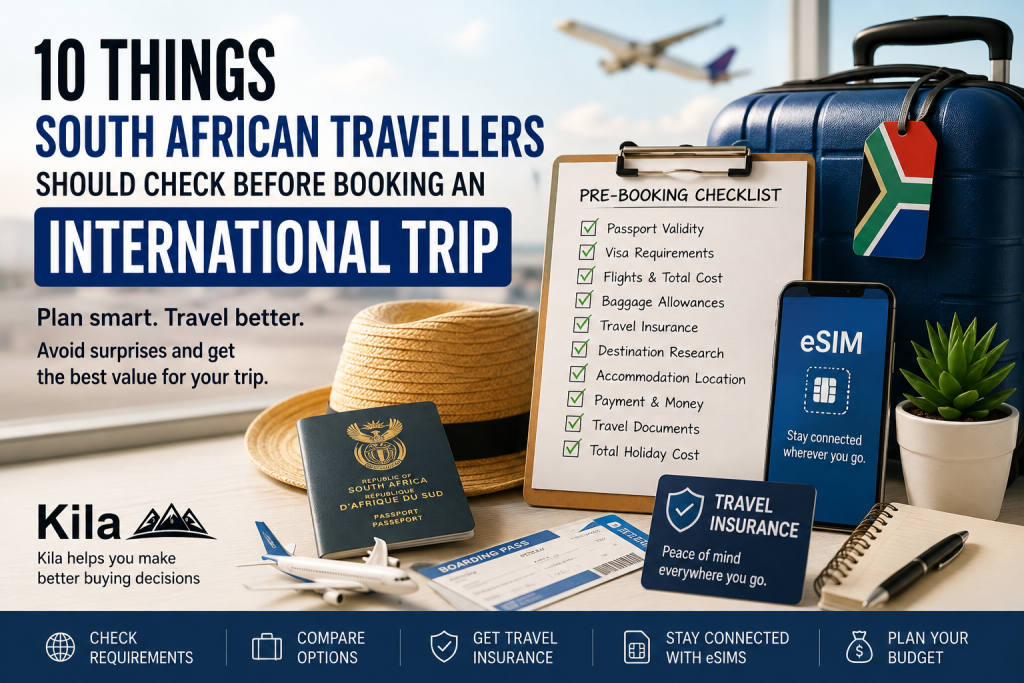
Planning an international holiday is exciting, but booking a flight and hotel is only the beginning.
For South African travellers, there are several practical details worth checking before committing your money. Passport requirements, visas, travel insurance, baggage allowances, connecting flights and even payment arrangements can all affect the real cost and convenience of a trip.
Taking a little time to check these things before booking can prevent expensive surprises later.
Here are 10 things to check before booking your next international trip.
1. Check Your Passport
Your passport is the most important document you will take with you.
Before making any non-refundable bookings, check the passport’s expiry date and make sure you have enough validity remaining for your destination.
Don’t simply assume that having a valid passport is sufficient. Individual countries can impose their own passport-validity requirements, and some destinations require a certain amount of validity beyond your intended departure date.
South Africa’s Department of International Relations and Cooperation advises travellers to check the requirements of their destination, particularly if their passport is approaching expiry or has limited blank pages.
Kila tip
Don’t wait until you are ready to travel to discover that your passport needs renewing.
Check it before you book.
You may also want to look into your cellphone connectivity and data availability. e-Sims are really the best way to go.
How to Choose the Best eSIM for International Travel
2. Find Out Whether You Need a Visa
Visa requirements are one of the easiest things to overlook when planning an overseas trip.
South African passport holders can enter some countries without obtaining a traditional visa beforehand, while other destinations require a visa, electronic authorisation or another form of travel permission.
And visa-free does not necessarily mean unrestricted entry.
The permitted length of stay and purpose of travel can still be subject to conditions.
DIRCO specifically advises South Africans to check visa requirements with the relevant foreign representative or appropriate travel authority before each trip because requirements can change.
Do note that there have been recent incidents where people were refused entry to the destination as online searches had led them to believe that visas were not needed when indeed they needed to have visas in place before travelling. Check and double-check.
Don’t forget transit countries
If your flight involves a connection in another country, check whether transit or airport-transfer requirements apply.
A cheap flight with two connections isn’t necessarily a bargain if the itinerary creates additional visa complications.
3. Compare the Total Cost of the Flight
The cheapest advertised airfare isn’t necessarily the cheapest way to get to your destination.
When comparing flights, look beyond the headline price.
Consider:
- Checked baggage
- Carry-on allowances
- Seat selection
- Meals
- Airport transfers
- Flight-change fees
- Cancellation conditions
- Connection times
- The number of stops
- The airport you will arrive at
A flight that costs R1,000 less but involves a long connection, additional baggage charges and an inconvenient airport may ultimately represent poor value.
Kila tip
When comparing flights, try to compare the complete cost of getting from your home to your destination, rather than simply comparing the initial airfare.
4. Check the Baggage Rules
Airlines don’t all use the same baggage rules.
Even airlines flying similar routes can have very different allowances depending on the ticket type.
Before booking, check:
Cabin baggage
- Maximum weight
- Maximum dimensions
- Number of bags permitted
Checked baggage
- Number of bags
- Weight allowance
- Additional-bag charges
Also check the rules for your connecting flights.
An itinerary involving multiple airlines can sometimes have different baggage policies.
A bargain airfare can become considerably less attractive once baggage is added.
5. Compare Travel Insurance Carefully
Travel insurance isn’t simply another box to tick during the booking process.
A good policy can provide protection against certain unexpected expenses involving medical emergencies, cancellation, interruption, baggage problems and other covered events.
DIRCO strongly recommends that South Africans obtain travel insurance when travelling abroad and notes the importance of medical expenses and emergency evacuation cover.
However, don’t choose a policy purely because it is the cheapest.
Look at:
- Medical cover
- Emergency evacuation
- Cancellation cover
- Trip interruption
- Baggage cover
- Excesses
- Destination exclusions
- Activity exclusions
- Pre-existing-condition provisions
- Maximum claim amounts
The right policy depends on your destination and the nature of your trip.
6. Check the Destination Before You Pay
A destination may look fantastic in photographs, but it is worth doing some research before booking.
Look at:
- Weather during your intended travel dates
- Local transport
- Political or security conditions
- Local customs
- Major public holidays
- Seasonal closures
- Accommodation availability
- Local costs
DIRCO recommends that South Africans travelling abroad learn about the financial, political, cultural and economic environment of their destination and pay particular attention to safety, health, immigration, customs and local regulations.
Kila tip
Don’t just ask:
“Where can I afford to go?”
Also ask:
“What will the destination actually be like when I arrive?”
7. Work Out How You Will Pay for Things
South Africans travelling overseas should think about money before leaving home.
Your bank card may work internationally, but it is worth checking:
- Whether your card is enabled for international transactions
- Foreign transaction fees
- ATM fees
- Currency-conversion charges
- Daily withdrawal limits
- Whether you need to notify your bank
- Whether you have access to an alternative payment method
It can also be sensible to have more than one way of accessing money while travelling.
For example, relying entirely on a single bank card creates an unnecessary problem if that card is lost, blocked or damaged.
8. Check Your Accommodation Location — Not Just the Price
A cheap hotel isn’t necessarily a cheap place to stay.
Look at the hotel’s location relative to the places you actually want to visit.
A hotel that saves R500 a night but requires expensive taxis or lengthy public transport journeys every day may end up costing more overall.
When comparing accommodation, consider:
- Location
- Transport connections
- Airport access
- Reviews
- Cancellation conditions
- Breakfast
- Resort or destination fees
- Wi-Fi
- Parking
- Check-in and check-out times
Kila tip
Think about total holiday cost, not just the nightly hotel rate.
9. Check Your Travel Documents Before Departure
Once your trip is booked, create a simple travel-document checklist.
Depending on your destination, this could include:
- Passport
- Visa or travel authorisation
- Flight confirmation
- Accommodation confirmation
- Travel insurance documents
- Driving licence or international driving documentation where applicable
- Important medical information
- Copies of important documents
- Emergency contact information
DIRCO recommends that travellers keep copies of important travel documents and have contact information for the nearest South African diplomatic mission available.
DIRCO also currently encourages South African citizens travelling abroad to register their whereabouts through its Travel Smart system.
10. Compare the Complete Holiday Cost
This may be the most important point of all.
A holiday advertised at R20,000 isn’t necessarily a R20,000 holiday.
Before booking, try to estimate the complete cost.
Consider:
Getting there
- Flights
- Baggage
- Airport transfers
Staying there
- Accommodation
- Taxes or additional fees
- Breakfast or meals
Getting around
- Public transport
- Car hire
- Fuel
- Transfers
While you’re there
- Food
- Attractions
- Activities
- Shopping
- Internet/data
Before you leave
- Travel insurance
- Visas
- Travel documents
- Currency or banking costs
Once you’ve added everything together, you may discover that a slightly more expensive flight or hotel actually provides better overall value.
Don’t Book on Price Alone
Finding a cheap international holiday can be satisfying, but the cheapest option isn’t automatically the best option.
A better approach is to compare:
Price + convenience + flexibility + inclusions + risk + overall value.
This is particularly important when comparing flights and holiday packages, because two apparently similar offers can have very different conditions.
The goal isn’t necessarily to find the absolute cheapest trip.
It’s to find the trip that gives you the best value for the money you are prepared to spend.
A Simple Pre-Booking Checklist
Before clicking “Book Now”, ask yourself:
☐ Is my passport valid for the destination?
☐ Do I need a visa or electronic travel authorisation?
☐ Have I checked the requirements for any transit countries?
☐ Have I compared the complete airfare rather than just the advertised price?
☐ Do I know how much baggage is included?
☐ Have I considered travel insurance?
☐ Have I researched the destination for my intended travel dates?
☐ Have I checked the accommodation location?
☐ Do I understand the cancellation and change conditions?
☐ Have I calculated the total cost of the holiday?
If you can answer yes to all ten, you’re in a much better position to make an informed booking.
Final Thoughts
International travel doesn’t have to be complicated, but good planning can make a significant difference to the experience — and the cost.
South African travellers should take the time to check their passport and visa requirements, compare the complete cost of flights and accommodation, understand baggage and cancellation conditions, and consider appropriate travel insurance before committing to a booking.
Most importantly, don’t let a low headline price decide for you.
Compare the whole deal. Check the details. Then decide whether it represents good value.
That’s what better buying decisions are all about.