
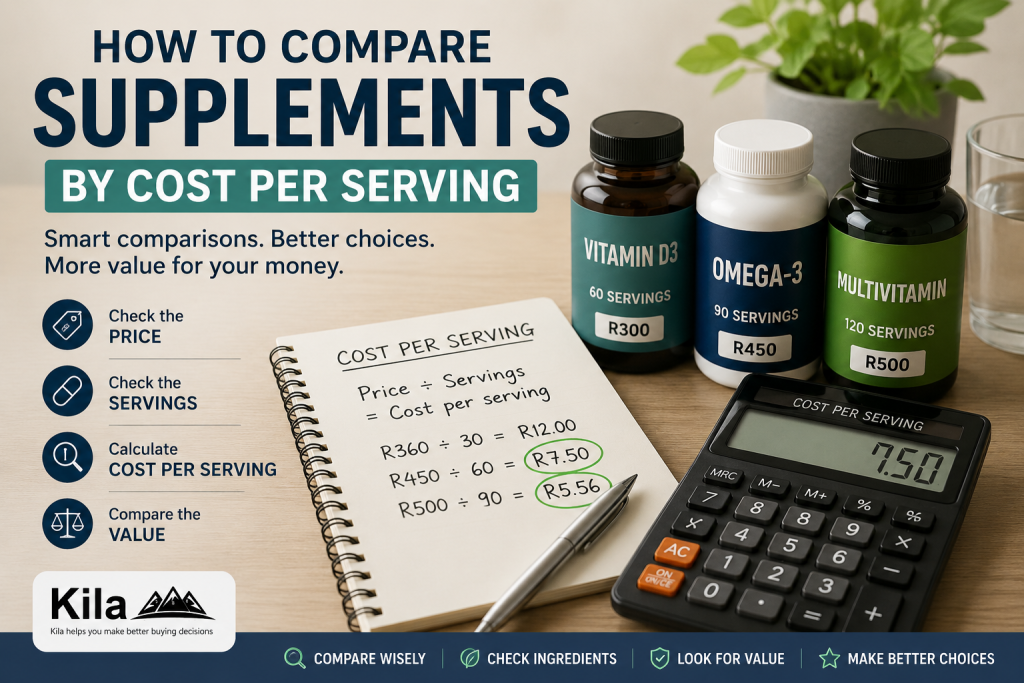
When comparing health & wellness supplements, it is tempting to look at the price on the front of the bottle and choose the cheaper option.
Unfortunately, it isn’t quite that simple.
A R250 supplement isn’t necessarily cheaper than a R400 supplement. One product might contain 30 servings while another contains 60. One might require two capsules per serving while another requires four. The products might also contain very different quantities of their active ingredients.
This makes comparing the price of the container alone a poor way of deciding which product represents better value.
A much more useful starting point is cost per serving.
But even that doesn’t tell the whole story.
Here’s how to compare supplements properly.
What is cost per serving?
Cost per serving is simply the price of a product divided by the number of servings it contains.
The basic calculation
Product price ÷ number of servings = cost per serving
For example:
| Product | Price | Servings | Cost per serving |
|---|---|---|---|
| Product A | R300 | 30 | R10.00 |
| Product B | R400 | 60 | R6.67 |
| Product C | R500 | 90 | R5.56 |
Looking only at the purchase price, Product A appears to be the cheapest.
But when we look at the cost of each serving, Product C is actually the least expensive.
This is why the price displayed on the bottle can be misleading.
Why bottle price isn’t enough
Imagine you are standing in a shop comparing two supplements.
One costs R300.
The other costs R450.
At first glance, the R300 product looks like the obvious bargain.
But suppose:
- The R300 product contains 30 servings.
- The R450 product contains 90 servings.
The first product costs:
R300 ÷ 30 = R10 per serving
The second costs:
R450 ÷ 90 = R5 per serving
You would pay more at the checkout for the second product, but each serving costs half as much.
This is why Kila recommends looking beyond the initial purchase price.
Step 1: Find the number of servings
The first thing to look for on a supplement label is the servings per container.
Don’t confuse this with the number of capsules or tablets.
For example, a bottle containing 120 capsules doesn’t necessarily provide 120 servings.
If the recommended serving is four capsules, the bottle contains:
120 ÷ 4 = 30 servings
That makes a significant difference to the calculation.
Always establish the actual number of servings before comparing prices.
Step 2: Calculate the cost per serving
Once you know the number of servings, the calculation is straightforward.
Example
A supplement costs R360 and contains 45 servings.
R360 ÷ 45 = R8 per serving
Now compare it with another product costing R450 with 75 servings:
R450 ÷ 75 = R6 per serving
The second product costs R90 more to buy but costs R2 less every time you use it.
If both products are otherwise comparable, the second product provides the lower cost per serving.
Step 3: Check what a serving actually contains
This is where things become more complicated.
Two products can have exactly the same cost per serving while providing very different formulations.
For example:
| Product A | Product B | |
|---|---|---|
| Price | R300 | R300 |
| Servings | 30 | 30 |
| Cost per serving | R10 | R10 |
| Ingredient X | 100 mg | 500 mg |
Both products cost R10 per serving.
But they aren’t necessarily equivalent products.
This is why cost per serving should be a starting point rather than the final decision.
You need to look at what you’re actually getting for that serving.
Health & wellness buying guide
Step 4: Compare the active ingredients
Once you’ve calculated the cost per serving, examine the formulation.
Ask:
- What are the active ingredients?
- How much of each ingredient is provided?
- Are the ingredients clearly listed?
- Are the quantities disclosed?
- Are there unnecessary ingredients?
- Are the two products actually intended for the same purpose?
A supplement containing ten ingredients isn’t automatically better than one containing three.
Likewise, a product containing a larger quantity of an ingredient isn’t automatically better.
The objective is to determine whether the formulation is appropriate for what you are looking for.
Step 5: Watch out for serving-size differences
Serving size is one of the easiest things to overlook.
Consider these two products:
Product A
- R300
- 60 capsules
- Serving size: 2 capsules
- 30 servings
Cost:
R300 ÷ 30 = R10 per serving
Product B
- R350
- 60 capsules
- Serving size: 1 capsule
- 60 servings
Cost:
R350 ÷ 60 = R5.83 per serving
Although both bottles contain 60 capsules, Product B provides twice as many servings.
The number of capsules alone therefore tells us very little.
Step 6: Calculate the approximate monthly cost
Cost per serving becomes even more useful when you calculate the cost of using the product over a month.
If a product costs R8 per serving and you take one serving per day:
R8 × 30 = R240 per month
If another product costs R5 per serving:
R5 × 30 = R150 per month
That R3 difference per serving becomes R90 per month.
Over a year, the difference would be approximately:
R1,095
This is why seemingly small differences in supplement prices can become significant over time.
Step 7: Consider the cost of the complete routine
Sometimes the real cost isn’t one product.
You may be considering several supplements together.
For example:
| Product | Monthly cost |
|---|---|
| Supplement A | R180 |
| Supplement B | R220 |
| Supplement C | R160 |
| Supplement D | R250 |
| Total | R810 |
Suddenly, what appeared to be a few relatively inexpensive purchases becomes an R810 monthly commitment.
Before adding another supplement to your routine, ask whether it provides something genuinely different from what you are already taking.
A simpler routine can sometimes be easier to manage and considerably less expensive.
Cost per serving isn’t the same as value
This is perhaps the most important point in this entire article.
The cheapest supplement isn’t necessarily the best value.
Imagine two products:
Product A
- R4 per serving
- Very basic formulation
- Limited ingredient information
Product B
- R8 per serving
- More comprehensive formulation
- Clearly disclosed ingredients
- Stronger manufacturing and quality information
It would be wrong to conclude automatically that Product A is twice as good simply because it costs half as much.
Similarly, Product B isn’t automatically better simply because it costs more.
The question is:
What are you actually getting for the difference in price?
That’s the comparison that matters.
Look at cost per useful ingredient
For some products, it may be useful to go one step further and compare the amount of a particular active ingredient relative to its price.
For example, if two products both provide the same active ingredient, you could calculate:
Cost ÷ amount of active ingredient
This can provide another useful comparison.
However, this calculation should only be used when comparing genuinely comparable products.
Different forms of an ingredient, different formulations and different intended uses can make a simple price-per-milligram comparison misleading.
So use this method as an additional piece of information, not as the only deciding factor.
Don’t ignore quality
Price comparison should never happen in isolation.
When comparing supplements, also investigate:
Manufacturing
Where and how is the product manufactured?
Testing
Does the manufacturer provide information about quality testing?
Transparency
Are ingredient quantities clearly disclosed?
Reputation
Does the manufacturer provide sufficient information about its products and manufacturing practices?
Formulation
Does the product actually contain what you are looking for?
A cheaper product isn’t necessarily better value if you don’t know enough about what you’re buying.
Consider the cost of waste
There’s another factor that doesn’t appear on the label.
Will you actually use the product?
A huge container may look like excellent value, but if you stop using it halfway through, the theoretical cost per serving becomes irrelevant.
Similarly, buying multiple products because they appear to be good deals can result in money being spent on products that sit unused in a cupboard.
Before buying, consider whether the product fits realistically into your routine.
An example of a proper supplement comparison
Let’s put everything together.
Imagine we’re comparing two hypothetical products.
Product A
- Price: R360
- Servings: 30
- Cost per serving: R12
- Clearly disclosed ingredients
- One serving per day
Product B
- Price: R480
- Servings: 60
- Cost per serving: R8
- Clearly disclosed ingredients
- One serving per day
At first glance, Product B looks like the better value.
But then we examine the formulations.
Product A contains ingredients that are relevant to our particular objective, while Product B contains a much broader combination of ingredients that we don’t actually need.
Suddenly, the decision isn’t so obvious.
Product B is cheaper per serving, but Product A may still be the more appropriate purchase.
This demonstrates why price should inform the decision, not make the decision.
What about Performance Lab?
Kila already lists a range of Performance Lab products, giving us a useful opportunity to apply this type of comparison to a real product range.
Rather than simply saying that a product is “expensive” or “affordable”, we can examine factors such as:
- Price
- Number of servings
- Cost per serving
- Ingredients
- Amount of active ingredients
- Intended purpose
- Formulation
- Manufacturing information
- Available alternatives
Explore the Performance Lab range
A simple checklist for comparing supplements
Before buying a supplement, run through this checklist.
Price
What does the container cost?
Servings
How many actual servings does it contain?
Cost per serving
What does each serving really cost?
Ingredients
What is contained in each serving?
Dosage
How much of each active ingredient is provided?
Quality
What information is available about manufacturing and testing?
Evidence
What credible information supports the ingredients or claims?
Convenience
Can you realistically use the product as intended?
Alternatives
Are there comparable products that offer better value?
Need
Do you actually need the product?
If you can answer all of these questions, you are in a much stronger position to make an informed purchase.
Don’t let the biggest discount win
One final warning is worth making.
A product advertised as:
“30% OFF!”
isn’t necessarily a better deal than another product without a discount.
A discount only tells you that the price has been reduced from a previous price.
It doesn’t tell you:
- How many servings you receive
- What the formulation contains
- How much of each ingredient is included
- Whether the product is appropriate for your needs
- Whether another product offers better value
Always compare the actual product value, not just the size of the discount.
The Kila approach
At Kila, we believe that a good buying decision starts with information.
That’s particularly important with health and wellness products, where prices, formulations and marketing claims can vary considerably.
When we compare products, we aim to look at the complete picture:
What does it contain?
How much does it cost per serving?
What are you getting for that money?
How does it compare with alternatives?
Is it appropriate for the purpose?
And most importantly:
Is it actually worth buying?
Final thoughts
Cost per serving is one of the simplest and most useful tools available when comparing supplements.
But it shouldn’t be the only tool.
Use it alongside ingredient information, serving size, formulation, quality, evidence and your own needs.
A product that costs R5 per serving isn’t automatically better than one costing R10.
And a product costing R20 per serving isn’t automatically superior because it is more expensive.
The goal isn’t to find the cheapest supplement. It’s to find the product that offers the most appropriate value for what you actually need.
That’s a much better way to shop.
Do the comparison first. Then decide.