
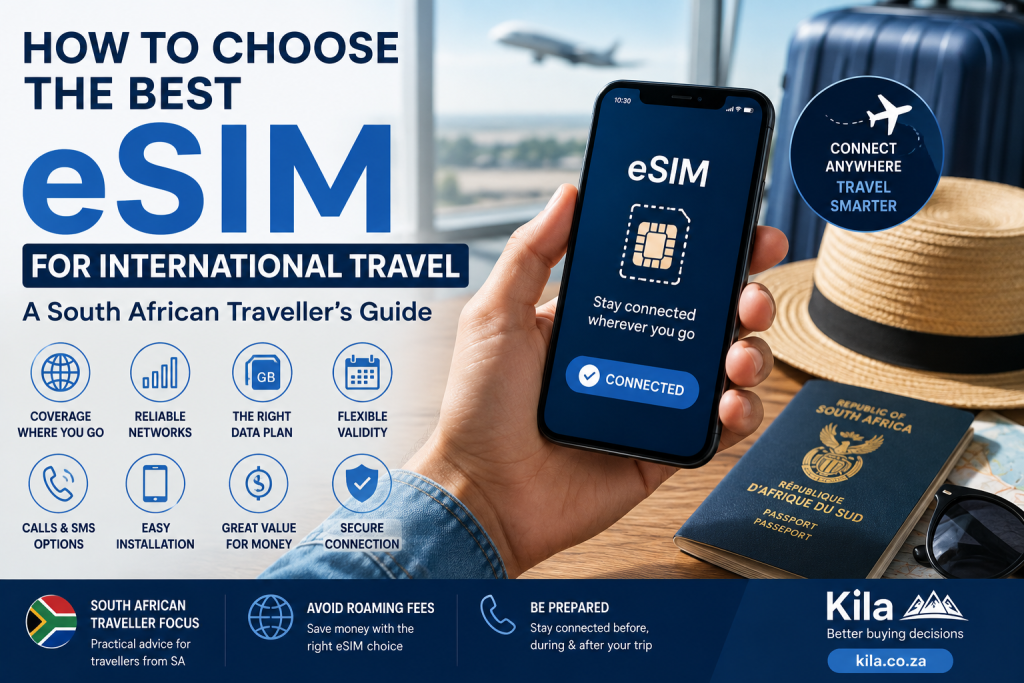
Staying connected has become an important part of international travel. From checking maps and booking transport to keeping in touch with family and accessing travel confirmations, having mobile data available can make travelling considerably easier.
For South African travellers, an eSIM can be one option for getting mobile connectivity overseas without physically replacing the SIM card in your phone.
Our Travel guides are designed to help South African travellers make better-informed decisions about the practical aspects of travelling, from planning and booking to staying connected while abroad.
But not every eSIM is the same. Plans differ in destinations, data allowances, validity periods, network coverage and whether they include calls and SMS.
So before buying one, it is worth understanding what you’re actually getting.
What Is an eSIM?
An eSIM is an electronic SIM built into a compatible device. Instead of inserting a physical SIM card, you download and activate a mobile plan digitally.
This can be particularly convenient for international travel because you may be able to arrange your connectivity before leaving South Africa.
Apple, for example, supports using a travel eSIM alongside a primary line on compatible iPhones. Apple notes that travellers can purchase travel eSIMs from local carriers or worldwide providers, with plans varying by destination, data allowance and duration.
The important point is that an eSIM isn’t itself a particular type of mobile plan.
The eSIM is the technology. The plan is what you actually purchase.
1. Check That Your Phone Supports eSIM
This should be the first thing you check.
Not every phone supports eSIM, and compatibility can also vary between regional versions of the same device.
Your phone may need to meet two requirements:
- It must support eSIM technology.
- It must be unlocked so that it can connect to another network.
For example, Apple says compatible iPhones must not be carrier-locked when using another carrier’s eSIM.
Some Android devices have different requirements and menus depending on the manufacturer and model.
Before buying
Check the exact model of your phone with:
- The manufacturer
- Your mobile network
- The eSIM provider
Don’t rely solely on the phone model name because regional variations can sometimes matter.
2. Check Whether the eSIM Covers Your Destination
This sounds obvious, but it’s one of the easiest mistakes to make.
An eSIM may offer:
Single-country coverage
or
Regional coverage
or
Multi-country/global coverage
For example, if you’re spending your entire holiday in France, a France-specific plan might be sufficient.
But if your itinerary is:
France → Germany → Italy → Switzerland
a European regional plan could potentially be more convenient than purchasing four separate plans.
Worldwide eSIM providers offer plans with different combinations of countries, regions, data allowances and validity periods.
Check the actual countries
Don’t assume that “Europe” means every European country.
Look at the provider’s actual coverage list before buying.
3. Decide How Much Data You Need
This is one of the biggest factors affecting the price of an eSIM.
A traveller who mainly uses WhatsApp messages and Google Maps won’t necessarily need the same amount of data as someone who streams video, uploads lots of photographs or works remotely.
Think about how you normally use your phone.
Light usage
You may mainly use:
- Maps
- Web browsing
- Travel apps
Moderate usage
You may also use:
- Social media
- Regular photo uploads
- Music streaming
- Video calls
Heavy usage
You may use:
- Video streaming
- Frequent video calls
- Large uploads
- Mobile hotspot
- Remote work
Rather than automatically buying the largest package available, estimate your likely usage and compare plans accordingly.
4. Check the Validity Period
An eSIM plan may be sold for a specific period such as:
- 7 days
- 15 days
- 30 days
- Longer periods
But don’t assume that the validity period always starts when you purchase the plan.
Activation rules vary between providers.
Some eSIMs may activate when they connect to a supported network at your destination, while others may begin their validity period when installed.
Cell C’s travel eSIM guidance, for example, specifically advises checking the activation policy before installation because activation rules can differ between plans.
Kila tip
If you’re installing your eSIM before leaving South Africa, check exactly when the validity period begins.
This can prevent accidentally using up part of your travel allowance before your holiday even starts.
5. Check the Network Coverage
An eSIM provider isn’t necessarily the mobile network itself.
The provider may have agreements with one or more local networks in the countries it covers.
This means two eSIM plans covering the same country could potentially use different networks.
Look for information about:
- Network partners
- 4G/LTE availability
- 5G availability
- Coverage areas
- Automatic network selection
- Rural coverage
Coverage can also vary substantially within a country.
If you’re visiting cities and major tourist areas, this may be less of a concern. If you’re travelling through rural areas, mountains or remote destinations, network coverage deserves more attention.
6. Data Only or Calls and SMS?
Many travel eSIMs are data-only.
That means they provide mobile internet but don’t necessarily give you a conventional local telephone number for calls and SMS.
This isn’t necessarily a problem.
Internet-based services such as WhatsApp can still be used over a data connection.
However, if you need:
- Local phone calls
- Traditional SMS
- A local telephone number
- Services that require SMS verification
you need to check the plan carefully.
Cell C’s travel eSIM information, for example, distinguishes between data-only plans and plans that include voice and text.
Ask yourself before buying
Do I need mobile data, or do I actually need a local phone number as well?
The answer can significantly affect which type of plan is appropriate.
7. Check Whether You Can Use Your Normal SIM at the Same Time
One of the useful features of eSIM technology is the ability to maintain your primary line while using a travel eSIM for data, where your device supports this configuration.
Apple explains that compatible iPhones can use a travel eSIM alongside the primary line.
This can be useful if you want to retain access to your normal South African number while using another plan for travel data.
However, be careful about roaming charges.
Having your South African SIM active doesn’t automatically mean that roaming is free.
Check your South African network provider’s roaming conditions before travelling.
8. Check the Installation Process
One of the attractions of an eSIM is that installation can be digital.
Depending on the provider and device, you may receive:
- A QR code
- An installation link
- An app-based installation process
- Manual activation details
For example, Cell C provides several installation methods depending on the device, including QR-code and manual installation.
It’s a good idea to download or save the installation instructions before you leave South Africa.
You don’t want to arrive at your destination and discover that you need information you left in an email you can’t access.
9. Compare the Price Per GB — But Don’t Stop There
Price is obviously important, but price per gigabyte isn’t the only measure of value.
When comparing two plans, look at:
| Feature | Why it matters |
|---|---|
| Price | Your overall cost |
| Data allowance | How much data you receive |
| Validity | How long the plan lasts |
| Countries covered | Important for multi-country trips |
| Network | Affects connectivity |
| 4G/5G | Affects available speeds |
| Calls/SMS | Important if you need a phone number |
| Hotspot | Useful for laptops/tablets |
| Top-ups | Useful if you run out |
| Support | Important if something goes wrong |
A slightly more expensive plan may offer substantially better value if it provides more useful coverage or a longer validity period.
10. Consider Your Alternatives
An eSIM isn’t automatically the best choice for every traveller.
There are several ways to stay connected overseas.
Use your South African network’s roaming
This can be convenient because you keep using your existing number and don’t have to arrange another service.
Some South African networks offer dedicated international travel bundles. For example, Vodacom currently offers travel data bundles for more than 200 destinations.
The disadvantage can be cost, depending on the destination and your existing plan.
Buy a local SIM
A local physical SIM can sometimes offer good value, particularly for longer stays.
However, you may need to purchase it after arrival, deal with local registration requirements and physically change SIM cards.
Buy a travel eSIM
A travel eSIM can provide a convenient middle ground: arrange your connectivity before travelling and avoid physically replacing your SIM.
The best option depends on your destination, length of stay, data requirements and the prices available.
How Much Data Do You Really Need?
There is no universal answer.
As a rough planning approach:
Light traveller
Maps + WhatsApp + email + occasional browsing
Consider a smaller data plan.
Average traveller
Maps + social media + browsing + photographs + occasional streaming
Consider a medium-sized plan.
Heavy user
Video streaming + video calls + frequent uploads + hotspot + work
Consider a larger plan or an unlimited option where the terms genuinely suit your needs.
Remember that using Wi-Fi at hotels, restaurants and other locations can reduce your mobile-data consumption.
You can also reduce usage by downloading maps, entertainment and other content before leaving home.
Before You Buy an eSIM
Run through this checklist:
☐ Does my phone support eSIM?
☐ Is my phone network-unlocked?
☐ Does the plan cover every country I’m visiting?
☐ How much data do I need?
☐ How long does the plan last?
☐ When does the validity period start?
☐ Which networks does the eSIM use?
☐ Does it include 4G or 5G?
☐ Is it data-only?
☐ Can I make calls or send SMS?
☐ Can I use my normal South African number at the same time?
☐ Is hotspot/tethering permitted?
☐ Can I top up if I run out of data?
☐ What customer support is available?
☐ What is the total price?
A South African Traveller’s eSIM Strategy
For most travellers, the easiest approach is to decide on the requirements before comparing providers.
Start with:
Where am I going?
↓
How long am I staying?
↓
How much data will I use?
↓
Do I need calls/SMS?
↓
Does my phone support eSIM and is it unlocked?
↓
Which plans offer suitable coverage?
↓
Which option offers the best overall value?
This is much better than simply searching for the cheapest eSIM and hoping it will meet your needs.
Final Thoughts
An eSIM can be a convenient way to stay connected while travelling internationally, but choosing one shouldn’t simply come down to finding the lowest advertised price.
Check compatibility, destination coverage, data allowance, validity, network availability and whether calls and SMS are included.
Also compare a travel eSIM with the roaming options offered by your South African network and the possibility of buying a local SIM.
The best option is the one that provides the connectivity you actually need at a price that makes sense for your particular trip.
Compare the details before you buy — not just the headline price.
That’s the approach Kila takes to travel and buying decisions.