
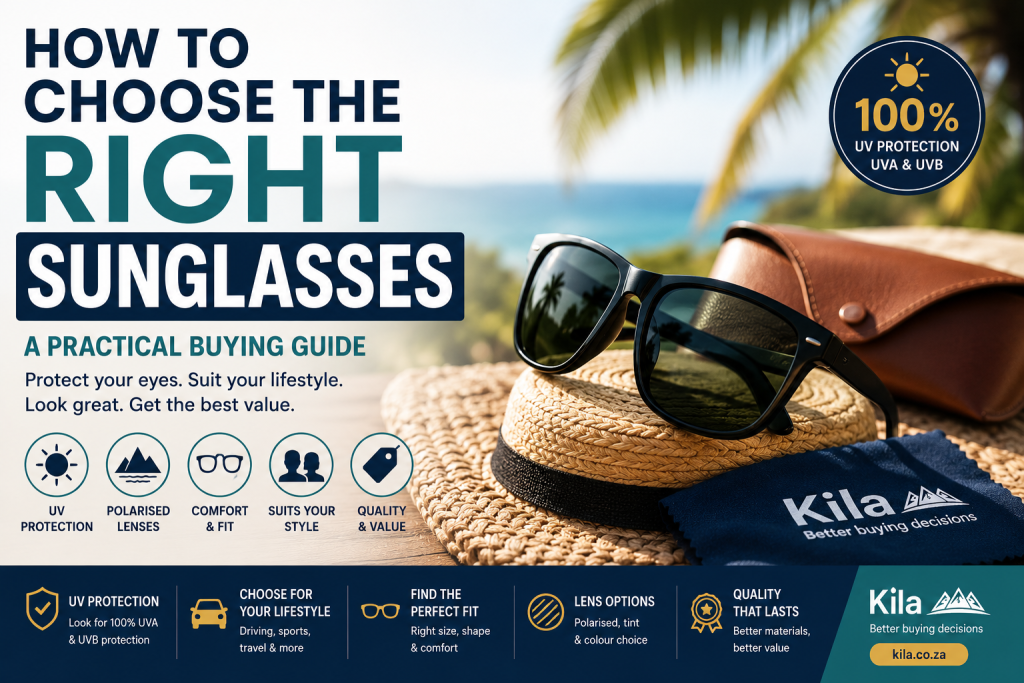
Style is about more than simply following the latest trends. The right accessories can complement what you wear while also providing practical benefits in everyday life. That’s why our Style & Fashion guides focus on helping South African shoppers make sensible choices when buying clothing, accessories and personal-style products.
Sunglasses are a good example. They can completely change the look of an outfit, but appearance shouldn’t be the only consideration when choosing a pair.
The right sunglasses should be comfortable, provide appropriate UV protection, suit the way you use them and offer good value for the money.
Whether you’re looking for an everyday pair, sunglasses for driving, something for travelling or simply an accessory to complement your personal style, there are several things worth considering before you buy.
1. Start With UV Protection
One of the first things to consider when buying sunglasses isn’t the frame colour or shape — it’s eye protection.
Look for sunglasses that provide 100% UV protection, including protection against both UVA and UVB radiation.
This is particularly relevant in South Africa, where bright sunlight and high UV levels are common.
Don’t assume that a darker lens automatically provides better UV protection. Lens darkness and UV protection are not the same thing.
A very dark pair of sunglasses without adequate UV protection isn’t necessarily a better choice than a lighter pair that provides proper UV protection.
What should you look for?
When shopping, look for descriptions such as:
- 100% UV protection
- UV400
- UVA and UVB protection
If the product listing doesn’t clearly state the level of UV protection, it may be worth looking for another option.
2. Consider How You Will Use Them
The best sunglasses for someone who spends most of their time driving aren’t necessarily the best choice for someone looking for a fashion accessory.
Think about where and when you’ll wear them.
Everyday use
For general everyday use, look for a comfortable frame and lenses that provide good protection without being excessively dark.
Driving
If you’re buying sunglasses primarily for driving, lens clarity and glare reduction are particularly important.
Polarised lenses can be worth considering because they can reduce certain types of reflected glare, particularly from surfaces such as roads and water.
Outdoor activities
If you spend considerable time outdoors, durability, secure fit and lens protection become more important.
Travel
For travel, a versatile pair that works with different outfits and activities can be more useful than buying a pair purely for fashion.
A protective case is also worth considering. Sunglasses that are constantly thrown into a handbag, backpack or car compartment are much more likely to become scratched or damaged.
3. Polarised vs Non-Polarised Lenses
One of the most common decisions you’ll encounter when shopping for sunglasses is whether to choose polarised lenses.
Polarisation is designed to reduce certain forms of glare caused by reflected light.
This can be particularly useful when:
- Driving
- Spending time near water
- Fishing
- Hiking
- Spending long periods outdoors
However, polarisation isn’t essential for everyone.
If your primary reason for buying sunglasses is fashion, everyday wear or simply reducing brightness, a good-quality non-polarised pair may be perfectly adequate.
The important point is that polarisation and UV protection are separate features.
A polarised lens should still provide appropriate UV protection.
4. Choose a Frame That Fits Properly
Even the best-looking sunglasses won’t be a good purchase if they don’t fit comfortably.
When trying on sunglasses, pay attention to:
- Whether they sit securely on your nose
- Whether the arms feel too tight
- Whether they slide down when you move
- Whether the frame touches your cheeks
- Whether the lenses sit at the correct position in front of your eyes
- Whether the frame feels excessively heavy
Your sunglasses should feel secure without creating uncomfortable pressure.
If you’re buying online, check whether the retailer provides frame measurements.
These can include:
Lens width: the width of each lens.
Bridge width: the distance between the lenses.
Temple length: the length of the arms that extend behind your ears.
These measurements can make online shopping considerably easier.
5. Does Face Shape Really Matter?
You’ll often see advice telling you that certain sunglasses are specifically designed for particular face shapes.
This can be useful as a starting point, but it shouldn’t be treated as a strict rule.
Different frame shapes can create different visual effects.
Round frames
Rounder frames can create an interesting contrast against more angular facial features.
Square and rectangular frames
These can provide a more structured appearance and are available in a huge range of styles.
Aviator styles
Aviator sunglasses remain popular because of their distinctive shape and versatile appearance.
Cat-eye styles
These can provide a more pronounced fashion statement and are particularly common in women’s eyewear.
Oversized frames
Large frames can provide substantial coverage and a strong fashion look, but make sure they remain comfortable and don’t overwhelm your face.
Ultimately, comfort and personal preference matter more than rigid face-shape rules.
6. Lens Colour Matters Too
Sunglasses come with lenses in almost every colour imaginable.
But lens colour isn’t simply about fashion.
Different tints can influence how you perceive contrast and brightness.
Common choices include:
- Grey
- Brown
- Green
- Blue
- Yellow
- Rose or pink
Grey lenses are popular for everyday use because they generally provide a relatively neutral view of colours.
Brown or amber lenses can provide increased contrast and are often used for outdoor activities.
Some coloured lenses are primarily chosen for their appearance rather than a particular optical advantage.
Whatever colour you choose, remember the important point:
Lens colour does not determine UV protection.
7. Don’t Confuse Brand Name With Quality
A well-known brand can certainly produce excellent sunglasses, but a famous logo doesn’t automatically make a particular pair the best choice.
When comparing sunglasses, consider the complete package:
- UV protection
- Lens quality
- Frame construction
- Comfort
- Fit
- Warranty
- Brand reputation
- Price
A cheaper pair that fits properly and provides appropriate protection may be a better purchase for you than an expensive pair chosen primarily because of the name on the frame.
Likewise, extremely cheap sunglasses with little information about their construction or UV protection may not represent good value simply because the initial price is low.
8. Buying Sunglasses Online
Buying sunglasses online can provide a much larger selection than visiting a single physical store.
It also makes it easier to compare prices between different retailers.
However, there are a few things to check before ordering.
Check the measurements
Don’t rely solely on photographs. Look for the actual frame dimensions.
Check the return policy
This is especially important if you’re buying a frame you’ve never tried before.
Check the warranty
Understand what is covered if the frame or lenses develop a problem.
Check UV protection
The product description should clearly specify the protection provided.
Check the retailer
Make sure you’re buying from a legitimate retailer and understand where the product is being shipped from.
Compare the complete price
When shopping online, look beyond the advertised price.
Consider:
Product price + delivery + duties/taxes where applicable = actual cost
This is particularly important when comparing local retailers with international websites.
9. Think About Your Wardrobe
Sunglasses are both a practical item and a fashion accessory.
If you’re buying your first good pair, a versatile design may provide more value than something extremely fashionable but difficult to wear with anything else.
Consider the colours and styles you normally wear.
A neutral frame can work with a wide range of clothing, while a more distinctive frame can become a deliberate part of your personal style.
There isn’t necessarily a right or wrong choice.
The important thing is to buy something you’re actually going to wear.
10. How Much Should You Spend?
There is no universal “correct” price for sunglasses.
The right budget depends on how often you’ll wear them, how important the brand is to you and what features you’re looking for.
Instead of starting with:
“How much should sunglasses cost?”
start with:
“What features are important to me, and what represents good value?”
For example, someone who spends hours outdoors every day may place greater value on lens technology and durability than someone who wants a pair to wear occasionally.
Likewise, someone who regularly loses or damages sunglasses might sensibly choose a less expensive pair.
Sunglasses Buying Checklist
Before purchasing, ask yourself:
☐ Do they provide appropriate UV protection?
☐ Do they fit comfortably?
☐ Are the frame dimensions suitable?
☐ Do I need polarised lenses?
☐ Are the lenses appropriate for how I intend to use them?
☐ Is the frame durable enough for my lifestyle?
☐ Do I like the style?
☐ Does the retailer have a reasonable return policy?
☐ Is there a warranty?
☐ Have I compared the complete price?
☐ Am I paying for useful features or simply the brand name?
Final Thoughts
The best sunglasses aren’t necessarily the most expensive or the most fashionable pair you can find.
They’re the ones that protect your eyes, fit comfortably, suit your lifestyle and represent good value for the money.
Start with protection and fit. Then consider lens type, intended use, style and price.
Once you’ve narrowed down those factors, comparing different brands and retailers becomes considerably easier.
And that’s the approach we take at Kila: look beyond the marketing, compare the important features and make a buying decision based on what actually matters.