
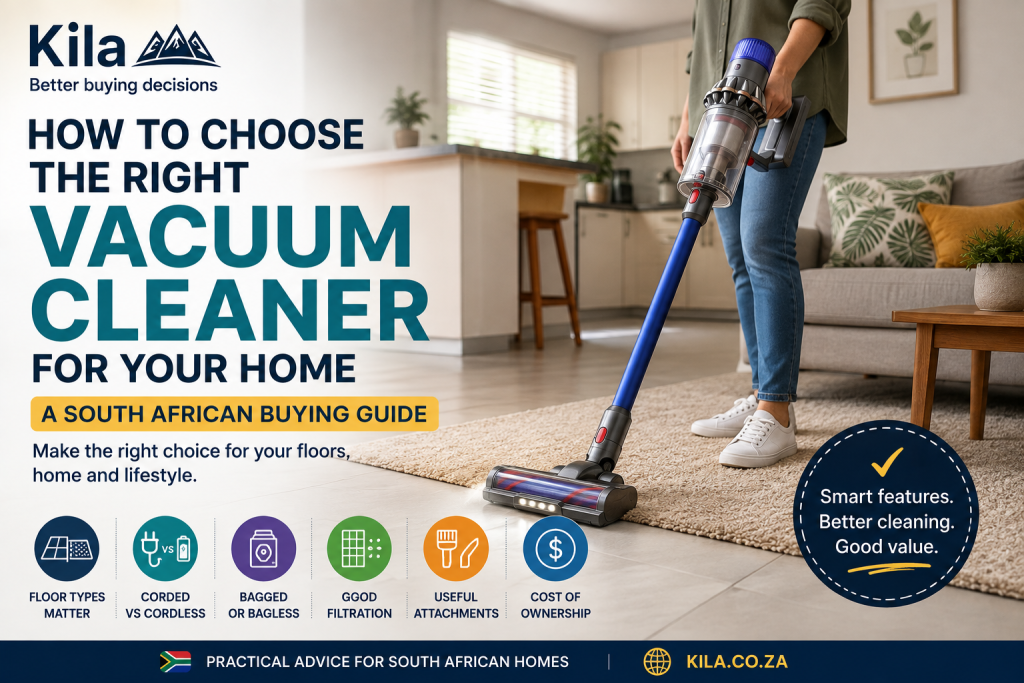
A vacuum cleaner is one of those household purchases that is easy to underestimate. There are plenty of models available, but the most expensive or most powerful-looking machine isn’t necessarily the best choice for your home.
The right vacuum cleaner depends on your floors, the size of your home, how often you clean, storage space, convenience and your budget.
Our Home & Living section covers practical buying guides and advice designed to help South African consumers make better decisions about products for their homes. In this guide, we’ll look at the features that actually matter when choosing a vacuum cleaner.
1. Start by Considering the Floors in Your Home
The type of flooring you have should be one of the first things you consider.
A home with mostly tiled, laminate or wooden floors has different requirements from one with extensive carpeting.
Hard floors
For tiled, vinyl, laminate and similar hard surfaces, look for a vacuum that can pick up dust, dirt and small debris effectively without unnecessarily complicated attachments.
A good floor head that can adapt to hard surfaces can be more useful than simply choosing a model with the highest advertised power.
Carpets
If your home has substantial carpeting, look for a vacuum designed to work effectively on carpet.
A powered brush or rotating brush head can help loosen dirt and debris trapped between carpet fibres.
If you have both carpet and hard flooring, a model with an adjustable floor head or different cleaning modes can be particularly useful.
A mixture of flooring
Many South African homes have a combination of tiled areas, carpets and other flooring.
In this situation, versatility can be more important than specialising in one particular surface.
Tip: Think about the surfaces you clean most frequently rather than choosing a vacuum based purely on its specifications.
2. Decide Between Corded and Cordless
One of the biggest decisions is whether you want a traditional corded vacuum or a cordless model.
Corded vacuum cleaners
The main advantage of a corded vacuum is that you don’t have to worry about battery life.
This can be particularly useful when cleaning a larger home or doing a thorough cleaning session.
The disadvantages are obvious: you need access to a power outlet and have to manage the cable while cleaning.
Cordless vacuum cleaners
Cordless models offer considerably more freedom of movement.
They can be particularly convenient for:
- Quick daily cleaning
- Stairs
- Cars
- Small homes or apartments
- Cleaning areas where plugging in a conventional vacuum is inconvenient
The main limitation is battery life.
When comparing cordless models, don’t look only at the manufacturer’s headline battery figure. Check whether the stated runtime applies to the lowest power setting and whether higher-power modes substantially reduce operating time.
For a larger home, battery capacity and charging time deserve particular attention.
3. Bagged or Bagless?
Another important decision is how the vacuum collects the dirt it picks up.
Bagged vacuum cleaners
Bagged machines collect dirt in a disposable or replaceable bag.
Advantages can include:
- Less direct contact with collected dust
- Simple disposal
- No need to empty a dust container after every cleaning session
The disadvantage is that you need to purchase replacement bags.
You should therefore check how easily replacement bags are available and what they cost before buying the vacuum.
Bagless vacuum cleaners
Bagless models use a removable container that you empty when it becomes full.
The obvious advantage is that you don’t have to keep buying replacement bags.
However, emptying the container can release some dust, particularly if you don’t do it carefully.
Don’t simply compare the purchase price of bagged and bagless models. Consider the ongoing cost and convenience as well.
4. Don’t Ignore Filtration
Filtration is an important part of a vacuum cleaner because the machine is designed to collect dust and debris while moving air through the system.
Some models use multiple filtration stages, while others include specialised filters.
When comparing models, find out:
- What type of filter does it use?
- Is the filter washable?
- How often does it need cleaning?
- Does the manufacturer recommend replacing it?
- Are replacement filters readily available?
A sophisticated filtration system is of limited practical value if replacement filters are difficult or expensive to obtain.
5. Look at the Attachments
Vacuum cleaners often come with a collection of accessories.
More attachments don’t necessarily mean a better vacuum.
Instead, consider whether the attachments are actually useful for your home.
Common accessories include:
Crevice tool
Useful for getting into narrow spaces such as gaps alongside furniture.
Upholstery tool
Useful for cleaning sofas, chairs and other fabric-covered furniture.
How to Choose the Right Sofa for Your Home
Dusting brush
Useful for shelves, furniture and other surfaces where a conventional floor head isn’t appropriate.
Motorised brush
Particularly useful for carpets and some types of fabric surfaces.
Extension tube or wand
Useful for reaching ceilings, curtains and high areas.
A smaller selection of genuinely useful accessories is often preferable to a box full of attachments that you never use.
6. Consider the Size and Weight
A vacuum cleaner needs to be practical to use.
A heavy machine might not be a problem if you’re cleaning a single-level home and have plenty of storage space.
But if you regularly need to carry the vacuum up and down stairs, weight becomes much more important.
Also consider:
- Handle design
- Wheel movement
- Overall height
- Storage requirements
- How easily it fits underneath furniture
- How easy it is to carry
For cordless stick vacuums, the weight of the main unit can be particularly important because you may be holding it rather than pushing it along the floor.
7. Think About Noise
Vacuum cleaners aren’t generally silent, but some models can be considerably more pleasant to use than others.
If you live in an apartment, have young children or regularly clean while other people are working or relaxing, noise may be worth considering.
Don’t assume that a quieter machine is necessarily less effective.
Instead, look for independent reviews that discuss the actual noise level and user experience.
8. Don’t Buy on Wattage Alone
One common mistake is assuming that a higher wattage automatically means a better vacuum cleaner.
It doesn’t.
Electrical power consumption and actual cleaning performance are not the same thing.
Factors such as:
- Airflow
- Suction design
- Floor head design
- Brush configuration
- Filtration
- Overall engineering
can all influence how well a vacuum performs.
Rather than choosing the machine with the biggest number on the box, look for independent testing and reviews where available.
Performance in real-world use is more useful than a single specification.
9. Check the Battery Carefully on Cordless Models
If you’re considering a cordless vacuum, battery specifications deserve particular attention.
Look for:
Runtime: How long can it operate on a charge?
Charging time: How long does it take to recharge?
Removable battery: Can the battery be replaced rather than replacing the entire vacuum?
Replacement cost: What does a replacement battery cost?
Power modes: Does maximum power dramatically reduce runtime?
A vacuum advertised with a long maximum runtime may provide considerably less cleaning time when used at higher power.
10. Check the Cost of Ownership
The purchase price is only part of the cost.
Before buying, investigate the availability and price of consumables and replacement components.
These might include:
- Filters
- Dust bags
- Batteries
- Brushes
- Floor heads
- Hoses
- Other replacement parts
This is particularly important when buying an unfamiliar brand.
A cheap vacuum isn’t necessarily cheap if replacement parts are difficult to find.
Conversely, paying more for a well-supported model can make sense if replacement parts remain available for many years.
11. Consider the Size of Your Home
Your home should influence the type of vacuum you choose.
Small apartment
A compact cordless stick vacuum may provide plenty of convenience.
Medium-sized home
A versatile vacuum with good battery life or a conventional corded model may be more appropriate.
Large home
Long operating time, larger dust capacity and comfortable handling become increasingly important.
Multi-storey home
Weight and portability deserve particular attention because you’ll probably be carrying the machine between floors.
12. Don’t Forget About Storage
Before buying, think about where the vacuum will live.
This sounds obvious, but larger conventional vacuum cleaners can take up considerable cupboard space.
Cordless stick vacuums generally have a smaller footprint, although some require wall mounting or a dedicated charging station.
Measure the available storage space before buying if space is limited.
13. How Much Should You Spend?
There isn’t a single correct amount to spend on a vacuum cleaner.
The objective should be to find the best combination of performance, reliability, convenience and price for your particular needs.
A more expensive model can be worthwhile if you use it frequently and it offers meaningful advantages.
But spending considerably more simply to obtain features you won’t use doesn’t necessarily represent good value.
When comparing prices, consider:
Purchase price + ongoing consumables + replacement parts + expected lifespan
rather than looking only at the initial price.
14. What Should You Look for When Comparing Models?
Before making a final decision, create a simple comparison between the models you’re considering.
| Feature | Model 1 | Model 2 | Model 3 |
|---|---|---|---|
| Corded/Cordless | |||
| Battery runtime | |||
| Charging time | |||
| Dust capacity | |||
| Bagged/Bagless | |||
| Filter type | |||
| Weight | |||
| Attachments | |||
| Warranty | |||
| Replacement parts available | |||
| Price |
This can make it much easier to identify the model that actually suits your requirements.
What Is the Best Vacuum Cleaner for You?
There is no single vacuum cleaner that is best for every household.
Instead, start with your own requirements.
If you have mostly hard floors, prioritise effective floor cleaning and convenience.
If you have lots of carpeting, pay greater attention to the floor head and brush system.
If you have a large home, battery life, capacity and cord length become more important.
If storage space is limited, a compact model may make more sense.
And if you’re looking for a machine that will last for years, don’t overlook the availability of replacement parts and consumables.
The Bottom Line
The best vacuum cleaner isn’t necessarily the most powerful or the most expensive one. It’s the model that suits the way you actually clean your home.
Before buying, consider your flooring, home size, storage space, corded versus cordless operation, filtration, attachments, maintenance requirements and long-term running costs.
Most importantly, compare several models rather than buying the first one that looks attractive.
That approach is much more likely to result in a vacuum cleaner that provides good value over the years.