
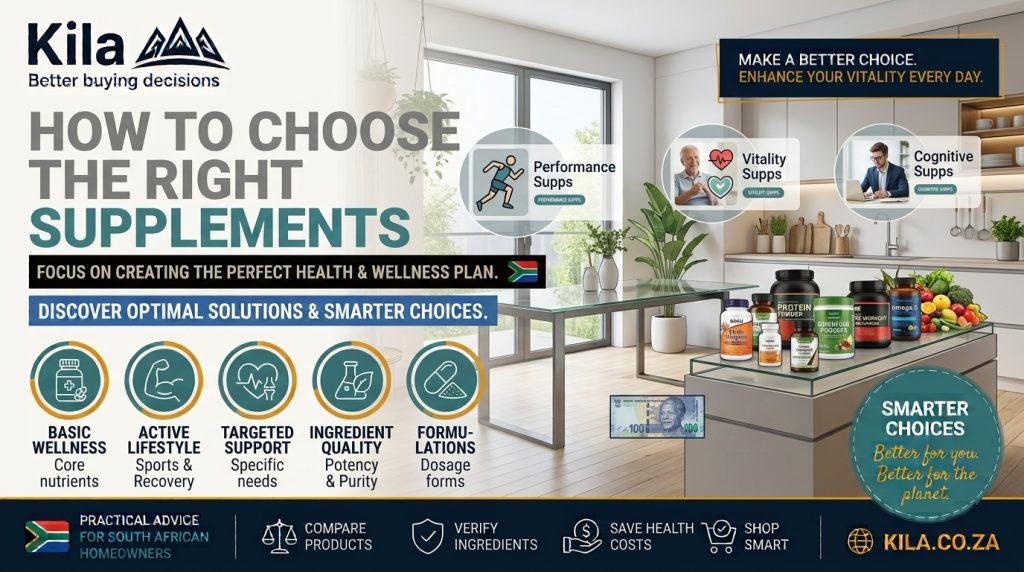
Walk into a health store or browse supplements online and you’ll quickly discover just how many products are available.
There are vitamins, minerals, protein products, herbal ingredients, performance supplements, nootropics and combination formulas — all promising different benefits.
With so much choice, it can be tempting to choose a product simply because it has an impressive label or because someone online recommends it.
A better approach is to start with what you actually need.
Whether you’re interested in general nutrition, exercise performance, energy, concentration or simply filling a nutritional gap, choosing supplements should involve more than looking at the front of the bottle.
Kila’s health and wellness guide explains what to look for when comparing supplements and how to make more informed purchasing decisions.
Start with your reason for taking a supplement
Before buying anything, ask yourself a simple question:
Why am I considering this supplement?
Your answer could be something like:
- Supporting general nutrition
- Supporting an active lifestyle
- Exercise performance
- Recovery
- Protein intake
- Energy
- Focus and concentration
- Supporting a particular dietary requirement
Having a specific reason makes it easier to determine whether a product is actually relevant.
It also reduces the temptation to buy several products simply because they look interesting.
Supplements shouldn’t replace a balanced diet
Supplements are exactly what the name suggests: supplements to your normal diet.
They shouldn’t generally be viewed as a substitute for nutritious food, adequate sleep, physical activity and other fundamentals of a healthy lifestyle.
A supplement can be useful in particular circumstances, but taking more products doesn’t automatically mean achieving better results.
The sensible approach is to get the basics right first and then consider whether a supplement has a useful role.
Look at the ingredients rather than the marketing
The front of a supplement container is designed to attract your attention.
It may highlight phrases such as:
- Advanced formula
- Maximum strength
- Premium blend
- Professional formula
- Next-generation nutrition
Those descriptions don’t tell you nearly as much as the actual ingredient panel.
When comparing products, look at:
- Active ingredients
- Amount per serving
- Number of servings
- Serving size
- Other ingredients
- Allergens
- Added sugars
- Artificial ingredients where relevant
Two products that appear very similar can have considerably different formulations.
Understand the serving size
This is one of the easiest details to overlook.
A product may appear cheaper because the container contains more capsules or tablets.
But that doesn’t necessarily mean it provides more servings.
For example:
Product A: 60 capsules
Serving size: 2 capsules
Total servings: 30
versus:
Product B: 90 capsules
Serving size: 1 capsule
Total servings: 90
Looking only at the number of capsules could give you the wrong impression.
Always compare the number of actual servings.
Compare the amount of active ingredient
The serving size isn’t the only important factor.
Look at how much of each relevant ingredient you receive per serving.
This becomes particularly important when comparing similar products from different brands.
One product might contain several ingredients in relatively small quantities, while another might contain fewer ingredients at different amounts.
More ingredients doesn’t necessarily mean better.
What matters is whether the formulation makes sense for the product’s intended purpose.
Be cautious with proprietary blends
Some supplements use proprietary blends where several ingredients are grouped together under one overall quantity.
For example, a label might tell you that a blend contains a certain total amount but not disclose the precise quantity of each individual ingredient.
This can make meaningful comparison more difficult.
Where transparency matters to you, look for products that clearly disclose the amounts of their active ingredients.
Don’t assume more is better
A common misconception is that if a small amount of something is useful, a much larger amount must be even better.
That isn’t necessarily true.
Nutrients and other supplement ingredients can have different effects depending on dosage, individual circumstances and interactions with other substances.
This is one reason why supplement labels should be followed carefully.
If you’re considering a supplement because of a specific health concern or you take medication, discuss it with an appropriate healthcare professional before using it.
Consider what you’re already taking
If you use several supplements, look at the ingredients across all of them.
You may discover that the same nutrient or ingredient appears in multiple products.
For example, a multivitamin could already contain an ingredient that is also present in a separate supplement.
Keeping track of what you’re taking can therefore help prevent unnecessary duplication.
A simple list on your phone can make this much easier.
Think about your lifestyle
There is no universal supplement routine that suits everyone.
Your requirements may be influenced by:
- Diet
- Exercise
- Age
- Lifestyle
- Activity level
- Dietary restrictions
- Personal goals
Someone who exercises regularly may approach supplementation differently from someone whose primary interest is general nutrition.
Likewise, someone following a restricted diet may have different nutritional considerations.
The important point is to choose based on your circumstances rather than someone else’s routine.
Supplements for an active lifestyle
If you’re physically active, you may encounter products marketed for:
- Protein
- Pre-workout energy
- Hydration
- Recovery
- Muscle support
- General performance
The first question should still be whether you actually need the product.
For example, someone who already obtains adequate protein from their normal diet may have less reason to use a protein supplement than someone who struggles to meet their dietary needs.
Supplements should complement your lifestyle rather than becoming a substitute for sensible nutrition.
What about energy supplements?
Products marketed for energy can contain very different ingredients.
Some may contain caffeine or other stimulants, while others rely on vitamins, minerals or herbal ingredients.
When considering these products, look carefully at the label.
Pay particular attention to:
- Caffeine content
- Serving size
- Other stimulants
- Recommended use
- Warnings
Avoid combining multiple products containing stimulants without understanding the total amount you’re consuming.
What about supplements for focus?
The nootropics category has become increasingly popular.
These products are often marketed around:
- Focus
- Concentration
- Mental performance
- Alertness
- Memory
However, products can differ substantially in their ingredients and evidence.
Don’t assume that an ingredient is effective simply because it appears on a supplement label.
When considering a nootropic, look at the actual formulation and the evidence behind its ingredients rather than relying solely on marketing claims.
Mind Lab Pro is an excellent nootropic that I personally recommend.
Check the manufacturer’s information
Before buying a supplement, investigate the manufacturer.
Look for information about:
- Company identity
- Product formulation
- Manufacturing standards
- Contact details
- Batch information where applicable
- Product testing
- Quality-control processes
A professional-looking website doesn’t automatically prove product quality, but a lack of basic information can be a reason to look elsewhere.
Look for transparent labelling
A good supplement label should make it reasonably clear what you’re buying.
You should be able to identify:
- Product name
- Ingredients
- Amount per serving
- Serving instructions
- Net quantity
- Storage instructions
- Manufacturer or distributor
- Relevant warnings
If you can’t determine what you’re actually buying from the label, think twice before purchasing.
Consider third-party testing
Where available, independent or third-party testing can provide additional confidence about product quality.
This can be particularly relevant for sports and performance supplements where contamination or inaccurate ingredient levels can be a concern.
Don’t assume that every product claiming to be “tested” has undergone the same type of testing.
If a manufacturer makes a testing claim, look for details about what was actually tested and by whom.
Check the expiry date
It sounds obvious, but it’s easy to overlook when buying supplements online.
Check:
- Expiry date
- Batch number where provided
- Storage requirements
This is particularly important when buying products that you don’t expect to finish quickly.
Think about storage
Some supplements require specific storage conditions.
Heat, moisture and sunlight can affect certain products.
Follow the manufacturer’s storage instructions and avoid storing products somewhere inappropriate simply because it’s convenient.
A bathroom cabinet, for example, may not be ideal for every type of supplement because of humidity.
Compare price per serving
This is one of the most useful ways to compare supplements.
Don’t simply compare:
Product A = R300
with:
Product B = R400
Instead calculate:
Price ÷ number of servings = cost per serving
A more expensive container may actually provide considerably better value if it contains more servings or a different formulation.
You should also compare the actual active ingredients rather than assuming two similarly priced products are equivalent.
Watch out for exaggerated claims
Be cautious when a product promises extraordinary results.
Statements suggesting that a supplement will:
- Transform your health overnight
- Produce guaranteed results
- Replace a healthy diet
- Solve numerous unrelated problems
- Work for absolutely everyone
should prompt closer examination.
Good supplement purchasing involves realistic expectations.
Be especially careful with testimonials
Customer reviews can help you understand things such as:
- Taste
- Packaging
- Ease of use
- Mixability
- Delivery
- General customer experience
But testimonials aren’t the same thing as scientific evidence.
One person’s experience doesn’t establish that a supplement will produce the same result for everyone.
Use reviews as one piece of information, not the entire basis for your decision.
Consider the form of the supplement
Supplements can come in many forms:
- Capsules
- Tablets
- Powders
- Liquids
- Gummies
- Softgels
The best format is often simply the one you can use consistently and comfortably.
Powders may be convenient for certain products, while capsules may be easier when travelling.
Gummies can be appealing, but check their ingredient and sugar content rather than assuming they’re equivalent to other forms.
Convenience matters
The most sophisticated supplement in the world isn’t particularly useful if you don’t take it consistently.
Consider whether the product fits naturally into your routine.
For example:
- Do you need to mix it?
- Does it require refrigeration?
- Does it have to be taken with food?
- How many capsules are required?
- Is it practical when travelling?
The easier something is to incorporate into your normal routine, the more likely you are to use it as intended.
Think about your budget
Supplements can become an expensive habit if you purchase multiple products every month.
Set a realistic budget and prioritise.
Ask:
Which product is actually most relevant to my goal?
You don’t necessarily need a shelf full of supplements.
In many cases, a small number of carefully selected products makes more sense than constantly adding new ones.
Buying supplements online
Online shopping gives you access to a much larger selection than many physical stores.
It also makes comparing products easier.
Before buying, check:
- Product information
- Ingredients
- Serving size
- Price
- Shipping cost
- Seller reputation
- Returns policy
- Expiry information
- Customer reviews
Also make sure you are buying from a reputable seller.
A simple supplement-buying process
If you’re unsure where to start, use this process.
Step 1: Define your goal
Why are you considering the supplement?
Step 2: Research the ingredients
Understand what the product actually contains.
Step 3: Compare formulations
Don’t compare products solely by brand or price.
Step 4: Calculate cost per serving
Work out what you’ll actually pay for each serving.
Step 5: Check quality information
Look for transparent labelling and manufacturer information.
Step 6: Check compatibility
Consider other supplements, medicines and dietary requirements.
Step 7: Decide whether you actually need it
Sometimes the best buying decision is not to buy the product.
Questions to ask before buying
Before adding a supplement to your shopping basket, ask:
☐ What am I hoping to achieve?
☐ Does this product actually address that goal?
☐ What are the active ingredients?
☐ How much does each serving contain?
☐ How many servings are in the container?
☐ What is the cost per serving?
☐ Am I already getting these ingredients elsewhere?
☐ Is the manufacturer transparent?
☐ Are the product claims realistic?
☐ Does the product fit my lifestyle?
☐ Have I checked the usage instructions and warnings?
Where Performance Labs products fit into the picture
Kila already offers a range of Performance Labs products, giving readers an opportunity to compare different supplement options in one place.
Rather than treating the entire range as something everyone should use, the better approach is to consider each product according to its intended purpose, ingredients and how well it fits your individual needs.
You can explore the Performance Labs range on Kila when you’re ready to compare specific products.
This is also an excellent place for a natural internal link to the relevant Kila product category.
Final thoughts
Choosing supplements doesn’t have to mean becoming an expert in every ingredient.
Start with your objective, look beyond the marketing on the front of the package and compare the information that actually matters.
Check the ingredients, serving size, dosage information, quality indicators, cost per serving and manufacturer’s information.
Most importantly, don’t assume that taking more supplements automatically means better results.
A good supplement purchase is one that has a clear purpose, fits your lifestyle and represents reasonable value for what you’re trying to achieve.
And if you’re uncertain whether a particular supplement is appropriate for you — especially if you have a medical condition, are pregnant, take medication or are considering a product for a specific health problem — speak to a qualified healthcare professional before using it.