
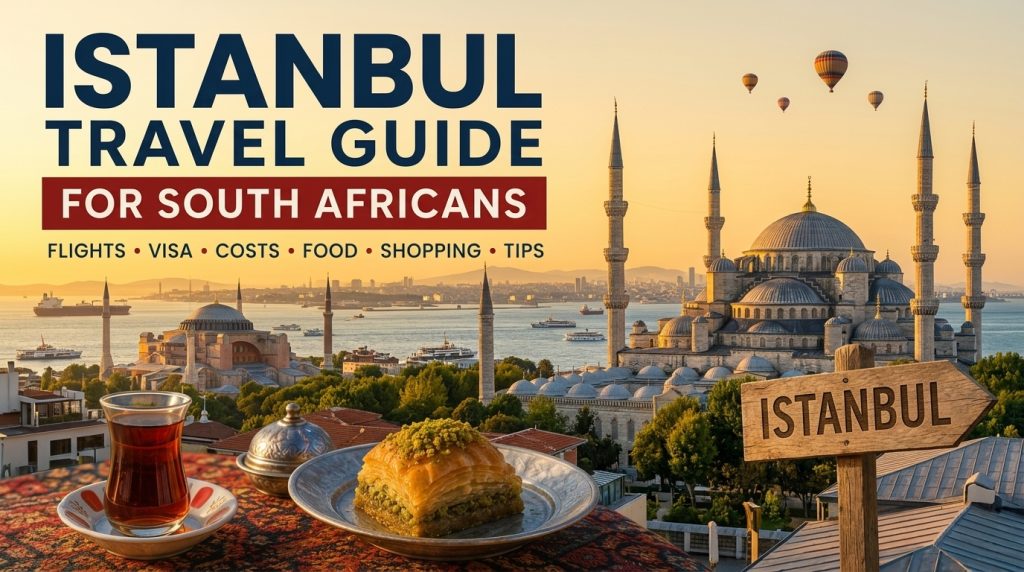
Istanbul is one of the world’s most fascinating cities — and a particularly interesting destination for South Africans looking for something different from a conventional European holiday.
The city sits on both sides of the Bosphorus, with Europe on one side and Asia on the other. Its history stretches across the Byzantine and Ottoman empires, while modern Istanbul combines historic mosques and palaces with shopping districts, restaurants, cafés, nightlife and contemporary neighbourhoods.
For a first-time visitor, Istanbul can also feel overwhelming. There is an enormous amount to see, the city is large, and deciding where to stay and how to get around can make a significant difference to your experience.
This guide explains what South African travellers should know before visiting Istanbul, including visas, flights, accommodation, transport, attractions, food, shopping and budgeting.
Why visit Istanbul?
Istanbul offers an unusual combination of history, culture, food and modern city life.
The city is home to major landmarks including Hagia Sophia, the Blue Mosque, Topkapı Palace, the Grand Bazaar and the Basilica Cistern. The official Go Türkiye tourism guide also highlights neighbourhoods and destinations ranging from the Historic Peninsula and Bosphorus to Beyoğlu, Galata, Kadıköy and the Asian side of the city.
You can spend one day exploring centuries-old buildings and the next browsing modern shops, eating Turkish food beside the Bosphorus or taking a ferry across to the Asian side.
For South African travellers, Istanbul can also work well as the first stop on a wider Turkish holiday.
Related Kila guide:
The Ultimate Turkey Travel Guide for South Africans
Do South Africans need a visa for Istanbul?
Yes.
South African ordinary passport holders require a visa to enter Türkiye. The Turkish Ministry of Foreign Affairs states that ordinary South African passport holders can obtain either a three-month multiple-entry visa through Turkish representations or a one-month single-entry e-Visa through the official e-Visa system.
Visa rules can change, so check the current requirements before booking your trip.
When applying for an e-Visa, use the official Turkish government system rather than an unofficial third-party website.
Important visa tip
Don’t leave your visa arrangements until the day before departure.
Check:
- Passport validity
- Current visa requirements
- Eligibility for an e-Visa
- Permitted length of stay
- Number of permitted entries
- Any additional documentation required
Keep your visa and travel documents accessible during your journey.
How do you get from South Africa to Istanbul?
Most South African visitors will fly to Istanbul.
When comparing flights, don’t automatically choose the cheapest advertised fare. Look at the complete journey.
Consider:
- Departure airport
- Arrival airport
- Number of connections
- Total journey time
- Baggage allowance
- Connection duration
- Seat selection
- Meal arrangements
- Change and cancellation conditions
- Final price
For travellers outside Johannesburg or Cape Town, also consider the cost and convenience of getting to the international departure airport.
Istanbul’s two airports
Istanbul is served by two major commercial airports.
Istanbul Airport (IST) is on the European side and is the city’s main international airport.
Sabiha Gökçen International Airport (SAW) is on the Asian side.
When booking accommodation, check which airport you’ll be arriving at.
The airport you use can affect your transfer time and cost, particularly if your hotel is on the opposite side of the city.
Most direct flights on Turkish Airlines from South Africa would land at the main Istanbul Airport.
Where should South Africans stay in Istanbul?
Choosing the right neighbourhood can make a big difference.
For a first visit, you don’t necessarily need to stay directly beside every attraction. Good transport connections can be more important.
Here are some areas worth considering.
Sultanahmet
Sultanahmet is the obvious choice for travellers who want to be close to Istanbul’s historic attractions.
The area puts you near:
- Hagia Sophia
- Blue Mosque
- Topkapı Palace
- Basilica Cistern
- Hippodrome
- Grand Bazaar
The advantage is convenience.
The disadvantage is that some parts of the area can feel heavily oriented towards tourists.
For a first visit of only a few days, however, staying here can make sightseeing very straightforward.
Beyoğlu and Taksim
Beyoğlu offers a very different atmosphere.
This is a good area to consider if you want:
- Restaurants
- Cafés
- Shopping
- Nightlife
- Contemporary Istanbul
- Easy access to other parts of the city
The area around İstiklal Avenue is particularly lively.
Galata
Galata is another attractive option.
Its central location provides convenient access to Beyoğlu, the Golden Horn and the Bosphorus while giving visitors plenty of cafés, restaurants and shops to explore.
It can be a good compromise between historic Istanbul and the city’s more modern side.
Kadıköy
Kadıköy is on the Asian side of Istanbul.
Staying here gives you a different perspective on the city and can be particularly appealing to travellers who want to experience a more local neighbourhood atmosphere.
It is also possible to travel between the European and Asian sides by ferry.
How many days do you need in Istanbul?
For a first visit, I’d recommend allowing at least three full days.
Four or five days would be even better if you want to explore without rushing.
Three days
Good for:
- Historic Peninsula
- Grand Bazaar
- Bosphorus
- Galata/Beyoğlu
Four days
Allows additional time for:
- Asian side
- Museums
- Neighbourhood exploration
- Shopping
- Food experiences
Five days or more
You can slow down considerably and explore beyond the obvious tourist attractions.
Istanbul rewards travellers who leave some time simply to walk around and discover the city.
The best things to do in Istanbul
There are enough attractions to fill several days.
Here are some of the highlights.
1. Visit Hagia Sophia
Hagia Sophia is one of Istanbul’s most famous landmarks.
The building has undergone several transformations throughout its long history and is currently a mosque. The official Go Türkiye guide describes it as one of Istanbul’s iconic landmarks and notes that its status as a place of worship returned in 2020.
Because it remains an active religious site, visitors should check the current visitor arrangements and dress appropriately.
2. See the Blue Mosque
The Sultan Ahmed Mosque, commonly known as the Blue Mosque, is another Istanbul landmark.
Its nickname comes from the İznik tiles used extensively within the interior. It remains an active place of worship.
If you’re visiting as a tourist, be respectful of people attending prayers and follow the site’s visitor instructions.
3. Explore Topkapı Palace
Topkapı Palace provides a glimpse into Ottoman imperial history.
It is located in the Historic Peninsula and can easily be combined with Hagia Sophia, the Blue Mosque and other nearby attractions.
Allow plenty of time rather than trying to rush through the complex.
4. Explore the Basilica Cistern
The Basilica Cistern is one of Istanbul’s most unusual historic attractions.
It lies beneath the city and provides a completely different experience from the mosques and palaces above ground.
It is particularly worthwhile if you enjoy history and architecture.
5. Walk through the Grand Bazaar
The Grand Bazaar is one of Istanbul’s best-known shopping destinations.
The official Turkish tourism guide describes it as one of the world’s oldest covered markets, with thousands of shops spread across its extensive network of streets and alleys.
You can find:
- Jewellery
- Textiles
- Ceramics
- Leather goods
- Lamps
- Spices
- Souvenirs
- Handbags
- Traditional crafts
Don’t feel obliged to buy something from the first shop you enter.
Walk around, compare prices and take your time.
6. Visit the Spice Bazaar
The Spice Bazaar is another excellent place to experience Istanbul’s historic trading culture.
It is particularly appealing if you enjoy food and traditional ingredients.
Look for:
- Spices
- Turkish tea
- Sweets
- Dried fruit
- Nuts
- Turkish delight
7. Take a Bosphorus cruise
A Bosphorus experience should be high on the list for a first-time visitor.
The Bosphorus separates Istanbul’s European and Asian sides and is lined with historic buildings, palaces, neighbourhoods and waterfront mansions.
You don’t necessarily need an expensive private cruise.
A local ferry can also provide a memorable way to see the city from the water.
Don’t spend your entire trip in Sultanahmet
The Historic Peninsula is spectacular, but Istanbul is much more than its famous landmarks.
Consider exploring:
- Galata
- Karaköy
- Beyoğlu
- Balat
- Kadıköy
- Üsküdar
- Ortaköy
- Moda
The official tourism guide lists many of these areas among Istanbul’s destinations, including Galata, Karaköy, Fener and Balat, Kadıköy, Moda, Üsküdar and Ortaköy.
This is where you’ll start to experience a different side of Istanbul.
Getting around Istanbul
Istanbul is a huge city, so don’t underestimate travel time.
Fortunately, it has an extensive public transport network.
Depending on your route, you can use:
- Metro
- Tram
- Bus
- Ferry
- Funicular
- Taxi
Public transport is often more practical than relying on taxis for every journey.
Metro Istanbul publishes information about its network and travel rules, and passengers generally need to use an electronic ticket or card when travelling on its rail services.
Should you use public transport?
For most visitors, yes.
The tram is particularly useful for sightseeing around the historic centre, while metro services can make longer journeys considerably easier.
Ferries are also an enjoyable way to travel between parts of the city.
Instead of treating public transport simply as a way of getting from A to B, consider the ferry as part of the Istanbul experience.
What about taxis?
Taxis can be useful, particularly when travelling with luggage or when public transport isn’t convenient.
However, traffic can be heavy.
A journey that looks short on a map can take much longer during busy periods.
Before getting into a taxi, make sure the meter is being used and confirm your destination.
Using reputable taxi-booking options or hotel assistance can also make the process easier.
What is the Istanbulkart?
The Istanbulkart is used for public transport in Istanbul.
Because transport arrangements and fares can change, check the current official information when you arrive.
If you expect to use public transport regularly, understanding the current card and ticket options can make getting around much easier.
What should you eat in Istanbul?
Istanbul is an excellent destination for food lovers.
Some things worth trying include:
- Turkish breakfast
- Simit
- Pide
- Lahmacun
- Kebabs
- Meze
- Börek
- Balık ekmek
- Baklava
- Turkish delight
- Turkish coffee
- Turkish tea
Don’t assume that the best food will always be found in the most expensive restaurants.
Some of the pleasure of visiting Istanbul is discovering small cafés, bakeries and local restaurants.
Turkish breakfast is worth experiencing
A traditional Turkish breakfast can be much more substantial than many South Africans may be used to.
It can include combinations of:
- Cheese
- Olives
- Eggs
- Bread
- Tomatoes
- Cucumbers
- Jams
- Honey
- Yogurt
- Sucuk
- Tea
Allow yourself time for breakfast rather than treating it as something to rush through before sightseeing.
Shopping in Istanbul
Shopping can easily become part of an Istanbul holiday.
The city offers everything from traditional markets to modern shopping centres and international brands.
The Grand Bazaar is particularly well known for jewellery, textiles, leather goods, ceramics and traditional products.
If you’re shopping for expensive goods, don’t be afraid to compare several sellers.
Ask questions about:
- Materials
- Origin
- Quality
- Returns
- Guarantees
- Final price
And remember that a bargain isn’t a bargain if you didn’t actually want the item.
How much does Istanbul cost?
Your Istanbul budget will depend heavily on your accommodation and travel style.
The main expenses are likely to include:
- Flights
- Accommodation
- Airport transfers
- Food
- Public transport
- Attractions
- Shopping
- Tours
- Travel insurance
- Mobile data
One advantage of planning your own trip is that you can control many of these costs.
You could spend considerably more on a centrally located luxury hotel, for example, or choose a smaller hotel and spend more of your budget on experiences.
How to save money in Istanbul
A few simple decisions can reduce the cost of your trip.
Stay near public transport
You don’t necessarily need to stay directly beside every attraction.
Eat some meals away from tourist hotspots
Restaurants aimed directly at tourists can be considerably more expensive.
Use public transport
It can be much more economical than taking taxis everywhere.
Compare attraction prices
Don’t automatically purchase the first tour or sightseeing package you find.
Set a shopping budget
Istanbul’s markets can make impulse buying very easy.
When is the best time to visit Istanbul?
Spring and autumn are particularly attractive for sightseeing because temperatures are generally more comfortable than during the hottest part of summer.
Spring
Good for:
- Walking
- Sightseeing
- Parks
- Photography
Summer
Good for:
- Long days
- Outdoor dining
- Bosphorus trips
- Combining Istanbul with a coastal holiday
But it can be hot and busy.
Autumn
A good balance between comfortable sightseeing weather and the summer peak.
Winter
Potentially colder and wetter, but the city can be quieter and atmospheric.
Your choice should depend on what you want from the trip rather than simply trying to identify one universally “best” month.
What should South Africans pack for Istanbul?
Your packing list will depend on the season.
Useful items include:
- Comfortable walking shoes
- Light layers
- Weather-appropriate jacket
- Sun protection
- Universal travel adaptor
- Portable power bank
- Prescription medication
- Copies of important travel documents
- Comfortable day bag
Comfortable footwear is especially important.
You can cover a surprising number of kilometres while sightseeing in Istanbul.
If you’re visiting mosques, bring clothing that allows you to dress respectfully.
What should you know about cultural etiquette?
Istanbul is accustomed to international visitors, but showing respect for local customs is important.
When visiting mosques:
- Dress appropriately
- Follow instructions
- Remove shoes where required
- Avoid disturbing people at prayer
- Follow photography restrictions
In markets, polite bargaining may be part of the experience.
Learning a few basic Turkish expressions can also be appreciated.
For example:
Merhaba — Hello
Teşekkür ederim — Thank you
Lütfen — Please
You don’t need to speak Turkish fluently to enjoy Istanbul, but making an effort can make interactions more pleasant.
Is Istanbul safe for tourists?
As with any major international city, visitors should take normal precautions.
Keep an eye on:
- Your wallet and phone
- Bags in crowded areas
- Important travel documents
- Unfamiliar taxi arrangements
- Unexpected requests for money
Crowded tourist areas and public transport require the same awareness you would use in any major city.
Before travelling, check the latest official South African travel advisory information and any relevant local guidance.
Staying connected in Istanbul
South African travellers have several potential options for mobile connectivity.
Depending on your phone and travel requirements, you could consider:
- International roaming
- A local SIM
- An international eSIM
An eSIM can be particularly convenient if your phone supports the technology.
When comparing plans, look at:
- Data allowance
- Coverage
- Validity
- Hotspot support
- Activation
- Whether the plan includes calls or SMS
[Future affiliate placement: Compare eSIM options for Turkey]
Related Kila guide:
Best eSIMs for South Africans Travelling Overseas
Should you get travel insurance for Istanbul?
Travel insurance is worth considering for an international trip.
Look beyond the headline price and compare:
- Emergency medical cover
- Medical evacuation
- Cancellation
- Baggage
- Travel delays
- Personal liability
- Exclusions
- Excesses
For a longer Turkish holiday, travel insurance becomes particularly relevant because unexpected problems can affect several parts of your itinerary.
A suggested three-day Istanbul itinerary
If you only have three days, don’t try to see everything.
Day 1 — Historic Istanbul
Start with:
- Hagia Sophia
- Blue Mosque
- Basilica Cistern
- Hippodrome
Then spend the evening enjoying dinner in the historic centre.
Day 2 — Ottoman Istanbul and shopping
Visit:
- Topkapı Palace
- Grand Bazaar
- Spice Bazaar
- Süleymaniye Mosque
The official Go Türkiye tourism site has a two-day Historic Peninsula itinerary that similarly groups Hagia Sophia, the Blue Mosque, Basilica Cistern, Topkapı Palace, Süleymaniye Mosque and Grand Bazaar into a practical sightseeing route.
Day 3 — Bosphorus and modern Istanbul
Consider:
- Bosphorus ferry
- Galata
- Karaköy
- İstiklal Avenue
- Beyoğlu
If time allows, cross to the Asian side and explore Kadıköy.
A suggested five-day Istanbul itinerary
With five days, you can slow things down.
Day 1
Historic Peninsula
Day 2
Topkapı Palace, Grand Bazaar and Spice Bazaar
Day 3
Bosphorus and Dolmabahçe
Day 4
Galata, Karaköy and Beyoğlu
Day 5
Kadıköy, Moda and the Asian side
The advantage of five days is that you don’t need to spend every day rushing between attractions.
Istanbul as part of a larger Turkey holiday
One of the biggest advantages of Istanbul is that it works well as the beginning or end of a broader Turkish itinerary.
For example:
7-day trip
Istanbul + Cappadocia
10-day trip
Istanbul + Cappadocia + Antalya
Two-week trip
Istanbul + Cappadocia + Ephesus + Mediterranean/Aegean coast
The right itinerary depends on whether you prefer history, beaches, food, shopping or outdoor experiences.
Related Kila guide:
The Ultimate Turkey Travel Guide for South Africans
Before you leave South Africa
Use this checklist before your Istanbul trip:
- Check passport validity
- Check the latest Turkish visa requirements
- Arrange your visa through the appropriate official channel
- Compare flights
- Book suitable accommodation
- Plan your airport transfer
- Arrange travel insurance
- Decide on roaming, SIM or eSIM
- Check your bank’s international transaction fees
- Research public transport
- Make copies of important documents
- Check the weather for your travel dates
- Research attractions that may require advance booking
Final thoughts
Istanbul is not a destination that needs to be rushed.
Its most famous landmarks are spectacular, but some of the best experiences can come from simply wandering through a neighbourhood, sitting down for Turkish tea, taking a ferry across the Bosphorus or discovering a small restaurant away from the main tourist routes.
For South Africans, the most important things to get right before travelling are the visa, flights, accommodation, insurance and overall itinerary.
Once those are organised, Istanbul becomes much easier to enjoy.
And if you’re planning a wider trip through Turkey, Istanbul makes an excellent starting point.