
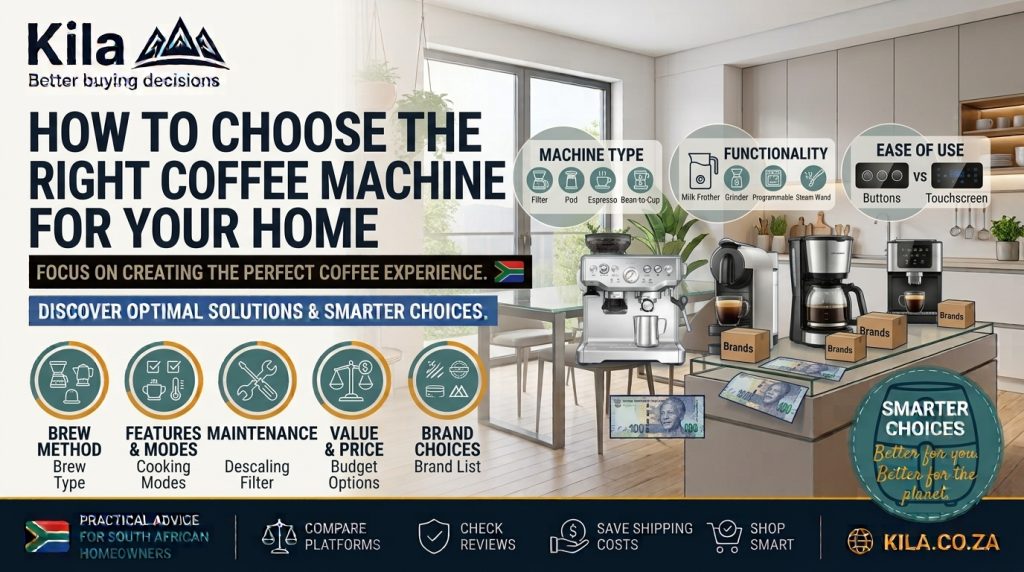
For many people, coffee is an important part of the morning routine.
But buying a coffee machine can be surprisingly complicated.
There are simple filter coffee makers, pod machines, manual espresso machines, automatic bean-to-cup machines and increasingly sophisticated appliances that can prepare everything from a basic espresso to a cappuccino or latte.
Prices can range from relatively affordable to several thousand rand or considerably more.
So how do you know which coffee machine is right for you?
The answer isn’t necessarily to buy the most expensive machine.
Instead, think about what coffee you enjoy, how often you drink it, how much effort you’re prepared to put into making it and how much space you have available.
This guide explains the main types of coffee machines and the factors worth considering before you buy.
Start with the coffee you actually drink
The most important question is surprisingly simple:
What type of coffee do you normally drink?
If you mainly want a large mug of straightforward coffee, a filter machine may be all you need.
If you enjoy espresso-based drinks, you’ll have more options to consider.
You might prefer:
- Espresso
- Americano
- Cappuccino
- Latte
- Flat white
- Mocha
- Filter coffee
- Iced coffee
Your preferred drink should influence the type of machine you buy.
There’s little point spending a large amount on a sophisticated espresso machine if you generally just want a quick cup of ordinary coffee in the morning.
The main types of coffee machines
There are four broad categories worth considering.
1. Filter coffee machines
These are among the simplest coffee makers.
Hot water passes through ground coffee and a filter before collecting in a jug or carafe.
They’re particularly suitable for people who enjoy:
- Regular black coffee
- Larger quantities
- Simple operation
- Making several cups at once
They can also be a practical choice for households where several people drink coffee.
2. Pod or capsule coffee machines
Pod machines use pre-portioned coffee capsules.
Their biggest attraction is convenience.
You generally:
- Insert the capsule
- Add or check the water
- Press a button
- Collect your coffee
Advantages include:
- Very easy to use
- Consistent results
- Little mess
- Quick preparation
- Large variety of coffee styles
The main disadvantage is the ongoing cost of capsules.
The machine itself may be reasonably affordable, but regular capsule purchases can add up over time.
3. Manual espresso machines
Manual espresso machines provide much greater control.
You generally use ground coffee and prepare the espresso yourself.
Depending on the machine, you may need to:
- Grind coffee
- Measure the dose
- Tamp the coffee
- Lock the portafilter into place
- Start the extraction
- Steam milk separately
This gives you considerable control, but it also requires more effort.
Manual machines are attractive to people who enjoy the process of making coffee rather than simply pressing a button. Most suitable for coffee nerds and home baristas who enjoy the finer notes in a cup of coffee.
4. Bean-to-cup machines
Bean-to-cup machines grind whole coffee beans immediately before preparing the drink.
Depending on the model, the machine can automate much of the process.
Some machines can prepare:
- Espresso
- Americano
- Cappuccino
- Latte
- Flat white
The major advantage is convenience combined with freshly ground coffee.
The disadvantages can include:
- Higher purchase price
- Larger size
- More cleaning
- More complicated maintenance
For serious daily coffee drinkers, however, the convenience can be worthwhile.
Which type of coffee machine is best?
There isn’t a universal winner.
| Machine type | Best for | Convenience | Control | Typical ongoing cost |
|---|---|---|---|---|
| Filter | Simple everyday coffee | High | Low | Relatively low |
| Pod | Convenience | Very high | Low | Higher |
| Manual espresso | Coffee enthusiasts | Lower | High | Varies |
| Bean-to-cup | Fresh coffee with convenience | High | Medium | Varies |
The right choice depends on your priorities.
How much should you spend?
Coffee machines are available at almost every price point.
Rather than choosing your budget based solely on what you can afford, consider the value you’ll get from the machine.
Someone who drinks one cup occasionally probably doesn’t need an expensive machine.
Someone who drinks several coffees every day may get considerably more value from investing in a better appliance.
Think about:
- Purchase price
- Coffee costs
- Capsules or beans
- Maintenance
- Filters
- Cleaning products
- Replacement parts
- Expected lifespan
The cheapest machine isn’t necessarily the cheapest option over several years.
Consider the ongoing cost of coffee
This is particularly important with pod machines.
A machine may seem inexpensive initially, but regular capsule purchases can become a significant recurring expense.
Before buying, estimate:
Number of coffees per day × cost per coffee × days per year
You may discover that a more expensive machine using ground coffee or beans could be more economical over the long term.
Of course, cost isn’t the only consideration.
Convenience has value too.
Pods versus ground coffee versus beans
The type of coffee you use has a major influence on the experience.
Coffee pods
Advantages:
- Convenient
- Consistent
- Easy to store
- Little mess
Disadvantages:
- Ongoing capsule cost
- More packaging
- Less control over the coffee
- Compatibility considerations
Ground coffee
Advantages:
- Wide variety
- Generally easy to find
- More control over coffee selection
- Suitable for manual espresso and filter machines
Disadvantages:
- Requires measuring
- Can lose freshness after opening
- More preparation
Whole coffee beans
Advantages:
- Can provide excellent flavour
- Freshly ground immediately before brewing
- Huge variety of beans available
Disadvantages:
- Requires a grinder unless the machine has one
- More preparation
- Beans need appropriate storage
Do you need a coffee grinder?
If you want to use whole beans with a manual espresso machine or a traditional brewing system, you’ll need a grinder.
This is an important additional cost that is easy to overlook.
A poor-quality grinder can also make it difficult to get consistent results from an espresso machine.
Coffee enthusiasts typically prefer a conical burr grinder as it provides a consistent coffee grind.
If convenience is important, a bean-to-cup machine with an integrated grinder may be more practical.
How important is pressure?
Pressure is frequently used in coffee-machine marketing, particularly for espresso machines.
You’ll often see pressure ratings prominently displayed in product descriptions.
However, don’t judge the quality of a coffee machine solely by the highest pressure number advertised.
The quality of the entire brewing system matters.
Other factors include:
- Temperature stability
- Coffee grind
- Dose
- Extraction time
- Water quality
- Machine design
A large pressure number on the box doesn’t automatically mean better coffee.
What is a milk frother?
If you enjoy cappuccinos, lattes or flat whites, you’ll need some way of preparing milk.
Coffee machines may include:
- Manual steam wands
- Automatic milk systems
- Milk containers
- Separate frothers
A manual steam wand provides greater control but requires practice.
An automatic system is easier for beginners.
Again, think about what you actually drink.
If you only drink black coffee, there’s little reason to pay extra for an elaborate milk system.
Manual versus automatic milk systems
Manual steam wand
Better suited to people who:
- Enjoy making coffee
- Want more control
- Are willing to practise
- Want to experiment with milk texture
Automatic milk system
Better suited to people who:
- Want convenience
- Regularly drink milk-based coffee
- Don’t want to learn steaming techniques
- Prefer consistent results
Neither is universally better.
How important is water quality?
Water quality can affect both coffee flavour and the machine itself.
Hard water can contribute to mineral deposits inside coffee equipment.
Depending on your local water quality and the machine manufacturer’s recommendations, you may need to use:
- Filtered water
- A water filter
- Descaling products
- Other approved maintenance methods
Always follow the manufacturer’s instructions.
Regular descaling can be particularly important for machines that heat water repeatedly.
Coffee machine cleaning
This is one of the most important things to consider before buying.
A machine that produces excellent coffee but requires complicated cleaning may become frustrating.
Check what needs to be cleaned regularly.
This can include:
- Brew groups
- Portafilters
- Milk systems
- Drip trays
- Water tanks
- Coffee grounds containers
- Capsule compartments
- Steam wands
If you don’t want much maintenance, choose a simpler machine.
How much counter space do you have?
Coffee machines can range from compact appliances to surprisingly large countertop systems.
Before buying, measure:
- Width
- Depth
- Height
- Available clearance
- Storage space
Also consider how easily you can access the water tank and coffee compartment.
An appliance that fits perfectly until you need to refill the water tank isn’t particularly practical.
Water tank size
A larger water tank means fewer refills.
This can be useful if:
- Several people drink coffee
- You make multiple drinks each day
- The machine is difficult to refill
However, a large tank also takes up more space.
For one person drinking one or two coffees a day, a smaller tank may be perfectly adequate.
Does the machine need a permanent water connection?
Most home coffee machines use a removable water tank.
Some more advanced systems can be connected directly to a water supply.
For most households, a removable tank is simpler.
Plumbed-in systems are generally more appropriate for commercial environments or specialist home installations.
How fast should a coffee machine be?
If you’re always rushing in the morning, speed may matter.
Pod and automatic machines can be particularly convenient.
Manual espresso machines generally require more preparation.
Consider the complete process rather than just the advertised heating time.
You may need to:
- Grind the beans
- Measure coffee
- Tamp
- Brew
- Steam milk
- Clean the machine
A machine that takes slightly longer to brew but requires almost no preparation could actually be faster for your routine.
Programmable coffee machines
Some machines allow you to programme brewing times or save preferred drink settings.
This can be useful if you have a consistent morning routine.
However, don’t pay significantly more for programming features that you’ll never use.
Convenience features are worthwhile when they genuinely make your daily routine easier.
Smart coffee machines
Some modern appliances offer app connectivity and other smart features.
Depending on the machine, you may be able to:
- Start or schedule brewing
- Save drink preferences
- Monitor maintenance
- Receive notifications
These features can be interesting, but they aren’t essential for making good coffee.
Consider them a bonus rather than a primary buying criterion.
Noise levels
Coffee grinders and pumps can make noise.
If you live in a small apartment, share your home with others or regularly make coffee early in the morning, noise could be worth considering.
Bean-to-cup machines may be noisier during grinding than pod machines.
If noise is important to you, look for customer reviews that specifically mention it.
How important is the brand?
Brand reputation can be useful when buying an appliance that you expect to use for years.
An established manufacturer may provide:
- Better after-sales support
- Spare parts
- Accessories
- Service centres
- Warranty support
- Replacement components
However, don’t assume that the most expensive brand is automatically the best choice.
Compare the actual specifications and support available for the model you’re considering.
Check the warranty
Coffee machines contain pumps, heaters, electronics and, in some cases, grinders and milk systems.
A warranty therefore matters.
Before buying, check:
- Warranty length
- What is covered
- Where repairs are performed
- Whether the retailer or manufacturer handles claims
- Availability of spare parts
- Service arrangements
This is particularly important for expensive bean-to-cup and espresso machines.
Buying a coffee machine online
Online shopping can make it easier to compare different machines.
Before ordering, check:
Dimensions
Make sure it fits your kitchen.
Water capacity
Consider how frequently you’ll need to refill it.
Coffee compatibility
Check whether it uses pods, ground coffee, beans or a combination.
Cleaning requirements
Understand what regular maintenance involves.
Warranty
Check exactly what is covered.
Returns
Understand the retailer’s return policy.
Reviews
Look for recurring patterns in customer feedback.
Don’t overlook the cost of accessories
Depending on the machine, you may also need:
- Coffee grinder
- Milk jug
- Coffee tamper
- Scales
- Water filter
- Cleaning products
- Descaling products
- Storage containers
A seemingly affordable manual espresso machine can become considerably more expensive once you add the equipment needed to use it properly.
Coffee machines for different households
For one person
A compact pod or filter machine may be ideal.
You probably don’t need a huge appliance.
For couples
A pod, filter or compact espresso machine can work well.
If both people prefer different drinks, an automatic machine may provide useful flexibility.
For families
A larger filter machine or bean-to-cup machine may be more practical.
If several people drink coffee throughout the day, a larger water capacity can be useful.
For coffee enthusiasts
A manual espresso machine combined with a good grinder may provide the greatest control.
Also, don’t forget the alternatives like a mocha pot, Aeropress, or pour-overs, all of which can provide an excellent flavour profile.
What about an office or home business?
If the machine will be used by many people throughout the day, durability and capacity become much more important.
Consider:
- Water capacity
- Brewing speed
- Ease of cleaning
- Reliability
- Warranty
- Service availability
- Number of drinks per day
A machine designed for occasional household use may not be suitable for heavy daily use.
Common coffee-machine buying mistakes
Buying based on price alone
The cheapest machine may not provide the features or durability you need.
Buying a machine that’s too complicated
If you want coffee quickly, a machine requiring extensive preparation may frustrate you.
Ignoring ongoing costs
Pods, beans, filters and maintenance can add considerably to the total cost.
Buying too large a machine
Counter space matters.
Paying for features you won’t use
More functions don’t automatically mean better value.
Ignoring cleaning
Maintenance is part of owning a coffee machine.
Forgetting the grinder
If you’re buying a machine for whole beans, remember to consider how the beans will be ground.
While purchasing pre-ground coffee is an option, the ideal is to grind your own coffee within minutes before using it. Coffee plavour quickly deteriated once teh bean has been ground.
How to choose your coffee machine in five steps
Step 1: Decide what coffee you drink
Espresso? Cappuccino? Filter coffee? Something else?
Step 2: Decide how much effort you want
Do you want to press a button or enjoy the preparation process?
Step 3: Decide your budget
Include coffee, accessories and maintenance.
Step 4: Measure your kitchen
Make sure the machine actually fits.
Step 5: Compare the complete ownership cost
Look beyond the purchase price.
This approach can make the buying decision much easier.
A simple coffee machine buying checklist
Before purchasing, ask:
- What type of coffee do I normally drink?
- Do I prefer convenience or control?
- Should I choose pods, ground coffee or beans?
- Do I need a milk frother?
- How many people will use the machine?
- How much counter space do I have?
- Is the water tank large enough?
- How difficult is it to clean?
- Will I need a separate grinder?
- What accessories are required?
- What is the warranty?
- Are spare parts and servicing available?
- What will the coffee cost over time?
- Does the machine offer features I’ll actually use?
Final thoughts
The right coffee machine isn’t necessarily the one with the most buttons, the highest price or the longest list of features.
It’s the one that fits naturally into your daily routine.
If you want a quick cup with almost no effort, a pod or automatic machine may be ideal.
If you enjoy the process of preparing coffee and want greater control, a manual espresso machine could be more satisfying.
If you simply want several cups of straightforward coffee, a filter machine may be all you need.
And if freshly ground coffee and convenience are both important, a bean-to-cup machine could provide a useful compromise.
Before buying, consider the entire ownership experience — including coffee costs, cleaning, accessories, maintenance, space and after-sales support.
That will help you choose a machine that you enjoy using long after the excitement of buying a new appliance has worn off.