
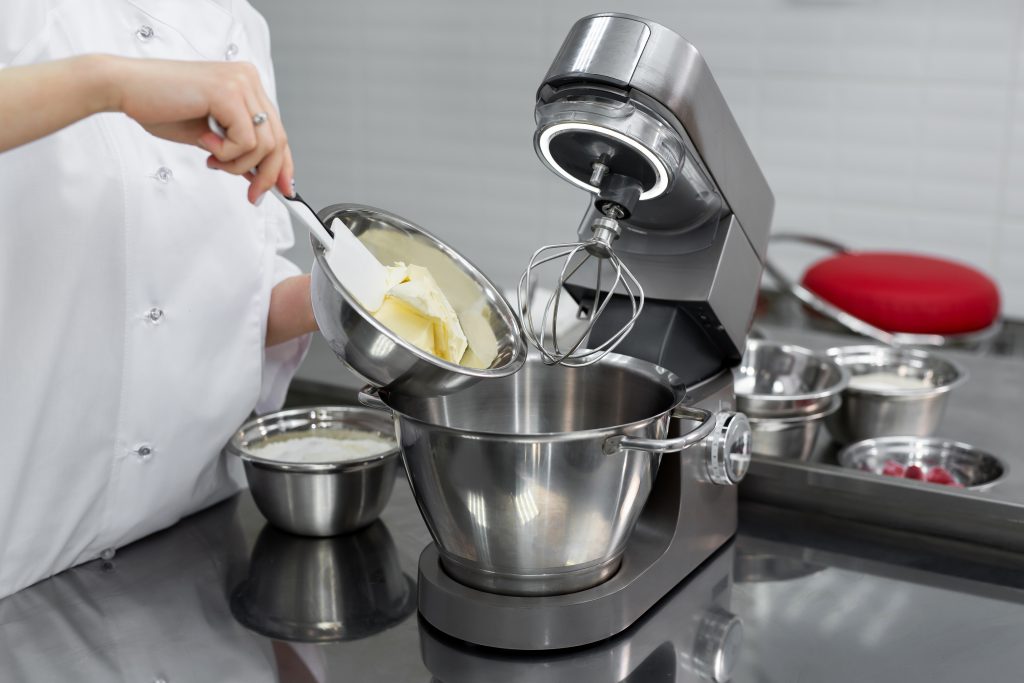
A stand mixer can be a valuable addition to a kitchen if you regularly bake bread, cakes, biscuits or pastries.
Unlike a hand mixer, a stand mixer sits on the countertop while the motor operates the mixing attachment. This leaves your hands free to add ingredients, prepare other components or simply get on with another task.
But stand mixers vary considerably in size, power, capacity, attachments and price.
A basic model may be perfectly adequate for occasional baking, while someone who regularly makes bread or large quantities of dough may need something considerably more robust.
The trick is not to buy the biggest or most powerful mixer you can afford.
It’s to choose one that matches what you actually bake and how often you use it.
What is a stand mixer?
A stand mixer is an electric mixer with a fixed motor housing and a removable bowl.
Most models include three basic attachments:
- A beater or paddle
- A whisk
- A dough hook
The mixer operates at different speeds, allowing it to perform tasks ranging from whipping cream and egg whites to mixing cake batter and kneading dough.
More advanced models may also accept additional attachments for tasks such as grinding, slicing, shredding or making pasta.
Stand mixer vs hand mixer
Before buying a stand mixer, consider whether you actually need one.
A hand mixer is generally:
- Smaller
- Lighter
- Easier to store
- Less expensive
- Convenient for occasional baking
A stand mixer is generally:
- More substantial
- More convenient for larger batches
- Better suited to hands-free mixing
- More useful for heavier doughs
- More expensive
- More demanding of counter and cupboard space
If you only make a cake occasionally, a hand mixer may be all you need.
If you’re regularly making bread, cakes, biscuits or pastry, a stand mixer can make the process considerably easier.
Consider what you bake most often
This should be your starting point.
Different recipes place different demands on a mixer.
Cakes and cupcakes
Almost any reasonable stand mixer should handle ordinary cake mixtures.
You don’t necessarily need an extremely powerful machine.
Biscuits and cookies
A reasonably sturdy mixer with a good paddle attachment is useful, particularly when mixing thicker doughs.
Bread
Bread dough places substantially more demand on the motor and mixing mechanism.
If bread is one of your main reasons for buying a stand mixer, look carefully at the manufacturer’s specifications concerning dough and maximum recommended quantities.
Pastry
Pastry requires a different approach from bread dough.
The ability to mix gently and accurately can be more important than simply having the highest available power rating.
What size bowl do you need?
Bowl capacity is one of the most obvious differences between stand mixers.
A larger bowl isn’t automatically better.
A very large bowl can actually be inconvenient when you’re making small quantities because ingredients may sit too far below the mixing attachment.
Think about your normal batch sizes.
Smaller capacity
Suitable for:
- Smaller households
- Occasional baking
- Smaller cake mixtures
- Small batches of biscuits
Medium capacity
A medium-sized bowl is likely to be the most versatile choice for many households.
It provides enough capacity for normal family baking without making the machine unnecessarily large.
Large capacity
A larger bowl makes sense if you regularly:
- Bake large batches
- Make substantial quantities of dough
- Cook for a large family
- Bake commercially or semi-commercially
Always check the manufacturer’s maximum recommended ingredient quantities, rather than assuming the bowl’s total capacity represents the amount of food you can safely mix.
Don’t judge a mixer by bowl capacity alone
A mixer may have a large bowl but still not be particularly suitable for heavy dough.
The motor, gearing, mixing mechanism and overall construction all matter.
For example, a machine designed primarily for light cake mixing shouldn’t necessarily be expected to knead large quantities of bread dough every day.
Look at the manufacturer’s intended uses.
How much motor power do you need?
Motor wattage is one of the specifications most prominently displayed on stand mixers.
However, more watts don’t automatically mean a better mixer.
Different manufacturers use different motor designs and specifications, so wattage isn’t always a reliable way to compare machines from different brands.
Instead, look at:
- Intended applications
- Maximum dough capacity
- Recommended batch sizes
- Motor design
- Gear mechanism
- User reviews
- Warranty
- Overall construction
If a manufacturer specifically states that a model is designed for heavy dough, that’s generally more useful information than simply comparing wattage numbers.
Speed settings
Most stand mixers offer several speed settings.
A basic mixer may have a relatively small number of speeds, while more sophisticated models provide much finer control.
In practice, you don’t necessarily need dozens of speeds.
What matters is having:
- A slow setting for incorporating ingredients
- Medium speeds for general mixing
- Higher speeds for whipping
A slow-start function can also be useful because it reduces the tendency for flour and other dry ingredients to fly out of the bowl when mixing begins.
The three attachments you should expect
Most conventional stand mixers come with three fundamental attachments.
Flat beater or paddle
This is commonly used for:
- Cake batter
- Cookie dough
- Icings
- Mashed mixtures
- General mixing
For many home bakers, this will be one of the most frequently used attachments.
Whisk
The whisk is designed for incorporating air.
It can be useful for:
- Egg whites
- Cream
- Meringues
- Light mixtures
Dough hook
The dough hook is designed for heavier mixtures.
It’s particularly useful for:
- Bread dough
- Pizza dough
- Other yeast-based doughs
If you intend to make bread regularly, make sure the mixer you’re considering includes a suitable dough hook.
What additional attachments are worth considering?
Some stand mixers can accept additional attachments.
Depending on the manufacturer and model, these may include:
- Pasta rollers
- Pasta cutters
- Meat grinders
- Vegetable slicers
- Shredders
- Spiralizers
- Juicers
These can turn a stand mixer into a much more versatile kitchen appliance.
However, don’t pay extra for a collection of attachments you are unlikely to use.
If you mainly bake cakes and bread, the standard three attachments may be all you need.
Tilt-head or bowl-lift?
Two common stand mixer designs are tilt-head and bowl-lift.
Tilt-head mixers
The upper section tilts backwards to provide access to the bowl.
Advantages include:
- Easy access
- Convenient attachment changes
- Generally compact design
- Often suitable for everyday home baking
Bowl-lift mixers
The bowl is raised towards the mixing head using a lifting mechanism.
These machines can provide a more substantial platform for larger or heavier batches.
They can be particularly attractive to serious bakers.
Neither design is automatically better.
Consider the amount of space you have and the type of baking you do.
How much space do you have?
This is an important consideration that is easy to overlook when looking at photographs online.
Stand mixers can be substantial appliances.
Before purchasing one, measure:
- Countertop width
- Available depth
- Height beneath cupboards
- Cupboard storage space
Remember that you also need enough space to operate the machine and remove the bowl.
If you intend to keep the mixer permanently on the countertop, its appearance may matter more than it would for an appliance that lives in a cupboard.
Weight can actually be an advantage
Unlike many kitchen appliances, a stand mixer doesn’t necessarily benefit from being extremely lightweight.
A heavier base can help keep the machine stable when mixing heavier ingredients.
The downside is obvious: moving a heavy mixer in and out of storage can become inconvenient.
This creates a useful rule:
If you intend to leave the mixer on the counter, weight may not matter much. If you need to store it after every use, consider how comfortable it will be to move.
Look at the controls
Controls should be easy to operate while you’re cooking.
Depending on the model, you may find:
- Rotary speed controls
- Push buttons
- Digital controls
- Timers
- Preset programmes
For most traditional baking, simple controls are perfectly adequate.
A digital display can look impressive, but it isn’t necessarily something you need.
Bowl material
Stand mixer bowls are commonly made from stainless steel, glass or other materials.
Stainless steel
A stainless-steel bowl is:
- Durable
- Relatively lightweight
- Resistant to staining
- Easy to clean
It is a practical choice for everyday use.
Glass
Glass bowls have the advantage of allowing you to see the contents clearly.
They can, however, be heavier and more vulnerable to breakage.
The best option depends on your priorities.
Check how easy it is to clean
Baking can produce a surprising amount of mess.
Flour gets everywhere, dough sticks to attachments and mixtures can collect around the bowl.
Look for:
- Removable attachments
- Easy-to-clean surfaces
- Dishwasher-safe components where appropriate
- A bowl that can be removed easily
- Minimal awkward gaps around the mixing head
Always check the manufacturer’s cleaning instructions.
The motor housing should not be treated like a dishwasher-safe component simply because the attachments are.
Can you buy replacement attachments?
This is worth considering when purchasing a more expensive machine.
Attachments can eventually become damaged or lost.
A manufacturer with readily available replacement parts can extend the useful life of the mixer considerably.
Check whether the manufacturer or authorised retailers supply:
- Replacement bowls
- Dough hooks
- Whisks
- Beaters
- Splash guards
- Other attachments
This is particularly important if you’re investing in a premium appliance.
What about a splash guard?
A splash guard can be useful when mixing liquids or adding dry ingredients.
It can help prevent ingredients from escaping the bowl and reduce mess.
It’s not an essential feature for everyone, but if the mixer you’re considering includes one, it can be a useful convenience.
Is a stand mixer noisy?
All electric mixers make some noise.
The amount can vary considerably depending on:
- Motor design
- Speed
- Load
- Construction
- Surface beneath the mixer
If noise is important to you, don’t rely solely on the manufacturer’s specifications.
Look for repeated comments from users who have actually operated the machine.
A mixer that sounds fine when whipping cream may sound very different when kneading heavy dough.
Buying a stand mixer online
Online shopping makes it easy to compare models, but don’t simply compare photographs and prices.
Check the specifications carefully.
Look at the bowl capacity
Make sure it matches the quantities you normally prepare.
Check recommended uses
Is the machine designed for cakes only, or is it suitable for heavy dough?
Check the attachments
Make sure the attachments you expect are included.
Check dimensions
Don’t forget the height and depth.
Check weight
Especially important if you plan to store the machine in a cupboard.
Check warranty
A good warranty is particularly valuable for a motorised appliance.
Check replacement parts
Find out whether bowls and attachments are available separately.
Read customer reviews
Look for repeated comments about:
- Motor performance
- Stability
- Noise
- Durability
- Cleaning
- Attachment quality
How much should you spend?
Stand mixers range from relatively inexpensive home appliances to premium machines costing considerably more.
The right price depends on how much you intend to use the machine.
Occasional baker
A basic model may be sufficient.
Regular home baker
A sturdier mid-range mixer may provide a better balance between price and performance.
Serious baker
A more robust machine can make sense if you regularly mix heavy dough or large batches.
The important point is to avoid paying for features you won’t use.
Common mistakes when buying a stand mixer
Buying the largest model
More capacity isn’t always better.
Choosing based on wattage alone
Motor power specifications aren’t directly comparable between every manufacturer.
Ignoring dough requirements
If you want to make bread, make sure the machine is designed for the task.
Forgetting about storage
A stand mixer can take up considerably more space than expected.
Buying attachments you don’t need
Extra accessories can significantly increase the price.
Ignoring replacement parts
A machine can become difficult to maintain if attachments aren’t readily available.
Choosing appearance over functionality
A beautiful mixer that doesn’t suit your baking habits isn’t a good investment.
A simple stand mixer buying checklist
Before purchasing, ask yourself:
What do I normally bake?
How often will I use the mixer?
Do I make bread or other heavy doughs?
What bowl capacity do I actually need?
Will it fit on my countertop?
Can I comfortably store it if necessary?
Which attachments are included?
Can additional attachments be purchased later?
Are replacement parts available?
Is the bowl easy to clean?
Does the machine have a suitable warranty?
Am I paying for features I will actually use?
Final thoughts
A stand mixer can be one of the more useful appliances in a kitchen if it matches your cooking habits.
For occasional cake baking, there’s little reason to buy an enormous professional-style machine.
For someone who regularly makes bread, pizza dough, biscuits and large batches of cakes, investing in a more robust mixer may make considerably more sense.
Rather than concentrating on a single specification such as wattage or bowl size, look at the whole appliance.
Consider its capacity, construction, attachments, controls, cleaning requirements, storage requirements and intended use.
The best stand mixer is ultimately the one that makes the type of baking you actually do easier, rather than simply being the most powerful machine available.