
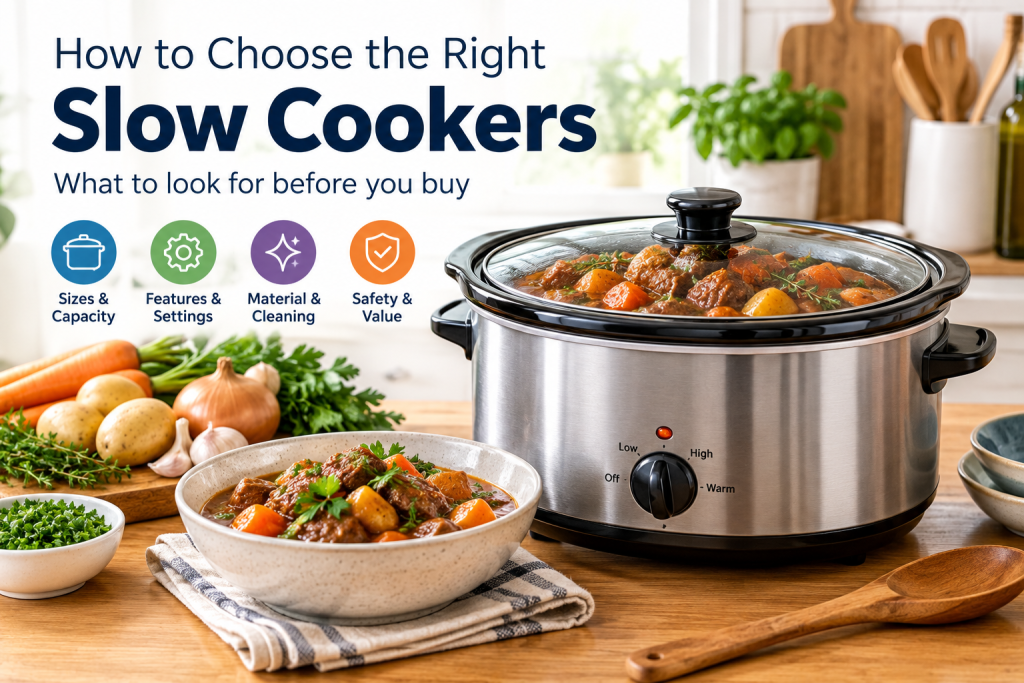
A slow cooker is one of those kitchen appliances that can make preparing certain meals considerably easier.
Instead of spending hours watching a pot on the stove, you can prepare ingredients, place them in the slow cooker and allow the appliance to cook the meal gradually over several hours.
This makes slow cookers particularly useful for dishes such as stews, curries, soups and slow-cooked meat.
But slow cookers aren’t all the same.
They differ in capacity, shape, controls, temperature settings, construction and additional features. Some are simple appliances designed to do one job, while others combine slow cooking with additional cooking functions.
So before buying one, it’s worth considering how you actually intend to use it.
What exactly is a slow cooker?
A slow cooker is an electric cooking appliance designed to cook food at relatively low temperatures over an extended period.
The appliance generally consists of:
- An outer heating unit
- A removable cooking pot
- A lid
- Temperature controls
Food is placed inside the cooking pot, the lid is fitted and the appliance gradually heats the contents.
Because cooking takes place slowly, it can be particularly useful for tougher cuts of meat and dishes where flavours benefit from longer cooking.
Why buy a slow cooker?
The main attraction is convenience.
Once the ingredients have been prepared and cooking has started, relatively little attention is normally required.
A slow cooker can therefore be useful for people who:
- Want to prepare meals in advance
- Prefer one-pot cooking
- Enjoy stews and casseroles
- Cook for several people
- Want to make use of less expensive cuts of meat
- Don’t want to spend a long time standing over a stove
It can also be useful for batch cooking, allowing you to prepare several portions at once.
What size slow cooker should you buy?
Capacity is one of the most important decisions.
A slow cooker that is too small can be frustrating, while a very large model may take up unnecessary cupboard space.
Think about the number of people you normally cook for and the types of meals you prepare.
Small slow cookers
These can be suitable for:
- One or two people
- Smaller portions
- Dips and side dishes
- Occasional use
They also take up less storage space.
Medium slow cookers
A medium-sized appliance can be a useful compromise for smaller families or couples who regularly prepare leftovers.
Large slow cookers
Larger models are useful for:
- Families
- Batch cooking
- Large stews
- Entertaining
- Preparing several portions at once
Don’t choose a large model simply because it seems to offer better value.
A bigger appliance also takes up more counter and cupboard space.
Think about the shape as well as the capacity
Two slow cookers can have similar capacities but very different shapes.
A round cooking pot may be perfectly adequate for many dishes.
An oval model can be useful when cooking larger cuts of meat because the shape provides more room.
Before buying, consider the foods you are most likely to prepare.
If you regularly cook whole chicken portions, roasts or larger cuts of meat, an oval shape may be more practical.
How many temperature settings do you need?
Many traditional slow cookers have relatively simple controls.
Common settings include:
- Low
- High
- Keep Warm
Some models offer additional temperature or timing controls.
For most people, complicated controls aren’t necessarily an advantage.
A simple slow cooker can perform its basic function very effectively.
The more important question is whether the controls make the appliance easy to use.
A timer can be useful
A programmable timer can make a slow cooker more convenient.
For example, you may be able to set a cooking period and have the appliance switch to a keep-warm setting afterwards.
This can be useful if you aren’t going to be available when the cooking time ends.
However, don’t assume that every appliance with a digital display is automatically better.
A timer is useful if you’ll actually use it.
What is a “keep warm” function?
A keep-warm setting is designed to maintain the food at a suitable temperature after cooking.
This can be convenient if your meal finishes before everyone is ready to eat.
It is important, however, to follow the manufacturer’s instructions regarding safe food holding times rather than assuming that food can remain in the slow cooker indefinitely.
Removable cooking pots make cleaning easier
Check whether the cooking pot can be removed from the heating unit.
A removable pot is generally much easier to clean than an integrated cooking chamber.
Some models also have pots that can be placed in a dishwasher.
If easy cleaning is important to you, check the manufacturer’s instructions before purchasing.
Don’t assume that the entire slow cooker can be immersed in water or placed in a dishwasher.
The electrical heating unit should be treated according to the manufacturer’s cleaning instructions.
Ceramic, stoneware or metal cooking pots?
Slow cookers can use different materials for their cooking vessels.
Traditional slow cookers commonly use ceramic or stoneware-style pots.
Other appliances may use metal cooking vessels.
Each approach has advantages and disadvantages.
Ceramic or stoneware
These traditional cooking pots are popular because they provide a substantial cooking vessel and are well suited to slow cooking.
The downside is that they can be relatively heavy and may break if handled roughly.
Metal
Metal cooking pots can be lighter and, depending on the appliance, may offer additional cooking flexibility.
Some multifunction appliances use metal inner pots because they can support other cooking methods as well.
The best choice depends on the appliance design and how you intend to use it.
Can you use a slow cooker to brown meat?
This is an important distinction between different models.
Traditional slow cookers generally aren’t designed to brown meat directly.
You may therefore need to brown meat separately in a frying pan before transferring it to the slow cooker.
Some more advanced appliances are designed with a cooking vessel that can be used directly on a suitable hob or has a dedicated browning function.
If browning meat before slow cooking sounds inconvenient, look specifically for a model designed to handle this step.
Slow cooker vs pressure cooker
These appliances perform very different jobs.
A slow cooker uses relatively low temperatures and longer cooking times.
A pressure cooker uses pressure to cook food much more quickly.
If your priority is:
Convenience and long, unattended cooking: a slow cooker may be ideal.
Fast cooking: a pressure cooker may be more appropriate.
Some modern appliances combine several cooking functions, including slow cooking and pressure cooking.
These multifunction appliances can be attractive if you have limited kitchen space, but they may cost more and have a steeper learning curve.
Slow cooker vs air fryer
These two appliances aren’t really substitutes for each other.
An air fryer is particularly useful for foods where you want a relatively dry cooking environment and a browned or crisp exterior.
A slow cooker is designed for slow, moist cooking.
For example:
Air fryer: chips, vegetables, chicken pieces and other foods where crispness is desirable.
Slow cooker: stews, casseroles, soups, curries and slow-cooked meat.
If you have the space and regularly prepare both types of food, the appliances can complement each other.
How to Choose the Right Air Fryer for Your Home
What can you cook in a slow cooker?
Slow cookers are particularly suited to meals containing ingredients that benefit from prolonged cooking.
Popular possibilities include:
- Beef stews
- Chicken dishes
- Lamb
- Curries
- Bean dishes
- Soups
- Casseroles
- Pulled meat
- Vegetable stews
- Sauces
They are also useful for recipes where you want several ingredients to cook together.
However, not every recipe can simply be transferred from a conventional pot to a slow cooker without adjustments.
Liquid levels, cooking times and ingredient preparation can all affect the result.
Don’t buy a slow cooker based only on wattage
Wattage is one of the specifications you’ll see when comparing appliances.
It can be useful when considering electricity consumption and the appliance’s heating system, but it shouldn’t be your only buying criterion.
A higher wattage number doesn’t automatically mean that one slow cooker will produce better meals than another.
Instead, consider the complete package:
- Capacity
- Temperature control
- Timer
- Keep-warm function
- Cooking-pot material
- Lid design
- Ease of cleaning
- Build quality
- Warranty
- Price
Look at the lid
The lid is easy to overlook when comparing appliances.
A well-fitting lid helps keep heat and moisture inside the cooking vessel.
Glass lids are particularly convenient because you can see the food without removing the lid.
This is useful because repeatedly lifting the lid can release heat and extend cooking time.
Check that the lid feels secure and is easy to handle.
Consider the handles
A slow cooker containing a large quantity of hot food can be surprisingly heavy.
Good handles on both the appliance and cooking pot can make moving it considerably easier.
This is another reason to consider practical design rather than simply choosing the appliance with the most features.
How easy is it to store?
Kitchen appliances can quickly consume cupboard space.
Before buying a slow cooker, consider:
- Appliance width
- Appliance height
- Cord storage
- Lid storage
- Weight
- Where you will keep it
If you have limited kitchen space, measure the available cupboard before ordering.
A large appliance that doesn’t fit comfortably into your kitchen is unlikely to become a favourite.
Is a digital slow cooker better?
Digital controls can provide useful features such as:
- Timers
- Automatic programme selection
- Digital temperature displays
- Keep-warm functions
But traditional manual controls have an advantage too: simplicity.
If you want an appliance that is easy to operate, a basic model may be all you need.
If you enjoy experimenting with cooking programmes and want more automation, a digital model could justify the additional cost.
What about multifunction slow cookers?
Some modern appliances combine several cooking functions into one machine.
Depending on the model, these may include:
- Slow cooking
- Pressure cooking
- Sautéing
- Steaming
- Rice cooking
- Other automated programmes
The advantage is obvious: one appliance can potentially replace several others.
The disadvantage is that multifunction appliances can be more expensive and complicated.
Before buying one, ask yourself:
Will I actually use the additional functions?
If the answer is no, a dedicated slow cooker may offer better value.
Safety considerations
Like any electrical cooking appliance, a slow cooker should be used according to its manufacturer’s instructions.
In particular:
- Place it on a stable, heat-resistant surface.
- Keep the electrical components dry.
- Don’t use a damaged power cord.
- Follow the manufacturer’s instructions for filling the pot.
- Don’t use a cracked cooking vessel.
- Follow the manufacturer’s guidance for cleaning.
- Don’t leave the appliance operating in circumstances prohibited by the manufacturer.
And don’t assume that because a slow cooker is designed for long cooking, it can simply be left operating indefinitely without consideration for the surrounding environment.
Buying a slow cooker online
Slow cookers are easy to compare online, but product photographs don’t tell you everything.
Before buying, check:
Capacity
Look at the actual litre capacity.
Dimensions
Make sure it will fit your kitchen.
Controls
Check whether they are manual or digital.
Timer
Determine whether there is a programmable timer.
Keep warm
Check whether the appliance automatically switches to keep warm.
Cooking pot
Look at the material and whether it is removable.
Cleaning
Check whether the pot and lid are dishwasher safe.
Warranty
Check the manufacturer’s or retailer’s warranty.
Replacement parts
Find out whether lids or cooking pots can be replaced if damaged.
Reviews
Look for repeated comments about durability, temperature control, lid fit and ease of cleaning.
How much should you spend?
As with most kitchen appliances, spending more doesn’t automatically mean you’ll get better results.
A basic slow cooker may be perfectly adequate if you primarily want to make stews and casseroles.
Paying more can make sense if you’re getting features that you’ll genuinely use, such as:
- Larger capacity
- Better construction
- Programmable controls
- Automatic keep-warm
- Browning capability
- Multiple cooking functions
Think about your cooking habits rather than buying the appliance with the longest feature list.
A simple slow cooker buying checklist
Before purchasing, ask yourself:
1. How many people will I normally cook for?
2. What types of meals will I make?
3. What capacity do I actually need?
4. Do I want manual or digital controls?
5. Would a timer be useful?
6. Do I want an automatic keep-warm function?
7. Is the cooking pot removable?
8. Is it easy to clean?
9. Will it fit in my kitchen?
10. Am I paying for features I’ll actually use?
Final thoughts
A slow cooker doesn’t need to be a complicated appliance.
For many households, a relatively simple model with the right capacity, reliable temperature settings, a good lid and an easy-to-clean cooking pot may be all that is required.
The most important decision is therefore not finding the slow cooker with the most buttons.
It’s finding one that matches the way you cook.
If you regularly prepare stews, curries, casseroles or other meals that benefit from slow cooking, a good slow cooker can become a genuinely useful part of your kitchen rather than another appliance that ends up sitting unused in a cupboard.
How to Choose the Right Cookware for Your Kitchen
You may also want to read:
How to Choose the Right Air Fryer for Your Home