
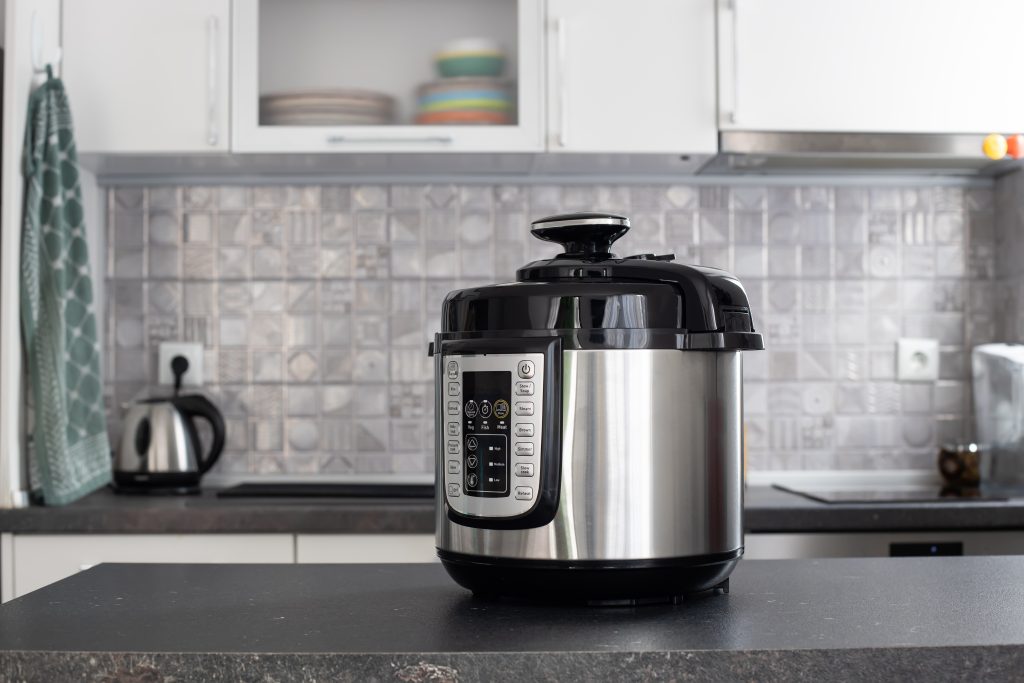
A pressure cooker can dramatically reduce the time needed to prepare many meals, particularly foods that normally require long cooking times.
Modern electric pressure cookers have also moved well beyond the traditional stovetop models. Many now combine pressure cooking with functions such as slow cooking, steaming, sautéing and keeping food warm.
However, not every pressure cooker is the same. Capacity, controls, cooking programmes, safety features and ease of cleaning can make a significant difference to how useful the appliance becomes in your kitchen.
This guide explains what to look for before buying a pressure cooker, whether you’re considering a traditional stovetop model or a modern electric multifunction appliance.
What Is a Pressure Cooker?
A pressure cooker is a sealed cooking vessel that uses steam pressure to raise the boiling point of water.
Under normal atmospheric conditions, water boils at around 100°C. Inside a pressure cooker, increased pressure allows the cooking temperature to rise above this level.
The result is faster cooking.
Foods such as beans, lentils, tougher cuts of meat and certain stews that normally require considerable cooking time can often be prepared much more quickly.
Electric pressure cookers automate much of the process, making them particularly attractive to people who want convenience.
Pressure Cooker vs Slow Cooker
Pressure cookers and slow cookers are sometimes considered alternatives, but they work in very different ways.
A slow cooker uses relatively low heat over several hours. It is particularly convenient when you want to prepare food in advance and let it cook gradually.
A pressure cooker uses high pressure and temperature to cook food much more quickly.
For example, a meal that might require several hours in a slow cooker can potentially be prepared much faster using pressure cooking.
Neither appliance is universally suitable for every recipe.
If you already have a slow cooker, a pressure cooker can actually complement it rather than replace it.
How to Choose the Right Slow Cooker for Your Kitchen
Pressure Cooker vs Air Fryer
An air fryer and pressure cooker also perform completely different jobs.
An air fryer circulates hot air around food to produce a browned or crisp exterior. It is particularly useful for foods such as chips, vegetables and certain meat or poultry dishes.
A pressure cooker is designed primarily for moist cooking using steam and pressure.
Some multifunction appliances combine several cooking methods, and certain models may include air-frying capabilities or compatible air-fryer accessories.
However, don’t assume that a multifunction appliance performs every function equally well.
Consider which cooking methods you actually use before paying extra for additional functions.
How to Choose the Right Air Fryer for Your Home
Electric or Stovetop Pressure Cooker?
One of the first decisions is whether you want a traditional stovetop pressure cooker or an electric model.
Stovetop Pressure Cookers
Traditional pressure cookers sit directly on a stove or hob.
Advantages include:
- Simple construction
- Fast heating
- No electronic controls
- Often relatively durable
- Can be used on suitable stovetops
However, you generally have more responsibility for controlling the cooking process.
You need to monitor the cooker and follow the manufacturer’s instructions regarding pressure and cooking times.
Electric Pressure Cookers
Electric models have built-in heating elements and electronic controls.
Depending on the model, you may be able to select a cooking programme and let the appliance manage much of the cooking process automatically.
Features can include:
- Digital controls
- Preset programmes
- Automatic pressure control
- Timers
- Keep-warm functions
- Delayed start
- Temperature control
For many households, the convenience of an electric model makes it the more attractive option.
Choosing the Right Capacity
Capacity is one of the most important considerations.
Pressure cookers are available in various sizes, from relatively compact models to large family-sized appliances.
However, the advertised capacity doesn’t necessarily represent the amount of food you can safely cook.
Pressure cookers generally need sufficient space for steam to build up and for food to expand during cooking.
That means you should not simply choose the largest possible model.
Smaller households
A smaller pressure cooker may be suitable if you’re cooking for one or two people and don’t normally prepare large batches.
Families
A medium or larger model is generally more practical when you’re regularly cooking meals for several people.
Batch cooking
If you like preparing large quantities of soups, stews, beans or other meals for later use, additional capacity can be useful.
Before buying, check both the total capacity and the manufacturer’s recommended usable capacity.
Consider What You Want to Cook
The best pressure cooker for one household may not be the best for another.
Think about the foods you regularly prepare.
A pressure cooker can be useful for:
- Stews
- Soups
- Curries
- Beans
- Lentils
- Tougher cuts of meat
- Rice
- Certain vegetables
- Stocks and broths
- Batch cooking
If you mainly cook small meals for yourself, a huge appliance could simply take up unnecessary cupboard space.
If you regularly cook large family meals, buying a model that is too small can become frustrating.
Look at the Cooking Functions
Electric pressure cookers often come with a selection of cooking programmes.
Depending on the model, these may include:
- Pressure cooking
- Slow cooking
- Sautéing
- Steaming
- Rice cooking
- Soup
- Meat
- Beans
- Yoghurt
- Keep warm
The number of programmes isn’t necessarily an indication of quality.
A cooker with 20 programmes isn’t automatically more useful than one with six.
Look at the functions you are genuinely likely to use.
A simple appliance with good controls and reliable construction may be more useful than a complicated model filled with functions you never use.
Pressure Settings Matter
Some pressure cookers offer more than one pressure setting.
This provides greater control over cooking.
Different foods can require different cooking conditions, so having selectable pressure levels can be useful if you intend to experiment with a variety of recipes.
For someone who mainly wants quick and convenient meals, however, a simple automatic programme may be perfectly adequate.
Check the Controls
Controls should be easy to understand.
On an electric pressure cooker, look for:
- Clearly labelled buttons
- A readable display
- Simple programme selection
- Easy-to-adjust cooking times
- Clear pressure indicators
- Straightforward start and stop controls
Touch controls can look modern, but physical buttons may sometimes be easier to operate when your hands are wet or messy.
If buying online, look carefully at photographs of the control panel rather than relying only on the product description.
Safety Features Are Essential
Pressure cooking involves high temperatures and pressure, so safety features deserve particular attention.
Modern pressure cookers should incorporate mechanisms designed to prevent the lid from being opened while the cooker is under pressure.
Other safety features may include:
- Automatic pressure regulation
- Overpressure protection
- Temperature monitoring
- Pressure release mechanisms
- Lid-locking systems
- Automatic shut-off
- Protection against overheating
Don’t choose a pressure cooker simply because it is cheap.
The quality of the pressure-control and safety mechanisms is much more important than saving a small amount of money.
Always read and follow the manufacturer’s operating instructions.
How Does Pressure Release Work?
Electric pressure cookers commonly provide different ways to release pressure.
Depending on the model and recipe, pressure may be released naturally over time or through a controlled release mechanism.
The appropriate method depends on the food being prepared and the manufacturer’s instructions.
A good pressure cooker should make the pressure-release process clear and easy to understand.
This is another reason why a well-designed appliance can be preferable to a cheaper model with confusing controls.
Look at the Inner Cooking Pot
The removable inner pot is the part that comes into direct contact with your food.
Common materials and finishes include stainless steel and non-stick coatings.
Stainless steel
Stainless steel cooking pots are generally durable and resistant to scratching.
They can also be useful when browning or sautéing ingredients before pressure cooking.
Non-stick
Non-stick interiors can make cleaning easier and may reduce food sticking.
However, coatings can eventually become damaged if they are scratched or treated incorrectly.
Check whether replacement inner pots are available before buying.
Is the Inner Pot Dishwasher Safe?
Cleaning is easy to overlook when buying an appliance.
Check which components can be removed and washed separately.
Useful features include:
- Removable inner pot
- Removable sealing ring
- Dishwasher-safe components
- Easy-to-clean lid
- Accessible steam-release components
- Minimal food traps
A cooker that is excellent at cooking but awkward to clean may spend more time sitting in the cupboard than being used.
Don’t Ignore the Sealing Ring
Electric pressure cookers normally use a sealing ring or gasket to create the airtight seal required for pressure cooking.
Over time, this component can absorb food smells and eventually require replacement.
Before buying, check:
- Whether replacement sealing rings are available.
- How much they cost.
- Whether they are easy to fit.
- Whether additional rings are available for different types of cooking.
This is a small component, but its availability can affect the long-term practicality of the appliance.
Consider the Size of the Appliance
Capacity isn’t the only size issue.
The physical footprint of the appliance matters too.
Pressure cookers can be surprisingly bulky, particularly multifunction electric models.
Before buying, consider where you will store it.
Measure your available:
- Counter space
- Cupboard space
- Shelf height
- Storage area
Also remember that the cooker needs enough clearance around it when operating, according to the manufacturer’s instructions.
What About Sautéing?
One useful feature of many electric pressure cookers is the ability to sauté ingredients in the cooking pot before pressure cooking.
For example, you may be able to brown meat and soften onions before adding liquid and switching to pressure cooking.
This means you can potentially prepare an entire meal in one appliance.
It also reduces the number of pots and pans that need washing.
Keep-Warm Functions
Many electric pressure cookers automatically switch to a keep-warm mode after cooking.
This can be useful if you’re not ready to eat immediately.
However, don’t assume that keeping food warm indefinitely is appropriate for every dish.
Use the manufacturer’s guidance and sensible food-safety practices.
Delayed Start: Is It Worth Having?
Some appliances allow you to delay the start of a cooking programme.
This may sound convenient, but it isn’t necessarily useful for every type of food.
For ingredients that should be refrigerated until cooking, you should follow appropriate food-safety guidance rather than simply leaving them sitting inside the cooker for extended periods.
A delayed-start function can be useful in certain circumstances, but it shouldn’t be a major reason for choosing a pressure cooker.
Pressure Cooker Power and Wattage
Electric pressure cookers will normally specify their power consumption in watts.
Higher wattage doesn’t automatically mean that one cooker is better than another.
Heating performance is affected by several factors, including:
- Appliance design
- Capacity
- Heating element
- Temperature control
- Insulation
- Cooking programme
Use wattage as one specification to compare rather than treating it as a simple measure of quality.
Check the Lid Design
The lid is one of the most important components of a pressure cooker.
Look for a design that:
- Locks securely
- Is easy to position correctly
- Has clear pressure indicators
- Allows safe pressure release
- Is relatively easy to clean
A complicated lid can make an otherwise excellent appliance frustrating to use.
If you’re buying online, look for photographs showing the lid mechanism from different angles.
What Accessories Are Included?
Depending on the model, accessories may include:
- Steaming baskets
- Trivets
- Measuring cups
- Rice paddles
- Extra sealing rings
- Recipe books
- Replacement valves
- Special cooking racks
Don’t pay significantly more simply because a product includes a large number of accessories.
Ask whether you would actually use them.
Pressure Cookers and Load-Shedding
For South African households, electricity availability is another practical consideration.
Electric pressure cookers depend on mains electricity, so they cannot operate during a power interruption.
A stovetop pressure cooker doesn’t have this limitation, provided you have a suitable heat source.
This doesn’t necessarily make one option better than the other, but it is worth considering if your household experiences regular electricity interruptions.
An electric model may still be the more convenient choice for normal day-to-day cooking, particularly if you value automatic controls.
Traditional vs Multifunction Pressure Cookers
Multifunction appliances are becoming increasingly common.
One appliance may combine:
- Pressure cooking
- Slow cooking
- Rice cooking
- Steaming
- Sautéing
- Keep warm
This can be attractive if kitchen space is limited.
However, consider whether you’re actually replacing several appliances or simply buying one appliance with functions you rarely use.
If you already own an air fryer, slow cooker and rice cooker, for example, adding another multifunction appliance may provide less benefit than you expect.
Buying a Pressure Cooker Online
Pressure cookers are widely available online, making it easy to compare specifications.
Before ordering, check:
Capacity
Is the usable capacity suitable for your household?
Functions
Does it have the cooking programmes you actually need?
Safety
Are the pressure-control and lid-locking systems clearly described?
Cleaning
Can the important components be removed and cleaned easily?
Replacement parts
Can you obtain sealing rings and other consumables?
Warranty
How long is the warranty, and who handles repairs?
Customer reviews
Look for repeated comments about reliability, leaks, difficult controls or poor customer service.
Dimensions
Will the appliance fit your kitchen?
Electricity
Check the voltage and electrical specifications are appropriate for South African use.
Common Pressure Cooker Buying Mistakes
Buying Too Large
A huge cooker can take up valuable kitchen space and may not be practical for smaller meals.
Choosing Based Only on Price
The cheapest appliance isn’t necessarily the best value.
Pressure control, safety, build quality and replacement parts matter.
Focusing on the Number of Programmes
More programmes don’t necessarily mean greater usefulness.
Ignoring Replacement Parts
Sealing rings and other components eventually need replacement.
Check their availability before buying.
Forgetting About Storage
Measure your available space before ordering.
Buying a Multifunction Appliance Without Checking What It Actually Does
“Multifunction” can mean very different things between models.
Read the individual specifications carefully.
How Much Should You Spend?
There is no single correct price for a pressure cooker.
A basic stovetop model can be relatively inexpensive, while larger electric multifunction appliances can cost considerably more.
Rather than setting a budget first and then buying whatever falls within it, decide which features matter to you.
For example:
Basic user:
A straightforward pressure cooker with reliable safety features may be sufficient.
Regular cook:
A good electric model with multiple useful programmes and easy cleaning may be worthwhile.
Batch cook:
Capacity and durability become more important.
Small kitchen:
A multifunction appliance could make more sense because one appliance can perform several jobs.
The key is to pay for useful features rather than simply paying for more features.
Pressure Cooker Buying Checklist
Before purchasing, ask:
- What capacity do I actually need?
- Will I choose stovetop or electric?
- What foods will I mainly cook?
- Do I need multiple pressure settings?
- Are the controls easy to understand?
- Does the lid lock securely?
- How is pressure released?
- Are important components removable?
- Is the cooking pot easy to clean?
- Are replacement sealing rings available?
- Are replacement parts readily available?
- What safety features are included?
- Will the appliance fit my kitchen?
- Is the warranty adequate?
- Is the appliance suitable for South African electrical requirements?
- Am I paying for functions I will actually use?
If you can answer these questions before buying, you are much less likely to end up with an appliance that doesn’t suit your kitchen.
Final Thoughts
A pressure cooker can be a very useful addition to a modern kitchen, particularly for people who regularly prepare stews, beans, curries, soups and other foods that traditionally require long cooking times.
For many households, an electric pressure cooker offers the easiest combination of convenience, automatic control and versatility.
However, don’t choose purely on capacity, wattage or the number of cooking programmes.
Pay particular attention to safety, pressure control, cooking capacity, ease of cleaning, replacement parts and the functions you will actually use.
And if you already own appliances such as a slow cooker, air fryer or food processor, consider how the new appliance will complement what you already have.