
Walk into a kitchen appliance shop and it is easy to feel that you need a different machine for every job.
There are food processors for chopping and slicing, blenders for smoothies and soups, and stand mixers for baking. Many modern appliances also promise to do several of these jobs in one machine.
But do you really need all three?
For most kitchens, the answer is no.
The better approach is to consider what you actually prepare, how often you cook, how much space you have available and which jobs you want an appliance to make easier.
This guide compares food processors, blenders and stand mixers so you can decide which appliance—or combination of appliances—makes sense for your kitchen.
How to Choose the Right Food Processor for Your Kitchen
The Short Answer
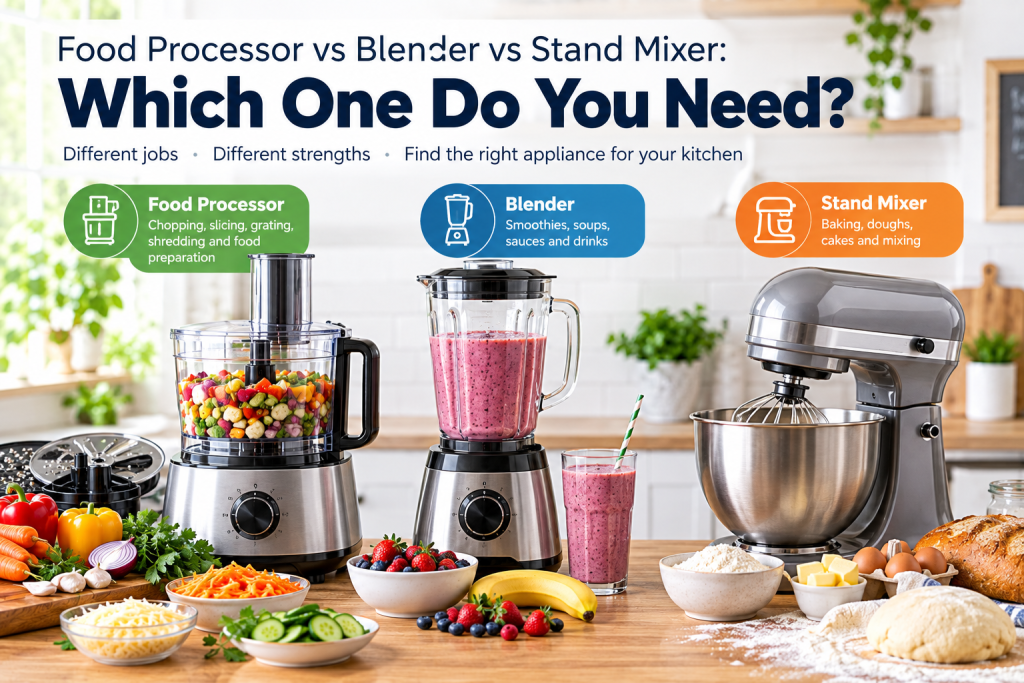
The three appliances have different strengths:
| Appliance | Particularly useful for | Less suitable for |
|---|---|---|
| Food processor | Chopping, slicing, grating, shredding, mixing and food preparation | Smooth liquids and serious baking |
| Blender | Smoothies, soups, sauces, drinks and liquid-based mixtures | Slicing, grating and kneading dough |
| Stand mixer | Bread dough, cakes, biscuits, whipping and mixing | Chopping vegetables or making smooth drinks |
If you:
- Do lots of food preparation: a food processor may be the most versatile choice.
- Make smoothies, soups and sauces: a blender may be the most useful.
- Bake regularly: a stand mixer can save considerable effort.
- Cook and bake regularly: owning two appliances may make more sense than expecting one machine to do everything.
1. What Does a Food Processor Do?
A food processor is primarily a food preparation appliance.
Its strength is using different blades and discs to process solid ingredients quickly.
Depending on the model, it can be used for:
- Chopping vegetables
- Slicing
- Grating and shredding
- Making breadcrumbs
- Chopping nuts
- Preparing pesto
- Making dips
- Mixing some doughs
- Preparing pastry
- Making sauces
- Processing larger quantities of ingredients
- Some forms of puréeing
The biggest advantage is its versatility.
A good food processor can replace several manual preparation tasks, particularly when you are cooking larger quantities.
Where a food processor shines
Imagine preparing a large meal involving onions, carrots, cheese, breadcrumbs and a sauce.
A food processor can potentially deal with several of those ingredients using different attachments.
That makes it particularly useful for people who cook from scratch and regularly prepare meals for families.
Where it has limitations
A food processor isn’t necessarily the best choice for:
- Smoothies
- Large quantities of liquid
- Very smooth drinks
- Long periods of mixing
- Serious bread baking
Although some processors can perform these jobs, they aren’t necessarily what the appliance is designed to do best.
2. What Does a Blender Do?
A blender is designed around one particularly important principle:
Turning ingredients into a smooth or relatively smooth mixture.
Blenders are particularly useful when there is enough liquid to allow the ingredients to circulate around the blades.
Typical uses include:
- Smoothies
- Milkshakes
- Soups
- Sauces
- Dips
- Purées
- Cocktails and other drinks
- Crushing ice, depending on the model
- Blending frozen fruit, depending on the model
How to Choose the Right Blender for Your Kitchen
Where a blender shines
If you regularly make smoothies for breakfast, homemade soups or sauces, a blender can be extremely useful.
It can also be much quicker and more convenient than manually processing ingredients.
A high-powered blender may be particularly useful for people who frequently blend tougher or frozen ingredients.
Where a blender has limitations
A blender isn’t designed to replace a food processor.
It generally isn’t the right tool for:
- Slicing vegetables
- Grating cheese
- Shredding vegetables
- Making breadcrumbs
- Chopping large quantities of dry ingredients
- Kneading bread dough
Trying to use a blender as a food processor can also produce disappointing results because the shape of the container and blade arrangement are designed for different purposes.
3. What Does a Stand Mixer Do?
A stand mixer is primarily a mixing and baking appliance.
Instead of processing ingredients with a blade, it uses interchangeable attachments to mix, beat or knead ingredients.
Typical attachments include:
- Beater/paddle
- Whisk
- Dough hook
Depending on the model, additional accessories may also be available.
A stand mixer is particularly useful for:
- Cakes
- Biscuits
- Cupcakes
- Bread
- Pizza dough
- Pastry
- Whipped cream
- Meringues
- Frostings
- Batters
How to Choose the Right Stand Mixer for Your Kitchen
Where a stand mixer shines
The major advantage is that you don’t have to hold the appliance while it works.
Put the ingredients into the bowl, select the appropriate attachment and speed, and the mixer can continue working while you prepare something else.
This becomes particularly valuable when making bread dough or recipes requiring several minutes of mixing.
Where it has limitations
A stand mixer isn’t designed to:
- Chop vegetables
- Slice potatoes
- Grate cheese
- Make smoothies
- Process soups
- Crush ice
Some models can perform additional tasks through optional attachments, but these shouldn’t automatically be considered a replacement for a dedicated food processor or blender.
4. Food Processor vs Blender
This is probably the most common comparison because the two appliances appear to overlap.
They do—but their primary jobs are different.
Choose a food processor when you mainly want to:
- Chop
- Slice
- Grate
- Shred
- Prepare vegetables
- Make dips
- Process solid ingredients
- Prepare larger quantities of ingredients
Choose a blender when you mainly want to:
- Make smoothies
- Blend soups
- Make sauces
- Prepare drinks
- Purée ingredients
- Blend softer or liquid ingredients
The important distinction
Think of it this way:
Food processor = preparation
Blender = blending
There is some overlap, but the distinction becomes obvious when you consider the attachments and container design.
A food processor’s discs and blades give it considerably more flexibility when dealing with solid ingredients.
A blender’s tall container and blade arrangement are intended to move ingredients through the blades and create a smooth mixture.
5. Food Processor vs Stand Mixer
These appliances overlap much less.
A food processor is primarily concerned with preparing ingredients.
A stand mixer is primarily concerned with mixing ingredients.
A food processor may be able to mix certain doughs and batters, but a stand mixer is generally more appropriate if baking is a regular part of your cooking.
Choose a food processor if you:
- Chop vegetables frequently
- Make homemade dips
- Grate or slice large quantities
- Prepare sauces
- Do a lot of meal preparation
- Want multiple processing attachments
Choose a stand mixer if you:
- Bake frequently
- Make bread
- Make pizza dough
- Prepare cakes and biscuits
- Whip cream or egg whites
- Regularly work with larger quantities of dough
If your main interest is baking, buying a food processor because it can also handle some dough may not be the best approach.
6. Blender vs Stand Mixer
These two appliances serve very different purposes.
A blender works with ingredients that you want to turn into a liquid or smooth mixture.
A stand mixer works with ingredients that need to be beaten, mixed or kneaded.
For example:
Making a smoothie: Blender
Making bread dough: Stand mixer
Making soup: Blender
Whipping cream: Stand mixer
Making a milkshake: Blender
Making cake batter: Stand mixer
This is one of the easiest comparisons because there is relatively little overlap between their main uses.
7. What If You Only Want One Appliance?
This is where things become more interesting.
There is no universally correct answer because your cooking habits matter more than the appliance specifications.
If you cook family meals from scratch
A food processor may offer the broadest range of food-preparation functions.
It can save time when chopping, slicing and grating ingredients.
If you make smoothies and drinks regularly
A blender may be the more useful everyday appliance.
There’s little point buying a large food processor if the job you want to perform most often is making smoothies.
If you bake several times a week
A stand mixer may make the biggest difference to your kitchen routine.
Especially if you regularly make bread, pizza dough or cakes.
If you are an enthusiastic cook
You may eventually find that having two appliances makes more sense.
For example:
Food processor + blender
is a useful combination for someone who cooks extensively but doesn’t do much baking.
Alternatively:
Stand mixer + blender
may suit someone who bakes frequently and also makes smoothies and soups.
8. Don’t Automatically Buy the Most Powerful Appliance
More power isn’t necessarily the most important consideration.
Manufacturers often promote motor wattage prominently, but wattage alone doesn’t tell you everything about how an appliance will perform.
Other factors can be just as important:
- Blade design
- Bowl or jug shape
- Capacity
- Speed control
- Attachment quality
- Stability
- Build quality
- Ease of cleaning
- Warranty
- Availability of replacement parts
A powerful appliance that is awkward to use may be less useful than a slightly less powerful appliance that fits your cooking habits better.
9. Consider Your Kitchen Space
This is particularly important if you have a smaller kitchen.
A food processor, blender and stand mixer can occupy a surprising amount of cupboard and countertop space.
Before buying, consider:
- Where will the appliance live?
- Will you leave it on the counter?
- How heavy is it?
- How much cupboard space do the attachments require?
- Can the bowl or jug be stored easily?
- How often will you realistically use it?
An appliance that takes ten minutes to get out and assemble may not be used as often as one that can remain conveniently accessible.
10. What About Multifunction Appliances?
Many modern kitchen appliances try to combine several functions.
You may find appliances advertised as:
- Food processor/blender combinations
- Multifunction cookers
- Stand mixers with food-processing attachments
- Blenders with food-processing accessories
- All-in-one cooking systems
These can be attractive because they potentially reduce the number of appliances you need.
However, there is an important question to ask:
Does the appliance perform each job well enough for your needs?
A multifunction appliance can be excellent if you have limited space and moderate requirements.
But if you regularly make large quantities of bread dough, for example, a dedicated stand mixer may still be preferable to a machine that merely offers a dough function.
11. Think About How Often You Will Use Each Function
One of the biggest mistakes when buying kitchen appliances is buying based on the number of things an appliance can do rather than the things you will actually use.
A food processor may come with ten different attachments.
That sounds impressive.
But if you only ever use the chopping blade and slicing disc, you might have paid for features that spend most of their lives in a cupboard.
The same applies to blenders and stand mixers.
Before buying, make a simple list:
What do I cook every week?
Then identify which appliance would make those jobs easier.
That is a much better starting point than looking at a list of features.
12. Which Appliance Is Best for Common Kitchen Tasks?
Here’s a practical comparison.
| Task | Food Processor | Blender | Stand Mixer |
|---|---|---|---|
| Chop vegetables | Excellent | Limited | No |
| Slice vegetables | Excellent | No | No |
| Grate cheese | Excellent | No | No |
| Shred vegetables | Excellent | No | No |
| Make smoothies | Limited | Excellent | No |
| Make soup | Good | Excellent | No |
| Make sauces | Good | Excellent | Limited |
| Make dips | Excellent | Good | No |
| Crush ice | Model dependent | Good on suitable models | No |
| Make cake batter | Good | Poor | Excellent |
| Whip cream | Limited | No | Excellent |
| Knead bread dough | Model dependent | No | Excellent |
| Make pizza dough | Model dependent | No | Excellent |
| Make breadcrumbs | Excellent | Possible | No |
| Process nuts | Excellent | Model dependent | No |
The table is deliberately broad because individual appliance capabilities vary.
Always check the manufacturer’s specifications for the particular model you are considering.
13. Don’t Forget Cleaning
An appliance can be fantastic when you’re using it and frustrating when you’re cleaning it.
Before buying, investigate:
- Which parts are dishwasher safe?
- How many separate pieces need cleaning?
- Can food become trapped around the blades?
- Is the bowl easy to remove?
- Is the lid easy to clean?
- Can replacement parts be purchased?
This is especially important for food processors because several blades, discs and attachments can quickly accumulate.
If an appliance is difficult to clean, you may eventually stop using it.
14. What About Noise?
All three types of appliances can be noisy, but the level varies significantly between models.
This may matter if:
- You have an open-plan kitchen
- You live in an apartment
- You regularly prepare food early in the morning
- You have young children
- You are sensitive to loud appliances
Don’t assume that a more expensive appliance will automatically be quieter.
If noise is important to you, check independent reviews as well as the manufacturer’s specifications.
15. Buying Online: What Should You Check?
Buying kitchen appliances online can be convenient, but don’t make your decision based solely on the product photograph.
Before ordering, check:
Capacity
Make sure the bowl or jug is large enough for the quantities you normally prepare.
Dimensions
Check the actual measurements, particularly if the appliance needs to fit beneath kitchen cupboards.
Motor and performance
Look beyond wattage and investigate what the manufacturer says the appliance is designed to process.
Attachments
Check exactly what is included.
A product photograph may show accessories that are optional rather than included.
Replacement parts
Find out whether blades, bowls, jugs, sealing rings and other consumable parts can be replaced.
Warranty
Check the warranty period and who provides after-sales support.
Reviews
Look for reviews discussing long-term use, cleaning, noise and reliability—not just comments about how the appliance looked when it arrived.
16. Should You Buy One Appliance or Three?
For most households, there’s no need to own all three simply because they are available.
Instead, build your kitchen around your actual cooking habits.
One appliance
Choose the appliance that handles your most frequent jobs.
Two appliances
This can be the sweet spot for many households.
For example:
Food processor + blender
gives you solid food preparation plus liquid blending.
Or:
Stand mixer + blender
works well for someone who bakes regularly but also makes smoothies and soups.
Three appliances
If you cook extensively, bake frequently and have sufficient storage space, having all three can make sense because each appliance has a clear role.
The important thing is that each appliance should earn its place in your kitchen.
17. What About Buying a Cheaper Appliance First?
This can be a sensible strategy.
If you’re not sure how often you will use an appliance, you don’t necessarily need to start with the most expensive model.
However, don’t buy so cheaply that the appliance cannot handle the jobs you actually want it to perform.
Instead, identify your minimum requirements.
For example:
“I want to chop vegetables, grate cheese and make dips twice a week.”
That’s a much more useful purchasing specification than:
“I want the most powerful food processor I can afford.”
18. A Simple Decision Guide
Use these questions to narrow down your choice.
Do you mainly chop, slice, grate and prepare solid ingredients?
Look at food processors.
How to Choose the Right Food Processor for Your Kitchen
Do you mainly make smoothies, soups, sauces and drinks?
Look at blenders.
How to Choose the Right Blender for Your Kitchen
Do you mainly bake cakes, biscuits, bread and pizza?
Look at stand mixers.
How to Choose the Right Stand Mixer for Your Kitchen
Do you cook extensively but don’t bake much?
A food processor and blender combination may be more useful.
Do you bake extensively and also make smoothies?
A stand mixer and blender combination may make more sense.
Do you regularly cook, bake and prepare large quantities?
You may eventually benefit from all three—but buy them based on actual requirements rather than trying to build a complete appliance collection immediately.
19. The Rest of Your Kitchen Matters Too
These appliances don’t work in isolation.
For example, a food processor becomes even more useful when you have good knives, cookware and food-storage solutions.
How to Choose the Right Kitchen Knives for Your Home
How to Choose the Right Cookware for Your Kitchen
Once food has been prepared, suitable storage containers can also make meal preparation easier.
How to Choose the Right Food Storage Containers for Your Kitchen
And if you’re building a larger kitchen appliance collection, you may also want to consider how appliances such as air fryers, slow cookers and pressure cookers fit into your cooking routine.
How to Choose the Right Air Fryer for Your Home
Slow Cookers Explained: What to Look For Before You Buy
Pressure Cookers Explained: What to Look For Before You Buy
20. Final Thoughts
A food processor, blender and stand mixer aren’t really competing appliances.
They are designed to solve different problems.
A food processor is primarily about preparing solid ingredients.
A blender is primarily about turning ingredients into smooth mixtures.
A stand mixer is primarily about mixing, beating and kneading.
The best choice therefore isn’t necessarily the appliance with the most features or the highest price.
It is the appliance that solves the jobs you perform most often.
Before buying, make a list of the meals and recipes you regularly prepare. Then identify which tasks take the most time or effort.
That simple exercise can tell you far more about which kitchen appliance you need than a long list of specifications.