
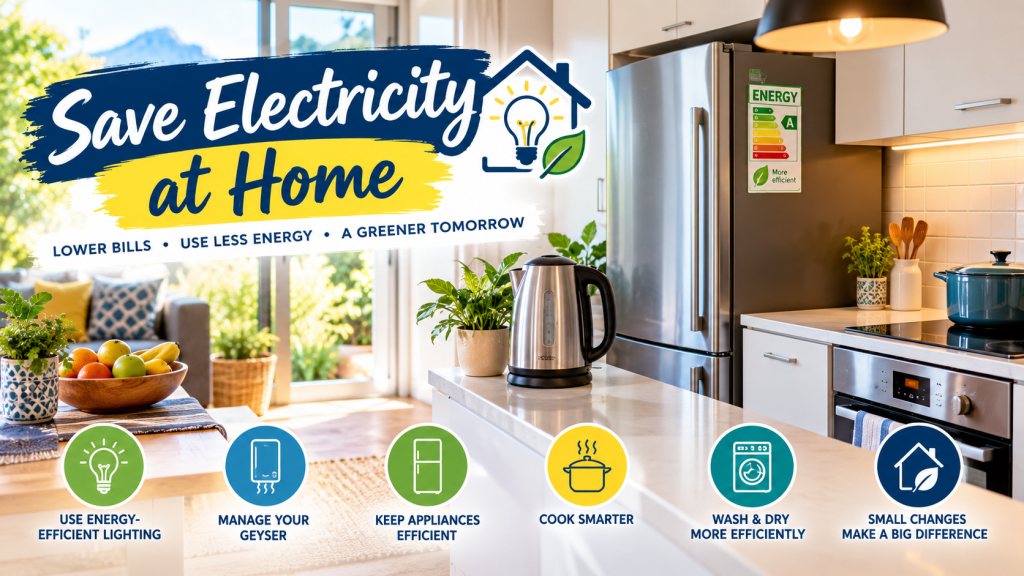
Electricity is an important household expense in South Africa, and the amount a household uses can make a noticeable difference to its monthly budget.
The good news is that reducing electricity consumption doesn’t necessarily require expensive equipment, major renovations or replacing every appliance in your home.
Simple changes to how you heat water, cook, wash clothes, light rooms and use appliances can help reduce unnecessary consumption.
The most effective approach is to identify where your household uses the most electricity, make practical changes and monitor whether those changes are making a difference.
This guide explains how to reduce electricity use at home in South Africa, with realistic suggestions for different households and budgets.
1. Find out which appliances use the most electricity
Before spending money on energy-saving products, find out where your electricity is going.
Some appliances consume relatively little power because they run for short periods. Others use substantial amounts of electricity because they generate heat, operate for long periods or cycle on and off throughout the day.
Common areas worth investigating include:
- Geysers and other water heaters.
- Space heaters.
- Electric ovens and hobs.
- Tumble dryers.
- Kettles.
- Refrigerators and freezers.
- Washing machines and dishwashers.
- Swimming pool pumps.
- Air conditioners.
Actual consumption depends on the appliance, its condition, how efficiently it operates and how frequently you use it.
If your electricity is prepaid, compare meter readings or purchase patterns over several weeks. If you receive a municipal or utility bill, review the consumption figures rather than looking only at the amount payable, since tariffs and fixed charges can also change your bill.
Where practical, a suitable electricity monitor can help identify individual appliance consumption. Check that any device is compatible with your electrical installation and use a qualified electrician where necessary.
2. Manage your geyser carefully
For many South African households, water heating is an important electricity expense.
A conventional electric geyser uses electricity to heat water and maintain its temperature. The amount consumed depends on the size of the geyser, incoming water temperature, thermostat setting, insulation and household hot-water use.
There are several ways to manage this consumption.
Check the thermostat setting
A thermostat setting that is unnecessarily high can increase heat loss and the energy required to heat water.
Ask a qualified plumber or electrician to check the appropriate setting and ensure that the geyser complies with applicable safety requirements. Don’t reduce the temperature without considering hygiene, scalding risks and the manufacturer’s recommendations.
Insulate the geyser and exposed hot-water pipes
Suitable insulation can reduce heat loss, particularly where the geyser or pipework is in a cold area.
Use insulation designed for the purpose and follow the manufacturer’s installation instructions. Never cover safety valves or interfere with electrical components.
Consider a geyser timer or controller
A timer or smart controller can help manage when a geyser heats water, particularly if your household has predictable hot-water needs.
However, switching a geyser off for a few hours does not automatically guarantee a saving. The result depends on heat loss, reheating requirements, the timing of hot-water use and the controller’s settings.
Choose a properly rated device and have it installed by a qualified professional when required.
Use hot water sensibly
Shorter showers and avoiding unnecessary hot-water use can reduce the amount of water that needs to be heated.
If several people use hot water at predictable times, organising showers sensibly may also help.
3. Use your kettle more efficiently
Kettles are convenient, but repeatedly boiling more water than you need wastes energy.
Try these habits:
- Measure the water you actually require.
- Avoid filling the kettle to the maximum for one cup of tea.
- Descale it when necessary, following the manufacturer’s instructions.
- Use the correct appliance for the task.
A kettle is often a practical way to heat a small quantity of water. For larger quantities, compare the capacity and efficiency of the appliances available to you rather than assuming one method is always best.
Small savings per use can add up when an appliance is used several times every day.
4. Reduce electricity used for cooking
Cooking appliances use electricity differently depending on the task, cooking time and quantity of food.
You can often reduce unnecessary consumption by changing how you prepare meals.
Match the pot to the hob
Use cookware that fits the heating element or cooking zone. A pot that is much smaller than the heating area may waste energy, while a warped base can reduce contact on some cooking surfaces.
Our guide to choosing the right cookware for your kitchen explains how cookware construction and hob compatibility affect everyday use.
Keep lids on pots
Using a suitable lid helps retain heat and can shorten cooking time for many dishes.
Once food is boiling, reduce the heat where appropriate rather than maintaining a high setting unnecessarily.
Avoid opening the oven repeatedly
Every time you open an oven, heat escapes. Check food through the door where possible and follow the recipe’s recommended cooking temperature.
Cook several items together
When suitable, prepare more than one dish during the same oven session.
Batch cooking can also reduce the need to heat the oven repeatedly for small meals.
Choose the right appliance for the job
A microwave, air fryer, slow cooker, pressure cooker and conventional oven each suit different tasks.
For small portions, a smaller appliance may be more economical than heating a large oven, although the result depends on the appliance and cooking time.
See our guide to choosing the right air fryer for your home if you’re comparing cooking options.
5. Make lighting more efficient
Lighting is an easy place to start because some changes cost very little.
Switch off lights in unused rooms
This is a straightforward habit, especially where lights would otherwise remain on for long periods.
Replace suitable bulbs with LEDs
LED bulbs generally use less electricity than traditional incandescent bulbs for a similar light output and usually last longer.
When choosing a replacement, compare brightness, measured in lumens, rather than relying only on wattage.
Check the bulb base, physical size, colour temperature and whether it is suitable for enclosed fittings or dimmer switches.
You don’t necessarily need to replace every working bulb immediately. Start with lights used for the longest periods, then replace other bulbs as needed.
Make better use of daylight
Open curtains and blinds during the day when privacy, glare and room temperature allow.
Arrange workspaces and reading areas to make practical use of natural light.
Avoid excessive outdoor lighting
Use suitable timers or motion sensors where they make sense. Outdoor fittings should be rated for their location and installed safely.
6. Use your refrigerator and freezer efficiently
Refrigerators and freezers operate for much of the day, so their efficiency and condition matter.
Useful habits include:
- Follow the manufacturer’s recommended temperature settings.
- Allow hot food to cool appropriately before refrigerating it.
- Avoid leaving the door open longer than necessary.
- Check door seals for damage.
- Keep ventilation areas clear.
- Defrost manual-defrost freezers when required.
- Avoid placing the refrigerator next to a heat source where possible.
Do not overfill a refrigerator to the point that air cannot circulate properly.
If you’re considering replacing an older appliance, compare energy use, capacity, purchase price, warranty and expected lifespan. A more efficient model may reduce running costs, but replacing a working appliance is not automatically the cheapest option.
7. Wash clothes using less energy
Laundry habits can affect electricity use, particularly where water is heated or clothes are tumble-dried.
Wash full loads where practical
Running a washing machine for a few items can use more energy and water per item than washing an appropriate full load.
Avoid overloading the machine, however, and follow the manufacturer’s instructions.
Use cooler wash settings when suitable
Heating water can account for a significant part of the energy used in some washing cycles.
For everyday laundry that can be washed effectively at a lower temperature, consider a cooler setting. Follow garment labels and the detergent manufacturer’s instructions.
Certain hygiene-sensitive loads may require specific temperatures or other precautions.
Reduce tumble-dryer use
Where weather and space permit, air-drying clothes can avoid the electricity used by a tumble dryer.
If you use a dryer, clean the lint filter as directed and avoid drying clothes longer than necessary.
8. Check your space-heating habits
Electric heaters can use substantial power, particularly when they operate for long periods.
During colder weather, consider whether you can make the room more comfortable without heating the entire home.
Options include:
- Closing doors to unused rooms.
- Using curtains to reduce heat loss through windows.
- Blocking draughts where safe and appropriate.
- Wearing suitable warm clothing.
- Heating occupied rooms rather than empty spaces.
- Using a thermostat or timer on compatible equipment.
If you use a portable heater, follow its safety instructions. Keep it away from curtains, bedding and other combustible materials, and never cover it.
Do not use outdoor combustion appliances, braais or generators indoors as substitutes for electric heating. They can produce dangerous carbon monoxide.
9. Switch off unnecessary standby equipment
Some electronic devices consume electricity while waiting to be used.
Examples may include televisions, gaming equipment, sound systems and other devices with standby modes.
Switching off equipment at the wall or using a suitable switched power strip can reduce this consumption when the devices do not need to remain connected.
However, some equipment needs continuous power for updates, recording, security, networking or other functions. Check the manufacturer’s instructions before disconnecting it.
Standby savings are usually more useful as part of a broader strategy than as a substitute for addressing major electricity users.
10. Check pool pumps and other long-running equipment
If your home has a swimming pool, pool pumps may be an important source of electricity consumption.
Check the manufacturer’s or pool professional’s recommendations for filtration requirements. Avoid reducing operating time so far that water quality becomes unsafe or difficult to maintain.
A properly sized, efficient pump and suitable operating schedule may help reduce consumption.
The same principle applies to other equipment that runs for long periods, such as ventilation systems and certain workshop appliances.
Only change operating schedules when it is safe and appropriate for the equipment.
11. Are energy-efficient appliances worth buying?
Energy-efficient appliances can reduce running costs, but the financial benefit depends on how much electricity the appliance uses and how often it operates.
Before buying a replacement, compare:
- Purchase price.
- Rated or estimated annual energy consumption.
- Capacity and suitability for your household.
- Expected lifespan.
- Warranty and repair costs.
- Installation requirements.
- Any additional costs, such as delivery.
A larger appliance may use more energy overall even if it is efficient for its size. Buy the capacity you actually need.
If the appliance you already own works well and is used infrequently, continuing to use it may be more economical than replacing it solely to save electricity.
If an older appliance is used daily and consumes substantial energy, a more efficient replacement may deserve closer consideration.
12. Should you install solar power or a solar water heater?
Solar equipment can reduce reliance on grid electricity, but the initial cost and suitability vary considerably.
Solar water heating
A solar water heater uses energy from the sun to heat water. Its performance depends on the system design, installation, available sunlight, household hot-water use and whether an electric backup is needed.
Compare the full installed cost, maintenance requirements, warranties and expected savings before deciding.
Solar photovoltaic panels
Solar photovoltaic panels generate electricity that can be used in the home. A suitable system may reduce the amount purchased from the grid, depending on generation, household consumption and system configuration.
The value of a system depends on factors such as:
- Installation cost.
- Roof orientation and shading.
- Daytime electricity consumption.
- System size.
- Inverter and battery requirements.
- Maintenance and replacement costs.
- Applicable municipal rules, tariffs and connection requirements.
A battery can provide additional flexibility, but it also adds cost. It is not automatically necessary for every household.
Get itemised quotations from reputable installers and compare realistic savings rather than relying on optimistic estimates.
For safety and compliance, use appropriately qualified professionals and confirm applicable local requirements before installation.
13. Understand your electricity tariff
Reducing consumption is only one part of managing your bill. The price you pay per unit can also depend on your supply arrangement and tariff structure.
South African households may receive electricity through a municipality or another authorised provider. Tariffs, fixed charges, prepaid arrangements and time-of-use options can differ.
Check your current tariff information and understand:
- The price per kilowatt-hour.
- Whether different usage blocks have different rates.
- Any fixed or service charges.
- Whether time-of-use pricing applies.
- Whether your municipality offers different suitable tariff options.
Don’t assume that using the same number of units will always produce the same bill. Tariff changes and fixed charges can affect the amount payable.
Use the official information from your municipality or electricity provider when calculating potential savings.
14. A practical electricity-saving checklist
Start with changes that cost little or nothing before considering major purchases.
- Check your electricity consumption and recent bills.
- Identify appliances that operate for long periods.
- Review geyser settings with a qualified professional where necessary.
- Use only the water needed in the kettle.
- Switch off lights in unused rooms.
- Replace frequently used inefficient bulbs with suitable LEDs.
- Keep refrigerator doors and seals in good condition.
- Wash appropriate loads at cooler temperatures.
- Air-dry clothes when practical.
- Avoid unnecessary space heating.
- Switch off suitable equipment that doesn’t need standby power.
- Review pool pump schedules where applicable.
- Compare appliance energy consumption before replacing equipment.
- Check your electricity tariff and billing information.
- Investigate solar options only after comparing full costs and realistic benefits.
Choose two or three changes to begin with, then monitor your consumption before adding more.
Final thoughts
Reducing electricity use at home in South Africa doesn’t have to start with expensive solar installations or replacing every appliance.
A sensible first step is to understand where your electricity is going. From there, you can make practical changes to hot-water use, cooking, lighting, laundry and long-running equipment.
Some changes cost nothing, while others require an initial investment. Prioritise the actions that fit your household, make changes safely and compare electricity consumption over time.
The goal is not simply to use less electricity at any cost. It is to reduce waste, manage household expenses and make informed decisions about the equipment and energy options you use.
Official information and further reading
For current electricity tariffs, installation requirements and energy guidance, consult your municipality, electricity provider and relevant South African authorities.