
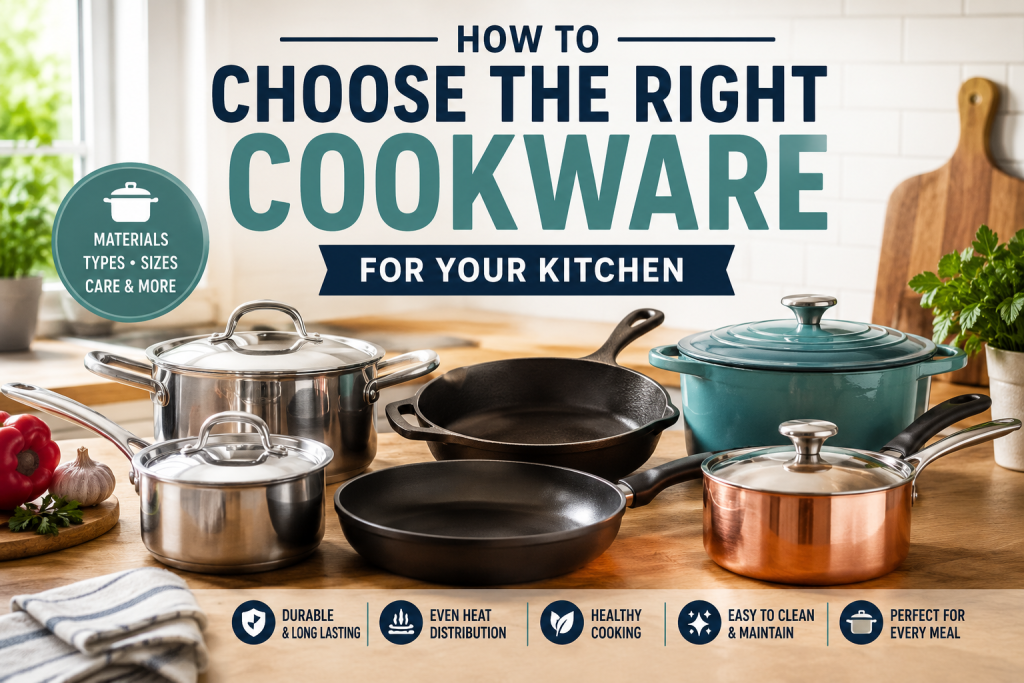
Good cookware can make everyday cooking easier, more enjoyable and more consistent.
But choosing pots and pans isn’t always straightforward.
Walk into a kitchen store or browse online and you’ll find stainless steel, non-stick, cast iron, ceramic-coated cookware and numerous combinations of materials, sizes and designs.
Some cookware sets contain a dozen or more pieces, while others contain only a few essential pots and pans.
So what do you actually need?
The answer depends on what you cook, how often you cook, the type of stove you have, how much storage space you have and how much you’re prepared to spend.
This guide looks at the main cookware options and explains what to consider before buying.
Do you need a complete cookware set?
One of the first decisions is whether to buy a complete set or individual pieces.
A cookware set can appear to offer excellent value because you receive several pots and pans together.
However, there’s an important question to ask:
Will you actually use everything in the set?
A large set might include:
- Small saucepan
- Large saucepan
- Frying pan
- Sauté pan
- Stockpot
- Steamer
- Dutch oven
- Lids
- Various accessories
If half of those pieces end up sitting unused in a cupboard, the apparent saving isn’t necessarily a saving.
For many households, buying a smaller number of quality pieces individually can be a better approach.
The basic cookware most kitchens need
A practical kitchen doesn’t necessarily require dozens of pots and pans.
A useful starting collection might include:
Small saucepan
Ideal for:
- Sauces
- Heating milk
- Small portions
- Vegetables
- Gravy
Medium saucepan
Useful for:
- Rice
- Pasta
- Vegetables
- Soups
- Everyday cooking
Large pot
Useful for:
- Pasta
- Soups
- Stews
- Large family meals
- Boiling vegetables
Frying pan
Useful for:
- Eggs
- Meat
- Fish
- Vegetables
- Stir-fries
Sauté pan
A deeper pan can be useful for meals that combine frying with sauces or larger quantities of ingredients.
Oven-safe casserole or Dutch oven
Useful for:
- Slow cooking
- Stews
- Braises
- Roasts
- One-pot meals
You can build a surprisingly capable kitchen with these basic pieces.
Why cookware material matters
The material used to construct cookware affects:
- Heat distribution
- Heat retention
- Cooking performance
- Weight
- Durability
- Cleaning
- Maintenance
- Price
There isn’t one material that is best for every cooking task.
Instead, different materials have different strengths.
Stainless steel cookware
Stainless steel is a popular choice because it is durable and versatile.
Quality stainless steel cookware can last for many years when properly maintained.
Advantages include:
- Durable construction
- Resistant to rust
- Generally easy to clean
- Suitable for many cooking methods
- Often dishwasher compatible
- Good resistance to scratching
Stainless steel can also tolerate relatively high cooking temperatures.
The downside is that food can stick if the pan isn’t used correctly.
Some stainless steel cookware therefore incorporates an aluminium or copper core to improve heat distribution.
What does tri-ply cookware mean?
You may come across terms such as:
- Tri-ply
- Three-ply
- Multi-layer
- Clad
These generally refer to cookware constructed from multiple layers of metal.
A common arrangement uses stainless steel around a heat-conductive aluminium layer.
The idea is to combine the durability and cooking surface of stainless steel with better heat distribution.
More layers don’t automatically mean better cookware, but construction quality can make a significant difference.
Non-stick cookware
Non-stick cookware is particularly popular for everyday cooking.
Its main advantage is obvious:
Food is less likely to stick to the cooking surface.
This can make it useful for:
- Eggs
- Pancakes
- Fish
- Omelettes
- Low-fat cooking
- Delicate foods
Non-stick cookware can also be relatively easy to clean.
However, the coating requires more care than bare stainless steel or cast iron.
Avoid using metal utensils unless the manufacturer specifically says they are suitable.
Follow the manufacturer’s instructions regarding cooking temperatures and cleaning.
How long does non-stick cookware last?
The lifespan depends on:
- Quality
- Frequency of use
- Cooking temperature
- Utensils used
- Cleaning method
- Storage
Even good non-stick cookware can eventually show signs of wear.
For this reason, don’t necessarily expect a non-stick frying pan to last as long as a high-quality stainless steel or cast iron pan.
Instead, consider non-stick cookware as a convenient tool for particular cooking tasks.
Cast iron cookware
Cast iron has been used for generations.
It is known for:
- Excellent heat retention
- Durability
- High-temperature cooking
- Versatility
- Long lifespan
A well-maintained cast iron pan can potentially last for decades.
Cast iron is particularly useful for:
- Steaks
- Roasting
- Frying
- Baking
- Slow cooking
- Outdoor cooking
The major disadvantage is weight.
A large cast iron pan can be considerably heavier than aluminium or stainless steel cookware.
What is seasoned cast iron?
Traditional cast iron cookware develops a layer known as seasoning.
This is created through the interaction of oil and heat and helps protect the surface while improving cooking performance.
Cast iron therefore requires somewhat different care from stainless steel.
It’s important to follow the manufacturer’s cleaning and maintenance recommendations.
Enameled cast iron
Enameled cast iron combines the heavy heat-retaining properties of cast iron with a coated cooking surface.
It can be particularly useful for:
- Casseroles
- Stews
- Braising
- Slow cooking
- Oven cooking
Enameled cookware can also look attractive enough to move directly from the oven or hob to the dining table.
The downside is generally its weight and price.
Ceramic cookware
Ceramic cookware can refer to several different products.
Some cookware is made from ceramic material, while other products have a ceramic-based non-stick coating.
Don’t assume that every product labelled “ceramic” has identical properties.
Check the manufacturer’s specifications carefully.
Potential advantages can include:
- Easy cleaning
- Attractive appearance
- Non-stick properties on coated cookware
As with other coatings, durability depends heavily on construction and use.
Aluminium cookware
Aluminium is lightweight and conducts heat efficiently.
It is therefore commonly used in cookware construction.
You may find:
- Aluminium frying pans
- Aluminium saucepans
- Hard-anodised aluminium cookware
- Aluminium cores inside multi-layer cookware
Hard-anodised aluminium is designed to provide a harder, more durable surface than conventional aluminium.
Copper cookware
Copper is highly regarded for its heat conductivity and responsiveness.
It can allow cooks to make very precise temperature adjustments.
However, copper cookware can be expensive and may require more maintenance.
It is often found in premium cookware rather than basic everyday kitchen sets.
For most households, there is no need to buy copper cookware simply because it is associated with professional kitchens.
What cookware works on an induction stove?
This is extremely important.
Not all cookware works with induction cooking.
Induction hobs require cookware with a suitable magnetic base.
If you have an induction stove, check that the cookware is specifically marked as induction compatible.
Don’t assume that a stainless steel pan will automatically work.
Some stainless steel cookware is induction compatible while other products aren’t.
Can cookware be used on gas?
Most conventional cookware is suitable for gas cooking, but always check the manufacturer’s instructions.
Gas cooking produces direct heat underneath the cookware.
This makes heat distribution and the construction of the base particularly important.
A quality pan should sit securely on the stove and have a suitable base.
What about ceramic and electric hobs?
Cookware suitable for ceramic and conventional electric hobs should have a reasonably flat base.
A warped pan may not make proper contact with the cooking surface.
This can affect:
- Heating
- Cooking consistency
- Efficiency
Again, check the cookware manufacturer’s recommendations for your specific hob.
Oven-safe cookware
If you enjoy one-pot meals, oven compatibility can be extremely useful.
But there is an important distinction between the cookware body and its handles.
A pan may technically be oven-safe while its handles or lid have a lower temperature rating.
Before putting cookware into the oven, check:
- Maximum oven temperature
- Handle material
- Lid material
- Knob temperature rating
- Manufacturer instructions
Dishwasher-safe cookware
Dishwasher compatibility can be convenient, particularly for busy households.
However, dishwasher-safe doesn’t necessarily mean that every material will benefit from frequent dishwasher cleaning.
Some cookware may maintain its appearance and performance better when hand-washed.
If easy cleaning is important to you, compare the manufacturer’s cleaning recommendations before buying.
How important are the handles?
Handles are easy to overlook when comparing cookware online.
But they can make a significant difference to everyday use.
Look for handles that are:
- Comfortable
- Secure
- Heat resistant
- Easy to grip
- Strongly attached
If you plan to use the cookware in the oven, check whether the handles are oven-safe.
Some cookware also has removable handles, which can make storage easier.
What makes a good saucepan?
A good saucepan should generally:
- Heat evenly
- Have a stable base
- Feel balanced
- Have a comfortable handle
- Include a suitable lid
- Be appropriate for your stove
The exact size depends on your household.
A small saucepan is useful for sauces and small portions, while a larger saucepan is better for family cooking.
What makes a good frying pan?
A good frying pan should heat evenly and sit securely on the cooking surface.
Consider:
- Diameter
- Depth
- Weight
- Handle design
- Cooking surface
- Oven compatibility
- Hob compatibility
- Cleaning requirements
If you cook eggs and delicate foods frequently, non-stick can be useful.
If you regularly sear meat at high temperatures, stainless steel or cast iron may be more suitable.
Should you buy different pans for different jobs?
Yes.
Trying to make one pan do absolutely everything isn’t always the best strategy.
For example:
Non-stick: eggs and delicate foods
Stainless steel: sauces, searing and general cooking
Cast iron: high-heat cooking and heat retention
Large pot: pasta, soups and stews
Having several specialised pieces can be more practical than buying one enormous cookware set.
How much should you spend on cookware?
Cookware prices vary considerably.
You can buy basic cookware relatively cheaply, while premium multi-layer stainless steel or cast iron cookware can cost considerably more.
Rather than deciding that you need the most expensive cookware, think about:
- How often you cook
- How long you want it to last
- What meals you prepare
- How much you can spend
- Which pieces you actually need
A good frying pan that gets used several times a week may be a better investment than an expensive ten-piece set.
Is a cookware set better value?
Sometimes.
Sets can be good value if you genuinely need most of the included pieces.
But check the individual sizes.
Some large cookware sets look impressive but contain several relatively small pieces that aren’t particularly useful for family cooking.
Before buying a set, list the pieces you actually need and compare them with what’s included.
Don’t forget the lids
A lid can significantly increase the usefulness of a saucepan or pot.
Lids help with:
- Simmering
- Retaining heat
- Cooking rice
- Reducing sauces
- Preventing splashing
- Keeping food warm
Glass lids can be useful because they allow you to monitor cooking without lifting the lid.
However, they can be more vulnerable to damage than metal lids.
Storage matters
A large cookware collection can quickly consume cupboard space.
Before buying a large set, consider how you’ll store it.
You may need:
- Deep cupboards
- Pan racks
- Drawer storage
- Hanging storage
- Stackable cookware
Stackable cookware can be particularly useful in smaller kitchens.
Weight matters more than you think
Heavy cookware can retain heat well, but weight affects everyday usability.
Think about who will be using the cookware.
A large cast iron pot may be excellent for slow cooking but difficult for some people to lift safely when full.
Don’t choose cookware solely based on durability.
It needs to be comfortable and practical for your household.
Cookware for a small kitchen
If space is limited, concentrate on versatility.
A compact collection might include:
- One small saucepan
- One medium saucepan
- One large pot
- One frying pan
- One versatile sauté pan
Stackable designs can help reduce storage requirements.
A smaller collection of frequently used cookware is often more useful than a cupboard full of rarely used pieces.
If you’re upgrading your kitchen appliances as well as your cookware, see our guide to choosing the right air fryer for your home.
Cookware for a family
Families may benefit from:
- Larger pots
- Larger frying pans
- Multiple saucepans
- A deep sauté pan
- A casserole or Dutch oven
Capacity becomes particularly important when preparing meals for several people.
Cookware for outdoor cooking
If you enjoy braais, camping or outdoor cooking, consider cookware specifically designed for high-heat or outdoor use.
Cast iron can be particularly useful for outdoor cooking because of its durability and heat retention.
However, choose cookware according to the cooking equipment you’ll actually be using.
For outdoor cooking, our guide to choosing the right pizza oven can help you compare the available options.

How to care for your cookware
Good maintenance can extend the useful life of cookware.
General principles include:
- Follow the manufacturer’s cleaning instructions.
- Avoid overheating coated cookware.
- Use appropriate utensils.
- Don’t subject hot cookware to sudden temperature changes unless it is designed for this.
- Dry cookware properly after cleaning.
- Store pieces carefully to avoid scratching.
- Maintain seasoned cast iron as recommended.
Different materials require different care.
Common cookware buying mistakes
Buying a huge set because it looks like good value
You may end up paying for pieces you rarely use.
Ignoring your stove
Not all cookware works on induction.
Buying only non-stick
Non-stick is useful, but different cooking tasks may benefit from other materials.
Ignoring handles
A pan can have excellent cooking performance but still be frustrating to use if the handle is uncomfortable.
Buying cookware that’s too heavy
Weight matters during everyday cooking.
Forgetting oven compatibility
Especially important if you enjoy one-pot cooking.
Ignoring storage
Make sure you have somewhere to put everything.
Choosing solely on appearance
Beautiful cookware is nice, but cooking performance and practicality matter more.
A simple cookware buying checklist
Before buying, ask:
- What type of stove do I have?
- Is the cookware compatible with it?
- What do I cook most often?
- Which pots and pans do I actually need?
- Do I need a complete set?
- What materials suit my cooking style?
- Do I need non-stick cookware?
- Do I need cast iron?
- Is the cookware oven-safe?
- Is it dishwasher-safe?
- Are the handles comfortable?
- Are the lids included?
- How much does each piece weigh?
- How will I store it?
- What is the warranty?
- Are replacement pieces available?
Final thoughts
The best cookware for your kitchen isn’t necessarily the most expensive cookware or the biggest set.
It is cookware that matches your cooking habits, your stove, your available space and the meals you actually prepare.
A practical kitchen may need only a handful of good-quality pieces.
A non-stick frying pan can make breakfast easier.
A stainless steel saucepan can handle everyday cooking.
A large pot can take care of pasta, soups and family meals.
A cast iron pan can provide excellent high-heat performance.
And a versatile casserole or Dutch oven can become one of the most useful pieces in the kitchen.
Instead of buying everything at once, consider building your cookware collection gradually.
Start with the pieces you use most frequently, choose quality where it matters and add specialist cookware only when you have a genuine need for it.
That approach can give you a kitchen that is better equipped without becoming unnecessarily expensive or cluttered.