
By the Kila team · Last updated 7 November 2026
The United Kingdom is one of the most popular overseas destinations for South Africans, whether for a family visit, a first trip to London or a business meeting. Unlike a few destinations that have loosened their rules, the UK still requires South African passport holders to apply for a visa before they travel, and the fee went up again in April 2026.
This guide explains which UK visa you need, what it costs in rand, how to apply from South Africa, how long it takes and what to put in your application. It sits alongside our guides to the Schengen visa and the US visa, so you can plan the whole trip.
Quick answers
- Do you need a visa? Yes. There is no visa-free entry for South Africans, and the UK’s Electronic Travel Authorisation (ETA) does not apply to South African passport holders.
- Which visa? The Standard Visitor visa, for tourism, family visits and business meetings, for stays of up to six months per visit.
- Fee: £135 since 8 April 2026, which is about R3,100 at roughly R23 to the pound. The fee is non-refundable.
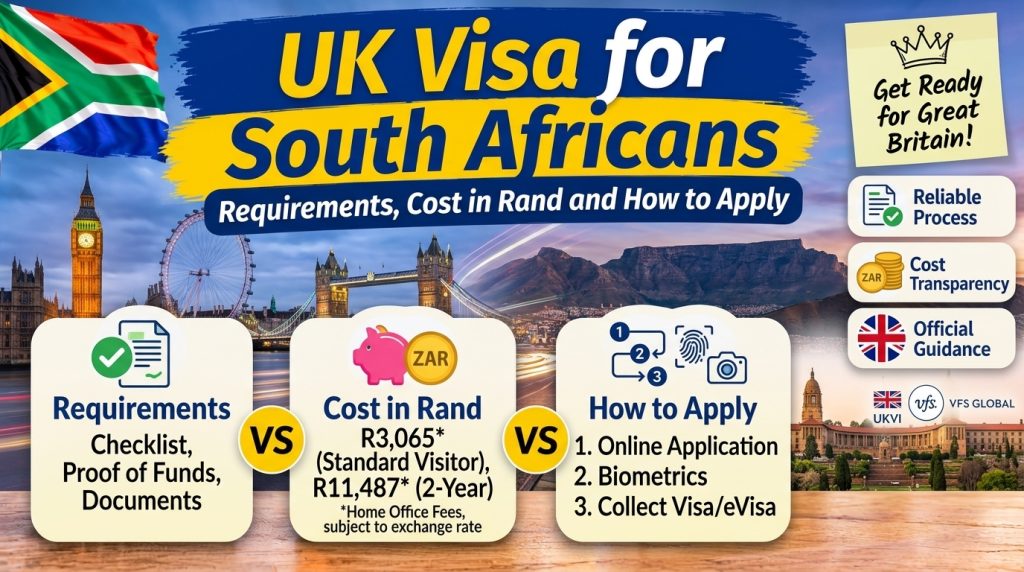
- How to apply: Online at GOV.UK, then a biometrics appointment at a visa application centre in South Africa. There is no interview.
- Processing time: About 15 working days from your biometrics appointment. Apply four to eight weeks before you travel.
- Ireland is separate. A UK visa does not cover Ireland.
Do South Africans need a visa for the UK?
Yes. South African citizens need a visa to visit England, Scotland, Wales and Northern Ireland. The UK’s ETA scheme is for visitors from visa-exempt countries and does not apply to South Africans, so you can’t simply register online and fly. If you are only visiting for a holiday, a family visit or a short business trip, you apply for the Standard Visitor visa. Our guide to visa-free countries for South Africans shows which destinations don’t need advance paperwork.
A UK visa does not cover Ireland, which has its own visa rules, and it is separate from the Schengen visa needed for most of mainland Europe. If your trip includes the UK and Europe, plan two applications and allow time for each.
If you plan to connect through a UK airport such as Heathrow, check GOV.UK’s guidance on visas for passing through the UK before you book, as transit rules differ from visit rules.
The Standard Visitor visa
| Detail | What to know |
|---|---|
| Purpose | Tourism, visiting family and friends, business meetings and certain other permitted activities |
| Length of stay | Up to six months per visit |
| Work and study | You cannot work in the UK, and study is limited to short courses |
| Validity options | Six months, or longer multiple-visit visas of two, five or ten years for frequent visitors |
| Interview | No. The decision is made on your application and documents |
| TB test | Not required for visits of six months or less |
The longer visas still limit each visit to six months, but they let you return without reapplying each time. They cost considerably more than the six-month visa, so they only make sense if you expect to visit often. Check the current fees on the GOV.UK visa fees page.
How much does a UK visa cost in rand?
The Standard Visitor visa for up to six months costs £135 since 8 April 2026, up from £127. Older blogs and some sites still quote £127, and a few quote older fees. Use the figure on the official GOV.UK visa fees page. The fee is paid online by card in pounds when you apply, so your bank’s exchange rate and card fees affect the final rand cost.
| Cost | Approximate amount |
|---|---|
| Standard Visitor visa (six months), per person | £135, about R3,100 |
| Family of four, visa fees only | £540, about R12,400 |
| Visa application centre service charges, courier and optional extras | Extra, varies by provider and options |
| Priority or faster decision services | Optional and extra. Check GOV.UK for current prices |
| Travel insurance | Not required, but recommended. Price varies |
Every applicant pays the fee, including children. Rand amounts here are rough and based on a recent exchange rate. Budget extra for photocopies, courier fees and travel to your appointment, and see our guide to travel insurance for South Africans.
How to apply for a UK visa from South Africa
- Check your passport. It must be valid for your whole stay and have blank pages.
- Apply online on GOV.UK. Start at gov.uk/apply-uk-visa or follow the link from the Standard Visitor visa page. Use the official site only. Agents and look-alike websites charge extra and can’t speed things up.
- Complete the application form. You will be asked about your travel plans, finances, employment, family, previous travel and any previous visa refusals. Answer carefully and consistently.
- Pay the visa fee. Pay online by card. The fee is non-refundable.
- Book your biometrics appointment. Appointments are held at visa application centres in South Africa, run by VFS Global and other providers. Centres are in Johannesburg, Pretoria, Cape Town and Durban, and some sources list Gqeberha as well. GOV.UK shows where to book. If you arrive late, you can forfeit your slot and fee.
- Attend your appointment. Bring your passport and appointment confirmation. Your fingerprints and photo are taken and your supporting documents are submitted or uploaded as instructed.
- Wait for the decision. The standard target is about 15 working days from your appointment. Your passport may be kept during processing, so don’t plan other trips in that time.
- Check the outcome. The UK has been moving to digital visas, so follow the instructions in your decision email on how your visa is issued and how to link it to your UKVI account. Check the dates and details carefully.
For wider trip preparation, see our guides to planning an international trip from South Africa and the 10 things South African travellers should check before booking.
How long does it take?
The UK’s service standard for a Standard Visitor visa is about 15 working days from your biometrics appointment, which is roughly three weeks. Peak periods such as summer and Christmas can be slower, and extra checks can add time. Faster paid services are available in some cases, but they cost extra and don’t guarantee approval.
We recommend applying four to eight weeks before you travel and no earlier than the UK allows, which is normally up to three months before your trip. Don’t buy non-refundable flights or accommodation until your visa has been approved.
Documents and evidence to prepare
The UK asks for different evidence depending on your circumstances, and the online form tells you what to upload. A strong application usually shows three things: why you are visiting, how you will pay for it and why you will leave when your visit ends.
- A valid passport, plus any older passports that show your travel history.
- Proof of funds, such as recent bank statements, usually covering several months, and payslips.
- Proof of employment or business, such as an employer letter confirming your role, salary and approved leave, or business registration documents if you are self-employed.
- Your travel plans, including flight details and where you will stay. Refundable bookings are safest before approval.
- An invitation or host details if you are visiting family or friends, including their address, status in the UK and relationship to you.
- Evidence of ties to South Africa, such as your job, property, family and other commitments.
- Documents in English or with certified translations.
- Consent documents for children travelling without both parents.
Never submit false or altered documents. Deception can lead to refusal and long bans on future UK visas.
Why UK visa applications are refused
Most refusals come down to doubts about whether you will leave the UK at the end of your visit, or whether you can afford the trip. Common problems include:
- Weak or unexplained finances. Large deposits without explanation or too little money for the trip.
- Unclear purpose or itinerary. Vague plans or a trip that doesn’t match your circumstances.
- Weak ties to South Africa. Little to show that you will return.
- Inconsistent information. Details that don’t match across the form and documents.
- Previous immigration issues. Overstays, refusals or breaches of conditions that weren’t declared.
If you are refused, you generally can’t appeal a visitor visa decision. Instead, read the refusal reasons carefully, fix the problems and apply again with stronger evidence. The earlier refusal must be declared on any future application.
After you are approved
- Check your visa details and keep the approval email and any visa documents safe.
- Carry supporting documents. Border officers can ask about your plans, accommodation, funds and return ticket.
- Stay within the conditions. No work, and no staying longer than permitted.
- Arrange travel insurance. NHS treatment can be charged for visitors, so cover for medical costs matters.
- Don’t overstay. Overstaying can affect future applications to the UK and other countries.
Planning your trip to the UK
With your visa sorted, start planning the flights and logistics. See how to choose the right flight and our tips for planning a long-haul flight from South Africa. Our hotel booking guide helps you choose where to stay, a travel eSIM keeps you connected (start with how eSIMs work and then how to choose one), and our guide to choosing luggage for international travel covers packing.
Heading further afield? Read our guides to the US visa, Japan from South Africa and South Korea from South Africa.
Before-you-apply checklist
- Passport valid with blank pages
- Application started on the official GOV.UK site
- Current fee checked on the GOV.UK fees page
- Bank statements, payslips and employer letter gathered
- Travel plan, host details and accommodation prepared
- Evidence of ties to South Africa ready
- Biometrics appointment booked
- Refundable flights and accommodation until approval
- Travel insurance arranged
Frequently asked questions
Do South Africans need a visa for the UK?
Yes. South African passport holders need a Standard Visitor visa for tourism, family visits and business meetings. The UK’s ETA does not apply to South Africans.
How much is a UK visa for South Africans in rand?
The Standard Visitor visa costs £135 since 8 April 2026, which is about R3,100 at recent exchange rates. Service charges and optional extras are additional, so check the official fees page.
How long does a UK visa take for South Africans?
The standard target is about 15 working days from your biometrics appointment. Apply four to eight weeks before you travel, and allow longer in peak seasons.
How long can I stay in the UK on a Standard Visitor visa?
Up to six months per visit.
Is there an interview for a UK visitor visa?
No. You apply online and attend a biometrics appointment, and the decision is made on your documents.
Where do I apply for a UK visa in South Africa?
You apply online on GOV.UK and then book a biometrics appointment at a visa application centre, with centres in Johannesburg, Pretoria, Cape Town and Durban.
Does a UK visa cover Ireland?
No. Ireland has its own visa rules, so check the Irish requirements separately.
Can I work in the UK on a visitor visa?
No. A Standard Visitor visa does not allow work, and study is limited to short courses.
Can I appeal if my UK visa is refused?
Generally no, for visitor visas. You can reapply with stronger evidence and must declare the earlier refusal.
Do I need a TB test for a UK visitor visa?
Not for visits of six months or less.
Final thoughts
The UK visa process is straightforward but unforgiving of mistakes. Use the official GOV.UK site, tell a clear and consistent story about your trip, show that you can fund it and will return, and keep your travel bookings refundable until the visa is approved. Start early, and you will avoid most of the stress.
Fees, processing times and procedures change often, so confirm all details on GOV.UK before you apply.
More Kila travel guides
- Schengen Visa for South Africans
- US Visa for South Africans
- Visa-Free Countries for South Africans in 2026
- How to Plan an International Trip from South Africa
- Travel Insurance for South Africans
- All Kila travel guides
Sources and official links
- GOV.UK: Standard Visitor visa
- GOV.UK: Apply for a UK visa
- GOV.UK: UK visa fees
- Travelstart: UK visa requirements for South Africans
- TravelReady: UK visa for South Africans, 2026 guide
Visa rules, fees and processing times change often. Always confirm current details on the official GOV.UK website before you apply. Rand amounts are approximate and based on a recent exchange rate. Kila may earn a commission if you buy through some links on our site. See our disclosure policy.