
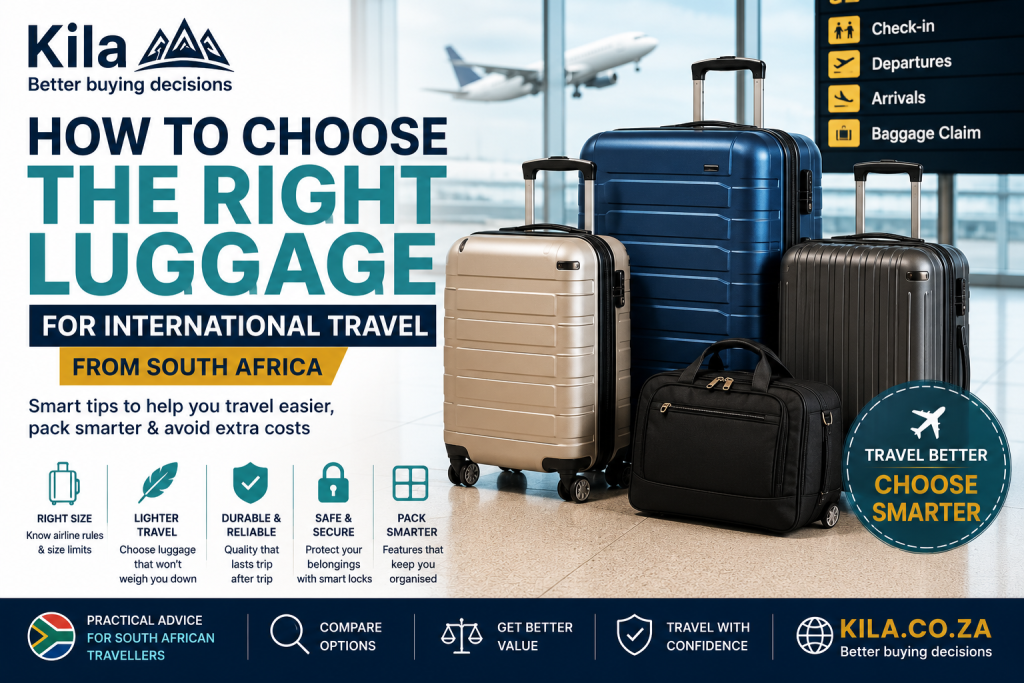
Choosing luggage might seem straightforward. Find a suitcase you like, make sure it is big enough and you’re ready to go.
In reality, the wrong suitcase can become an expensive and inconvenient mistake.
The luggage you choose needs to cope with airports, transfers, baggage handling, hotel rooms and potentially several different forms of transport. It also needs to fit within airline size and weight restrictions while giving you enough space for everything you actually need.
For South African travellers planning an international trip, choosing luggage before you travel is one of those small decisions that can make the entire journey easier.
This guide looks at what really matters when choosing a suitcase, carry-on bag or luggage set.
Start with how you travel
There isn’t one suitcase that is best for everyone.
Before looking at brands, colours or features, think about the type of travelling you normally do.
Ask yourself:
- Do you usually travel internationally or domestically?
- How long are your trips?
- Do you normally check luggage?
- Do you prefer travelling with only carry-on baggage?
- Will you be changing trains or buses?
- Do you normally hire a car?
- Are you likely to move between several hotels?
- Do you tend to pack heavily?
- Do you need to carry specialist equipment?
A traveller taking a two-week international holiday may have very different requirements from someone travelling for a three-day business trip.
The best luggage is the luggage that matches the way you travel.
Decide how much luggage you actually need
One of the easiest mistakes is buying the biggest suitcase available simply because it gives you more packing space.
More space isn’t always an advantage.
A large suitcase can encourage you to pack unnecessary items, and once it is full, it can become heavy and difficult to handle.
Instead, think about what you realistically need.
For many travellers, a combination such as:
- one checked suitcase
- one carry-on bag
- one small personal item
may provide a useful balance between capacity and convenience.
However, your airline’s specific baggage allowance should always be checked before travelling.
Carry-on luggage vs checked luggage
The two serve different purposes.
Carry-on luggage
Carry-on luggage stays with you during the flight.
Advantages include:
- You don’t have to wait at baggage reclaim.
- There is less risk of checked baggage being delayed.
- Important items can remain with you.
- It can be useful for short trips.
The disadvantage is limited space.
Airlines also have their own restrictions regarding dimensions and weight, so don’t assume that a suitcase advertised as “cabin size” will automatically meet every airline’s requirements.
Checked luggage
Checked luggage gives you considerably more packing capacity.
It is generally better suited to:
- Longer holidays
- Family travel
- Winter clothing
- Travelling with bulky items
- Trips where carry-on space isn’t sufficient
The downside is that you need to check the bag in, wait for it at your destination and comply with the airline’s weight restrictions.
Always check your airline’s baggage rules
This is one of the most important points in the entire article.
Don’t buy luggage based solely on the manufacturer’s description.
Airlines can have different requirements for:
- Maximum dimensions
- Maximum weight
- Number of bags
- Carry-on baggage
- Personal items
- Checked baggage
- Additional baggage
Even if a suitcase is described as suitable for international travel, that doesn’t necessarily mean it complies with every airline’s current rules.
Check the airline you are actually travelling with before purchasing.
This is especially important when your itinerary involves multiple airlines.
What suitcase size should you buy?
Suitcases are commonly described as small, medium or large, but these descriptions aren’t standardised.
One manufacturer’s “large” suitcase may be considerably different from another’s.
Instead of relying on the label, look at the actual external dimensions and weight.
Also remember that airlines generally care about the external dimensions of the luggage, including wheels and handles.
For this reason, don’t assume that a suitcase advertised as offering a certain number of litres will automatically meet an airline’s requirements.
Hard-shell vs soft-shell luggage
One of the biggest decisions is whether to choose a hard-shell or soft-sided suitcase.
Neither is automatically better.
Hard-shell luggage
Hard-shell cases are usually made from materials such as:
- Polycarbonate
- ABS
- Polypropylene
Their advantages can include:
- Protection from impacts
- A rigid exterior
- Resistance to some types of moisture
- Easy cleaning
Some hard-shell cases also have a clamshell design, opening into two halves.
The downside is that the case itself can take up some of your available space and some cheaper hard-shell materials can be more prone to cracking or damage.
Soft-sided luggage
Soft luggage is commonly made from fabrics such as polyester or nylon.
Advantages can include:
- Flexibility
- External pockets
- Easier access to certain items
- Potentially lighter construction
The downside is that soft luggage provides less rigid protection and can be more susceptible to staining or tearing.
Don’t focus only on appearance
A suitcase can look excellent in a product photograph and still be poorly suited to frequent travel.
Pay attention to the functional details.
Wheels
Look for wheels that move smoothly and allow the case to be controlled easily.
Four-wheel spinner luggage can be particularly convenient in airports because it can usually be pushed alongside you rather than pulled behind you.
Handles
Check that the telescopic handle extends and retracts smoothly.
A handle that feels loose or flimsy when the suitcase is empty may become more problematic once the case is packed.
Zips
Check the quality and operation of the zips.
They should move smoothly without catching.
Seams
With soft luggage, inspect the stitching and seams carefully.
Locks
If the suitcase includes a built-in combination lock, understand how it works before travelling.
For international travel, you may also encounter luggage featuring TSA-compatible locks, which are designed for use within the relevant security framework.
Weight matters more than many people realise
A suitcase itself contributes to your baggage weight.
This matters because airlines generally impose weight limits.
Imagine two suitcases offering similar packing capacity:
Suitcase A: 3.5 kg empty
Suitcase B: 5 kg empty
The second suitcase leaves you with less of your baggage allowance for your actual belongings.
For travellers who regularly struggle to stay within airline weight limits, choosing lighter luggage can be more useful than buying a larger suitcase.
However, don’t choose luggage purely because it is lightweight.
Extremely lightweight construction may involve compromises in durability.
The goal is to find a sensible balance between weight, capacity and construction quality.
Think about the wheels
Wheels receive a lot of abuse during travel.
A suitcase with poor wheels can become frustrating surprisingly quickly.
Consider:
- Number of wheels
- Wheel size
- Smoothness
- Stability
- Ease of turning
- Quality of wheel housing
Four-wheel spinner cases are particularly popular because they can be manoeuvred in several directions.
Two-wheel luggage, however, can sometimes be easier to pull over rougher surfaces.
Think about where you will actually use the suitcase.
A perfectly smooth airport floor isn’t representative of every surface you’ll encounter.
Look at the interior design
Packing capacity isn’t only about litres.
The internal design of the suitcase can make a significant difference.
Useful features can include:
- Compression straps
- Zipped compartments
- Divider panels
- Expandable sections
- Dedicated pockets
Consider how you normally pack.
If you prefer everything separated and organised, internal compartments may be particularly useful.
If you tend to pack bulky items, a simpler interior may give you more flexibility.
Expandable luggage can be useful — but be careful
Some suitcases have an expansion zip that increases their capacity.
This can be useful when returning home with additional purchases.
However, there is a catch.
Expanding your suitcase doesn’t increase your airline’s baggage allowance.
A larger suitcase that exceeds the airline’s permitted dimensions or weight can still result in additional charges.
Expansion is therefore best viewed as a flexibility feature rather than an excuse to pack more.
Consider your travel itinerary
Your luggage needs may change depending on how you travel once you arrive.
If you’re flying into one city, staying at one hotel and hiring a car, a large suitcase may be relatively easy to manage.
But if your itinerary involves:
Airport → train → hotel → train → hotel → airport
you may appreciate something considerably easier to manoeuvre.
This is one reason why the “best” luggage depends so heavily on the individual traveller.
Don’t forget your personal item
Many travellers focus on their suitcase and carry-on bag but forget the smaller personal item.
Depending on the airline’s rules, this might be:
- A small backpack
- Handbag
- Laptop bag
- Small day bag
It can be extremely useful for items you want immediately accessible during the journey.
For example:
- Passport
- Phone
- Charger
- Travel documents
- Medication
- Headphones
- Reading material
- Small toiletries
Always check the airline’s current requirements for personal items.
What should go in your carry-on?
Even when you are checking a suitcase, there are certain things that are generally better kept with you rather than packed into checked luggage.
Important travel documents and essential personal items should remain accessible.
You should also consider what you would need if your checked bag were temporarily delayed.
A simple approach is to make sure your carry-on contains the essentials you couldn’t comfortably do without for a short period.
Don’t forget baggage identification
A simple luggage tag can make your suitcase easier to identify.
Consider adding:
- Your name
- A contact number
- An email address
You can also choose luggage in a distinctive colour or add a visible identifier to make it easier to recognise on the baggage carousel.
A plain black suitcase can be surprisingly difficult to distinguish from dozens of others.
Should you buy a luggage set?
Luggage sets can be attractive because they provide several matching pieces.
A typical set might contain:
- Large suitcase
- Medium suitcase
- Carry-on suitcase
The advantage is consistency and potentially better value than buying each piece separately.
But don’t assume a set is automatically cheaper or better.
If you only need one suitcase and one carry-on, buying a three- or four-piece set may simply result in you owning luggage you rarely use.
Buy the pieces you actually need.
How much should you spend on luggage?
There is no single price that guarantees good luggage.
Very cheap luggage can be tempting, particularly if you’re only travelling occasionally.
However, replacing a suitcase after every few trips isn’t necessarily economical.
At the other extreme, expensive luggage isn’t automatically worth the additional cost.
When comparing luggage, consider:
- Construction
- Weight
- Wheels
- Handles
- Warranty
- Capacity
- Features
- Reviews
- Intended frequency of use
Think about value rather than price alone.
Read reviews carefully
Online reviews can be useful, but don’t simply look at the star rating.
Read what customers actually say.
Pay particular attention to comments about:
- Wheels failing
- Handles becoming loose
- Zips breaking
- Cracks
- Water resistance
- Actual weight
- Size
- Customer service
- Warranty claims
If multiple independent buyers report the same problem, it deserves attention.
Check the warranty
Luggage can experience considerably more physical abuse than many household products.
A manufacturer’s warranty can therefore be important.
Before buying, find out:
- How long the warranty lasts
- What it covers
- What it excludes
- How claims are handled
- Whether you need proof of purchase
Don’t assume that every type of damage will be covered.
Where should you buy luggage?
There are several places to shop for luggage in South Africa.
You can compare:
- Department stores
- Specialist luggage retailers
- Online marketplaces
- Travel retailers
- Major e-commerce websites
Shopping online makes it easier to compare specifications and prices, but remember that photographs don’t tell you everything.
If possible, check the actual dimensions, weight and warranty before purchasing.
A useful luggage-buying strategy
If you’re planning an international trip, don’t leave your luggage purchase until the day before departure.
Instead:
Step 1: Check your airline’s baggage allowance
Know the permitted dimensions and weight.
Step 2: Decide what luggage you need
Work out whether you require checked luggage, carry-on luggage or both.
Step 3: Set a realistic budget
Don’t automatically choose the cheapest option.
Step 4: Compare specifications
Look at weight, dimensions, capacity and construction.
Step 5: Read reviews
Look for recurring problems rather than relying solely on star ratings.
Step 6: Check the warranty
Especially if you expect to travel frequently.
Step 7: Buy before your trip
Give yourself enough time to test the suitcase and make sure it works for you.
Kila’s luggage checklist
Before buying, ask:
☐ Does it meet my airline’s size requirements?
☐ Is the empty weight reasonable?
☐ Is the capacity suitable for my trip?
☐ Are the wheels sturdy and smooth?
☐ Does the handle feel secure?
☐ Are the zips good quality?
☐ Is the interior practical?
☐ Does it have the features I actually need?
☐ Have I checked independent reviews?
☐ Does it have a worthwhile warranty?
☐ Is the price reasonable compared with alternatives?
If you can answer these questions, you’re much more likely to end up with luggage that suits your travel rather than simply buying the suitcase that looks best.
Final thoughts
The best luggage isn’t necessarily the most expensive, the biggest or the most fashionable.
It’s the luggage that fits your airline’s requirements, suits the way you travel, is easy to handle and provides reasonable value for its price.
For South African travellers, the most important first step is therefore not choosing a brand.
It’s understanding where you’re going, how you’re getting there and what you’re actually going to need.
Once you know that, comparing luggage becomes considerably easier.
And that’s the approach Kila takes with every buying decision: work out what matters first, then compare your options.