
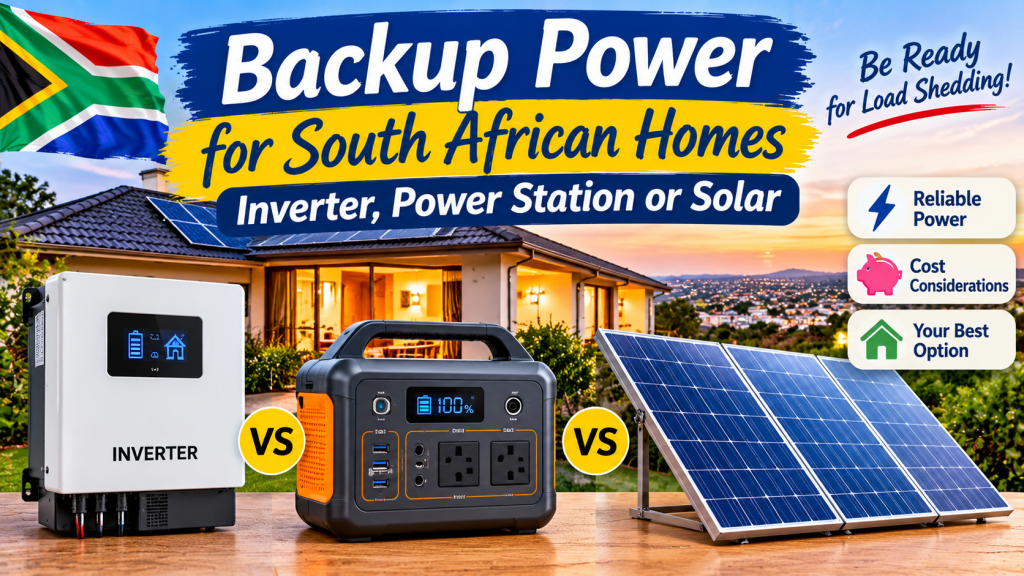
By the Kila team · Last updated 6 November 2026
For years, South African households bought inverters and batteries for one reason: load shedding. In 2026 the picture looks very different. Eskom reported more than 500 consecutive days without load shedding in early October, yet backup power is still selling strongly. Local outages haven’t disappeared, electricity prices keep rising and falling solar costs have changed the sums for many homes.
This guide explains whether you still need backup power, compares portable power stations, inverter-and-battery systems and solar, shows how to work out what you actually need to run, and covers the safety and compliance rules that catch many buyers out. It works alongside our guides to reducing electricity use at home and keeping your home cool in summer.
Quick answers
- Is load shedding over? There has been none for more than 500 days, according to Eskom’s statement in early October 2026. Outages caused by local faults, cable theft, storms, maintenance and load reduction in some areas still happen.
- Cheapest backup: A portable power station, from roughly R10,000 for a small unit to about R18,000 for a 1,000 Wh model. It keeps essentials running but can’t power a whole house.
- Inverter and battery (backup only): Around R60,000 to R90,000 installed for a typical 5 kW inverter with about 5 kWh of lithium battery, including the compliance certificate.
- Solar with battery: Roughly R70,000 to R145,000 for typical family systems, and more for big homes. Published price guides vary widely, so get several quotes.
- Savings come from the panels. A battery gives you backup and night-time solar use, but the panels are what cut your bill.
- Safety first: Use a registered electrician who issues a Certificate of Compliance (CoC). Insurers and buyers increasingly ask for it.
Do you still need backup power in 2026?
It depends on what you are protecting and how often you lose power. If you work from home, run a medical device, keep a lot of food in the freezer, rely on an electric gate and alarm, or live in an area with frequent local outages, backup power can still be worth it. If your supply is reliable and a few hours without electricity would be an inconvenience, a small and cheap solution may be all you need.
The case for solar is now mostly about money. Municipal tariffs rose about 9% on 1 July 2026, and rates in the big metros are roughly R3.40 to R4.40 per kWh, so every unit of electricity you generate yourself saves that amount. Ask yourself two separate questions: do I need backup? and do I want to cut my bill? The best system for each answer is different.
Four ways to keep the lights on
| Option | What it does | Indicative cost | Best for |
|---|---|---|---|
| Small UPS or power bank for the router | Keeps Wi-Fi, a router and phones running | Low (a small fraction of the options below) | Working from home and staying connected during short outages |
| Portable power station | Powers plug-in devices such as lights, a TV, a laptop, a router and sometimes a fridge for a few hours | About R10,000 to R18,000 for 500 to 1,000 Wh models | Occasional outages, renters and people who want something movable |
| Inverter and battery (backup only) | Runs chosen circuits from a wall-mounted battery when the grid goes off | About R60,000 to R90,000 installed for 5 kW and about 5 kWh | Frequent outages or when backup matters more than saving money |
| Solar, inverter and battery (hybrid) | Backup, plus it generates your own electricity and lowers your bill | Roughly R70,000 to R145,000 for typical homes | Homeowners who want to cut their bill and have backup |
Prices are from 2026 retail listings and price guides. Many of those guides are published by installers or quote-comparison sites, and prices vary by brand, roof type and region, so treat them as ballpark figures. Portable power stations are priced in dollars, so their rand price moves with the exchange rate.
Work out what you actually need to run
Choosing the right system starts with a list of what you want to keep running, not with a brand. Add up the power each device uses (watts) and how long you want it on (hours). The result in watt-hours (Wh) or kilowatt-hours (kWh) tells you how much battery you need. The formula is watts × hours = watt-hours.
A worked example: a four-hour outage
| Device | Typical power | Energy over 4 hours |
|---|---|---|
| Wi-Fi router | 15 W | 60 Wh |
| 6 LED bulbs | about 50 W in total | 200 Wh |
| TV | 100 W | 400 Wh |
| Laptop | 60 W | 240 Wh |
| Fridge-freezer (average, as it cycles on and off) | about 80 W | 320 Wh |
| Phone and device charging | 20 W | 80 Wh |
| Total | about 1,300 Wh (1.3 kWh) |
With conversion losses, plan for roughly 1.5 kWh. A 1,000 Wh power station would not quite last four hours with this load, while a 5 kWh battery would use only about a third of its capacity. Efficient LED lighting helps keep the numbers down.
The big power-hungry appliances
Some appliances use so much power that they quickly drain a small battery or overload a small inverter. Plan around them or leave them off the backup circuit.
| Appliance | Typical power draw |
|---|---|
| Kettle | 2,200–3,000 W |
| Microwave | 850–1,800 W |
| Fan heater | about 2,000 W |
| Air conditioner | about 500–3,500 W, depending on the model |
| Electric geyser | typically about 3,000 W for long periods |
| Electric oven and hob | Several thousand watts when in use |
A sensible approach is to back up essentials only: lights, internet, TV, a laptop, phone charging and the fridge. Cook with gas or a slow cooker or air fryer where possible, and read our oven guide for energy use. Leave the geyser and oven off the battery.
Option 1: Portable power stations
A portable power station is a large battery with built-in sockets. You plug devices into it and recharge it from the wall, and some models can also charge from portable solar panels.
- Cost: Small units of around 500 to 750 Wh sell from roughly R10,000, and 1,000 Wh models are around R18,000. Larger models cost much more.
- Pros: No installation, no compliance paperwork, movable, quiet and good for camping and load reduction.
- Cons: It can’t run a whole house, big appliances drain it quickly, and it only works for what you plug into it. Capacity is limited and the cost per kWh is high.
- What to check: The capacity in Wh, the continuous output in watts, the number of South African sockets, how quickly it recharges and the warranty.
Option 2: Inverter and battery (backup only)
A hybrid inverter and lithium battery system is wired into your home’s distribution board. When the grid fails, it switches automatically to battery power for the circuits you have chosen. Most modern installations use lithium iron phosphate (LiFePO4) batteries, which cost more upfront than lead-acid batteries but last much longer.
- Cost: A typical 5 kW hybrid inverter with about 5 kWh of lithium battery costs roughly R65,000 to R90,000 installed with a Certificate of Compliance. The lithium battery is the biggest cost, at roughly R8,500 per kWh installed in one price guide.
- Pros: Automatic changeover, powers selected circuits throughout the house and can be expanded with panels and extra batteries later.
- Cons: A high upfront cost and no bill savings unless you add solar panels.
- kVA or kW? You will see both. For comparing quotes, ask what continuous output (in kW) the inverter can deliver and how much usable battery capacity (in kWh) it comes with.
Option 3: Solar panels with a battery
Adding panels turns a backup system into a power station on your roof. During the day the panels power the house and charge the battery, and any surplus is stored for the evening. This is the option that can lower your bill as well as keep the lights on.
- Cost: Recent examples include a 5 kW inverter with a 5 kWh battery and six 550 W panels at R69,900, and 5 kW systems with 8 kWh of storage at about R74,500 to R90,500 fully installed. A 5 kVA inverter with 10 kWh of battery and four panels is quoted at R90,000 to R145,000, and a Sandton family system cost R128,000. Larger homes with air conditioning, pools or boreholes need more.
- Panels only (grid-tied): Cheaper, but without a battery or a suitable hybrid inverter they normally shut down when the grid goes off, so they don’t provide backup.
- Financing: Some installers and banks offer solar loans. One guide cites around R1,900 a month over five years for an R87,000 system, so compare the total repayment with your expected savings.
Will solar save you money?
You can estimate the saving yourself. Installer guides suggest that each kilowatt of panels produces roughly 4 to 5 kWh a day on average after real-world losses. At R4.00 per kWh, that is about R16 to R20 a day, or roughly R480 to R600 a month per kW, if you use all of it. A 3 kW array could therefore save up to about R1,500 a month in the best case.
The real figure depends on how much of the power you use during the day, your tariff, shading and roof direction, and whether you pay a fixed monthly charge regardless. Installer guides often quote payback periods of roughly four to seven years, but these are marketing estimates. Ask each installer for a written calculation based on your own bill and check it against the formula above.
Keep these points in mind:
- The panels generate the savings. A battery on its own mostly gives backup.
- Cut your usage first. The cheapest kWh is the one you don’t use, and a smaller system costs less.
- Don’t oversize. A system matched to your bill beats the biggest one on offer.
What about generators?
Petrol and diesel generators have a lower upfront cost, but they are noisy, need fuel and maintenance and are not suitable for indoor use. Never run a generator in a house, garage or other enclosed space because exhaust fumes contain carbon monoxide, which can kill. Never plug a generator into a wall socket to power the house, as this can send electricity back into the grid and endanger electrical workers. If you choose a generator, have an electrician install a proper changeover switch.
Rules, compliance and safety
A solar or inverter system is an electrical installation on your property, so it is governed by South African electrical safety rules. In practice this means:
- Use a registered electrician or contractor who issues a Certificate of Compliance (CoC) confirming the installation meets the wiring standard (SANS 10142-1). Ask to see their registration.
- Check whether registration is needed. Eskom and many municipalities require grid-connected solar systems to be registered, and some have set deadlines and fees. The rules differ between municipalities and have been disputed, so ask your installer in writing who handles any approval and check with your municipality or Eskom.
- Tell your insurer. Insurers increasingly want a CoC or a PV GreenCard, and claims for fire or other damage can be rejected without one.
- Keep your paperwork. Buyers and their lawyers may ask for the CoC and any registration documents when you sell.
- Avoid DIY and unbranded batteries. Cheap or poorly installed lithium batteries are a fire risk. Insist on certified equipment with a proper warranty.
How to compare quotes
- Get at least three written quotes on the same specification.
- Check the inverter’s continuous output in kW and the battery’s usable capacity in kWh.
- Ask which circuits will be backed up and which will not.
- Find out how long the inverter, battery and panels are warranted, and who honours the warranty if the installer closes.
- Confirm that the price includes mounting, cabling, protection devices, the CoC and any registration.
- Ask for references and photos of recent installations.
- Be wary of very low prices and pressure to sign the same day.
Which option should you choose?
| Your situation | A sensible starting point |
|---|---|
| Rare outages and you mainly want internet and lights | A small UPS or a 500–1,000 Wh power station |
| Work from home and want a reliable office | A power station or a small inverter and battery on the office circuit |
| Frequent local outages and you want the whole house essentials | An inverter and lithium battery installed by a registered electrician |
| High electricity bill and a sunny, unshaded roof | Solar panels with a hybrid inverter, adding a battery if you want backup |
| Renting or likely to move soon | A portable power station, which you can take with you |
Buying checklist
- List what you need to run and total the watts and hours
- Decide whether you want backup, savings or both
- Check your current bill and your tariff per kWh
- Compare at least three written quotes
- Confirm the CoC, the installer’s registration and any municipal or Eskom approval
- Check the warranty terms for the inverter, battery and panels
- Tell your insurer once the system is installed
Frequently asked questions
Is load shedding over in South Africa?
Eskom reported more than 500 consecutive days without load shedding in early October 2026. Outages from local faults, theft, storms and maintenance still happen, and load reduction continues in some areas.
Is it still worth buying an inverter if there is no load shedding?
It can be, if you have frequent local outages or need reliable power for work, medical equipment or security. If not, solar panels may make more sense financially, or a small power station may be enough.
How much does a solar system cost in South Africa in 2026?
Published 2026 prices for typical homes range from about R65,000 to R145,000 for a 5 kW system with a battery, depending on the battery size, number of panels and installer. Larger systems cost more, so compare several quotes.
What size inverter and battery do I need?
List the devices you want to run, add up their watts and decide how many hours of backup you want. A 5 kW inverter with about 5 kWh of battery is a common starting point for essentials, but heavy loads such as geysers and ovens need far more.
Can a portable power station run my whole house?
No. They suit lights, a router, a TV, a laptop and sometimes a fridge. Big appliances such as kettles, geysers and ovens drain them quickly.
Do solar panels work during a power outage?
Panels alone normally shut down when the grid goes off. You need a battery with a suitable hybrid inverter for backup.
Do I need a Certificate of Compliance for solar?
Yes. A registered electrician should issue a CoC for any solar or inverter installation. Insurers and buyers increasingly ask for it.
Do I have to register my solar system?
Eskom and many municipalities require grid-connected systems to be registered, but the rules differ and have been disputed. Ask your installer who handles registration and check with your municipality or Eskom.
Is it safe to use a generator at home?
Only outdoors, in an open and well-ventilated area, and never plugged into a wall socket. Exhaust fumes contain carbon monoxide, so never run one indoors or in a garage.
Final thoughts
The right backup solution is the smallest one that does what you need. For most households that means working out your essential loads, deciding whether backup or savings matters more, and getting several written quotes from registered installers. A portable power station is the easy, low-commitment choice. An inverter and battery suit people with frequent outages. Solar panels are the part that actually cuts your bill.
Prices, regulations and local conditions change quickly, so confirm current prices, registration requirements and warranty terms before you buy.
More Kila home and living guides
- How to Reduce Electricity Use at Home in South Africa
- How to Keep Your Home Cool in a South African Summer
- How to Choose the Right Lighting for Your Home
- How to Choose the Right Oven for Your Kitchen
- All Kila Home & Living guides
Sources and further reading
- SAnews: No load shedding in over 500 days, says Eskom
- OurPower: Electricity price increases, July 2026
- OurPower: 3 kVA solar and inverter system cost (2026)
- EnergyBee: Rooftop solar installation cost in South Africa (2026)
- Kandua: Inverter and battery installation cost in South Africa
- Briefly: Homeowner switches to a R69,900 solar system
- EnergyBee: Best portable power stations in South Africa (2026)
- BusinessTech: Important notice for South Africans with rooftop solar
- Looksee: How much electricity do your appliances use?
Prices, regulations and appliance power ratings vary and change often. Cost examples come from 2026 retailer listings and price guides, many published by installers, and are indicative only. This article is general information, not electrical or financial advice. Use a registered electrician for any installation. Kila may earn a commission if you buy through some links on our site. See our disclosure policy.