
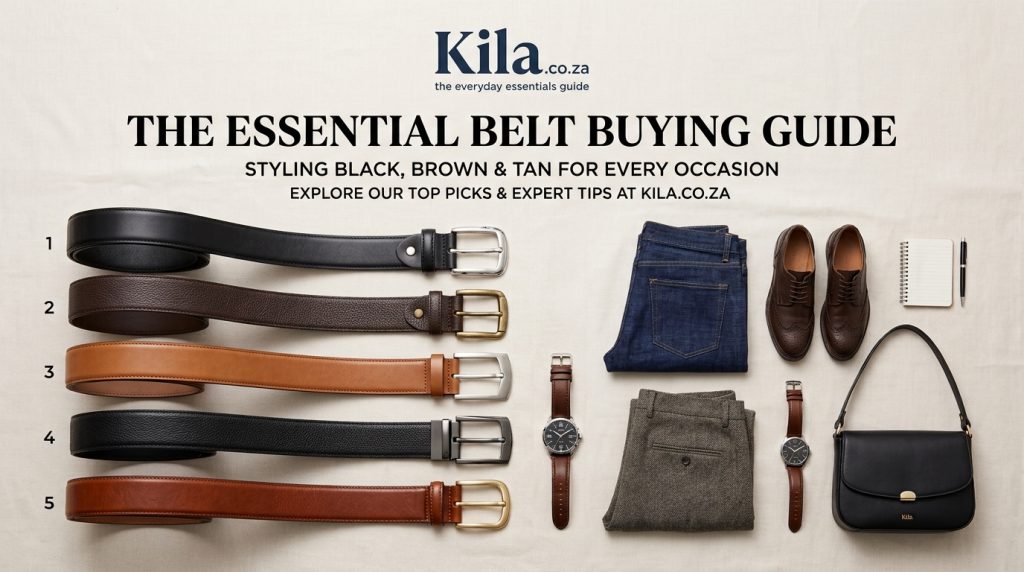
A belt may seem like a simple fashion accessory, but choosing the right one involves more than finding a colour you like.
The wrong size can be uncomfortable, the wrong material may not last, and a belt that looks good with one outfit may not work with another. There are also different belt widths, buckle styles and materials to consider.
Whether you are looking for an everyday belt, a smart leather belt or something to complete a particular outfit, understanding what to look for can make buying much easier.
Here is what to consider when choosing the right belt.
1. Start With How You Intend to Wear It
Before looking at colours and designs, think about what you actually need the belt for.
A belt can be:
- A practical accessory for holding trousers in place
- A smart accessory for business clothing
- A casual addition to jeans or chinos
- A fashion statement
- A way to define the waist when wearing certain outfits
You may find that one belt cannot do everything.
A simple everyday belt may be ideal for jeans and casual trousers, while a narrower leather belt may work better with formal clothing.
2. Get the Right Belt Size
Size is one of the most important considerations when buying a belt online.
Belts are commonly described using a waist measurement or the distance from the buckle to the centre hole.
Unfortunately, sizing is not completely standard between brands.
A belt marked as 90 cm by one manufacturer may not fit exactly the same as a 90 cm belt from another.
Check the manufacturer’s size guide
When buying online, always check the seller’s own measurements rather than assuming your normal clothing size will automatically correspond to the correct belt size.
If possible, measure a belt that currently fits you well and compare that measurement with the manufacturer’s sizing information.
Remember that your trouser size and your belt size are not necessarily identical.
3. Consider the Number of Holes
Traditional belts usually have several holes so that the fit can be adjusted.
A belt that fits comfortably around the middle hole gives you some room for adjustment.
If you are buying a belt that is only just large enough or requires using the very first or last hole, another size may be more suitable.
Some modern belts use a ratchet or track system instead of traditional holes. These can provide finer adjustment.
4. Choose the Right Belt Width
Belt width can make a surprising difference to both comfort and appearance.
Narrow belts
Narrow belts can work well with:
- Dress trousers
- Formal clothing
- Certain dresses and skirts
- More delicate outfits
- Some women’s fashion styles
Medium-width belts
A medium-width belt is often a versatile everyday choice.
It can work with:
- Chinos
- Casual trousers
- Jeans
- Smart-casual clothing
Wider belts
Wider belts are generally more casual and can make a stronger visual statement.
They may work particularly well with:
- Jeans
- Casual clothing
- Outdoor-inspired outfits
- Certain fashion looks
The belt should also fit comfortably through the loops on the trousers or jeans you intend to wear it with.
5. Leather Belts
Leather remains one of the most popular belt materials.
A good leather belt can be suitable for both everyday and smart-casual wear, depending on its construction and finish.
When looking at a leather belt, consider:
- Type of leather
- Thickness
- Surface finish
- Stitching
- Edge finishing
- Buckle quality
- Flexibility
Not every belt described as “leather” will have the same construction or durability.
If longevity is important, look at the product description carefully rather than choosing based purely on appearance.
6. Genuine Leather, Full-Grain and Other Descriptions
Leather terminology can be confusing.
Different sellers may use terms such as:
- Full-grain leather
- Top-grain leather
- Genuine leather
- Bonded leather
- Synthetic leather
- Vegan leather
These descriptions refer to different materials or manufacturing processes.
Rather than assuming that one label automatically means a particular level of quality, look at the complete product description and construction.
For online purchases, photographs showing the edges, buckle and surface can also be useful.
7. Synthetic and Vegan Belts
Not everyone wants a leather belt.
Synthetic and vegan alternatives are available in a wide range of styles and prices.
Potential advantages include:
- Wide choice of colours
- Lower price options
- Consistent appearance
- Easy availability
- Alternatives for people who don’t want animal leather
However, durability can vary considerably between products.
Check what material is actually being used and look at customer reviews where available.
8. Choose the Buckle Carefully
The buckle is one of the most noticeable parts of a belt.
Traditional buckle styles include:
- Pin buckles
- Automatic or ratchet buckles
- Slide buckles
- Reversible buckles
- Decorative buckles
For a smart wardrobe, a relatively simple buckle is usually easier to combine with different outfits.
For casual or fashion wear, you have considerably more freedom to choose a distinctive buckle.
9. Match the Belt With Your Shoes
One of the traditional rules of dressing is to coordinate your belt with your shoes.
This is particularly useful with formal clothing.
For example:
Black shoes → black belt
Brown shoes → brown belt
The exact shade does not always need to be identical, particularly with casual clothing. But coordinating the overall colour family usually creates a more deliberate appearance.
With jeans and casual clothing, there is considerably more flexibility.
10. Think About the Buckle Finish
The colour of the buckle can also influence how well a belt works with the rest of your outfit.
Common finishes include:
- Silver
- Stainless steel
- Gold
- Brass
- Black
- Gunmetal
You don’t necessarily need to match every piece of metal in your outfit perfectly.
However, if you are creating a formal or coordinated look, keeping metal finishes reasonably consistent can make the outfit look more polished.
11. Consider Belt Colour
Black and brown are generally the most versatile belt colours.
A black belt can work particularly well with:
- Black trousers
- Grey trousers
- Darker formal clothing
- Black shoes
Brown belts can be useful with:
- Blue jeans
- Chinos
- Khaki clothing
- Brown shoes
- Earth-tone outfits
Other colours can be useful when you are buying a belt specifically as a fashion accessory.
Tan, navy, burgundy and other shades can add interest to an outfit without necessarily being as versatile as black or brown.
12. Think About the Trousers You Wear Most
Your wardrobe should influence your belt purchase.
If you mostly wear jeans, a casual leather or canvas belt may be more useful than a very formal dress belt.
If you regularly wear business trousers, a slimmer, more understated belt may make more sense.
If you wear a mixture of styles, start with one versatile belt before buying several specialised designs.
13. Belt Loops Matter
A belt should fit comfortably through the loops of the trousers or jeans you intend to wear.
Before buying an unusually wide belt, check the loop dimensions.
A very wide fashion belt may not fit through standard trouser loops.
Similarly, a very narrow belt can look out of proportion when worn with heavy denim.
14. Consider Reversible Belts
A reversible belt can provide two colours in one accessory.
The traditional combination is:
Black on one side + brown on the other
This can be useful if you want to reduce the number of belts in your wardrobe.
However, check the buckle mechanism before buying.
A reversible belt needs a buckle designed to rotate or detach so that the other side can be used.
15. Ratchet Belts Offer Fine Adjustment
Traditional belts normally have several holes.
Ratchet belts use a track or series of positions, allowing smaller adjustments.
Potential advantages include:
- More precise fitting
- No need to choose between widely spaced holes
- Easy adjustment
- Clean appearance
The mechanism does add another component that can eventually wear or fail, so construction quality still matters.
16. Look at the Construction
When buying a belt, don’t concentrate only on the front surface.
Look closely at:
- Stitching
- Edges
- Buckle attachment
- Material thickness
- Backing
- Rivets
- Adjustment holes
- Finish
A belt that looks attractive in a product photograph may not necessarily be well constructed.
Close-up photographs and customer reviews can provide useful additional information when shopping online.
17. Check the Belt’s Flexibility
A belt should provide support without feeling unnecessarily stiff.
A very stiff belt may be appropriate for certain heavy-duty or work applications, but it may not be comfortable for everyday clothing.
For everyday wear, look for a balance between:
Support + flexibility + comfort
The ideal balance depends on the material and how the belt is intended to be used.
18. Think About Comfort
You may wear an everyday belt for many hours, so comfort matters.
Consider:
- Belt thickness
- Material flexibility
- Buckle size
- Buckle edges
- Where the buckle sits
- Whether the belt digs into your waist
- Whether the adjustment range suits you
A fashionable belt that becomes uncomfortable after an hour may spend more time in the cupboard than around your waist.
19. Buying Belts Online
Belts are relatively easy to buy online, but sizing deserves particular attention.
Before ordering, check:
- Manufacturer’s size chart
- Belt length
- Belt width
- Material
- Buckle dimensions
- Colour
- Return policy
- Customer reviews
If measurements are given, compare them with a belt you already own.
Don’t rely solely on the size you normally buy in trousers.
20. Be Careful With Product Photography
Product photographs can sometimes make belts appear different from how they look in real life.
Colour can vary depending on:
- Lighting
- Camera settings
- Screen settings
- Image editing
This is particularly important with brown, tan and other shades where relatively small differences can affect how well the belt coordinates with your clothing.
Customer photographs can sometimes provide a more realistic impression.
21. Don’t Overpay for a Belt Just Because of the Brand
Brand name can influence price considerably.
That doesn’t automatically mean that a branded belt will be the best choice for your needs.
Compare:
- Material
- Construction
- Buckle quality
- Comfort
- Warranty or returns
- Reviews
- Overall design
A simple, well-made belt can be more useful than an expensive belt that doesn’t suit your wardrobe.
22. How Many Belts Do You Actually Need?
You don’t necessarily need a large collection.
A practical starting wardrobe could include:
One everyday belt
A versatile brown or black belt suitable for jeans, chinos and casual trousers.
One smarter belt
A relatively simple belt suitable for dress trousers and more formal occasions.
Optional fashion belt
A more distinctive belt if accessories are an important part of your personal style.
This approach allows you to build a useful collection without buying belts that rarely get worn.
23. Common Belt-Buying Mistakes
Buying the wrong size
Always check the manufacturer’s measurements.
Choosing only by appearance
A belt needs to be comfortable and functional as well as attractive.
Ignoring belt width
Make sure it fits through your trouser loops.
Buying a formal belt for casual clothing
A very formal belt may look out of place with jeans.
Buying a casual belt for formal clothing
The opposite can also create a mismatched appearance.
Ignoring construction
Check stitching, edges, buckle attachment and material.
Choosing the cheapest option
Price is useful for comparison, but construction and durability also matter.
Buying too many belts
Start with versatile options and add specialist styles only when you actually need them.
24. A Simple Belt-Buying Checklist
Before buying a belt, ask:
- Is the size correct?
- Have I checked the manufacturer’s measurements?
- Is the width suitable for my trousers?
- Is the material appropriate for how I’ll use it?
- Is the buckle suitable for my style?
- Does the colour work with my wardrobe?
- Does it coordinate with my shoes?
- Is the construction good?
- Are the edges and stitching finished properly?
- Is it comfortable?
- Have I checked customer reviews?
- Can I return it if the size is wrong?
Final Thoughts
The right belt should be comfortable, practical and appropriate for the clothes you intend to wear it with.
For most people, it makes sense to start with versatile colours and styles rather than buying a large collection. Pay particular attention to sizing when shopping online, because belt measurements are not always directly equivalent to trouser sizes.
Once you have the basics covered, belts can also become an easy way to add personality to an outfit.
A well-chosen belt may be a small part of your wardrobe, but it can make a noticeable difference to the finished look.