
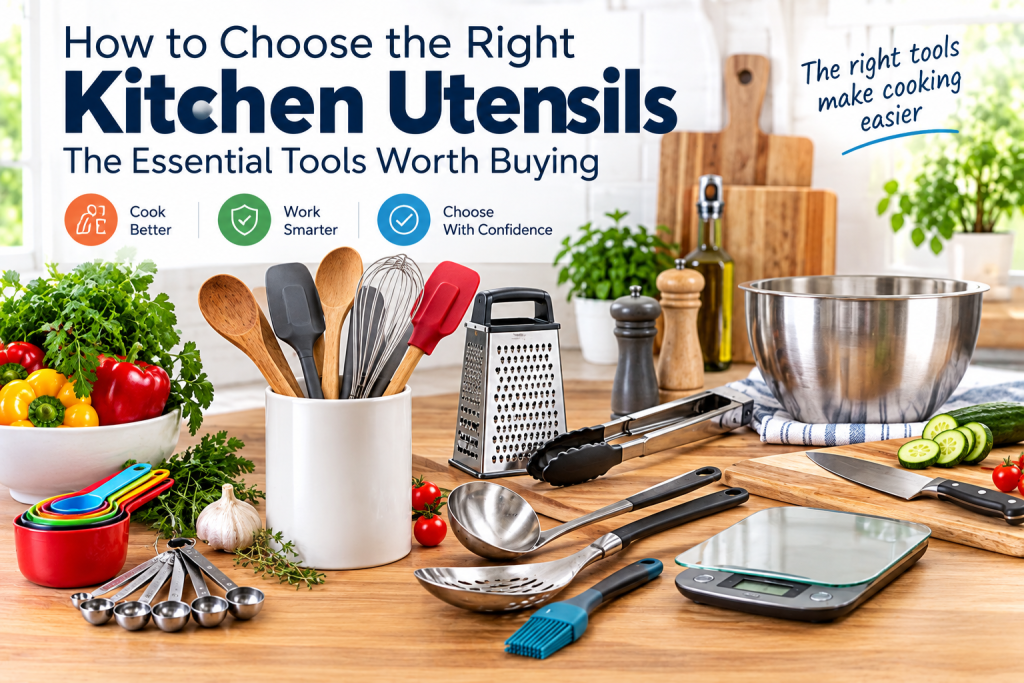
You don’t need a kitchen cupboard overflowing with specialist tools to cook good food.
In fact, many households accumulate kitchen utensils over the years without ever considering whether they are actually useful. A drawer full of poorly designed spatulas, tongs, whisks and miscellaneous gadgets can take up valuable space while the few tools you use regularly are nowhere to be found.
The better approach is to build a collection around the way you actually cook.
The right kitchen utensils should be comfortable, durable, easy to clean and suited to the cookware you use.
This guide looks at the essential kitchen utensils worth considering, what to look for when buying them and which features may not be worth paying extra for.
How to Choose the Right Cutting Board for Your Kitchen
What Counts as a Kitchen Utensil?
The term “kitchen utensil” covers a surprisingly broad range of tools.
It can include everyday items such as:
- Spatulas
- Wooden spoons
- Tongs
- Whisks
- Ladles
- Slotted spoons
- Serving spoons
- Turners
- Peelers
- Graters
- Can openers
- Measuring spoons
- Measuring cups
- Potato mashers
Some items are used during cooking, while others are primarily for preparation.
The important question isn’t how many different utensils exist.
It’s:
Which ones will you actually use?
Start With the Way You Cook
Before buying a kitchen utensil set, think about your normal cooking routine.
Do you mainly:
- Cook simple family meals?
- Bake?
- Fry and sauté?
- Make soups and sauces?
- Prepare large quantities?
- Cook outdoors?
- Make elaborate meals from scratch?
Someone who mainly cooks pasta, vegetables and meat doesn’t need the same collection as an enthusiastic baker.
Likewise, someone who frequently makes sauces and soups will probably use a ladle more often than someone who rarely cooks liquid-based dishes.
Your cooking habits should determine your utensil collection.
The Basic Utensils Most Kitchens Need
While everyone’s requirements differ, there are several tools that are useful in most kitchens.
1. Spatula or Turner
A spatula—or turner—is useful for lifting and turning food during cooking.
It can be used for:
- Eggs
- Pancakes
- Burgers
- Fish
- Vegetables
- Fried foods
Look for a turner that is thin enough to slide underneath food without being flimsy.
If you use non-stick cookware, choose an appropriate material that won’t damage the cooking surface.
How to Choose the Right Cookware for Your Kitchen
2. Silicone Spatula
A flexible silicone spatula is different from a cooking turner.
It is particularly useful for:
- Scraping mixing bowls
- Folding ingredients
- Mixing batters
- Spreading icing
- Getting the last of a sauce or mixture out of a container
A good silicone spatula can be surprisingly useful.
Look for one that has a reasonably firm core but a flexible edge.
A completely floppy spatula may struggle with heavier mixtures.
3. Wooden Spoon
The humble wooden spoon remains one of the most useful kitchen tools.
It can be used for:
- Stirring sauces
- Mixing ingredients
- Stirring soups
- Cooking vegetables
- General food preparation
Wood is comfortable to hold and generally doesn’t scratch cookware.
However, wooden utensils require more care than some plastic or silicone alternatives.
They should be washed appropriately and allowed to dry thoroughly.
4. Kitchen Tongs
Tongs are essentially an extension of your hand.
They are useful for:
- Turning meat
- Handling vegetables
- Serving pasta
- Tossing salads
- Removing food from hot pans
- Grilling
A good pair should open and close smoothly and provide enough grip to hold food securely.
What to look for
Look for:
- Comfortable handles
- Strong gripping ends
- A reliable locking mechanism
- Suitable length
- Heat-resistant construction
Longer tongs can be particularly useful around hot pans and grills.
5. Whisk
A whisk is essential for many cooking and baking tasks.
It can be used to:
- Beat eggs
- Mix sauces
- Make gravy
- Combine dry ingredients
- Whip cream
- Incorporate air into mixtures
There are different styles of whisk, but a standard balloon whisk is a good general-purpose option.
If you regularly make sauces, a smaller whisk may also be useful.
6. Ladle
A ladle is particularly useful for:
- Soup
- Stews
- Sauces
- Gravy
- Curries
The bowl should hold enough food to make serving practical without becoming unnecessarily large.
A long handle can also be useful when working with deep pots.
7. Slotted Spoon
A slotted spoon allows liquid to drain while retaining solid food.
It’s useful for:
- Vegetables
- Pasta
- Fried foods
- Poached foods
- Removing ingredients from cooking liquid
The size and shape of the slots affect how useful the spoon is for different foods.
8. Potato Masher
If you regularly make mashed potatoes, a masher is a simple tool worth having.
It can also be useful for:
- Mashed vegetables
- Beans
- Soft fruit
- Some sauces
Look for a strong handle and a sturdy mashing plate.
A flimsy masher can bend when used with firmer ingredients.
9. Vegetable Peeler
A good peeler can save considerable time.
It’s useful for:
- Potatoes
- Carrots
- Apples
- Cucumbers
- Other vegetables and fruit
The blade should be sharp and the handle comfortable.
A peeler that requires excessive pressure can become tiring to use.
10. Grater
A grater can be useful for:
- Cheese
- Carrots
- Chocolate
- Citrus zest
- Ginger
- Vegetables
A box grater provides several grating surfaces and is a versatile choice.
A flat grater can take up less storage space.
If you already own a food processor with a grating disc, however, you may not need to buy a large number of additional grating tools.
How to Choose the Right Food Processor for Your Kitchen
11. Measuring Cups and Spoons
Measuring tools are particularly important for baking.
A basic set might include:
- Measuring cups
- Tablespoon
- Teaspoon
- Smaller measuring spoons
If you bake regularly, consider using a kitchen scale as well.
How to Choose the Right Kitchen Scale for Your Kitchen
Weight measurements can provide greater consistency than volume measurements for many ingredients.
12. Kitchen Scraper
A kitchen scraper can be a simple but useful tool.
It can help with:
- Dividing dough
- Scraping work surfaces
- Moving chopped ingredients
- Cleaning flour and dough from countertops
It is particularly useful if you bake bread or pizza.
What Material Should Kitchen Utensils Be Made From?
Kitchen utensils commonly use:
- Stainless steel
- Silicone
- Nylon
- Plastic
- Wood
- Bamboo
Each has advantages and disadvantages.
Stainless Steel
Stainless steel is durable, heat-resistant and easy to clean.
It’s particularly suitable for:
- Whisks
- Tongs
- Ladles
- Serving spoons
- Some turners
However, stainless steel can scratch certain cookware surfaces.
If you use non-stick cookware, check whether the utensil is appropriate.
Silicone
Silicone is popular because it is flexible and generally heat-resistant.
It’s particularly useful for:
- Spatulas
- Scrapers
- Some turners
- Baking utensils
A good silicone utensil should retain its shape without becoming excessively floppy.
Nylon
Nylon utensils can be lightweight and relatively inexpensive.
They are often used for:
- Turners
- Spoons
- Tongs
- Cooking utensils
Check the manufacturer’s temperature rating because not every nylon utensil is suitable for very high temperatures.
Wood
Wooden utensils are traditional and comfortable.
They are particularly useful for:
- Spoons
- Stirring
- General food preparation
They can be durable, but they need appropriate cleaning and drying.
Bamboo
Bamboo utensils are lightweight and can be attractive.
Like wood, they need appropriate care and should not generally be left soaking in water.
Consider the Cookware You Already Own
Your utensils should be compatible with your cookware.
This is particularly important if you use:
- Non-stick pans
- Ceramic-coated cookware
- Enamelled cookware
Metal utensils can potentially damage certain surfaces.
If protecting your cookware is important, look for utensils specifically designed for use with the type of cookware you own.
How to Choose the Right Cookware for Your Kitchen
Heat Resistance Matters
A utensil may be perfectly suitable for stirring a cold mixture but not necessarily for leaving in a hot pan.
Check the manufacturer’s stated heat resistance, particularly for:
- Silicone
- Nylon
- Plastic
Avoid leaving utensils in hot cookware unnecessarily.
Handles can become hot, materials can deteriorate and some utensils can deform when exposed to excessive temperatures.
Are Dishwasher-Safe Utensils Better?
Dishwasher compatibility can be very convenient.
However, don’t assume every utensil is dishwasher-safe.
Wooden and bamboo utensils generally require more careful cleaning.
Some silicone and stainless-steel utensils can be placed in a dishwasher, but always follow the manufacturer’s instructions.
If convenience is important to you, dishwasher compatibility is worth checking before buying.
Look at the Handle
The handle is easy to overlook.
But if you’re cooking for 30 minutes, the difference between a comfortable handle and an awkward one becomes obvious.
Look for:
- Comfortable grip
- Suitable thickness
- Secure attachment
- Non-slip surface where appropriate
- Balanced weight
A heavy metal utensil with an uncomfortable handle may be less pleasant to use than a lighter alternative.
One-Piece Construction vs Separate Handles
Some utensils are made from one continuous piece.
Others have a separate handle attached to the working end.
One-piece construction can reduce the number of joints where food and moisture can accumulate.
However, a well-designed multi-part utensil can also be durable and comfortable.
Don’t assume that one-piece construction automatically means better quality.
Inspect how the utensil is made and read reviews where available.
Do You Need a Kitchen Utensil Set?
Kitchen utensil sets can be convenient.
A typical set may contain:
- Spatula
- Spoon
- Ladle
- Tongs
- Whisk
- Slotted spoon
- Turner
Buying a set can sometimes cost less than buying individual utensils.
But there is a downside.
You may end up with several tools you rarely use.
Before buying a set, check exactly what it contains.
Ask yourself:
Would I buy each of these items individually?
If the answer is no for most of them, buying individual utensils may be better.
Don’t Buy Every Specialist Utensil
Kitchen shops contain hundreds of specialised tools.
There are gadgets for:
- Cutting specific vegetables
- Separating eggs
- Opening particular types of packaging
- Making decorative shapes
- Slicing specialised foods
- Preparing individual recipes
Some are useful.
Many are not essential.
A good basic collection of versatile utensils will usually handle far more cooking tasks than a drawer full of single-purpose gadgets.
Kitchen Utensils for Baking
If you bake regularly, your requirements change slightly.
Useful baking utensils can include:
- Silicone spatula
- Balloon whisk
- Dough scraper
- Measuring spoons
- Measuring cups
- Rolling pin
- Pastry brush
- Mixing bowls
- Kitchen scale
A stand mixer can also take over much of the mixing and kneading work.
How to Choose the Right Stand Mixer for Your Kitchen
Kitchen Utensils for Everyday Cooking
For general cooking, a practical collection might include:
- Wooden spoon
- Silicone spatula
- Turner
- Tongs
- Ladle
- Slotted spoon
- Whisk
- Vegetable peeler
- Grater
- Can opener
You don’t necessarily need all of these in multiple sizes.
Start with the tools you use most frequently.
Kitchen Utensils for Outdoor Cooking
If you regularly use a barbecue or outdoor cooker, consider utensils designed for that environment.
Useful tools can include:
- Long-handled tongs
- Long-handled turner
- Basting brush
- Meat thermometer
- Heat-resistant gloves where appropriate
Longer handles can keep your hands further from the heat.
The utensils should also be strong enough for the food and cooking method involved.
Don’t Forget a Good Can Opener
A can opener isn’t glamorous, but it is one of those tools you don’t appreciate until you need one.
Look for:
- Smooth operation
- Comfortable handle
- Strong cutting mechanism
- Easy cleaning
A poor-quality can opener can be surprisingly frustrating.
Storage Matters
Kitchen utensils can quickly create drawer clutter.
Consider how you’ll store them.
Options include:
- Kitchen drawers
- Utensil organisers
- Countertop containers
- Wall-mounted rails
- Hanging hooks
Frequently used utensils should be easy to reach.
There’s little benefit in having a great spatula if it is buried underneath 20 other tools.
Should You Buy Matching Utensils?
Matching utensils can look attractive, particularly when displayed in a countertop holder.
But appearance shouldn’t be the main consideration.
Different materials may be better suited to different tasks.
For example:
Silicone spatula: Mixing and scraping
Stainless-steel whisk: Beating and mixing
Wooden spoon: Stirring
Long-handled tongs: Handling hot food
There is nothing wrong with combining materials if each utensil performs its job well.
Buying Kitchen Utensils Online
Kitchen utensils are easy to compare online, but product descriptions don’t always tell the complete story.
Check:
Material
What is the utensil actually made from?
Dimensions
A photograph can make utensils appear larger or smaller than they really are.
Heat resistance
Particularly important for cooking utensils.
Dishwasher compatibility
Check the manufacturer’s instructions.
Handle construction
Look for secure, durable construction.
Reviews
Look for comments about:
- Bending
- Melting
- Rusting
- Handles becoming loose
- Difficult cleaning
- Actual size
- Long-term durability
What’s included
This is particularly important when buying a set.
How Much Should You Spend?
There is no need to spend a fortune on basic kitchen utensils.
However, extremely cheap utensils can sometimes be false economy if they:
- Bend easily
- Break
- Melt
- Rust
- Have uncomfortable handles
- Need replacing frequently
A better approach is to spend more on the utensils you use constantly and less on occasional-use items.
For example, if you cook every day, a good pair of tongs and a durable spatula may be worth spending more on.
Common Kitchen Utensil Buying Mistakes
Buying too many
A huge utensil collection isn’t necessarily a better kitchen.
Buying a complete set without checking the contents
You may end up paying for several items you never use.
Ignoring cookware compatibility
Metal utensils aren’t suitable for every type of cookware.
Choosing appearance over function
A beautiful utensil isn’t useful if it is uncomfortable or poorly constructed.
Ignoring heat resistance
Always check whether the material is suitable for the temperatures involved.
Buying poor-quality handles
The working end might be excellent, but a loose or uncomfortable handle can make the utensil frustrating to use.
Forgetting storage
Plan where your utensils will go before buying another collection.
A Practical Starter Collection
If you’re starting from scratch, you don’t need 20 utensils.
A sensible basic collection could include:
- Wooden or silicone cooking spoon
- Silicone spatula
- Turner
- Tongs
- Whisk
- Ladle
- Slotted spoon
- Vegetable peeler
- Grater
- Can opener
- Measuring spoons
- Kitchen scale
From there, add specialist tools only when you discover that you actually need them.
Kitchen Utensil Buying Checklist
Before buying, ask:
☐ Is this utensil something I will actually use?
☐ Is the material suitable for the job?
☐ Is it compatible with my cookware?
☐ Is it sufficiently heat-resistant?
☐ Is the handle comfortable?
☐ Is it strong enough for the task?
☐ Is it easy to clean?
☐ Is it dishwasher-safe if that’s important to me?
☐ Will it fit my available storage space?
☐ If buying a set, will I use most of the included items?
☐ Does the price reflect the quality and frequency of use?
☐ Can replacement items or parts be obtained if necessary?
Final Thoughts
A well-equipped kitchen doesn’t need to contain every utensil available in the shops.
The most useful collection is usually a relatively small group of reliable, versatile tools that you actually use.
For most kitchens, that means starting with basics such as a spatula, spoon, tongs, whisk, turner, ladle, peeler and grater, then adding specialist utensils as your cooking develops.
Pay particular attention to material, heat resistance, cookware compatibility, handle comfort, cleaning and durability.
And don’t automatically assume that a large matching utensil set represents better value. Sometimes buying a handful of good individual tools will give you a more useful kitchen with considerably less clutter.
Your kitchen equipment should make cooking easier—not create another cupboard that needs organising.
Choose the tools you actually need, buy them well, and let the rest stay in the shop.