
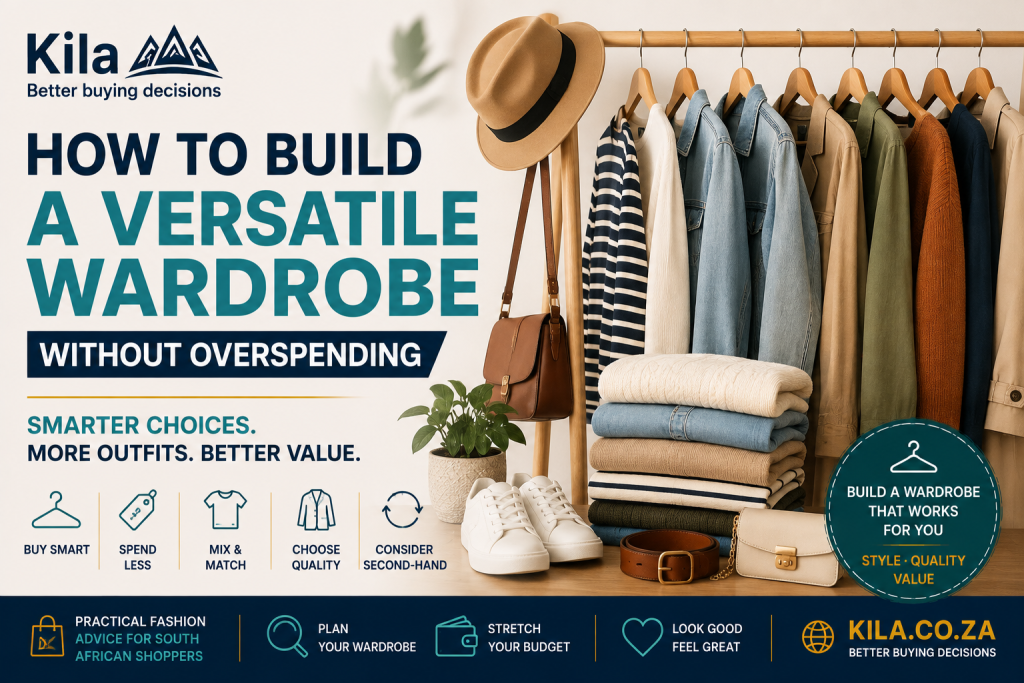
Building a wardrobe doesn’t have to mean constantly buying new clothes.
In fact, one of the easiest ways to spend too much on clothing is to buy individual items simply because they look attractive, are on sale or happen to be fashionable at the time.
A more useful approach is to think about your wardrobe as a collection of clothes that work together.
The goal isn’t necessarily to own hundreds of items. It’s to have enough useful clothing to cover your everyday needs, while making it easy to put outfits together without constantly wondering what to wear.
For South African shoppers, that can also mean combining new clothing with sales, clearance purchases and good-quality pre-owned items.
Here is how to approach your new outlook on your style and fashion.
Start by looking at what you already own
Before buying anything, take a good look at your existing wardrobe.
You may already have more usable clothing than you realise.
Separate your clothes into a few simple groups:
- Items you wear regularly
- Items you occasionally wear
- Items you rarely wear
- Items that no longer fit your lifestyle
- Items that need repairing
- Items that are worn out
This exercise can reveal gaps that actually need filling.
It can also prevent you from buying another version of something you already have.
Ask yourself three questions
Before buying an item, ask:
Do I need it?
Can I wear it with clothes I already own?
Will I realistically wear it often?
If the answer to all three is yes, the purchase is more likely to add genuine value to your wardrobe.
Think about your lifestyle
A versatile wardrobe should reflect the way you actually live.
Someone who works in an office five days a week will have different clothing requirements from someone who works from home.
Likewise, a person who spends most of their free time outdoors will have different priorities from someone who frequently attends social events.
Consider where you actually spend your time.
For example:
- Work
- Casual outings
- Social occasions
- Exercise
- Holidays
- Formal events
- Everyday activities
Build your wardrobe around those requirements rather than around what happens to be popular in fashion advertising.
Choose clothes that work together
One of the biggest advantages of a versatile wardrobe is that individual pieces can be combined in multiple ways.
A shirt that works with only one pair of trousers has limited versatility.
A shirt that works with several trousers, jeans or skirts can become one of the more useful pieces in your wardrobe.
When shopping, consider the combinations rather than the individual item.
Before buying something new, ask:
“How many outfits could I realistically create with this?”
If the answer is only one, think carefully before buying it.
Don’t confuse versatile with boring
A versatile wardrobe doesn’t have to consist entirely of plain, neutral clothing.
Colour, patterns and distinctive pieces can make a wardrobe more interesting.
The key is balance.
You might choose relatively easy-to-combine everyday clothing and then use a smaller number of distinctive pieces to add personality.
This approach can give you variety without requiring a completely different wardrobe for every occasion.
Spend more carefully on frequently worn items
Not every item of clothing deserves the same budget.
Think about how frequently you are likely to wear something.
A basic item that you expect to wear several times a week may justify spending more on quality if the additional cost results in better durability and comfort.
A highly specific item that you may wear only once or twice might not deserve the same investment.
This is where cost per wear can be useful.
What is cost per wear?
Cost per wear is a simple way of thinking about the value of clothing.
For example, imagine you spend R600 on a jacket.
If you wear it 60 times, the purchase has effectively cost you:
R600 ÷ 60 = R10 per wear
Compare that with a R300 item that you wear only three times:
R300 ÷ 3 = R100 per wear
The cheaper item isn’t necessarily the better value.
This doesn’t mean that you should always buy expensive clothing. It simply means that purchase price alone doesn’t tell the whole story.
Don’t automatically buy something because it’s on sale
Sales can be useful, but they can also encourage unnecessary purchases.
A 50% discount isn’t saving you money if you wouldn’t have bought the item in the first place.
Before buying sale clothing, ask:
- Would I buy this at the normal price?
- Do I actually need it?
- Does it work with my existing wardrobe?
- Is my size available?
- Is the item likely to get regular use?
A genuine bargain is something that gives you useful value.
A discounted item that remains unworn in your cupboard isn’t a bargain.
Consider second-hand clothing
Buying pre-owned clothing can be another way to stretch your budget.
It can allow you to find:
- Better-quality garments at lower prices
- Older styles that are no longer widely available
- Designer or premium items
- Vintage pieces
- Clothing that has been lightly used
However, buying second-hand requires a little more attention.
Check the condition carefully before purchasing.
Look for:
- Stains
- Tears
- Missing buttons
- Damaged zips
- Excessive wear
- Alterations
- Accurate sizing information
Also check the seller’s reputation and the platform’s policies.
Buying second-hand online
Kila’s guide on how to shop for second-hand clothing online in South Africa provides more detailed advice on checking condition, measurements, seller information, pricing and delivery before buying.
Online second-hand clothing platforms, like Yaga, make it possible to search for specific items rather than relying entirely on what happens to be available in local stores.
When you buy at Yaga also take into account that you can also register to sell your unused clothing items there as well.
Know your measurements
One of the biggest problems when buying clothing online is sizing.
Don’t assume that a particular size will be identical across every brand.
Instead, check the retailer’s sizing information and, where possible, compare it with measurements from clothing you already own that fits well.
Depending on the item, useful measurements may include:
- Chest
- Waist
- Hips
- Shoulder width
- Sleeve length
- Inside leg
- Garment length
This becomes particularly important when buying second-hand clothing online.
Quality matters more than labels
A well-known brand isn’t automatically better quality than a less expensive brand.
When assessing clothing, look at the actual garment.
Check:
- Fabric composition
- Stitching
- Seams
- Buttons
- Zips
- Lining
- Fabric thickness
- Overall construction
A garment doesn’t have to carry an expensive label to be useful and durable.
Likewise, a familiar brand name shouldn’t be used as a substitute for checking quality.
Learn to read fabric labels
The fabric composition can tell you a lot about a garment.
Common materials include:
- Cotton
- Linen
- Wool
- Polyester
- Nylon
- Viscose
- Elastane
- Blended fabrics
Each has different characteristics.
For example, some fabrics may be valued for breathability, while others may offer stretch, durability or easier care.
There isn’t one material that is automatically best for every item.
Instead, consider whether the fabric is appropriate for the way you intend to use the garment.
Think about South Africa’s different climates
South Africa has a wide variety of climates, so your wardrobe needs may depend heavily on where you live and travel.
Someone living in a warmer region may have very different requirements from someone experiencing colder winters.
If you travel regularly, consider whether your wardrobe can adapt to different conditions.
Layering can be particularly useful because several lighter garments can sometimes provide more flexibility than buying completely separate wardrobes for different temperatures.
Build around a few reliable basics
A versatile wardrobe generally benefits from having a foundation of dependable everyday pieces.
Depending on your lifestyle, these might include:
- Comfortable trousers or jeans
- Everyday shirts or tops
- A versatile jacket
- Comfortable shoes
- Smart-casual clothing
- Clothing suitable for work
- Clothing for social occasions
The exact list should be determined by your lifestyle rather than by a generic “must-have” list.
There is little value in buying a wardrobe essential simply because someone on the internet says everybody needs one.
Don’t forget your shoes
Shoes can have a significant impact on how versatile your wardrobe is.
A small collection of shoes covering different needs can often be more useful than owning numerous pairs that serve essentially the same purpose.
Think about your actual requirements:
- Everyday casual
- Work
- Smart occasions
- Outdoor activities
- Exercise
- Walking
Comfort and durability should be considered alongside appearance.
Accessories can change an outfit
Accessories can provide variety without requiring a completely new outfit.
Depending on your personal style, these could include:
- Belts
- Handbags
- Scarves
- Jewellery
- Watches
- Hats
- Sunglasses
Because accessories are often smaller purchases, they can provide a relatively inexpensive way of changing the appearance of an existing outfit.
However, the same rule still applies:
Buy accessories because they add value to your wardrobe, not simply because they’re on sale.
Create a shopping list before you browse
Online shopping makes it extremely easy to buy things you weren’t planning to purchase.
A simple shopping list can help.
For example:
This month I need:
☐ One pair of everyday trousers
☐ One versatile top
☐ Comfortable everyday shoes
☐ Lightweight jacket
You can then search specifically for those items.
This turns shopping from an open-ended browsing exercise into a more controlled buying decision.
Compare prices before buying
The first price you see isn’t necessarily the best price.
Before buying an item, consider searching several retailers.
Compare:
- Selling price
- Original price
- Current promotion
- Delivery charges
- Return policy
- Available sizes
- Material
- Customer reviews
Sometimes a slightly more expensive garment from one retailer can offer considerably better value than a cheaper alternative.
Consider buying from different types of retailers
There isn’t any reason your entire wardrobe needs to come from one retailer.
You might buy:
Everyday basics from one retailer.
Something more distinctive from another.
Pre-owned clothing from a second-hand platform.
A higher-quality investment piece from a specialist retailer.
This approach allows you to focus on value rather than brand loyalty.
Don’t overlook pre-owned and clearance clothing
If your primary objective is getting more clothing value for your money, consider three sources:
New clothing
Good for predictable sizing, current collections and broad availability.
Sale and clearance clothing
Useful when you already know what you need and can find a genuine discount.
Second-hand clothing
Potentially useful for finding quality garments at substantially lower prices.
None of these approaches is automatically superior.
The best choice depends on the individual item and the value you’re getting.
A simple wardrobe-building strategy
If you’re starting from scratch or rebuilding your wardrobe, don’t try to buy everything at once.
Instead:
Step 1: Identify the gaps
Work out what you actually need.
Step 2: Prioritise
Buy the items that will get the most use first.
Step 3: Set a budget
Decide how much you can comfortably spend.
Step 4: Compare
Look at several retailers and options.
Step 5: Consider second-hand
Check whether the item is available pre-owned at a worthwhile price.
Step 6: Think about versatility
Make sure the new item works with clothing you already own.
Step 7: Review before buying
Give yourself a little time before making non-essential purchases.
This simple process can substantially reduce impulse buying.
A practical checklist before buying clothes
Before clicking Buy Now, ask yourself:
☐ Do I actually need this?
☐ Can I wear it with several things I already own?
☐ Is the size correct?
☐ Have I checked the measurements?
☐ Is the material suitable?
☐ Does the quality justify the price?
☐ Have I compared prices elsewhere?
☐ Have I checked delivery costs?
☐ Can I return it if it doesn’t fit?
☐ Would I still want it if it wasn’t on sale?
☐ Am I buying it because I need it or because the discount looks attractive?
If you can answer these questions confidently, you’re much more likely to make a worthwhile purchase.
Final thoughts
Building a versatile wardrobe isn’t about owning as many clothes as possible.
It’s about making better choices with the money you spend.
Buy clothes that suit your lifestyle, look for pieces that work with what you already own, pay attention to quality and don’t be afraid to consider sales or second-hand clothing when the value makes sense.
Most importantly, don’t let fashion retailers determine what you need.
Decide what you need first, then go shopping for it.
That’s ultimately the principle behind Kila: better buying decisions rather than simply more buying.