
Your home is made up of countless choices, from the furniture you live with every day to the products that make your space more comfortable, practical and enjoyable. Home & Living is about making those choices with confidence.
From choosing the right sofa and improving your living space to comparing household products and finding practical solutions for everyday life, our Home & Living guides are designed to help you get more value from your home.
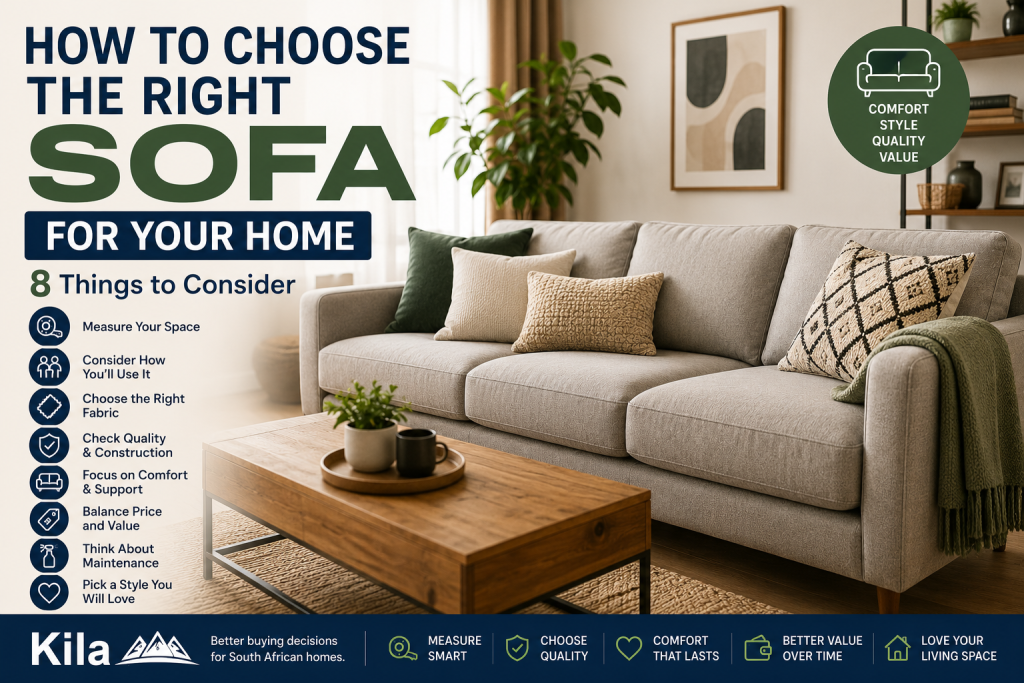
In this guide, we start with one of the most important pieces of furniture in your living room: the sofa. Before choosing one based simply on appearance, we’ll look at the factors that really matter — size, comfort, construction, upholstery, durability and value for money.
1. Measure Your Room Before Looking at Sofas
It is tempting to start browsing furniture websites and showrooms before getting out the tape measure. That’s often the wrong way around.
Start with the space.
Measure:
- The length of the wall where the sofa will stand
- The available floor space
- Doorways
- Passageways
- Staircases
- Other furniture that will remain in the room
Remember that a sofa that technically fits against a wall can still make a room feel cramped if it is too deep.
One useful approach is to mark the proposed sofa footprint on the floor using masking tape. This gives you a much better idea of how much space the sofa will actually occupy before you spend any money.
Don’t forget the delivery route
This is one of the easiest mistakes to make.
Your sofa might fit perfectly into the living room but be impossible to get through the front door or around a tight corner.
Measure the narrowest parts of the route from the point where the sofa will be unloaded to its final position. If you’re buying online, also ask the retailer for the packaged dimensions, particularly if the sofa arrives assembled.
2. Think About How You Will Actually Use the Sofa
There is no universally “best” sofa.
The best sofa for a formal living room may be completely unsuitable for a family that spends several hours a day watching television.
Ask yourself:
- Will the sofa be used mainly for entertaining?
- Will the family use it every day?
- Do you like sitting upright or stretching out?
- Will children regularly use it?
- Do you have pets?
- Do you occasionally sleep on it?
- Do you need somewhere that is easy to get in and out of?
These questions should influence your choice of size, depth, upholstery, cushion filling and overall design.
For example, a deep, low sofa might be wonderfully comfortable for lounging but less suitable if you prefer a more upright sitting position.
3. Choose the Right Sofa Size
The number of seats isn’t the only consideration.
A three-seater sofa can vary considerably in overall width and usable seating space depending on the design.
Look at:
Overall width:
How much wall or floor space does the sofa occupy?
Overall depth:
How far does it extend into the room?
Seat depth:
How much usable space is there from the front of the seat to the backrest?
Seat height:
How easy is it to sit down and get back up?
Inside seat width:
How much actual seating space is available between the arms?
Two sofas with similar external dimensions can feel very different because of differences in arms, cushions and seat proportions.
Comfort is particularly personal. Shallower seating generally suits a more upright sitting position, while deeper seating tends to be better suited to relaxing and lounging.
4. Choose Upholstery for Your Lifestyle
The fabric or upholstery isn’t simply a colour decision.
Think about how much use the sofa will receive and how easy it needs to be to maintain.
Fabric
Fabric sofas are available in an enormous range of colours, textures and price points.
They can be a good choice when you want plenty of styling options, but check the manufacturer’s cleaning instructions and, where available, information about durability.
Leather
Leather can offer a different look and feel and may be particularly appealing if you want an upholstery material that can be wiped clean relatively easily.
However, leather quality varies considerably, so don’t assume that every sofa described as “leather” will have the same characteristics.
Performance and easy-care fabrics
If your sofa is going to experience heavy everyday use, children, pets or frequent entertaining, practical considerations should probably take priority over choosing the most delicate-looking fabric.
If you’re buying online, look for information about:
- Fabric composition
- Cleaning instructions
- Durability
- Stain resistance
- Warranty
- Whether replacement covers are available
For South African homes, also consider how much direct sunlight the sofa receives. Fabric selection can make a significant difference to how well the sofa continues to look over time.
5. Don’t Ignore the Frame
The frame is essentially the skeleton of the sofa.
Unfortunately, it is also something you can’t see once the sofa has been upholstered.
When comparing sofas, look for clear information about the frame construction rather than simply assuming that a higher price means better construction.
Quality furniture commonly uses robust frame construction and properly reinforced joints. Some manufacturers specify solid timber or engineered timber construction, while others provide little useful information at all.
If you’re shopping in a showroom, don’t be afraid to ask:
What is the frame made from and how are the joints constructed?
If the salesperson cannot provide a meaningful answer, that should form part of your purchasing decision.
6. Pay Attention to the Cushions
The cushions have an enormous effect on how a sofa feels.
Common filling options include:
Foam
Foam tends to provide a more supportive and structured feel and generally retains its shape well.
Fibre
Fibre fillings can provide a softer feel while still offering reasonable support.
Feather or down
These can provide a particularly soft, relaxed feel but normally require more maintenance and regular reshaping.
Combination fillings
Some sofas combine different materials, such as a foam core with a softer fibre or feather layer. This can provide a compromise between support and softness.
There is no single correct choice.
If possible, sit on the actual sofa before buying it.
If you’re buying online, pay close attention to the manufacturer’s description of the cushion construction rather than relying solely on photographs.
7. Think About Maintenance Before You Buy
A sofa can look fantastic when it is brand new. The more important question is what it will look like after several years of everyday use.
Consider:
- Can the cushion covers be removed?
- Are replacement covers available?
- What cleaning methods are recommended?
- Is the fabric suitable for your household?
- Are individual cushions replaceable?
- What does the warranty cover?
Removable covers can be particularly useful because they make cleaning and eventual replacement easier.
If you have children or pets, don’t choose upholstery based purely on appearance. A slightly less glamorous fabric that is practical and easy to maintain may prove to be the better purchase.
8. Don’t Judge a Sofa by Its Appearance Alone
This is perhaps the most important point.
A sofa can look wonderful in a photograph and still be wrong for you.
Before making your decision, consider the complete package:
Size + comfort + construction + upholstery + maintenance + price
Rather than simply asking:
“Do I like the way it looks?”
If you’re buying from a physical retailer, sit on the sofa for several minutes rather than simply sitting down for a few seconds.
Try your normal sitting position.
Lean back.
Check whether your feet sit comfortably.
Try the seat depth.
Consider whether the arm height works for you.
If you’re buying online, look for detailed specifications, customer reviews and a clear returns and warranty policy. Some South African furniture retailers now provide detailed specifications and even showroom opportunities so customers can assess comfort before ordering.
What About Price?
A more expensive sofa isn’t automatically a better sofa.
At the same time, choosing solely on the lowest price can be a false economy if the furniture doesn’t stand up to regular use.
Instead, compare what you’re actually getting for the money.
For example:
| What to compare | Why it matters |
|---|---|
| Dimensions | Determines whether it fits your room |
| Frame construction | Influences durability |
| Cushion filling | Affects comfort and support |
| Upholstery | Influences appearance and maintenance |
| Warranty | Provides some protection after purchase |
| Replacement parts/covers | Can extend useful life |
| Delivery | Important for large furniture |
| Reviews | Provides experience beyond the product description |
The goal isn’t necessarily to buy the cheapest sofa or the most expensive sofa.
It’s to find the best overall value for the way you will use it.
A Simple Sofa Buying Checklist
Before you place your order, make sure you can answer “yes” to these questions:
☐ Have I measured the available space?
☐ Have I measured the delivery route?
☐ Does the sofa suit the way I actually use my living room?
☐ Is the seat depth comfortable for me?
☐ Is the seat height suitable?
☐ Do I understand what the frame is made from?
☐ Do I know what the cushions are filled with?
☐ Is the upholstery suitable for my household?
☐ Do I understand the cleaning requirements?
☐ Have I checked the warranty?
☐ Have I read reviews from actual customers?
☐ Does the price make sense compared with the quality and specifications?
If you’ve answered all of these, you’re in a much better position to make an informed decision.
Final Thoughts
Choosing a sofa shouldn’t start with “Which one looks nicest?”
It should start with “What do I need this sofa to do?”
Measure the room, consider your lifestyle, understand the materials and construction, test the comfort where possible and compare the complete package rather than the headline price.
A little research before buying can prevent an expensive piece of furniture from becoming something you regret every time you sit down.
And that’s exactly what Kila is about: helping you make better buying decisions.