
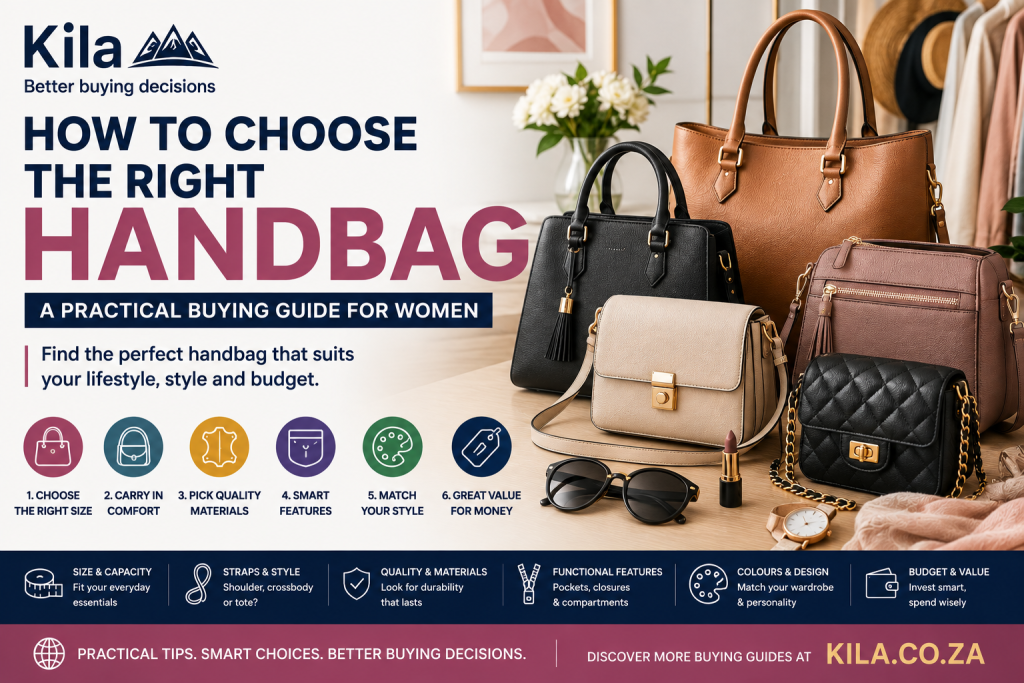
A handbag is more than just something to carry your belongings in. For many women, it is an everyday essential that needs to combine practicality, comfort, durability and personal style. Handbags and sunglasses are among the most popular fashion accessories.
The problem is that there are countless handbags to choose from. Different sizes, shapes, materials, colours and designs can make the decision surprisingly difficult.
The most expensive handbag isn’t necessarily the best choice, and the latest fashion trend may not suit the way you actually live.
The better approach is to start with your needs.
In this Style & Fashion guide, we’ll look at the things that really matter when choosing a handbag, from size and style to materials, functionality and value for money.
1. Start by Thinking About How You Will Use It
Before looking at colours or designs, ask yourself a simple question:
What do I actually need this handbag to do?
A handbag used every day for work will have different requirements from one used occasionally for evenings out.
For example, you might need to carry:
- Your phone
- Wallet or purse
- Keys
- Sunglasses
- Makeup
- Small personal items
- A water bottle
- Documents or a tablet
If you’re buying a handbag for everyday use, practicality should probably take priority over appearance alone.
On the other hand, a small handbag for an evening occasion may only need to accommodate a phone, cards, keys and a few essentials.
The best handbag is one that matches your actual lifestyle.
2. Choose the Right Size
Size is one of the easiest things to get wrong.
A handbag that looks attractive in a photograph may be frustrating to use if it doesn’t hold what you need.
Small handbags
Small handbags are useful when you want to carry only a few essentials.
They can work particularly well for:
- Evening occasions
- Restaurants
- Social events
- Shopping trips when you don’t want to carry much
The downside is obvious: there is limited space.
Medium handbags
For many people, a medium-sized handbag offers a good compromise between capacity and portability.
It can usually accommodate everyday essentials without becoming unnecessarily bulky.
Large handbags
Larger handbags provide considerably more carrying capacity.
They can be useful for work, travelling or situations where you need to carry additional items.
However, there’s an important downside:
The more space you have, the more likely you are to fill it.
A large handbag can quickly become heavy and uncomfortable.
3. Consider the Weight
The weight of the handbag itself is often overlooked.
A handbag may feel perfectly comfortable when empty but become surprisingly heavy once you’ve added everything you normally carry.
This is particularly important if you carry your handbag for several hours at a time.
When comparing bags, consider both:
The weight of the handbag itself + the weight of everything you intend to put inside it.
If you’re choosing an everyday bag, a lightweight design can be a significant advantage.
4. Think About How You Prefer to Carry It
Different handbag designs offer different carrying options.
Shoulder bags
Shoulder bags are designed to hang from one shoulder and are often convenient for everyday use.
They can provide easy access while leaving both hands relatively free.
Crossbody bags
Crossbody bags have a longer strap designed to sit across the body.
They can be particularly practical when shopping, travelling or walking because the bag stays relatively secure while your hands remain free.
A crossbody handbag can therefore be a particularly useful option for travel.
Tote bags
Tote bags are generally larger and open at the top or have a simple closure.
They’re useful when you need to carry more items, although the lack of compartments on some designs can make smaller belongings harder to find.
Handbags with top handles
These are carried primarily by hand or the forearm.
They can provide a more structured and polished appearance, although they aren’t always as convenient when you need both hands free.
Backpacks
Although technically different from a conventional handbag, a stylish backpack can be a useful alternative where carrying comfort and capacity are priorities.
5. Check the Strap
The strap can have a surprisingly large effect on comfort.
If you are buying an everyday handbag, look at:
- Strap width
- Strap length
- Adjustability
- Padding
- Attachment points
- Whether the strap can be removed
A narrow strap can dig into your shoulder when carrying a heavier bag.
An adjustable strap is particularly useful because it allows you to change how the handbag sits.
If you like to change the way you carry your bag, a removable or interchangeable strap can also provide additional versatility.
6. Look at the Compartments
A handbag doesn’t need dozens of pockets to be practical.
In fact, too many compartments can sometimes make it difficult to remember where you’ve put things.
However, a few well-designed compartments can make a big difference.
Useful features can include:
- A zipped internal pocket
- A dedicated phone pocket
- Key clip
- Central divider
- Secure external pocket
- Separate compartment for valuables
Think about the things you carry every day and whether the handbag gives you a sensible place to store them.
7. Check the Closure
The way a handbag closes affects both convenience and security.
Common closures include:
Zip
A zip provides good security and keeps the contents enclosed.
Magnetic fastening
Magnetic closures can make a bag very quick to open and close.
Snap fastening
Simple and convenient, although the level of security depends on the design.
Drawstring
Often found on softer or bucket-style bags.
Open-top
Convenient for accessing your belongings but generally less secure than a fully enclosed design.
If you regularly use public transport, travel or spend time in busy shopping areas, security may deserve greater consideration.
8. Choose the Material Carefully
Handbags are available in many different materials, each with advantages and disadvantages.
Leather
Leather can be durable and develop an attractive appearance over time.
However, quality varies considerably and genuine leather handbags can be more expensive.
They may also require additional care.
Synthetic leather
Synthetic materials can provide the appearance of leather at a lower price.
Quality varies, however, so check the construction rather than judging the bag purely by appearance.
Canvas and fabric
Fabric handbags can be lightweight and versatile.
They’re often available in a wide range of colours and patterns.
The downside is that some fabrics may be more difficult to clean.
Other materials
Modern handbags can also be made from nylon, polyester and various other synthetic materials.
These can offer advantages such as light weight and easy maintenance.
Don’t automatically assume that one material is better than another. Consider how you intend to use the handbag.
9. Think About Colour
Colour is where practicality and personal style come together.
Neutral colours such as black, brown, beige, navy and tan can be particularly versatile because they tend to work with a wide range of clothing.
A brighter handbag can make more of a statement and may be a useful way to add colour to a relatively simple outfit.
There’s no universally correct choice.
If you’re buying your first everyday handbag, however, a versatile colour may give you considerably more opportunities to use it.
10. Match the Handbag to Your Existing Wardrobe
One mistake is choosing a handbag in isolation.
Instead, consider the clothes and shoes you already own.
Think about:
- The colours you normally wear
- Whether your clothing is casual or formal
- The shoes you wear most often
- Whether you prefer classic or contemporary styles
- Whether you generally wear prints or plain colours
A handbag doesn’t have to match your outfit perfectly.
In fact, contrasting colours can work very well.
The important thing is that the handbag feels like a natural part of your existing wardrobe.
11. Consider the Occasion
One handbag doesn’t necessarily need to do everything.
You may find that having two or three different styles makes more sense than trying to find one bag suitable for every situation.
For example:
Everyday: Medium-sized practical handbag
Work: Larger structured bag or tote
Travel: Secure crossbody bag
Evening: Small handbag or clutch
This approach allows you to choose the right balance of practicality and style for each situation.
12. Pay Attention to Construction
A handbag can look excellent in a photograph while being poorly constructed.
Before buying, look at:
- Stitching
- Seams
- Handles
- Strap attachments
- Zips
- Fasteners
- Lining
- Base construction
The areas where handles and straps attach to the bag deserve particular attention because they experience considerable stress.
A beautiful handbag isn’t good value if the handle or strap fails after a short period of use.
13. Don’t Confuse Price With Quality
A higher price doesn’t automatically mean better quality.
At the same time, the cheapest handbag available isn’t necessarily good value.
When comparing handbags, consider:
Price + materials + construction + practicality + expected lifespan
A handbag that costs a little more but is used regularly for several years may represent better value than a cheaper bag that needs replacing frequently.
This is exactly the type of comparison that Kila aims to help consumers make.
14. How Much Should You Spend?
There’s no universal answer.
Your budget should depend on how frequently you expect to use the handbag and what you’re looking for.
For an occasional fashion accessory, spending less may make sense.
For an everyday handbag that you expect to carry for years, durability and construction may justify spending more.
The key is to establish your budget before you start shopping.
This helps prevent an attractive design from persuading you to spend considerably more than you intended.
15. A Simple Handbag Buying Checklist
Before buying, ask yourself:
☐ Is it large enough for everything I normally carry?
☐ Is it comfortable when fully loaded?
☐ Is the strap long enough?
☐ Can the strap be adjusted?
☐ Does it have useful compartments?
☐ Is the closure suitable for how I use it?
☐ Is the material appropriate for my lifestyle?
☐ Does the colour work with my existing wardrobe?
☐ Is the construction good enough for the price?
☐ Can I easily clean and maintain it?
☐ Is it suitable for the occasions where I intend to use it?
If you can answer yes to most of these questions, you’re probably looking at a handbag that will work well for you.
Final Thoughts
Choosing a handbag doesn’t have to be complicated.
Instead of starting with “Which handbag looks best?”, start with:
“What do I need this handbag to do?”
Once you’ve established the size, carrying style, capacity, material and features you need, choosing a design becomes much easier.
The ideal handbag combines functionality and personal style without compromising on comfort or quality.
And remember: the most expensive handbag isn’t necessarily the best one for you.
The best choice is the one that fits your lifestyle, your wardrobe and your budget.