
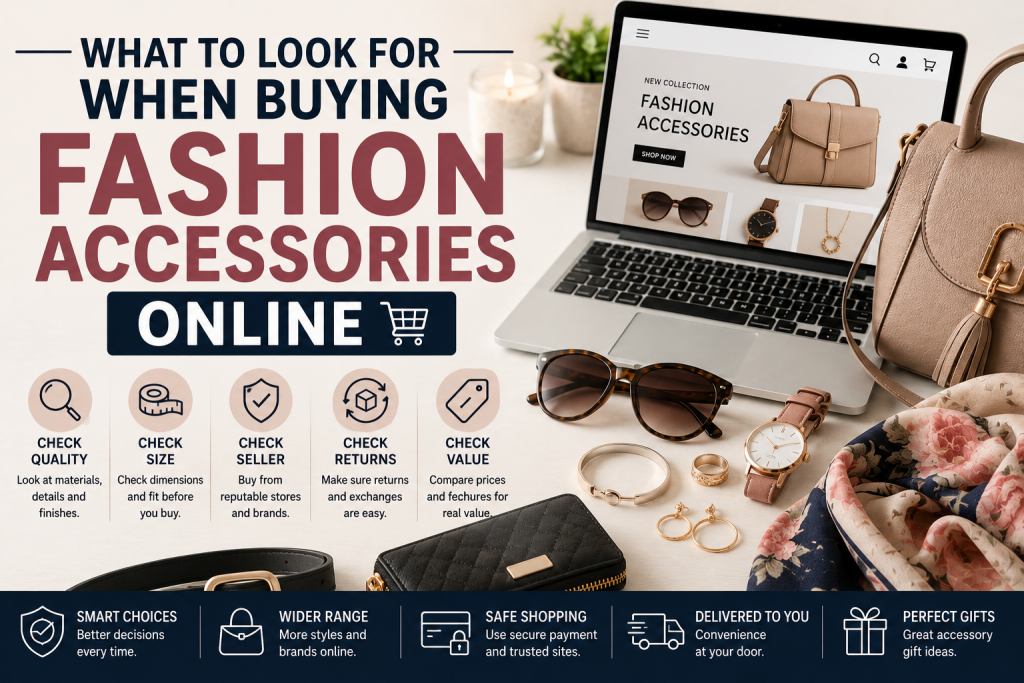
Fashion accessories can completely change the appearance of an outfit.
A handbag can add practicality and personality. Sunglasses can become an important part of your everyday look. A watch can provide both functionality and style, while jewellery and other accessories can add the finishing touch.
The advantage of shopping online is that you’re no longer limited to the selection available at your local shopping centre.
You can compare hundreds of products, prices and styles from different retailers without leaving home.
But there’s also a downside.
You can’t physically examine the product before buying it.
Photographs can make an inexpensive product look impressive, while an item that looks excellent on a website may be smaller, lighter or less substantial than you expected when it arrives.
That makes it important to know what to look for before placing an order.
Whether you’re shopping for a handbag, sunglasses, watch, jewellery or another fashion accessory, a few simple checks can help you make better buying decisions.
Start With What You Actually Need
The first question shouldn’t be:
“What looks nice?”
It should be:
“What do I need this accessory for?”
This simple change in approach can prevent a lot of unnecessary purchases.
For example, you might need:
- A handbag for everyday use
- A smaller bag for evenings
- Sunglasses for driving
- A watch for work
- Jewellery for special occasions
- A practical wallet
- A travel accessory
- A gift
Once you know the purpose, you can judge products according to how well they meet that requirement.
Don’t Buy an Accessory Simply Because It’s on Sale
A large discount can make an item appear irresistible.
But a discount isn’t a saving if you didn’t need the product in the first place.
Before buying a heavily discounted accessory, ask yourself:
Would I still want this if it wasn’t on sale?
If the answer is no, think twice.
A smaller collection of accessories that you actually use can provide considerably better value than a cupboard full of impulse purchases.
Think About How Often You’ll Use It
One of the easiest ways to judge value is to consider expected usage.
A handbag you use several times a week may justify spending more than a bag you’ll only use once or twice a year.
The same applies to watches, sunglasses and other accessories.
Consider:
How often will I realistically use this?
An accessory that becomes part of your everyday routine can be worth paying more for if the additional quality and durability justify the difference.
Check the Actual Dimensions
One of the biggest problems with buying fashion accessories online is judging size from photographs.
A handbag can look large in a carefully staged photograph but be surprisingly small in reality.
A watch can look relatively modest on a model but be much larger than expected.
Sunglasses can also appear different depending on the person’s face and the angle of the photograph.
Always look for actual measurements.
Depending on the product, these could include:
- Length
- Width
- Height
- Depth
- Strap length
- Case diameter
- Lens width
- Weight
If measurements aren’t provided, consider whether you can find them elsewhere before ordering.
Pay Attention to Materials
Product descriptions often contain useful information about materials.
For example, a handbag may be made from:
- Genuine leather
- Synthetic leather
- Canvas
- Nylon
- Polyester
- Other textile materials
Sunglasses may use different frame and lens materials.
Watches can have cases and straps made from stainless steel, leather, resin, silicone and other materials.
Jewellery can similarly vary enormously in material and finish.
Don’t assume that two products that look almost identical will have the same durability or feel.
Learn the Difference Between Appearance and Quality
Good product photography can make almost anything look attractive.
When evaluating quality online, look beyond the main photograph.
Look for information about:
- Materials
- Stitching
- Hardware
- Closures
- Construction
- Finishing
- Product weight
- Manufacturer
- Warranty
Customer photographs can also be particularly useful because they often show the product under less controlled conditions than professional photography.
Buying Handbags Online
Handbags are particularly suitable for online shopping because there is an enormous range of styles available.
However, appearance isn’t the only consideration.
Think about:
- Size
- Number of compartments
- Strap length
- Handle design
- Closure
- Material
- Weight
- Interior space
- Ease of cleaning
A handbag that looks beautiful but doesn’t accommodate the things you normally carry isn’t necessarily a good purchase.
If you’re buying a handbag for everyday use, think about what you carry with you.
Will it accommodate:
- Your phone?
- Wallet?
- Keys?
- Sunglasses?
- Small personal items?
- Water bottle?
- Tablet or other device?
There’s little point buying a beautiful bag that doesn’t meet your practical requirements.
How to Choose the Right Handbag: A Practical Buying Guide
Consider the Weight of a Handbag
The weight of an empty handbag is easy to overlook.
A large bag may already weigh a surprising amount before you put anything into it.
If you’re going to carry it for several hours every day, weight can become an important consideration.
This is a good example of why product specifications can be more useful than photographs.
Check the Strap and Handles
Look carefully at how the bag is designed to be carried.
Consider whether you prefer:
- Hand handles
- Shoulder straps
- Crossbody straps
- Adjustable straps
- Detachable straps
For everyday use, an adjustable or removable strap can make a handbag considerably more versatile.
Buying Sunglasses Online
Sunglasses are another fashion accessory where appearance isn’t the only consideration.
When shopping online for sunglasses, look at:
- Frame dimensions
- Lens dimensions
- Frame material
- Lens characteristics
- UV protection information
- Fit
- Brand
- Warranty
- Returns policy
Don’t choose sunglasses purely because they look good on the model.
The shape and dimensions of the frame matter.
How to Choose the Right Sunglasses: A Practical Buying Guide
Pay Attention to Sunglasses Measurements
Sunglasses may have measurements such as:
- Lens width
- Bridge width
- Temple length
These measurements can help you compare a new pair with sunglasses you already own and find comfortable.
This is particularly useful when buying online because you can’t try the frames on before ordering.
Don’t Ignore UV Protection
Sunglasses are often purchased primarily as a fashion accessory, but eye protection is also important.
Look for clear information about the level of UV protection provided.
Avoid assuming that a darker lens automatically means better protection.
The colour or darkness of a lens doesn’t by itself tell you how effectively it filters ultraviolet radiation.
Buying Watches Online
Watches are another category where specifications matter considerably.
When comparing watches online, check:
- Case diameter
- Case thickness
- Strap width
- Movement type
- Case material
- Strap material
- Water resistance
- Battery information
- Warranty
Photographs can make watches difficult to judge accurately for size.
Measurements provide a much better indication.
[INTERNAL LINK: How to Choose the Right Watch for Your Lifestyle — link this phrase to the existing watch article.]
Consider the Watch Movement
The movement is the mechanism that powers the watch.
Common choices include:
- Quartz
- Automatic
- Mechanical
Quartz watches are generally convenient and accurate.
Automatic and mechanical watches appeal to people who appreciate traditional watchmaking and mechanical engineering.
There is no universally correct choice.
The right movement depends on what you want from the watch.
Buying Jewellery Online
Jewellery can be one of the more difficult fashion accessories to evaluate online.
Photographs can make pieces appear larger or smaller than they actually are.
Before buying, check:
- Dimensions
- Materials
- Metal type
- Stone information
- Weight where provided
- Clasp or fastening
- Care instructions
- Warranty
- Return policy
If a product is described using terms such as “gold plated”, “gold filled”, “sterling silver” or “solid gold”, make sure you understand what the description actually means.
Don’t assume that similar-looking terms represent the same material or quality.
Check the Product Description Carefully
A common mistake when shopping online is looking at the photographs while ignoring the description.
The description may tell you:
- What the product is made from
- Its dimensions
- Its weight
- How it closes
- How it should be maintained
- What is included
- Whether accessories shown in the photograph are included
Read the description before making your decision.
Be Careful With Photograph Styling
Online retailers often photograph accessories in attractive settings.
A handbag might be shown next to a laptop, phone and cosmetics.
A watch may be photographed beside other luxury-looking items.
Sunglasses may be shown on a model.
These photographs can be useful for demonstrating how the product looks, but they can also make it difficult to judge actual size.
Always distinguish between:
What is included with the product
and
What is simply being used as a photographic prop.
Customer Reviews Can Reveal a Lot
Reviews can provide information that isn’t obvious from the manufacturer’s description.
Look for recurring comments about:
- Size
- Colour
- Quality
- Durability
- Comfort
- Material
- Packaging
- Fit
- Appearance
Pay particular attention to reviews containing photographs.
They can provide a more realistic representation of the product.
Don’t Rely on One Review
One customer may have an unusually good or bad experience.
Instead, look for patterns.
If several customers independently mention that:
- A bag is smaller than expected
- A watch is particularly large
- Sunglasses fit tightly
- A particular material scratches easily
then the information becomes more useful.
Check the Return Policy
The return policy is particularly important when buying fashion accessories online.
Before ordering, find out:
- How long you have to return the product
- Whether returns are accepted for change of mind
- Who pays return shipping
- Whether sale items can be returned
- Whether the product must be unused
- Whether original packaging is required
- How refunds are processed
Policies can differ substantially between retailers.
Be Careful With International Sellers
International shopping can provide access to products that aren’t readily available locally.
However, consider:
- Delivery times
- Shipping costs
- Import duties
- Taxes
- Returns
- Warranty support
- Currency conversion
- Customer service
A product that appears inexpensive can become considerably more expensive once delivery and other costs are included.
For South African shoppers, always look at the total cost of getting the product to your door.
Compare the Total Price
The advertised product price isn’t always the final cost.
Consider:
Product price + delivery + applicable taxes or duties = actual cost
This is particularly important when comparing local and international retailers.
A slightly more expensive local product may ultimately represent better value if delivery is cheaper and returns are easier.
Look for a Reputable Retailer
The retailer matters just as much as the product.
Before buying, look for:
- Clear contact information
- Established customer service
- Secure payment options
- Transparent returns policy
- Clear delivery information
- Customer reviews
- A professional website
- Reasonable product descriptions
Be particularly cautious when a product is dramatically cheaper than comparable products elsewhere.
Is the Product Authentic?
Authenticity becomes particularly important when buying branded fashion accessories.
If a product is advertised as a well-known brand at an unusually low price, investigate carefully.
Check:
- Who is selling it
- Whether the retailer is authorised
- Whether the product has a manufacturer’s warranty
- Whether the model or product number can be verified
- Whether customer reviews raise concerns
A bargain isn’t a bargain if the product isn’t what it claims to be.
Think About Versatility
One of the best ways to improve the value of a fashion accessory is to choose something that works in several situations.
For example, a handbag that works with both casual and smart-casual clothing may be more useful than a highly specialised bag.
A watch that works at work and during social occasions can reduce the need to buy multiple watches.
A pair of sunglasses that suits your everyday wardrobe can potentially be used far more frequently than an unusual fashion-only pair.
Match Accessories With What You Already Own
Before buying something new, look at your existing wardrobe.
Consider:
- Colours
- Styles
- Materials
- Patterns
- Clothing types
Ask yourself:
What can I wear this with?
If you can immediately think of several outfits, the accessory is likely to be more useful.
If it only works with one particular outfit, consider whether you really need it.
Neutral Colours Versus Statement Pieces
There is room for both.
Neutral accessories
Black, brown, tan, navy and similar colours can be versatile and easy to combine.
Statement accessories
Bright colours, unusual shapes and distinctive designs can add personality to an outfit.
Neither is inherently better.
If you’re building a practical collection, however, versatile pieces can provide more value.
Quality Versus Price
The cheapest option isn’t always the best value.
But neither is the most expensive option automatically the best.
Instead, compare:
- Materials
- Construction
- Expected lifespan
- Warranty
- Brand reputation
- Customer reviews
- Frequency of use
A moderately priced product that you use regularly can offer excellent value.
Consider Cost Per Use
Suppose you buy an accessory for R1,000.
If you use it 200 times, your approximate cost per use is R5.
If you buy another accessory for R400 but only use it four times, the effective cost per use is R100.
This isn’t a reason to spend more than you can afford.
It’s simply a useful way of thinking about value rather than price alone.
Don’t Try to Follow Every Trend
Fashion changes constantly.
If you buy every accessory simply because it is currently fashionable, your spending can quickly increase.
Instead, consider buying a mixture of:
- Timeless basics
- Versatile pieces
- A few trend-driven items you genuinely like
This can help keep your wardrobe interesting without constantly replacing everything.
Accessories Can Also Make Good Gifts
Fashion accessories can be attractive gift options because they can be both useful and personal.
Potential gifts include:
- Handbags
- Sunglasses
- Watches
- Wallets
- Jewellery
- Scarves
- Belts
When buying for someone else, consider their existing style.
A versatile and relatively understated accessory may be safer than something highly specialised.
Check the Gift and Return Policies
If you’re buying an accessory as a gift, don’t forget to check the return policy.
The recipient may:
- Already own something similar
- Prefer a different colour
- Need a different size
- Simply not like the style
A flexible return or exchange policy can make the purchase considerably less risky.
Common Mistakes When Buying Fashion Accessories Online
Buying based only on photographs
Photographs don’t always tell you the true size, weight or quality.
Ignoring measurements
Always check dimensions where available.
Failing to read the description
Important information can be hidden in the product specifications.
Assuming expensive means better
Price alone doesn’t guarantee quality.
Buying because something is discounted
A product you don’t use isn’t a saving.
Ignoring delivery costs
The cheapest product isn’t necessarily the cheapest purchase.
Forgetting about returns
Especially important when buying products you can’t try before purchasing.
Ignoring materials
Two similar-looking products can have very different durability.
Buying too many similar accessories
Consider whether the new item adds something useful to your collection.
Following trends blindly
Choose accessories that fit your own style and lifestyle.
A Simple Online Fashion Accessory Buying Checklist
Before clicking Buy, ask:
- Do I actually need this?
- What will I use it for?
- How frequently will I use it?
- Have I checked the dimensions?
- Do I understand the materials?
- Have I read the complete product description?
- Have I looked at customer reviews?
- Are customer photographs available?
- Is the retailer reputable?
- Is the product genuine if it is branded?
- What will delivery cost?
- Are there possible additional charges?
- What is the return policy?
- What does the warranty cover?
- Does it work with things I already own?
- Is the price reasonable?
- Am I buying it because I need it or because it is on sale?
Final Thoughts
Buying fashion accessories online can be convenient, affordable and surprisingly rewarding.
The enormous selection available online means you can often find products that would be difficult to locate in local stores.
But convenience doesn’t remove the need to shop carefully.
The most important thing is to look beyond the photograph.
Check the dimensions, materials, specifications, reviews, retailer reputation, delivery costs and return policy before making your decision.
Think about how frequently you’ll use the product and whether it complements things you already own.
And don’t assume that the most expensive accessory is necessarily the best choice.
A well-chosen handbag, pair of sunglasses, watch or other accessory can provide years of use and become an important part of your personal style.
The objective isn’t to own the largest collection.
It’s to buy accessories that you genuinely like, actually use and feel represent good value for your money.
Building Your Style Collection
Kila already has individual guides covering several of the most popular fashion accessories.
If you’re looking for a handbag, our practical handbag buying guide explains what to consider before choosing one.
How to Choose the Right Handbag: A Practical Buying Guide
For sunglasses, we’ve looked at the practical considerations that go beyond simply choosing a frame that looks good.
How to Choose the Right Sunglasses
We’ve also covered watches, including movements, materials, features, sizing and value.
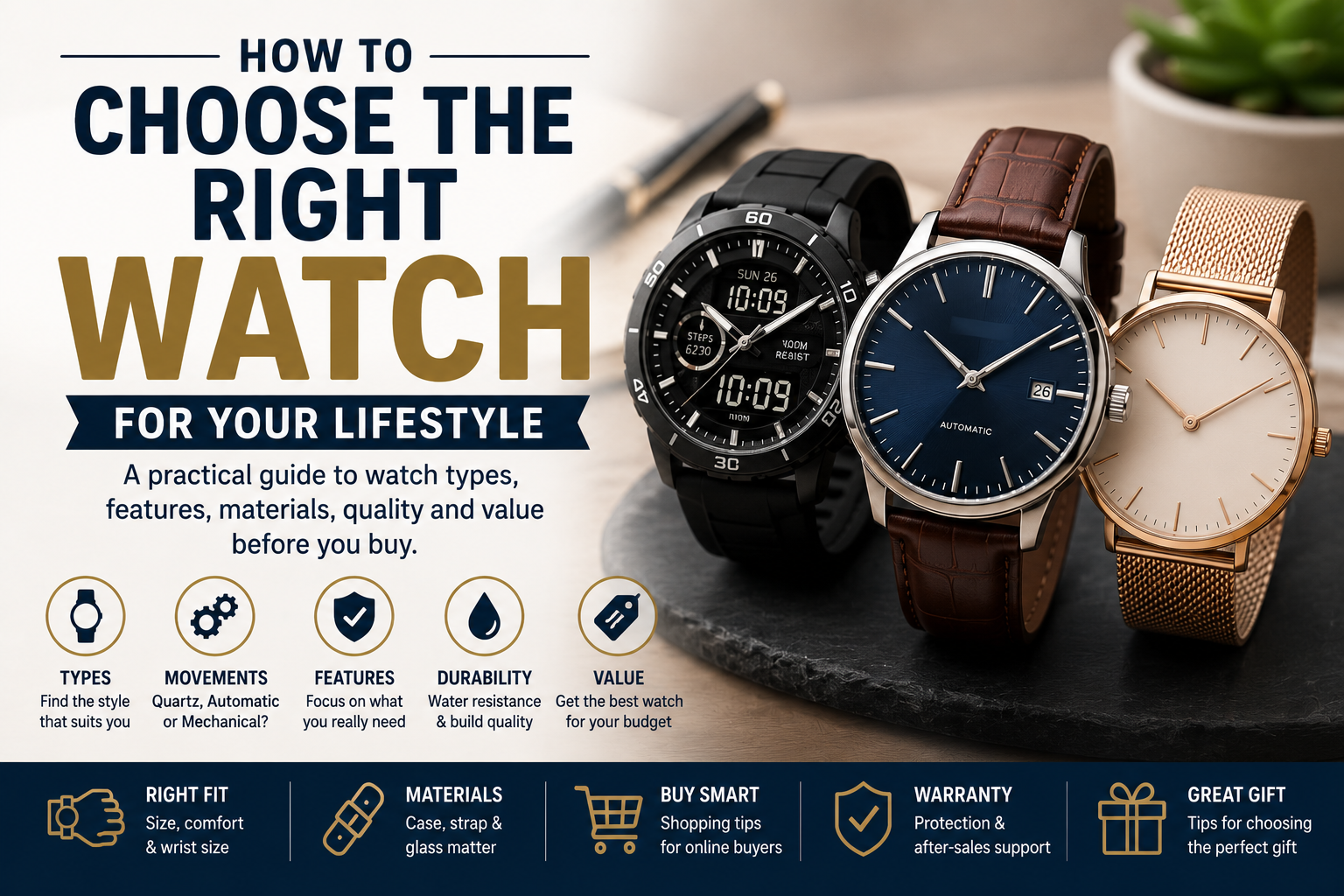
And when it comes to footwear, choosing according to your lifestyle can help ensure that your purchases are actually used.
Finally, our guide to building a versatile wardrobe looks at how to make clothing purchases that work together rather than buying individual pieces in isolation.