
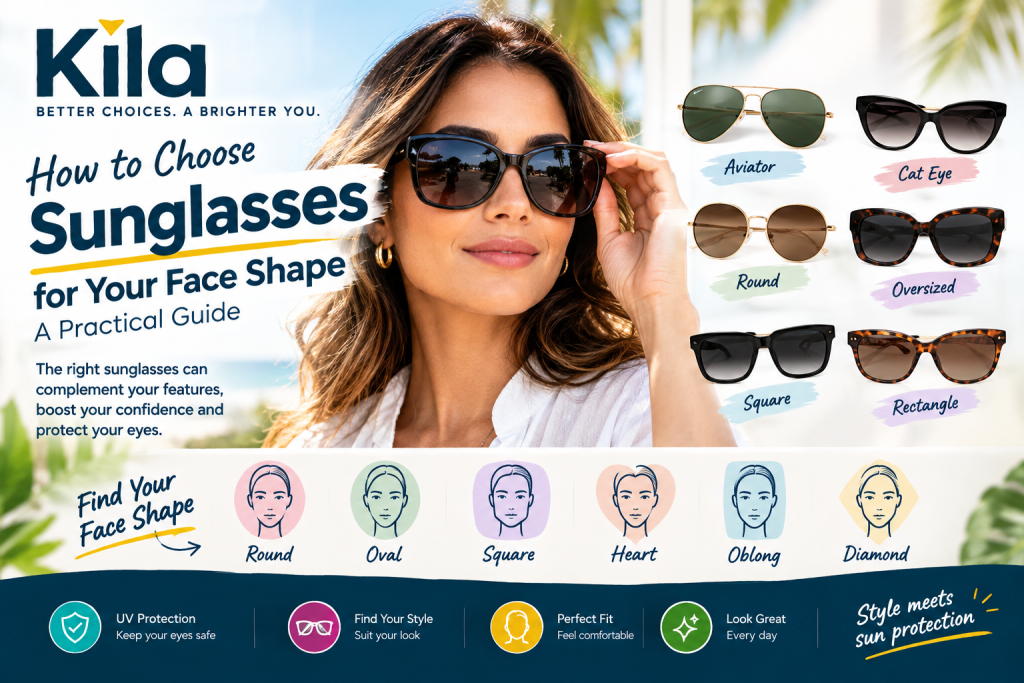
Choosing sunglasses isn’t only about finding a pair that protects your eyes from bright sunlight. Sunglasses are also an important fashion accessory, and the right frame can complement your face, balance your features and become a useful part of your everyday wardrobe.
With so many styles available—from aviators and cat-eye frames to oversized rectangles and round sunglasses—it can be difficult to know which shape will suit you best.
One useful starting point is your face shape.
While there are no strict rules saying that a particular face shape can only wear certain sunglasses, understanding the general relationship between face and frame shapes can make choosing much easier.
This guide explains the main face shapes, the sunglasses styles that can complement them, and the other factors you should consider before buying.
Why Face Shape Matters When Choosing Sunglasses
Sunglasses sit directly across the most noticeable part of your face, so their shape can have a significant effect on your overall appearance.
A frame can:
- Add definition to softer features
- Balance a wider forehead
- Make a longer face appear more proportionate
- Add width to a narrow face
- Complement angular facial features
- Create contrast with your natural face shape
The goal isn’t necessarily to find a frame that perfectly matches your face.
In many cases, contrast is what makes a frame look particularly attractive.
For example, a rounded frame can soften a face with strong angular features, while a more structured rectangular frame can add definition to a rounder face.
How to Determine Your Face Shape
Before choosing sunglasses, take a look at your face in a mirror or photograph.
The most common face shapes are:
- Round
- Oval
- Square
- Heart-shaped
- Oblong or rectangular
- Diamond
Most people won’t fit perfectly into one category.
You may have characteristics of two different shapes, and that’s perfectly normal.
Instead of trying to identify your face shape with absolute precision, look at the general proportions of your forehead, cheekbones, jaw and chin.
A simple method
Stand in front of a mirror with your hair pulled away from your face.
Look at:
- The widest part of your face
- The shape of your jaw
- The length of your face compared with its width
- Whether your features are mostly rounded or angular
You can also take a straight-on photograph and compare the overall outline of your face.
Sunglasses for a Round Face
A round face generally has softer curves, with the width and length relatively similar and less prominent angles around the jaw.
If this describes you, frames with stronger angles can provide useful contrast.
Styles worth considering
Rectangular frames can add definition and make the face appear slightly longer.
Square frames can create a stronger visual structure.
Wayfarer-style frames can also work well because of their combination of angular and slightly rounded elements.
Oversized rectangular sunglasses can create a fashionable statement while adding definition.
Styles to approach carefully
Very small, completely round frames can sometimes emphasise the rounded characteristics of the face.
That doesn’t mean you can’t wear round sunglasses. Personal style matters more than rigid rules. However, if your objective is to create contrast, angular frames are often a useful starting point.
Sunglasses for an Oval Face
An oval face is generally longer than it is wide, with relatively balanced proportions and a gently curved jawline.
This is often considered one of the most versatile face shapes for sunglasses.
You can experiment with many different styles, including:
- Aviators
- Rectangular frames
- Cat-eye frames
- Round frames
- Oversized sunglasses
- Classic square frames
Because the proportions are relatively balanced, you have considerable freedom to choose based on your personal style.
What should you consider?
Rather than concentrating too heavily on correcting the shape of your face, think about the overall appearance you want.
A large oversized frame can create a dramatic fashion look.
A smaller classic frame may be better for everyday wear.
An aviator can provide a timeless appearance, while a bold rectangle can create a more contemporary look.
Sunglasses for a Square Face
A square face generally has a stronger jawline and forehead, with relatively straight sides and more angular features.
Rounded or curved frames can provide contrast.
Styles worth considering
Round sunglasses can soften angular facial features.
Oval frames can also provide a useful contrast.
Aviators are another popular choice because their curved lower section can balance a stronger jawline.
What about rectangular sunglasses?
You can certainly wear them.
If you want to emphasise your angular features, a structured rectangular frame can create a bold, confident appearance.
The important point is that you’re choosing whether you want contrast or reinforcement.
Sunglasses for a Heart-Shaped Face
A heart-shaped face is generally wider around the forehead and narrower toward the chin.
The aim can be to balance the width of the upper face with the narrower lower portion.
Styles worth considering
- Aviators
- Rounded frames
- Light or thin frames
- Slightly wider frames
- Softly curved sunglasses
Aviator sunglasses can be particularly interesting because the shape can complement the proportions of a heart-shaped face without adding excessive visual weight to the forehead.
Cat-eye frames can also work, although the degree of upward sweep varies considerably between designs.
If your forehead is already visually prominent, look for a cat-eye style that isn’t excessively wide or dramatic.
Sunglasses for an Oblong or Rectangular Face
An oblong or rectangular face is generally longer than it is wide.
The objective, if you want to balance the proportions, can be to add some visual width and reduce the emphasis on length.
Styles worth considering
- Oversized frames
- Large square frames
- Wide rectangular frames
- Aviators
- Bold frames
Larger frames can work particularly well because they provide more visual width across the face.
Very narrow sunglasses may make a long face appear even longer, so consider wider styles if you’re trying to create more balanced proportions.
Sunglasses for a Diamond Face
A diamond-shaped face is typically characterised by more prominent cheekbones with a narrower forehead and jaw.
This can make the face particularly well suited to frames that soften or complement the cheekbones.
Consider:
- Oval frames
- Cat-eye styles
- Aviators
- Softly curved frames
- Rimless or lightweight designs
Cat-eye sunglasses can be especially interesting because the upward shape can complement prominent cheekbones.
Cat-Eye Sunglasses
Cat-eye sunglasses have remained popular because they can create a distinctive and feminine fashion statement.
They are available in many variations.
Some have:
- A subtle upward sweep
- A dramatic wing
- Thick frames
- Thin frames
- Oversized lenses
- Small vintage-inspired lenses
The right version depends on both your face shape and your personal style.
If you’re new to cat-eye sunglasses, a moderately shaped frame may be easier to incorporate into your wardrobe than an extremely dramatic design.
Aviator Sunglasses
Aviators are one of the most recognisable sunglasses styles.
They typically feature:
- A wider upper frame
- A curved or teardrop-shaped lens
- A relatively thin frame
- A distinctive bridge
Aviators can work particularly well with oval, square, heart-shaped and some oblong faces.
Their versatility is one reason they remain popular.
A classic black or metal-framed aviator can also be easier to wear with different outfits than an extremely distinctive fashion frame.
Round Sunglasses
Round sunglasses create a softer, more retro appearance.
They can be particularly effective for people with angular or square facial features because the curves create contrast.
However, the size of the frame matters.
A small round frame produces a very different look from a large oversized round frame.
If you’re looking for a contemporary fashion appearance, consider the overall proportions rather than simply choosing “round” as a category.
Rectangle and Square Sunglasses
Structured frames can create a stronger and more contemporary appearance.
They can work particularly well with:
- Round faces
- Oval faces
- Softer facial features
A bold rectangular frame can also become the main fashion statement in an otherwise simple outfit.
Oversized rectangular sunglasses are especially useful if you’re looking for a more noticeable accessory.
Oversized Sunglasses
Oversized sunglasses are a fashion choice as much as an eye-protection product.
They can provide:
- A dramatic appearance
- Greater facial coverage
- A statement accessory
- A glamorous look
However, proportion is important.
If the frame is so large that it overwhelms your face, the result may look less balanced.
Try to find a frame that is large enough to create the desired effect without completely dominating your features.
Don’t Forget Your Eyebrows
Your eyebrows form an important part of the overall relationship between your face and sunglasses.
The top edge of the frame can:
- Follow your eyebrow line
- Sit slightly below it
- Create contrast with it
When trying sunglasses on, look at your entire face rather than concentrating only on the lenses.
The frame should generally feel like part of your face rather than an object sitting independently on it.
Consider the Width of the Frame
Face shape is only one part of finding the right sunglasses.
Frame width is equally important.
A frame that is too narrow may feel uncomfortable and can look disproportionate.
A frame that is too wide may slip down or overwhelm your features.
When trying sunglasses, check whether:
- The frame sits comfortably across your temples
- The arms don’t press uncomfortably
- The sunglasses remain stable when you move
- The lenses cover the appropriate area
- The bridge sits comfortably on your nose
Comfort should never be sacrificed purely for appearance.
Consider Your Nose and Bridge Fit
Different sunglasses have different bridge designs.
Some have a defined nose bridge, while others have adjustable nose pads.
The bridge should sit comfortably without creating excessive pressure.
If sunglasses continually slide down your nose, the problem may be the bridge fit rather than the overall frame size.
This is particularly important when buying online because you cannot try the sunglasses on before ordering.
Frame Colour Matters Too
Once you’ve found a suitable shape, consider the colour.
Black frames are versatile and can work with many wardrobes.
Brown and tortoiseshell frames can create a warmer appearance.
Metallic frames can provide a more understated or classic look.
Coloured frames can become a stronger fashion statement.
Think about the clothes you normally wear.
If most of your wardrobe consists of neutral colours, a bold pair of sunglasses can add an interesting accent.
If your clothing is already colourful, a neutral frame may be easier to coordinate.
Match Sunglasses to Your Personal Style
Face shape provides a useful starting point, but your personality and wardrobe are equally important.
Ask yourself:
Do I prefer classic or fashionable styles?
Classic frames are generally easier to wear for many years.
Do I want sunglasses to stand out?
If so, consider oversized, coloured or distinctive frames.
Do I want one pair for everything?
Choose a versatile style that works with most of your clothing.
Do I enjoy having several accessories?
You can then choose different frames for different occasions.
This approach can be particularly useful if you are building a versatile wardrobe. How to Build a Versatile Wardrobe Without Overspending explains why versatile purchases can often provide better long-term value.
Consider UV Protection Before Fashion
Face shape and style are useful considerations, but they should not come before eye protection.
When buying sunglasses, check the manufacturer’s information about UV protection.
Look for sunglasses that provide appropriate protection against ultraviolet radiation.
A dark lens does not automatically mean better UV protection.
A very dark pair of sunglasses without appropriate UV protection is not necessarily a better choice than a lighter pair that provides proper protection.
Our guide Sunglasses: What UV Protection, Lens Colour and Polarisation Really Mean explains the difference between these features in more detail.
What About Polarised Lenses?
Polarised lenses can reduce certain types of glare, particularly reflected glare from surfaces such as:
- Water
- Roads
- Glass
- Snow
They can be particularly useful for driving and outdoor activities.
However, polarisation isn’t essential for every situation.
If you’re mainly looking for a fashion accessory for occasional use, UV protection and comfortable fit may be more important priorities.
Lens Colour Can Affect the Look
Different lens colours create different visual appearances.
Common options include:
- Grey
- Brown
- Green
- Yellow
- Gradient
- Mirrored finishes
Yellow-tinted lenses, for example, create a distinctive fashion appearance and are sometimes marketed for particular visual conditions.
However, don’t assume that lens colour alone determines the quality or effectiveness of the sunglasses.
Consider lens specifications alongside the frame.
Think About Your Wardrobe
Sunglasses are one of the easiest accessories to use for changing the appearance of an outfit.
A classic black frame can work with:
- Jeans
- Shirts
- Jackets
- Casual clothing
- Smart-casual outfits
A bold fashion frame can add personality to a relatively simple outfit.
If you’re buying your first pair, consider which clothes you already own.
A versatile frame that works with many outfits may provide more value than an unusual pair that only works with one particular style.
For additional fashion buying advice, What to Look for When Buying Fashion Accessories Online provides a useful checklist for evaluating accessories before purchasing.
One Pair or Several?
There is no reason to limit yourself to one style if you regularly wear sunglasses.
You might have:
Everyday pair: A versatile neutral frame.
Driving pair: Comfortable lenses suitable for daytime driving.
Fashion pair: A more distinctive shape for social occasions.
Outdoor pair: A practical pair for holidays and outdoor activities.
You don’t need all four.
The right number depends on your lifestyle.
Buying Sunglasses Online
Buying sunglasses online can provide access to a much wider selection of styles.
However, there are several things to check before ordering.
Check the measurements
Look for measurements such as:
- Lens width
- Bridge width
- Temple length
These measurements can help you compare a new pair with sunglasses you already own.
Check the product description
Look for information about:
- UV protection
- Lens material
- Frame material
- Polarisation
- Lens colour
- Included accessories
Look at photographs from different angles
A front-facing product photograph doesn’t always show the actual proportions of the frame.
Look for side and angled photographs where available.
Check the returns policy
This is particularly important when buying sunglasses online because fit is difficult to judge from a photograph.
Consider customer reviews
Reviews can provide useful information about:
- Actual frame size
- Comfort
- Build quality
- Appearance
- Whether the product matches its photographs
A Simple Sunglasses Shopping Checklist
Before buying, ask:
Face shape
- What is the general shape of my face?
- Do I want contrast or a similar shape?
Fit
- Is the frame wide enough?
- Is it too wide?
- Does the bridge sit comfortably?
- Do the sunglasses stay in place?
Style
- Does the frame suit my wardrobe?
- Is it appropriate for everyday use?
- Do I want a classic or statement look?
Lenses
- Is appropriate UV protection specified?
- Do I need polarised lenses?
- Is the lens colour suitable for how I intend to use them?
Online purchase
- Have I checked the frame measurements?
- Have I looked at photographs from different angles?
- Have I checked reviews?
- What is the returns policy?
Final Thoughts
Choosing sunglasses based on face shape can make the shopping process considerably easier, but it shouldn’t become a set of rigid rules.
The best sunglasses are the ones that combine comfortable fit, appropriate eye protection and a style that makes you feel confident.
If you have a round face, you may enjoy the contrast provided by rectangular or square frames. If you have a square face, rounded frames or aviators may soften your features. Oval faces can generally accommodate a wide range of styles, while oversized and wider frames can work particularly well with longer face shapes.
But ultimately, your face shape is only a starting point.
Consider the frame size, bridge fit, lens protection, colour, wardrobe and the occasions where you will wear the sunglasses.
With so many styles available—from classic aviators to cat-eye, round and oversized rectangular frames—there is no reason to settle for a pair that is uncomfortable or doesn’t suit your personal style.
The right sunglasses should protect your eyes, fit comfortably and feel like a natural part of your wardrobe.