
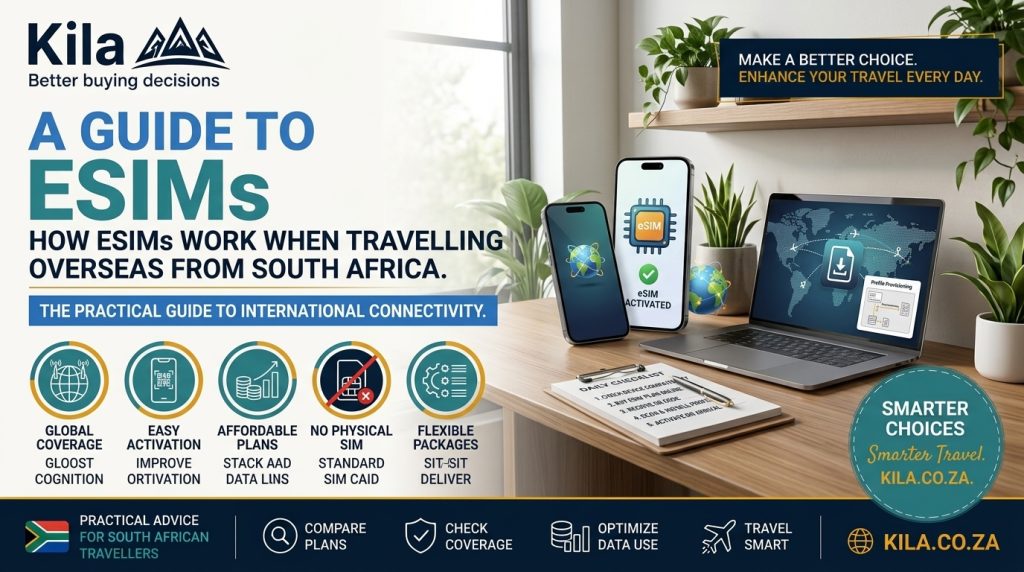
Using your South African cellphone number overseas can be surprisingly expensive.
International roaming charges, unfamiliar networks and the need to find a local SIM card can all make staying connected more complicated than it needs to be.
An eSIM can provide another option.
Instead of physically replacing the SIM card in your phone, an eSIM allows you to add a compatible mobile plan electronically. For international travellers, this can make it possible to arrange mobile data before leaving South Africa and connect to a network when you arrive at your destination.
But an eSIM isn’t automatically the best option for every traveller.
You need to consider your phone, destination, data requirements, existing mobile contract and the type of eSIM plan you’re buying.
Here’s what you need to know before your next international trip.
What is an eSIM?
An eSIM is an embedded SIM built into a compatible device.
Unlike a traditional physical SIM card, there is no small plastic card that needs to be inserted into the phone.
Instead, a mobile plan can be downloaded and activated electronically.
This means a compatible smartphone can potentially have more than one mobile connection available, depending on the device and its configuration.
For travellers, this creates an interesting possibility:
You can potentially keep your South African SIM active while using a separate travel eSIM for mobile data overseas.
That can be particularly convenient if you want to remain reachable on your normal number while avoiding using your South African mobile data allowance abroad.
Is an eSIM the same as roaming?
No.
This distinction is important.
With traditional international roaming, your South African mobile provider allows your existing SIM and number to connect to a foreign network.
A travel eSIM is generally a separate mobile service that you purchase for use in another country or group of countries.
For example, you could potentially have:
South African SIM:
Your normal phone number and existing mobile service.
Travel eSIM:
A separate data plan for the country or countries you’re visiting.
The exact functionality depends on your phone and the eSIM provider.
Why are travel eSIMs becoming popular?
The main attraction is convenience.
Instead of arriving at an airport and looking for a SIM card retailer, you can potentially purchase and install your travel eSIM before leaving home.
Depending on the provider and destination, you may be able to choose a plan based on:
- Country
- Region
- Number of days
- Amount of data
- Number of countries covered
This can make planning your connectivity much easier.
Can you use your South African number with an eSIM?
Often, yes — provided your phone supports the necessary dual-SIM functionality and your South African SIM remains active.
This is one of the most useful aspects of eSIM technology for travellers.
You may be able to configure your phone so that:
South African SIM → calls/SMS
Travel eSIM → mobile data
However, the exact options vary between phones.
Don’t assume that every phone handles dual SIMs in exactly the same way.
Does every phone support eSIM?
No.
Your phone must have eSIM capability.
Many newer smartphones support eSIM, but compatibility depends on the specific model, region, and sometimes the version of the device.
Before purchasing an eSIM, check your phone manufacturer’s specifications.
You should also check whether the phone is network unlocked.
A phone that is restricted to a particular mobile network may not accept another provider’s eSIM.
How do you check whether your phone supports eSIM?
The easiest approach is to check your phone’s settings.
The terminology varies between manufacturers, but look for options relating to:
- Mobile networks
- SIM management
- Add eSIM
- Add mobile plan
- Add cellular plan
- Download SIM
You can also check the exact model on the manufacturer’s website.
Do this before buying an eSIM.
There is little point in purchasing a travel plan only to discover that your phone doesn’t support it.
How does a travel eSIM work?
The process is generally straightforward.
You first purchase an eSIM plan from a provider.
The provider normally supplies installation or activation instructions, which may involve a QR code or an in-app installation process.
You then add the eSIM to your phone.
Depending on the provider, activation may occur:
- Immediately after installation
- When the eSIM connects to a supported network
- On a specified activation date
This is important because you don’t necessarily want a limited-duration plan to start running several days before your trip.
Always check when the validity period begins.
Should you install your eSIM before leaving South Africa?
In many cases, installing it before departure is sensible.
Doing so gives you time to deal with any installation problems while you still have access to your normal internet connection.
However, installation and activation aren’t necessarily the same thing.
Some providers allow you to install the eSIM in advance but only activate it once it connects to a supported network at your destination.
Check the provider’s instructions carefully.
What happens when you arrive overseas?
Once you arrive at your destination, you may need to select the travel eSIM as the source of your mobile data.
Your phone may then connect to one of the networks supported by the eSIM provider.
The exact process varies according to your device.
You may need to:
- Enable the travel eSIM.
- Select it for mobile data.
- Enable data roaming for that eSIM if instructed by the provider.
- Disable mobile data on your South African SIM.
- Check that the travel eSIM has connected to a supported network.
The settings can vary significantly between Android and Apple devices, so follow the instructions provided for your particular phone.
Be careful with data roaming
This is one of the most important settings to understand.
If your South African SIM remains active and your phone is allowed to use its mobile data connection overseas, you could potentially incur roaming charges from your South African provider.
If your intention is to use the travel eSIM for data, make sure your phone is configured appropriately.
It is worth checking the settings before you board your flight rather than trying to figure them out after landing.
Can you make phone calls with a travel eSIM?
This depends on the particular eSIM plan.
Some travel eSIMs are primarily data-only.
Others may include voice and messaging services.
Don’t assume that purchasing an eSIM automatically gives you a foreign telephone number or conventional voice calling.
For many travellers, data is enough because internet-based services can handle much of their communication.
Apps such as WhatsApp can be used over an internet connection for messaging and voice or video calls.
What about WhatsApp?
This is one of the reasons a data-only eSIM can be sufficient for many travellers.
WhatsApp is linked to your account and existing phone number rather than requiring the travel eSIM itself to provide your normal South African number.
As long as your phone has an internet connection, you can generally continue using WhatsApp.
This means you may be able to travel with:
South African number + travel eSIM data
rather than obtaining a new local phone number.
How much data do you need?
This depends on how you use your phone.
A traveller who mainly uses:
- Google Maps
- Occasional web browsing
may require considerably less data than someone who regularly watches video, uploads photographs or uses their phone as a hotspot.
Before buying an eSIM, consider your normal usage.
Light user
Mostly messaging, maps and occasional browsing.
Moderate user
Regular social media, browsing, maps and photo uploads.
Heavy user
Video streaming, frequent uploads, hotspot use and extensive online activity.
Don’t automatically buy the largest package.
You may simply end up paying for data you never use.
Don’t forget navigation
Maps are one of the most useful reasons to have mobile data while travelling.
An eSIM can allow you to access navigation services without relying entirely on hotel Wi-Fi or public Wi-Fi.
However, you can also download offline maps before travelling.
This provides a useful backup if your connection isn’t available.
A good travel strategy is therefore:
Mobile data + offline maps + saved travel information
rather than relying entirely on one method.
What if you’re visiting several countries?
This is where regional or multi-country eSIM plans can become particularly useful.
For example, a trip could involve:
South Africa → France → Italy → Switzerland → South Africa
Rather than purchasing a separate plan for every country, some providers offer regional plans covering multiple destinations.
This can be considerably more convenient.
However, don’t assume that a “Europe” or “regional” plan covers every country you intend to visit.
Check the provider’s current coverage list before purchasing.
What about a long trip?
For longer journeys, compare the cost of several shorter plans against a longer-duration plan.
Look at:
- Number of days
- Total data allowance
- Countries covered
- Network access
- Hotspot restrictions
- Top-up options
- Expiry conditions
A plan that looks cheap initially may not be the best value if you need to purchase several additional packages.
eSIM vs buying a local SIM
Both options can work.
Travel eSIM
Advantages:
- Can be arranged before departure
- No physical SIM card required
- Convenient for multi-country travel
- Can potentially keep your South African SIM
- No need to find a SIM retailer immediately after landing
Disadvantages:
- Requires a compatible phone
- Some plans are data-only
- Coverage varies by provider
- Some plans may have restrictions on tethering or hotspot use
Local SIM
Advantages:
- May offer competitive local pricing
- Can provide a local telephone number
- Widely available in many destinations
Disadvantages:
- Requires obtaining a physical SIM
- You may need to visit a shop
- You have to remove or replace a physical SIM in some phones
- Keeping track of the original SIM can be inconvenient
Neither is automatically better.
It depends on the destination and your requirements.
eSIM vs international roaming
Your existing mobile provider may offer an international roaming package.
This can be convenient because you continue using your normal number and service.
However, pricing can vary significantly.
Before travelling, compare:
Your network’s roaming option
against
A suitable travel eSIM
Look at the total cost rather than simply the advertised daily rate.
Also consider whether calls and SMS are included.
Don’t choose an eSIM based only on price
A cheap eSIM isn’t necessarily the best option.
Before buying, check:
- Countries covered
- Network partners
- Data allowance
- Validity period
- Activation rules
- Hotspot availability
- Top-up options
- Customer support
- Refund policy
Two plans offering the same amount of data can provide very different value depending on the coverage and conditions.
Check the network coverage
An eSIM provider may use one or more local network operators.
This matters because network quality can vary by location.
A plan that works well in a major city may have different performance in rural areas.
If your trip involves:
- Rural areas
- Mountains
- Islands
- Road trips
- Remote tourist destinations
Check the provider’s stated network coverage before purchasing.
Public Wi-Fi isn’t always enough
Free Wi-Fi at hotels, restaurants and airports can be useful.
But relying exclusively on public Wi-Fi can be inconvenient.
You may need internet access when:
- Ordering a taxi
- Checking directions
- Looking up a booking
- Contacting your accommodation
- Translating something
- Checking flight information
- Paying for something
- Dealing with an unexpected problem
Having mobile data available can therefore be particularly useful when you’re away from your hotel.
How to save money on travel data
You don’t necessarily need unlimited data.
A few simple habits can reduce your usage:
Download before you leave Wi-Fi
Download:
- Maps
- Podcasts
- Music
- Travel documents
- Entertainment
before leaving your accommodation.
Reduce automatic updates
Prevent apps from using mobile data for unnecessary background updates.
Be careful with video
Video streaming can consume large amounts of data.
Use Wi-Fi where appropriate
Use trusted Wi-Fi for large downloads and updates.
Monitor your usage
Check how much data you’re actually consuming.
This can help you decide whether you need a larger package.
Keep your eSIM information safe
Treat your eSIM installation information as important.
Keep your:
- Activation details
- Provider account information
- Support details
- Purchase confirmation
accessible while travelling.
If your phone is lost or damaged, you may need this information to deal with the provider or transfer your service to another device, depending on the provider’s policies.
When should you buy your travel eSIM?
There isn’t one universal answer.
The ideal timing depends on the provider’s activation rules.
In general, you want enough time before departure to:
- Confirm compatibility
- Purchase the plan
- Install it
- Read the instructions
- Resolve any problems
But avoid activating it unnecessarily early if the plan’s validity period begins immediately.
Always check the activation conditions before installing or activating the plan.
A simple eSIM checklist
Before buying a travel eSIM, check:
☐ Is my phone eSIM compatible?
☐ Is my phone unlocked?
☐ Does the plan cover every country I am visiting?
☐ How much data do I actually need?
☐ How long is the plan valid?
☐ When does the validity period start?
☐ Does it support hotspot use?
☐ Is it data-only?
☐ Which networks does it use?
☐ Can I top it up?
☐ What happens if I run out of data?
☐ How good is customer support?
☐ Have I compared it with my network’s roaming option?
Should South African travellers use an eSIM?
For many travellers, an eSIM can be a convenient way to stay connected overseas.
It can eliminate the need to find a physical SIM immediately after landing and can potentially allow you to keep your South African number while using a separate data plan.
But it isn’t automatically the cheapest or best solution.
The right choice depends on your phone, destination, trip length, data requirements and the alternatives available.
That’s why comparing the options before you travel is worthwhile.
Final thoughts
Staying connected overseas doesn’t have to be complicated.
A travel eSIM can provide a convenient alternative to traditional international roaming or buying a physical SIM after you arrive.
The important thing is to do your homework first.
Check your phone compatibility, understand the activation process, compare coverage and data allowances, and make sure you understand exactly what you’re buying.
And remember one of Kila’s basic principles:
Don’t buy the cheapest option simply because it’s cheap. Buy the option that provides the best value for what you actually need.
You may also like:
How to Choose the Right Luggage for International Travel from South Africa