
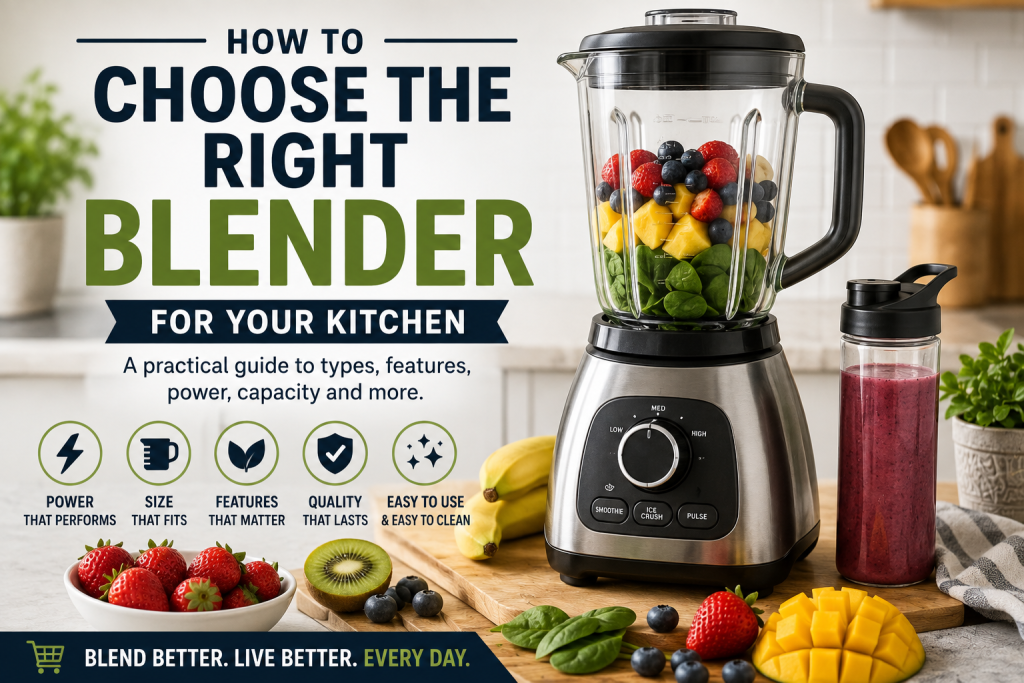
A good blender can become one of the most useful appliances in a kitchen.
It can turn fruit into smoothies, vegetables into soups, nuts into spreads and ingredients into sauces. Depending on the model, it may also be capable of crushing ice, making frozen drinks and handling much tougher ingredients.
But choosing a blender isn’t simply a matter of buying the model with the highest wattage.
There are different types of blenders, different jug sizes, different blade designs and a wide range of features.
Some are designed primarily for individual smoothies, while others are powerful countertop machines intended for family-sized preparation.
So how do you choose?
The best blender is the one that matches what you want to make, how often you’ll use it, how much food you normally prepare and how much space you have available.
What will you use the blender for?
Start with the most important question:
What do you actually want the blender to do?
Your answer will narrow down the choices considerably.
You might want a blender for:
- Smoothies
- Protein drinks
- Soups
- Sauces
- Dips
- Baby food
- Frozen drinks
- Crushing ice
- Chopping softer ingredients
- Nut-based preparations
- General food preparation
A person who mainly makes a morning smoothie doesn’t necessarily need the same machine as someone who wants to prepare large quantities of soup or process tougher ingredients.
Countertop blender or personal blender?
One of the biggest choices is between a conventional countertop blender and a smaller personal blender.
Countertop blenders
These generally have a larger jug and are designed to remain on the kitchen counter.
They can be suitable for:
- Family-sized smoothies
- Soups
- Sauces
- Larger quantities
- Ice crushing
- General blending
They tend to offer greater capacity and versatility.
The disadvantage is that they take up more space.
Personal blenders
Personal blenders are designed around smaller quantities.
They can be particularly convenient for:
- Individual smoothies
- Protein drinks
- Quick breakfasts
- Small portions
Some models allow you to blend directly into a drinking container.
This can reduce washing up and make the appliance convenient for people who mainly prepare one serving at a time.
However, capacity is naturally limited.
How powerful should a blender be?
Power is one of the specifications you’re likely to see when comparing blenders.
But wattage shouldn’t be the only consideration.
A higher power rating can be useful when processing tougher ingredients, but the overall design of the blender also matters.
Performance can depend on:
- Motor design
- Blade design
- Jug shape
- Blade position
- Program settings
- Ingredient quantity
- How the ingredients are added
A well-designed blender with a moderate power rating may perform better for your particular needs than a poorly designed high-wattage machine.
Do you need a high-powered blender?
Not necessarily.
If you mainly make:
- Soft fruit smoothies
- Milkshakes
- Sauces
- Simple drinks
you may not need a particularly powerful machine.
If you regularly want to:
- Crush ice
- Blend frozen fruit
- Process fibrous vegetables
- Make thicker mixtures
- Handle tougher ingredients
then additional power may be worthwhile.
Think about your actual recipes rather than simply choosing the largest number on the specification sheet.
What size blender jug do you need?
Capacity is another important consideration.
A small jug can be convenient for individuals or couples.
A larger jug becomes useful when preparing drinks or food for several people.
Consider how much you normally prepare at one time.
A larger jug can be useful for family meals, but it also takes up more cupboard or counter space.
Don’t confuse jug capacity with usable capacity
A blender may advertise a particular total capacity, but you shouldn’t necessarily fill it to the very top.
There may be a recommended maximum operating level.
This is particularly important when blending hot ingredients.
Always follow the manufacturer’s instructions regarding maximum filling levels.
Glass versus plastic blender jugs
Blender containers are commonly made from different materials.
Plastic
Advantages can include:
- Lightweight
- Less likely to break if dropped
- Easy to handle
- Generally practical for everyday use
Potential disadvantages include:
- May scratch over time
- Some materials can retain odours or become cloudy
Glass
Glass can provide:
- A premium feel
- Good resistance to staining
- Good resistance to absorbing odours
However, glass is heavier and can break if dropped or handled roughly.
Neither option is automatically better.
What about BPA-free materials?
If you’re buying a blender with a plastic container, you may see claims about BPA-free construction.
Check the manufacturer’s specifications to understand exactly which components the claim applies to.
More importantly, look at the overall quality and suitability of the appliance rather than choosing purely on one marketing statement.
Blade design matters
The blades are obviously important, but more blades don’t automatically mean a better blender.
What matters is how effectively the blade system works with:
- The jug shape
- Motor
- Ingredient flow
- Speed settings
Some designs are intended to create better circulation of ingredients through the blending area.
This can help produce a more consistent result.
What speeds do you need?
Basic blenders may offer only a few speed settings.
More advanced models can offer:
- Low speed
- Medium speed
- High speed
- Pulse
- Preset programmes
For many everyday recipes, you don’t need dozens of settings.
A few well-chosen speeds and a useful pulse function may be more practical than an unnecessarily complicated control panel.
Why is the pulse function useful?
A pulse setting allows you to operate the blender in short bursts.
This can be useful when you want greater control over texture.
For example, you may want to avoid turning an ingredient completely into a smooth puree.
Pulse can also help move ingredients around the jug during blending.
Are preset programmes worth paying for?
Some blenders offer programmes specifically designed for things such as:
- Smoothies
- Ice crushing
- Soups
- Frozen drinks
- Cleaning
These can be convenient because the machine controls the blending cycle automatically.
However, preset programmes aren’t essential.
If you are comfortable adjusting the speed yourself, a simpler blender may provide everything you need.
Can a blender crush ice?
Some can, but don’t assume every blender is designed for it.
If crushing ice is important to you, check that the manufacturer specifically states that the blender is suitable for this purpose.
Repeatedly asking a blender to perform tasks it wasn’t designed for can put unnecessary strain on the motor and blades.
Can you blend frozen fruit?
Many blenders can handle frozen fruit, but performance varies.
Frozen ingredients are considerably harder than fresh fruit.
A blender intended for smoothies should provide clear guidance about the types and quantities of frozen ingredients it can process.
You may also need to add enough liquid to allow the ingredients to circulate properly.
Can you blend hot food?
This is an area where you should pay particular attention to the manufacturer’s instructions.
Not every blender is designed to process hot liquids.
Heat and steam can create pressure inside a sealed container.
If you want to make soups or other hot preparations, make sure the blender is specifically designed for that purpose and follow its instructions carefully.
Never assume that because a blender can process food, it is automatically suitable for hot liquids.
What about making soup?
Some blenders are particularly useful for making smooth soups.
However, there are two different approaches.
You can:
- Cook the ingredients separately and blend them afterwards, or
- Use a blender specifically designed to handle hot ingredients.
If soup is one of your main reasons for buying a blender, choose a model based on its manufacturer’s stated capabilities.
Blender versus food processor
These appliances overlap, but they aren’t identical.
A blender is particularly good at:
- Smoothies
- Liquids
- Sauces
- Soups
- Drinks
- Smooth mixtures
A food processor is generally better suited to:
- Chopping
- Slicing
- Grating
- Shredding
- More solid food preparation
If your kitchen activities include both types of tasks, owning both appliances can eventually make sense.
But if you mainly want smoothies and sauces, a blender may be all you need.
Blender versus stick blender
A stick blender, also called an immersion blender, is another alternative.
It can be particularly useful for:
- Soups
- Sauces
- Purees
- Small quantities
One of its major advantages is that it can often be used directly in a suitable cooking container.
It also takes up considerably less storage space than a conventional countertop blender.
A countertop blender, however, can be more suitable for smoothies, drinks and larger quantities.
What is a smoothie blender?
A smoothie blender is essentially a blender designed with smoothie preparation in mind.
Some personal models are particularly convenient because the blending container doubles as a drinking bottle.
If smoothies are your primary reason for buying a blender, you may not need the versatility or capacity of a large countertop model.
How noisy are blenders?
Blenders can be surprisingly loud.
High-powered motors and hard ingredients can produce considerable noise.
If you live in an apartment or frequently make early-morning smoothies, noise may be worth considering.
Unfortunately, noise isn’t always easy to judge from an online product description.
Look for independent reviews and manufacturer information where available.
Does the blender need suction feet?
Some countertop blenders have non-slip or suction-style feet designed to help keep the appliance stable.
This can be useful because the machine may move slightly during operation, particularly at high speeds.
A stable base is therefore an important practical feature.
How easy is the blender to clean?
This is one of the most overlooked considerations.
A blender that performs brilliantly but takes ten minutes to clean every time may quickly become an appliance you stop using.
Look for:
- Removable components where appropriate
- Smooth surfaces
- Easily accessible areas
- Dishwasher-safe parts if offered
- Simple blade assemblies
- Clear cleaning instructions
Some blenders also offer a self-cleaning programme.
This can be convenient, although it doesn’t necessarily eliminate the need for occasional manual cleaning.
Are dishwasher-safe blender parts useful?
They can be.
Dishwasher-safe components can make cleaning easier.
However, always check which parts can actually go into the dishwasher.
The motor base obviously cannot.
Some blades, seals and containers may also have specific cleaning requirements.
How much counter space does a blender need?
Measure before buying.
Don’t forget to consider:
- Width
- Depth
- Height
- Lid clearance
- Power cord
- Storage
If you plan to keep the blender underneath kitchen cupboards, make sure there is sufficient space to remove the jug and lid comfortably.
Storage matters
If you don’t plan to leave the blender permanently on the counter, consider where you’ll store it.
Large countertop blenders can be awkward to move repeatedly.
A smaller personal blender may be much easier to store in a cupboard.
Think about this before choosing a large model simply because it has more features.
What accessories are actually useful?
Depending on the blender, you may receive:
- Multiple containers
- Travel cups
- Different lids
- Measuring cups
- Tamper tools
- Additional blades
- Recipe books
Accessories can be useful, but don’t allow a long accessory list to determine your purchase.
Ask whether you would actually use them.
A blender with fewer accessories but better core performance may be the better choice.
What is a tamper?
Some high-powered blenders include a tamper.
A tamper is used to help move thick ingredients towards the blades.
It can be useful when making very thick mixtures where the ingredients don’t circulate easily.
If you regularly make thick smoothies or similar recipes, this could be a worthwhile feature.
What warranty should you look for?
A blender contains a motor and moving parts, so warranty support is worth considering.
Check:
- Warranty duration
- What components are covered
- Whether the motor has separate coverage
- Where repairs are performed
- Whether replacement parts are available
A slightly more expensive blender from a company with good local support can sometimes be a better long-term purchase than a cheaper product with limited after-sales support.
Are replacement parts available?
This is particularly important for an appliance you expect to use for several years.
Possible replacement components include:
- Jugs
- Lids
- Seals
- Blades
- Cups
- Drive components
Before buying, check whether replacement parts are available.
This can extend the useful life of the appliance and potentially save you from replacing the entire blender because of one damaged component.
How much should you spend on a blender?
Blenders are available at a wide range of prices.
Before setting your budget, consider how frequently you’ll use the appliance.
Occasional user
A basic blender may be sufficient.
Regular smoothie maker
A personal or mid-range blender may provide the right balance.
Family kitchen
A larger countertop model may be more practical.
Frequent heavy user
A more powerful machine with better construction and warranty support may justify the additional cost.
The most expensive blender isn’t necessarily the best blender for your kitchen.
Buying online versus buying in a store
Online shopping makes it easier to compare:
- Prices
- Specifications
- Capacity
- Power
- Features
- Customer reviews
However, a physical store can allow you to examine:
- Build quality
- Controls
- Jug weight
- Handle design
- Overall size
If you’re unsure about a particular model, seeing it in person can be useful before buying.
Don’t rely entirely on customer ratings
Customer reviews can provide useful information, particularly about long-term reliability and everyday usability.
But read beyond the star rating.
Look for recurring comments about:
- Noise
- Leaking
- Cleaning
- Motor performance
- Blade durability
- Warranty support
- Ease of use
One negative review doesn’t necessarily mean a product is bad.
Patterns are more useful.
Common blender buying mistakes
Buying the most powerful model
More power isn’t automatically better if you don’t need it.
Choosing the largest jug
A large jug can be inconvenient in a small kitchen.
Ignoring cleaning
A difficult-to-clean appliance may end up unused.
Assuming every blender can crush ice
Check the manufacturer’s specifications.
Ignoring hot-liquid limitations
Always verify whether the blender is designed for hot ingredients.
Buying too many features
Extra programmes are only useful if you actually use them.
Ignoring warranty support
A kitchen appliance with a motor should have appropriate after-sales support.
Forgetting replacement parts
A replacement jug or blade can extend the life of the machine.
A simple blender buying checklist
Before buying, ask:
- What will I mainly use the blender for?
- Do I need a personal or countertop model?
- How many people will I normally prepare food for?
- What capacity do I need?
- How powerful does it really need to be?
- Can it handle frozen ingredients?
- Can it crush ice?
- Can it safely process hot ingredients?
- How many speed settings does it have?
- Does it have a pulse function?
- Are preset programmes useful to me?
- Is the jug easy to clean?
- Are parts dishwasher-safe?
- How noisy is it?
- How much counter space does it require?
- Are replacement parts available?
- What warranty is included?
- Is there local after-sales support?
Final thoughts
A blender can be an extremely useful addition to a modern kitchen, but you don’t need to buy the most powerful or expensive model available.
Start by deciding what you want to make.
If you’re mainly preparing individual smoothies, a compact personal blender could be ideal.
If you’re preparing drinks and food for the whole family, a larger countertop model may make more sense.
If you want to crush ice or regularly process frozen or tougher ingredients, pay particular attention to the manufacturer’s specifications and motor performance.
And don’t overlook the practical details.
Capacity, cleaning, noise, storage, warranty and replacement parts can be just as important as power.
The best blender is ultimately the one that fits your kitchen and your cooking habits.
Rather than paying for features you’ll never use, concentrate on the capabilities that will make your everyday food preparation easier.