
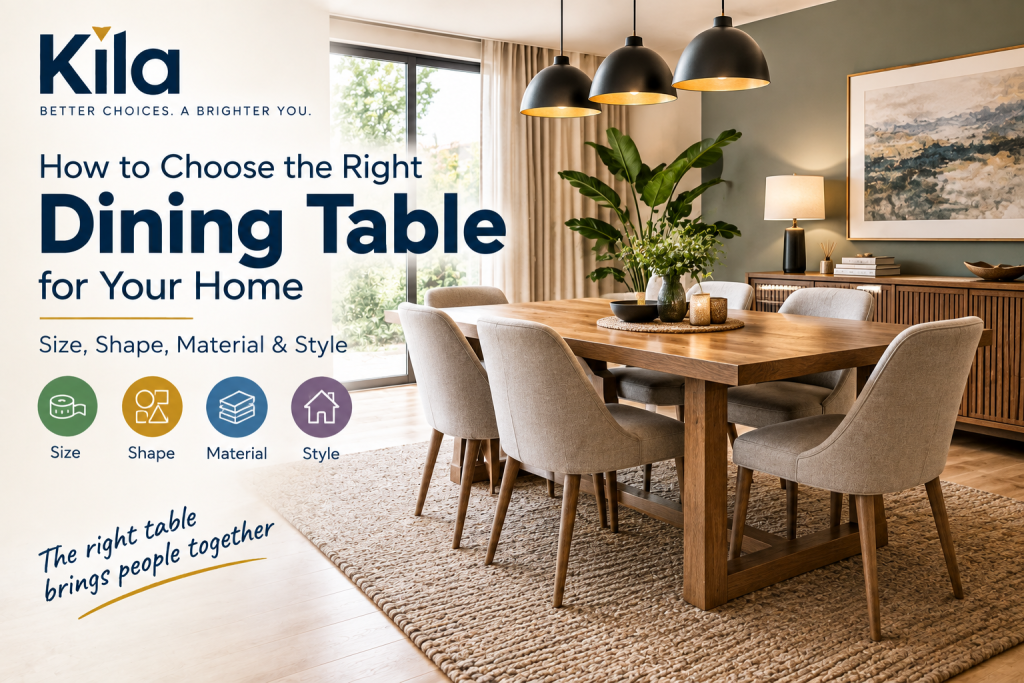
A dining table is more than a place to eat. It often becomes a central part of the home where people work, entertain guests, have conversations and spend time together.
Choosing the right dining table therefore involves more than finding a design you like. The table needs to fit the available space, provide enough seating, work with your existing furniture and suit the way you actually use your home.
This guide explains what to consider before buying a dining table, from size and shape to materials, seating, maintenance and buying online.
1. Start With the Space You Have
Before looking at styles and materials, measure the area where the table will go.
This is particularly important if you are buying online because photographs can make furniture appear smaller than it really is.
Measure:
- The length and width of the available space
- Doorways and entrances
- Nearby furniture
- The distance to walls
- The space required for chairs
- Any walkways around the dining area
Don’t measure only the space occupied by the tabletop. You also need room for people to pull chairs out and move around the table.
Allow space around the table
A dining table that technically fits into a room can still be too large if there isn’t enough clearance around it.
As a general guide, aim for approximately 90 cm of usable space around the table where possible. This gives people room to sit down and move their chairs.
If the dining area also forms part of a walkway, you may need more space.
2. Decide How Many People You Need to Seat
Think about your normal requirements rather than only occasional entertaining.
A table for four may be sufficient for a couple or small household, while a larger family may need six or eight seats.
Consider:
- How many people normally eat together?
- Do you regularly entertain?
- Do you need extra seats during holidays or special occasions?
- Could the table serve as a workspace?
- Will children be using it regularly?
If you only occasionally need additional seating, an extendable table may be more practical than permanently buying a much larger table.
3. Choose the Right Table Shape
The shape of the table has a significant effect on how the dining area looks and functions.
Rectangular dining tables
Rectangular tables are the most common choice.
They work particularly well in larger rooms and can provide considerable seating capacity without taking up unnecessary width.
They are also relatively easy to position against the proportions of a rectangular dining room.
Square dining tables
Square tables can work well in smaller square-shaped rooms.
They create an intimate arrangement and can make conversation easier when everyone is sitting relatively close together.
However, a large square table can require considerable floor space.
Round dining tables
Round tables are useful when you want a more informal and social arrangement.
There are no corners to navigate around, and everyone can generally see and speak to everyone else easily.
A round table can also work particularly well in a smaller dining area.
Oval dining tables
Oval tables combine some of the advantages of rectangular and round designs.
They can provide substantial seating while having softer edges than a conventional rectangular table.
An oval table can also be useful where you want to improve movement around the ends of the table.
4. Consider the Number of Chairs
Don’t choose a table and only think about the tabletop.
The chairs are part of the overall space requirement.
A table may have enough physical room for six chairs, but that doesn’t necessarily mean six people will be comfortable.
Look at:
- Chair width
- Legroom
- Space between chairs
- Table-leg position
- Armrests
- Chair height
- Clearance underneath the table
A table with substantial legs at each corner can sometimes provide less usable seating space than a table with a central pedestal.
5. Think About Table Height
Most standard dining tables are designed around conventional dining-chair heights, but it is still worth checking the measurements.
Pay attention to the relationship between:
- Table height
- Chair seat height
- Seat cushion thickness
- Armrest height
- Legroom underneath the table
This becomes especially important if you are buying chairs and a table separately.
If possible, check the measurements of both before purchasing.
6. Choose the Right Material
Dining tables are available in a huge range of materials.
The right choice depends on your budget, lifestyle and preferred appearance.
Solid wood
Solid wood provides a natural appearance and can be extremely durable when properly maintained.
Different woods have different characteristics, so don’t assume that every wooden table will perform in exactly the same way.
Ask about the type of wood, finish and maintenance requirements.
Wood veneer
A veneer table has a thin layer of real wood over another material.
It can provide the appearance of natural timber while potentially costing less than a solid-wood table.
Quality varies, so check the construction and finish before buying.
Engineered wood
Materials such as MDF and other engineered boards are commonly used in furniture.
They can provide a stable and affordable option, particularly when combined with a durable surface finish.
However, moisture resistance and durability can vary significantly between products.
Glass
Glass dining tables can make a room feel lighter and more open.
They can work particularly well in modern interiors.
The downside is that fingerprints, marks and dust can be more visible, so regular cleaning may be necessary.
Stone and stone-look surfaces
Stone, marble and engineered stone can provide a distinctive premium appearance.
They can also be heavy, so consider delivery, installation and the strength of the supporting structure.
Some natural stone surfaces may require particular care to prevent staining or damage.
Metal
Metal dining tables can work well in contemporary or industrial interiors.
They may also be combined with wood, glass or other materials.
Check the construction carefully because the appearance of a metal table doesn’t necessarily indicate how stable or durable it is.
7. Consider Your Lifestyle
The best-looking table isn’t necessarily the best table for your household.
If you have young children, a delicate surface that marks easily may become frustrating.
If you entertain frequently, durability and seating capacity may be more important.
If your dining table doubles as a home office or homework station, you’ll probably want a surface that is comfortable to work on and easy to clean.
If the table is mainly used for occasional meals, you may have more freedom to prioritise appearance.
Ask yourself:
How will this table actually be used most days?
That question can be more useful than simply asking which table looks best.
8. Think About Maintenance
Different materials require different levels of care.
Before buying, find out:
- How the surface should be cleaned
- Whether it is resistant to spills
- Whether hot dishes can be placed directly on it
- Whether coasters and placemats are recommended
- Whether the finish needs periodic treatment
- Whether scratches can be repaired
- Whether sunlight can affect the finish
If you want a table that requires minimal maintenance, prioritise practical finishes over delicate decorative surfaces.
9. Match the Table to Your Existing Décor
Your dining table doesn’t have to match every other piece of furniture exactly.
In fact, combining complementary materials and colours can create a more interesting interior.
Consider the relationship between the table and:
- Dining chairs
- Flooring
- Curtains
- Lighting
- Sideboards
- Wall colours
- Decorative accessories
How to Choose the Right Lighting for Your Home
Lighting is particularly important because a pendant or chandelier positioned above the dining table can become a major part of the overall design.
How to Choose the Right Curtains for Your Home
10. Don’t Forget the Dining Chairs
A beautiful dining table can still be uncomfortable if the chairs are wrong.
When choosing chairs, consider:
- Seat height
- Seat width
- Back support
- Cushioning
- Armrests
- Material
- Cleaning requirements
- Overall style
You don’t necessarily have to buy matching table and chairs.
A simple wooden table can work with upholstered chairs, while a modern table can be paired with more traditional seating.
The important thing is that the combination looks intentional.
11. Consider an Extendable Table
An extendable dining table can be a useful solution if your everyday requirements are smaller than your entertaining requirements.
For example, a table can remain relatively compact for everyday meals and then be extended when guests arrive.
Before buying, check:
- How the extension mechanism works
- Where the additional sections are stored
- Whether the extended table remains stable
- How many additional people it accommodates
- Whether the extension leaves an obvious gap
- How much space the fully extended table requires
Remember to measure the room with the table fully extended, not just in its everyday configuration.
12. Think About Table Legs and Base Design
The base of a table affects both its appearance and its practicality.
Four-legged tables
These are traditional and generally straightforward.
However, the position of the legs can interfere with where chairs are placed.
Pedestal tables
A central pedestal can provide more flexibility because there are fewer legs occupying the space underneath.
This can be particularly useful with round tables.
Trestle tables
Trestle designs can provide a distinctive appearance and work well with farmhouse or rustic interiors.
However, check where the supports are positioned because they can affect legroom.
13. Dining Tables for Smaller Homes
If space is limited, look for furniture that provides flexibility.
Possible options include:
- Round tables
- Compact square tables
- Drop-leaf tables
- Extendable tables
- Narrow rectangular tables
- Tables with benches
A bench can sometimes provide additional seating while taking up less visual space than individual chairs.
However, comfort should still be considered, particularly if the table is used every day.
14. Dining Tables for Open-Plan Homes
In an open-plan home, the dining table often needs to work visually with both the kitchen and living area.
Rather than treating the dining area as a completely separate room, consider the overall design.
Look at:
- Kitchen cabinetry
- Flooring
- Living-room furniture
- Lighting
- Wall colours
- Decorative finishes
The dining table can either blend into the overall scheme or deliberately act as a focal point.
How to Choose the Right Sofa for Your Home: 8 Things to Consider
The sofa and dining table don’t need to match, but they should work together visually.
15. Consider a Rug Under the Dining Table
A rug can help define the dining area, particularly in an open-plan home.
However, the rug needs to be large enough for the chairs to remain on it when they are pulled away from the table.
How to Choose the Right Rug for Your Home: Size, Material, Style & Care
This is an especially important consideration because a rug that is too small underneath a dining table can become awkward and impractical.
16. Buying a Dining Table Online
Buying furniture online can give you access to a wider selection, but dining tables require some additional checks.
Check the exact dimensions
Don’t rely on the photograph.
Check:
- Length
- Width
- Height
- Leg position
- Extension size
- Weight
Check delivery arrangements
A dining table can be a large and heavy item.
Check whether delivery is included and whether the retailer delivers to your area.
Check whether assembly is required
Some tables arrive fully assembled, while others require significant assembly.
Find out what is involved before ordering.
Check the return policy
Returning a large piece of furniture can be much more complicated than returning a small household product.
Read the retailer’s return conditions carefully.
Read customer reviews
Look for comments about:
- Stability
- Assembly
- Surface quality
- Colour accuracy
- Delivery
- Packaging
- Long-term durability
Photographs from customers can also provide a better indication of the actual size and appearance.
Best Places to Buy Home Décor Online in South Africa.
17. Don’t Ignore Delivery and Installation
The advertised price isn’t necessarily the final cost.
When comparing tables, consider:
- Product price
- Delivery
- Assembly
- Installation
- Additional chairs
- Protective accessories
- Possible return costs
A table that appears cheaper initially may not remain cheaper once all associated costs are included.
18. Common Dining Table Buying Mistakes
Buying a table that is too large
Always measure the entire usable area, including chair clearance.
Choosing style over practicality
A delicate designer-style table may not be appropriate for a busy family.
Forgetting the chairs
The table and chairs need to work together.
Ignoring table legs
The position of the legs can have a surprising effect on seating.
Not measuring doorways
A table that fits the dining room is useless if it cannot get through the front door.
Forgetting an extension
If you regularly entertain, make sure the extended table will actually fit in the room.
Assuming online colours are exact
Screen settings and photography can affect how furniture colours appear.
Failing to check maintenance requirements
A beautiful table can become frustrating if it needs more care than you are prepared to provide.
19. How Much Should You Spend?
There is no universal right price for a dining table.
The amount you spend should reflect how often the table will be used, how long you expect to keep it and the quality of construction.
A table used every day by a family may justify spending more on durability.
A table used occasionally in a guest area may not require the same investment.
Instead of asking only “How much does it cost?”, consider:
“What am I getting for the money?”
Look at construction, materials, finish, stability, warranty and expected lifespan.
20. A Simple Dining Table Buying Checklist
Before buying, check the following:
- Measure the available space
- Allow enough room for chairs
- Decide how many people you need to seat
- Choose the most suitable shape
- Consider the table height
- Decide which material suits your lifestyle
- Check maintenance requirements
- Consider the table-leg design
- Decide whether you need an extension
- Check that the table suits your existing décor
- Choose suitable dining chairs
- Consider whether you need a rug
- Measure doorways and access routes
- Check delivery costs
- Check assembly requirements
- Read the return policy
- Read customer reviews
- Check the warranty
- Confirm the final dimensions before ordering
Final Thoughts
Choosing the right dining table is ultimately about finding the balance between space, practicality, comfort and style.
Start by measuring the room and deciding how many people you need to accommodate. Then consider the shape, material, construction and maintenance requirements.
Don’t overlook the chairs, lighting and surrounding furniture either. A dining table works best when it forms part of a coordinated room rather than being treated as an isolated purchase.
Most importantly, choose a table that suits the way you actually live.
A dining table that looks good but is too large, difficult to maintain or uncomfortable to use will quickly become frustrating. A well-chosen table, on the other hand, can remain a useful and attractive part of your home for many years.