
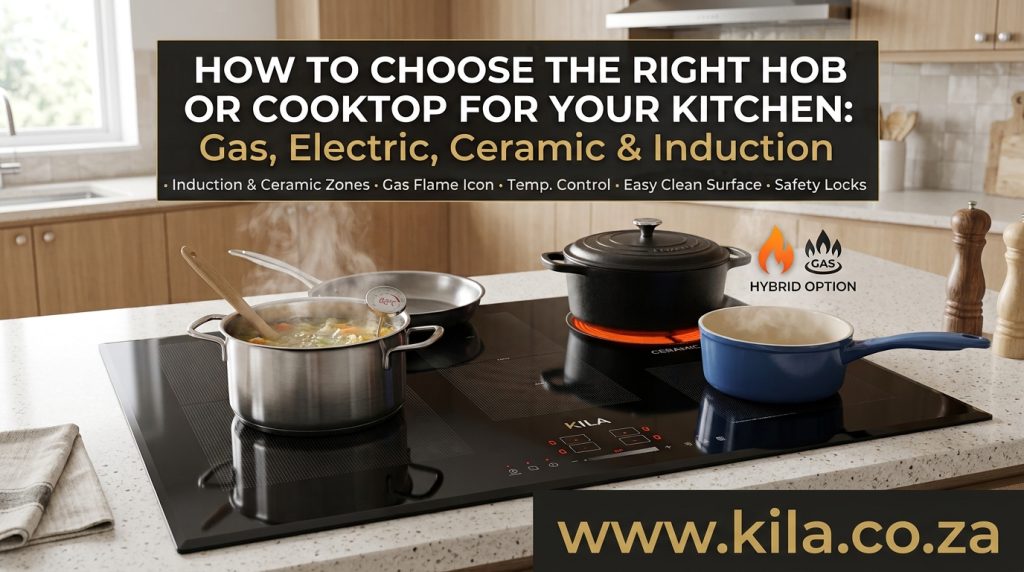
Choosing a hob or cooktop is an important decision when designing, renovating or upgrading a kitchen. Unlike smaller kitchen appliances that can easily be replaced, a hob is usually integrated into the kitchen and may require specific electrical, gas or installation arrangements.
There are several types to consider, including gas, solid electric, ceramic and induction hobs. Each has advantages and disadvantages, and the right choice depends on how you cook, the cookware you already own, the space available and your installation requirements.
For South African households, it is also worth considering electricity costs, gas availability and the practicalities of cooking during power interruptions.
This guide explains what to look for before buying a hob and how to compare the different types.
1. Start With How You Cook
Before comparing brands and specifications, consider your normal cooking habits.
Ask yourself:
- How often do you cook?
- How many pots do you normally use at once?
- Do you prefer gas or electric cooking?
- Do you frequently use high heat?
- Do you simmer sauces for long periods?
- Do you cook large family meals?
- Do you already own suitable cookware?
- How important is easy cleaning?
- Is electricity consumption a major consideration?
- Are you renovating an existing kitchen or designing a new one?
There is no universally perfect hob.
A serious home cook may have different priorities from someone who mainly prepares simple weekday meals.
2. Choose the Type of Hob
The four main options are:
- Gas
- Solid electric
- Ceramic
- Induction
There are also combination hobs that use more than one cooking technology.
Understanding how each works is the best place to start.
3. Gas Hobs
Gas hobs have been popular for many years and remain a practical choice for people who like direct heat and highly responsive temperature control.
The flame provides immediate heat when switched on and disappears when switched off.
Advantages of gas
Gas hobs offer:
- Very responsive heat adjustment
- Visual feedback from the flame
- Strong high-heat performance
- Good control for simmering
- Compatibility with many types of cookware
- Continued cooking capability when electricity is unavailable, depending on the hob’s ignition system and household gas setup
Many cooks also appreciate being able to adjust the flame instantly.
Disadvantages of gas
Gas hobs can have some drawbacks:
- More difficult to clean
- Open burners can collect food debris
- Require a gas supply
- Installation needs to comply with applicable safety requirements
- Heat can spread around the sides of cookware
- Some models require electrical power for ignition
If you choose gas, make sure you understand whether the appliance is designed for the type of gas supply available in your home.
4. Electric Solid-Plate Hobs
Traditional electric solid-plate hobs use heated metal elements beneath or at the cooking surface.
They are generally straightforward and can be relatively inexpensive.
Advantages
- Simple technology
- Usually straightforward to operate
- Compatible with most cookware
- No gas supply required
- Generally durable
Disadvantages
- Slower to heat and cool
- Less responsive than gas or induction
- Hot surfaces remain hot after cooking
- Can be more difficult to clean than smooth ceramic or induction surfaces
- Traditional designs may look less modern
Solid-plate hobs can make sense where simplicity and price are more important than advanced features.
5. Ceramic Hobs
Ceramic hobs use electric heating elements beneath a smooth glass-ceramic surface.
They offer a cleaner and more modern appearance than traditional solid-plate hobs.
Advantages
- Smooth, attractive surface
- Relatively easy to wipe clean
- No open flame
- Suitable for most cookware
- Generally straightforward to operate
Disadvantages
- The surface becomes very hot
- Residue can burn onto the surface
- Heat response is generally slower than induction
- Glass-ceramic surfaces can be damaged by inappropriate cookware or impacts
- The surface remains hot after the element has been switched off
Ceramic hobs are a useful middle ground for households that want a modern appearance without moving to induction cooking.
6. Induction Hobs
Induction cooking works differently from conventional electric cooking.
Instead of simply heating an element beneath the cookware, an induction hob generates a magnetic field that heats compatible cookware directly.
This can provide very fast and responsive cooking.
Advantages of induction
Induction hobs can offer:
- Very fast heating
- Precise temperature control
- Efficient transfer of heat
- A smooth cooking surface
- Easy cleaning
- No open flame
- A cooler surrounding surface compared with traditional electric cooking
- Useful safety features on many models
Because the cookware itself becomes the primary source of heat, induction cooking can be particularly efficient.
Disadvantages of induction
The main disadvantages include:
- Higher purchase price on some models
- Requires compatible cookware
- The glass surface still needs care
- Electronic controls may be less intuitive for some users
- Installation requirements can be significant
If you are considering induction, check your existing pots and pans before buying.
7. Do You Need New Cookware for Induction?
This is one of the most important questions to answer before purchasing an induction hob.
Induction requires cookware with a suitable magnetic base.
A simple way to test some existing cookware is to see whether a magnet sticks firmly to the base.
Cookware that is commonly suitable includes many:
- Cast-iron pots
- Enameled cast-iron pots
- Magnetic stainless-steel pans
- Induction-compatible cookware sets
Some aluminium, copper, glass and non-magnetic stainless-steel cookware may not work unless specifically designed with an induction-compatible base.
If you need to replace several pots and pans, include that cost in your overall budget.
If you are replacing your cookware at the same time, see How to Choose the Right Cookware for Your Kitchen for guidance on materials, sizes and construction.
8. Consider the Number of Cooking Zones
Hobs are available with different numbers and arrangements of cooking zones.
Common configurations include:
- Two zones
- Three zones
- Four zones
- Five zones
Four zones are often sufficient for a typical household, but your requirements may be different.
Think about how many pots you normally use simultaneously.
A five-zone hob isn’t necessarily more useful if you rarely cook more than two dishes at once.
Conversely, a keen cook preparing several components of a meal simultaneously may appreciate additional cooking zones.
9. Look at the Size of the Cooking Zones
The number of burners or zones isn’t the only consideration.
The diameter and arrangement of the zones matter as well.
If you frequently use large pots or frying pans, check whether the hob has sufficiently large cooking areas.
Some models also have flexible or expandable zones that can accommodate different cookware sizes.
This can be especially useful if you regularly use:
- Large frying pans
- Griddles
- Oval dishes
- Large stock pots
- Roasting pans
10. Consider the Layout
The physical arrangement of the cooking zones can make a surprising difference.
Imagine placing your normal cookware on the hob.
Can you comfortably fit:
- A large pot at the back?
- A frying pan at the front?
- A saucepan alongside it?
- Several large pieces of cookware simultaneously?
A hob can have four cooking zones but still be awkward to use if they are positioned too close together.
Look at the actual measurements rather than simply counting the number of zones.
11. Check the Controls
Hob controls should be easy to understand and operate.
Depending on the model, you may find:
- Rotary knobs
- Touch controls
- Slider controls
- Digital displays
- Individual controls for each zone
Touch controls can provide a sleek appearance and are particularly common on ceramic and induction hobs.
However, some people prefer physical knobs because they provide tactile feedback.
Consider which type you will find easiest to use when cooking.
12. Look for Useful Safety Features
Modern hobs can include several safety functions.
Depending on the model, these may include:
- Child locks
- Automatic shut-off
- Residual heat indicators
- Overheat protection
- Flame failure protection on gas models
- Pan detection on induction models
- Automatic power reduction
These features can provide useful additional protection.
However, don’t assume every model has the same functions. Check the manufacturer’s specifications.
13. Residual Heat Indicators
A residual heat indicator is particularly useful on ceramic and induction-style glass hobs.
It alerts you when a cooking zone or part of the surface remains hot.
This is useful because a smooth glass surface may not look hot after cooking.
If you have children in the household, this feature can be particularly valuable.
14. Consider Gas Flame Failure Protection
If you choose gas, look for a model with an appropriate flame-failure safety system.
This type of system is designed to stop the gas supply if the flame goes out unexpectedly.
It is an important safety consideration when comparing gas appliances.
Always follow the manufacturer’s installation and operating instructions.
15. Think About Cleaning
Cleaning requirements vary significantly between hob types.
Gas
Gas hobs generally require cleaning around burners, pan supports and other components.
Food can get into small gaps and around the burner assembly.
Solid electric
Traditional solid plates are relatively robust but can be more awkward to clean around.
Ceramic
The smooth surface makes everyday wiping easier, although burned-on spills may require additional attention.
Induction
Induction hobs also have smooth surfaces and are generally straightforward to wipe clean.
Remember that a smooth surface doesn’t mean maintenance-free. Spills should still be cleaned according to the manufacturer’s instructions.
16. Consider Your Kitchen Worktop
The installation of a built-in hob requires a suitable cut-out in the worktop.
Before purchasing, check:
- Hob width
- Hob depth
- Required cut-out dimensions
- Minimum clearances
- Ventilation requirements
- Position of electrical or gas connections
- Clearance below the hob
This is particularly important if you are replacing an existing hob.
Never assume that a new hob will fit the existing cut-out simply because both are advertised as the same nominal width.
Always compare the manufacturer’s installation dimensions.
17. Think About the Hob and Oven Together
If you are installing a separate oven and hob, you have more flexibility than with a traditional freestanding cooker.
You can choose the oven and hob independently.
For example, you might select:
- A large built-in electric oven
- A four-zone induction hob
Or:
- A built-in fan-assisted oven
- A gas hob
This allows you to choose each appliance according to its intended use.
If you are planning a complete kitchen upgrade, see How to Choose the Right Oven for Your Kitchen for guidance on oven types, capacity, cooking functions and installation.
18. Consider a Combination Hob
Some manufacturers offer combination hobs with different cooking technologies.
For example, a hob might combine gas burners with induction or electric cooking zones.
This can provide flexibility for households with different cooking preferences.
Combination hobs can also be useful if you want access to more than one cooking method.
However, they can be more expensive and may require more complicated installation.
19. Think About Electricity Consumption
For electric, ceramic and induction hobs, energy consumption is worth considering.
Actual electricity use depends on:
- Cooking temperature
- Cooking time
- Number of zones being used
- Size of cookware
- Amount of food being heated
- Cooking habits
Induction cooking is generally efficient because energy is transferred directly to compatible cookware rather than heating a conventional element first.
However, don’t choose a hob based solely on efficiency claims.
Consider the appliance’s overall purchase price, your cooking habits and how long you expect to keep it.
20. What About Cooking During Load Shedding?
Electricity reliability can be a practical consideration in South Africa.
If your household experiences power interruptions, think about whether you have an alternative cooking method.
A gas hob can continue to provide cooking capability during an electricity interruption, depending on the model’s ignition system and gas supply.
Some households therefore choose gas specifically because of its independence from the electrical cooking system.
Others prefer induction or ceramic cooking because they have backup power or simply prefer electric cooking.
The important point is to consider your own circumstances rather than assuming one option is suitable for everyone.
21. Check the Installation Requirements
A hob isn’t an appliance that should necessarily be treated as a simple plug-in purchase.
Depending on the type, installation may involve:
- Electrical work
- Gas installation
- Worktop cutting
- Ventilation
- Cabinet modifications
- Safety clearances
Gas installations should be handled by an appropriately qualified professional.
Electrical installation should likewise comply with applicable requirements.
Before purchasing, obtain the manufacturer’s installation specifications and determine what work will be required.
22. Don’t Forget Ventilation
Cooking produces heat, steam, grease and odours.
A good kitchen ventilation system can help remove these from the cooking area.
If you cook frequently, consider whether your kitchen needs:
- A cooker hood
- Extraction to the outside
- A recirculating extractor
- Additional ventilation
If you are planning the rest of your kitchen, How to Choose the Right Kitchen Utensils: The Essential Tools Worth Buying can help with the smaller equipment that complements your cooking area.
23. Check the Hob’s Power Requirements
Some electric and induction hobs have substantial power requirements.
Before buying, check the manufacturer’s specifications and ensure that your kitchen’s electrical installation can accommodate the appliance.
This is particularly important when replacing a smaller appliance with a more powerful model.
Do not assume that the existing electrical connection is automatically suitable.
If necessary, have the installation assessed before purchasing.
24. Consider the Cookware You Already Own
Your existing cookware can influence your choice.
If you already have a large collection of conventional pots and pans and don’t want to replace them, gas or ceramic may be simpler.
If you are happy to change cookware, induction becomes another option.
This is a good example of why the cheapest hob isn’t necessarily the cheapest overall solution.
A lower-priced induction hob could become significantly more expensive if you need to replace most of your cookware.
25. Think About Maintenance and Repairs
A hob is a long-term appliance.
Before buying, investigate:
- Warranty length
- Availability of replacement parts
- Local service support
- Cost of replacement glass
- Availability of burner components
- Availability of control components
Glass-ceramic and induction surfaces can be expensive to replace if damaged.
For gas hobs, burner components and pan supports may eventually need replacement.
A recognised brand with accessible local support can make long-term ownership easier.
26. Read Reviews for Real-World Information
Product specifications tell you what an appliance is designed to do.
Customer reviews can tell you what it is actually like to live with.
Look for repeated comments about:
- Heat control
- Noise
- Cleaning
- Control responsiveness
- Burner performance
- Induction pan detection
- Glass durability
- Installation
- Reliability
Pay particular attention to recurring complaints.
One negative review may simply represent an individual experience. A consistent pattern across many reviews deserves more attention.
27. Don’t Pay for Features You Won’t Use
Hobs can become surprisingly sophisticated.
Some premium models offer:
- Wi-Fi connectivity
- Automatic cooking programmes
- Smart controls
- Multiple sensors
- Advanced timers
- Flexible cooking zones
Some of these features may be useful.
But if your primary requirements are simply reliable cooking, good temperature control and easy cleaning, you may not need a premium model.
Make a list of your essential features before comparing prices.
28. A Simple Hob Buying Checklist
Before buying, ask the following questions.
Cooking method
- Do I prefer gas, electric, ceramic or induction?
- Do I need cooking capability during power interruptions?
Size
- Will the hob fit my worktop?
- Are the cut-out dimensions correct?
- Are the cooking zones large enough?
Capacity
- How many pots do I normally use?
- Can I use several large pans simultaneously?
Controls
- Are the controls easy to understand?
- Do I prefer knobs or touch controls?
Cookware
- Is my current cookware compatible?
- Will I need to buy new pots and pans?
Cleaning
- How easy will the surface be to clean?
- Are there areas where food can become trapped?
Installation
- What electrical or gas connection is required?
- Will the worktop need modification?
- Will professional installation be necessary?
Safety
- Does it have appropriate safety features?
- Does a gas model have flame-failure protection?
- Does an electric model have a residual heat indicator?
Long-term ownership
- What is the warranty?
- Are replacement parts available?
- Is there local service support?
Gas vs Ceramic vs Induction: A Quick Comparison
| Feature | Gas | Ceramic | Induction |
|---|---|---|---|
| Heat response | Very responsive | Moderate | Very responsive |
| Surface | Metal/glass + burners | Smooth glass-ceramic | Smooth glass |
| Cleaning | More involved | Relatively easy | Relatively easy |
| Cookware compatibility | Broad | Broad | Requires compatible cookware |
| Electricity dependence | Lower, depending on ignition | Yes | Yes |
| Temperature control | Excellent | Good | Excellent |
| High-heat cooking | Excellent | Good | Excellent |
| Purchase price | Varies | Often moderate | Often higher |
| Installation | Gas installation required | Electrical | Electrical |
| Residual surface heat | Lower around flame but components stay hot | High | Lower than conventional electric, but surface can still become hot |
The table is a starting point rather than a definitive ranking. Different models within the same category can perform very differently.
Final Thoughts
Choosing a hob is ultimately about matching the cooking technology to your household.
Gas remains attractive to people who value direct heat and highly responsive control. Ceramic hobs provide a smooth, modern cooking surface without requiring specialised cookware. Induction offers fast, precise cooking and an easy-to-clean surface, but requires compatible cookware and can cost more initially.
Before making a purchase, measure the installation space carefully, check the electrical or gas requirements and consider the cookware you already own.
It is also worth looking beyond the advertised purchase price. Installation, cookware, servicing and long-term energy use can all affect the actual cost of ownership.
Most importantly, choose based on how you cook rather than simply selecting the appliance with the longest list of features. A well-chosen hob should make everyday cooking easier, safer and more enjoyable for years to come.