
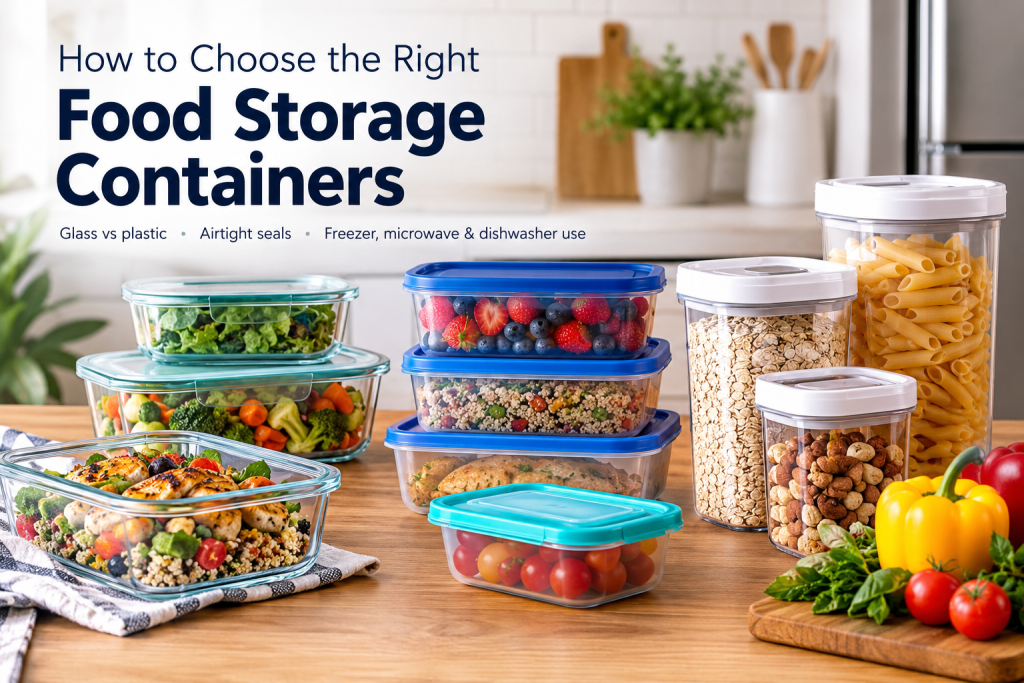
Good food storage containers are one of those kitchen essentials that are easy to overlook until you discover how frustrating poor-quality ones can be.
Lids that don’t fit properly, containers that stain after a few uses, awkward shapes that waste refrigerator space and plastic that becomes unpleasant after heating are all common problems.
The right containers can make it easier to store leftovers, prepare meals, organise the refrigerator and freezer, and keep dry ingredients fresh.
But there isn’t necessarily one “best” food storage container. The right choice depends on what you’re storing, where you’re storing it and how you intend to use the container.
This guide looks at the features worth considering before spending money on a new set.
Start by deciding what you need the containers for
Before buying a large matching set, think about what you actually use food containers for.
Your requirements may include:
- Storing leftovers
- Taking lunch to work or school
- Meal preparation
- Freezing food
- Refrigerating prepared meals
- Storing dry ingredients
- Keeping opened food fresh
- Organising pantry shelves
- Reheating food
- Transporting food
These uses don’t necessarily require the same type of container.
For example, a container intended primarily for pantry storage may need a very different lid from one designed for carrying soup in a lunch bag.
Buying containers according to their intended use is usually better than simply buying the largest set available.
Glass or plastic: which is better?
One of the first decisions is whether to choose glass, plastic or a combination of the two.
Both have advantages.
Glass food containers
Glass is popular because it is durable, easy to clean and doesn’t generally absorb food odours as readily as some plastics.
Glass containers can also be useful when you want to move food from the refrigerator directly into an oven, provided that the particular container is specifically designed and rated for oven use.
Glass is heavier than plastic, however, and can break if dropped.
Advantages of glass
- Good durability
- Easy to clean
- Generally doesn’t retain odours as readily
- Useful for refrigerator storage
- Some are suitable for oven use
- Can be attractive enough for serving
Disadvantages
- Heavier
- Can break
- Usually more expensive than basic plastic containers
- Takes more care when transporting
Plastic food storage containers
Plastic containers are lightweight and generally less likely to break when dropped.
This makes them particularly convenient for lunches, picnics and transporting food.
They are available in a huge range of shapes and sizes, from inexpensive basic containers to higher-quality products designed for repeated use.
The important thing is not simply whether a container is plastic, but what type of plastic it is and what the manufacturer says it is suitable for.
Advantages of plastic
- Lightweight
- Convenient for transportation
- Generally inexpensive
- Available in many sizes
- Less likely to break
- Useful for lunchboxes and meal preparation
Disadvantages
- Some plastics can stain
- Some retain food odours
- Poor-quality containers may warp
- Not every plastic container is suitable for microwave or dishwasher use
Don’t assume every container is microwave safe
This is an important point.
A container being made from plastic doesn’t automatically mean it can safely be used in a microwave.
Likewise, a glass container shouldn’t automatically be assumed to be suitable for microwave heating.
Look for the manufacturer’s instructions and symbols indicating whether the container is suitable for microwave use.
And remember that the lid may have different limitations from the container itself.
If you intend to reheat food regularly, choose containers specifically designed for that purpose.
What about freezer use?
If you regularly freeze leftovers, batch-cooked meals or ingredients, make sure the containers are specifically suitable for freezer use.
A container that performs well in the refrigerator may not necessarily be appropriate for freezing.
Consider:
- Temperature ratings
- Expansion space
- Lid seal
- Material durability
- Shape
- Stackability
Food can expand when frozen, so avoid filling containers completely to the top unless the manufacturer specifically indicates that this is appropriate.
Airtight containers are worth considering
An airtight or well-sealed container can be particularly useful for foods that need protection from moisture and air.
For example:
- Rice
- Flour
- Pasta
- Cereals
- Biscuits
- Coffee
- Dried fruit
- Nuts
- Baking ingredients
For pantry storage, an effective seal can help keep food fresher and make it easier to organise your cupboards.
However, “airtight” shouldn’t simply be assumed because a product has a lid.
Look at how the lid seals and whether the manufacturer specifically describes it as airtight or leak-resistant.
Leak-proof isn’t the same as airtight
These terms are sometimes confused.
An airtight container is primarily designed to limit the exchange of air.
A leak-resistant or leak-proof container is designed to prevent liquid from escaping.
For storing leftover stew or soup, the second characteristic may be more important.
If you’re carrying food in a bag, a secure liquid seal is especially important.
If you’re storing flour or cereal in a pantry, an airtight seal may be the more useful feature.
Choosing the right sizes
Buying a collection of different sizes is usually more useful than buying ten containers that are all approximately the same size.
Consider having a mixture of:
Small containers
Useful for:
- Sauces
- Dips
- Small portions
- Nuts
- Leftover ingredients
Medium containers
Useful for:
- Individual meals
- Leftovers
- Chopped ingredients
- Lunches
Large containers
Useful for:
- Family leftovers
- Batch cooking
- Larger quantities
- Prepared salads
Very large containers
These can be useful, but don’t buy too many unless you regularly have a need for them.
Large containers can take up substantial refrigerator space.
Shape matters more than you might think
A container’s shape affects how efficiently you can use your refrigerator, freezer and cupboards.
Rectangular and square containers often make better use of shelf space than round containers.
Round containers can nevertheless be useful for certain foods and may be easier to clean because they don’t have corners.
Think about your available storage space.
If your refrigerator shelves are relatively narrow, a tall container might work better than a wide one.
If you stack containers in a freezer, shallow rectangular designs may be particularly convenient.
Look for stackability
Stackability can make a major difference in a smaller kitchen.
Ideally, containers should:
- Stack securely when full
- Nest inside one another when empty
- Have lids that can be stored conveniently
- Use similar footprints
- Make good use of vertical space
A beautifully designed container is less useful if its unusual shape means it occupies twice as much cupboard space as necessary.
Lids deserve as much attention as the containers
A good container with a poor lid can quickly become a bad purchase.
Before buying, examine how the lid attaches.
Some common designs include:
- Push-on lids
- Clip-lock lids
- Screw-on lids
- Silicone-sealed lids
- Hinged lids
There is no single best design.
A clip-lock lid can provide a very secure seal, while a simple push-on lid may be quicker to use.
The important thing is that the lid fits securely and can be removed without excessive effort.
Check whether lids are interchangeable
This is an often-overlooked feature.
Some manufacturers design a range of containers with compatible lids.
That can be very convenient because you don’t need to find a specific lid for every container.
It can also make replacing a lost or damaged container easier.
Before buying a large set, check whether the different sizes use compatible lids.
Consider dishwasher use
If you have a dishwasher, look for containers specifically labelled as dishwasher safe.
But don’t assume that every part of a food storage system has exactly the same dishwasher rating.
Lids, seals and other components may have different requirements.
Repeated exposure to high temperatures can also affect some plastics and seals over time.
If you’re washing containers by hand, consider whether the design is easy to clean.
Containers with complicated grooves and seals can sometimes require more attention than simple designs.
Transparent containers make life easier
Being able to see what’s inside a container sounds trivial, but it can make a noticeable difference.
Transparent or translucent containers make it easier to:
- Identify leftovers
- Find ingredients
- Monitor quantities
- See whether food needs to be used
- Organise the refrigerator
Opaque containers can still be useful, particularly when light protection is important for a particular food.
For general household use, however, visibility is often an advantage.
Watch out for staining and odours
Some foods are particularly good at leaving their mark on plastic.
Tomato-based sauces, curries and strongly coloured foods can cause staining in some containers.
Strong-smelling foods can also leave odours behind.
This doesn’t necessarily mean that a particular container is poor quality. Different materials behave differently.
If you regularly store strongly coloured or aromatic foods, glass may be worth considering.
How many food containers do you really need?
It’s tempting to buy a huge 30- or 40-piece set because it appears to offer better value.
But remember that a “30-piece set” might consist of 15 containers and 15 lids.
And you may end up using only five or six of them regularly.
A better approach is to consider your normal household requirements.
A practical starting collection might include:
- Several small containers
- Several medium containers
- A few larger containers
- A few containers suitable for freezing
- Several pantry containers if you regularly decant dry ingredients
You can always add more later.
Should you buy matching containers?
Matching containers aren’t essential, but there are some practical advantages.
A coordinated range can make it easier to:
- Stack containers
- Store lids
- Replace individual pieces
- Organise the refrigerator
- Keep cupboards tidy
However, don’t replace perfectly good containers simply because they don’t match.
The objective is functionality, not creating a showroom refrigerator.
Food storage containers for meal preparation
If you prepare several meals in advance, your requirements change slightly.
Look for containers that are:
- Easy to portion
- Stackable
- Suitable for refrigeration
- Suitable for freezing if required
- Microwave safe if you plan to reheat food in them
- Easy to clean
- Secure enough for transportation
Uniform-sized containers can be particularly useful because they make portions easier to organise and stack.
Containers for pantry storage
Pantry storage is different from leftover storage.
Here, you may want containers designed specifically for dry ingredients.
Useful features include:
- Airtight seals
- Wide openings
- Transparent bodies
- Stackable shapes
- Easy-to-read labels
- Consistent sizes
If you buy ingredients in different package sizes, don’t automatically transfer everything into containers.
Consider whether the container actually improves storage and whether you will use the ingredient frequently enough to justify the extra step.
Don’t forget labelling
A good storage system isn’t only about the container.
For freezer and pantry storage, labels can be extremely useful.
Consider recording:
- What the container contains
- The date it was stored
- A use-by or recommended-use date where appropriate
This is especially useful when freezing food because it can otherwise become surprisingly difficult to remember what is inside an unmarked container several weeks later.
Buying food storage containers online
Food storage containers are particularly easy to buy online because you can compare sets, sizes and specifications without visiting multiple shops.
But don’t judge a set purely from photographs.
Check:
Dimensions: Make sure the containers will fit your refrigerator and cupboards.
Capacity: Look for the actual volume rather than relying on photographs.
Material: Check whether the product specifies glass, polypropylene or another material.
Temperature suitability: Check refrigerator, freezer, microwave and oven claims.
Lid design: Look carefully at how the lid seals.
Number of actual containers: Make sure you understand whether the advertised piece count includes lids.
Replacement availability: Check whether individual containers or lids can be replaced.
Reviews: Look for repeated comments about leaking, staining, cracking or lids becoming loose.
What should you spend?
You don’t necessarily need premium containers throughout your kitchen.
It can make sense to spend more on containers that receive heavy use and buy simpler containers for occasional storage.
For example, you might choose higher-quality glass containers for everyday leftovers while using inexpensive plastic containers for transporting snacks or storing miscellaneous ingredients.
The best value isn’t necessarily the lowest price.
It’s the container that does the job reliably for a reasonable length of time.
A simple food storage container buying checklist
Before purchasing, ask:
What will I store?
Leftovers, dry ingredients, lunches and frozen meals have different requirements.
Glass or plastic?
Choose according to weight, durability, cleaning and intended use.
Is it airtight?
Important for many dry foods.
Is it leak-resistant?
Important for liquids and food transported in bags.
Is it microwave safe?
Check the manufacturer’s instructions.
Is it freezer safe?
Especially important if you batch cook.
Is it dishwasher safe?
Useful if you regularly use a dishwasher.
Does it stack?
Consider your available cupboard and refrigerator space.
Are the lids secure?
A good seal can be more important than the container itself.
Can replacement pieces be purchased?
This can extend the useful life of the set.
Final thoughts
The best food storage containers aren’t necessarily the most expensive or the most fashionable.
A good collection should simply make your kitchen easier to manage.
Look for containers that match the way you actually cook and store food. For most households, that means having a useful mixture of sizes, choosing between glass and plastic according to the job, and paying particular attention to lids, seals, stackability and temperature suitability.
And don’t underestimate the value of buying fewer, better-designed containers rather than filling a cupboard with a huge collection of pieces you rarely use.
Food storage is one of those areas where a little planning can make everyday kitchen life considerably easier.
Related Kila reading
How to Choose the Right Cookware for Your Kitchen
How to Choose the Right Blender for Your Kitchen