
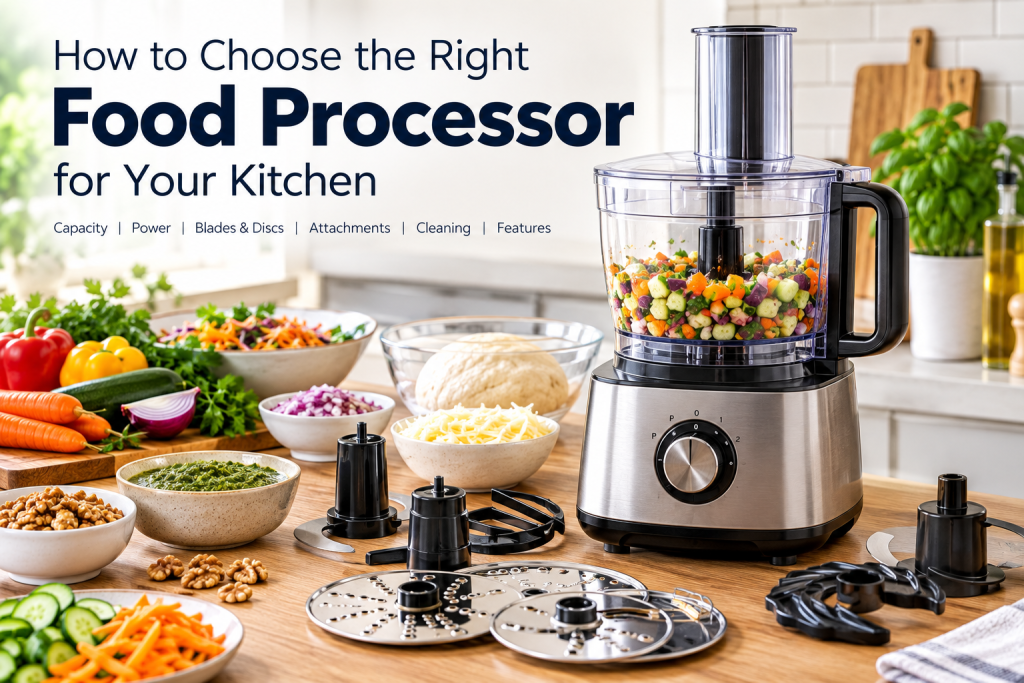
A food processor can be one of the most versatile appliances in a kitchen.
While a blender is particularly good at turning ingredients into liquids, purées and smoothies, a food processor is designed to perform a wider range of preparation tasks.
Depending on the model and attachments, a food processor can chop vegetables, grate cheese, slice ingredients, make dough, prepare sauces and process nuts and other foods.
That versatility can make it a very useful appliance—but it can also make choosing one confusing.
Food processors come in different sizes, with different motors, bowl capacities, blade designs and attachments. Some are relatively simple, while others are packed with accessories.
The important question isn’t “Which food processor has the most features?”
It’s:
“Which food processor will handle the jobs I actually do in my kitchen?”
What does a food processor do?
A food processor uses a motor-driven blade or attachment to process food inside a bowl.
Depending on the attachment, it can perform tasks such as:
- Chopping
- Slicing
- Grating
- Shredding
- Mixing
- Puréeing
- Grinding
- Kneading
- Emulsifying
This makes it particularly useful when preparing larger quantities of ingredients.
For example, chopping several onions by hand might be manageable, but processing a large quantity of vegetables for a family meal can be much quicker with a food processor.
Food processor vs blender
This is one of the most important distinctions to understand.
A blender is generally designed around a tall container and rapidly rotating blades. It excels at liquids and foods that need to become smooth.
A food processor normally uses a wider bowl and interchangeable blades and discs.
It is particularly useful for solid ingredients and preparation tasks.
A blender is generally useful for:
- Smoothies
- Soups
- Smooth sauces
- Drinks
- Purées
- Crushing or blending suitable ingredients
A food processor is generally useful for:
- Chopping vegetables
- Slicing
- Grating
- Shredding
- Making pastry
- Making dough
- Chopping nuts
- Preparing dips
- Processing larger quantities of solid ingredients
If you already own a good blender, a food processor can still complement it rather than simply duplicate its functions.
How to Choose the Right Blender for Your Kitchen
Start with what you actually cook
Before looking at brands or specifications, think about the jobs you want the food processor to perform.
Do you regularly:
- Chop onions and vegetables?
- Grate cheese?
- Slice vegetables?
- Make pastry?
- Make bread or pizza dough?
- Prepare dips?
- Chop nuts?
- Make large batches of sauces?
- Prepare vegetables for cooking?
Write down the three or four tasks you would use most often.
Those should determine which features matter.
There’s little value in buying a food processor with twelve attachments if you only use the basic chopping blade.
Choosing the right bowl capacity
Capacity is one of the biggest differences between food processors.
A small food processor may be perfectly adequate for someone who cooks for one or two people.
A larger model can be much more useful for family cooking and batch preparation.
Small food processors
These are useful for:
- Small quantities
- Chopping herbs
- Making small dips
- Preparing sauces
- Occasional food preparation
They are also easier to store.
Medium-sized food processors
A medium-sized machine can provide a good balance between capacity and storage requirements.
It can handle a wider range of everyday preparation tasks without becoming excessively large.
Large food processors
A larger bowl is useful if you regularly:
- Cook for a family
- Prepare large quantities
- Make dough
- Process large amounts of vegetables
- Batch cook
However, bigger isn’t automatically better.
A very large bowl may be inconvenient when processing a small quantity because the ingredients may not interact effectively with the blade.
Don’t confuse total bowl capacity with working capacity
Manufacturers may advertise a food processor’s total bowl capacity.
That doesn’t necessarily mean you can fill it completely with every type of food.
Liquid and dough capacities can be different from the bowl’s maximum volume.
When comparing models, look for the manufacturer’s stated maximum working capacity for the foods you intend to process.
This is particularly important if you plan to make dough or process liquids.
Motor power: what does it really tell you?
Motor wattage is one of the first specifications shoppers tend to compare.
But wattage alone doesn’t tell the complete story.
Two machines with similar wattage can behave differently because motor design, gearing, blade design and overall construction also affect performance.
Instead of asking only:
“How many watts does it have?”
look at:
- Intended uses
- Maximum processing capacity
- Dough capacity
- Manufacturer recommendations
- Motor and gearing design
- Reviews from people using the machine for similar tasks
- Warranty
If you plan to process heavy mixtures regularly, pay particular attention to what the manufacturer says about those applications.
The main chopping blade
The chopping blade is likely to be the attachment you use most frequently.
It is generally used for tasks such as:
- Chopping vegetables
- Herbs
- Nuts
- Meat where permitted by the manufacturer
- Making dips
- Preparing sauces
- Mixing certain ingredients
Look at how easily the blade can be fitted and removed.
Also check that the blade is securely housed inside the bowl before operation.
Slicing and grating discs
If you want a food processor to save preparation time, slicing and grating attachments can be extremely useful.
A slicing disc can help prepare:
- Potatoes
- Carrots
- Cucumbers
- Onions
- Other suitable vegetables
A grating or shredding disc can be useful for:
- Cheese
- Carrots
- Cabbage
- Vegetables
- Other suitable ingredients
If these are tasks you regularly perform by hand, these attachments may be more valuable to you than several specialised accessories.
What about a dough blade?
Some food processors include a dedicated dough attachment.
This can be useful for:
- Bread dough
- Pizza dough
- Pastry
- Other mixtures supported by the manufacturer
However, don’t assume that every food processor is suitable for heavy dough simply because it includes a dough blade.
Check the manufacturer’s recommended quantities and usage limits.
If bread and pizza dough are a major reason for buying the appliance, make sure the model is specifically designed for that workload.
How to Choose the Right Pizza Oven for Your Home
Feed tubes make preparation easier
Many food processors have a feed tube in the lid.
This allows ingredients to be introduced while the machine is operating.
The size of the feed tube can matter more than you might expect.
A wider feed tube can allow you to insert larger pieces of vegetables without cutting them into very small pieces first.
If slicing vegetables is one of your main reasons for buying a food processor, pay attention to the size and design of the feed tube.
Variable speeds or one-touch operation?
Food processors can have different types of controls.
You may find:
- One-speed operation
- Two-speed controls
- Multiple speeds
- Pulse controls
- Digital controls
- Preset programmes
A pulse function can be particularly useful.
It allows you to process ingredients in short bursts rather than continuously.
This gives you greater control over the texture of chopped ingredients.
For many people, a simple speed control combined with a pulse function is sufficient.
Why is the pulse button useful?
Imagine you’re chopping onions.
You may want chopped onions rather than onion purée.
Running the machine continuously can make it difficult to control the final texture.
Short pulses allow you to check the progress and stop when the desired consistency is reached.
The same principle can be useful for nuts, vegetables and other ingredients where you don’t want to over-process them.
Consider the shape of the bowl
A wide bowl can be useful because it provides room for ingredients to move around the processing area.
It can also make it easier to add and remove ingredients.
A narrow bowl may require less counter space but can behave differently depending on the quantity being processed.
Look at the bowl design rather than focusing only on its stated capacity.
Does the food processor need to be heavy?
A food processor needs to remain stable while operating.
This is particularly important when processing hard ingredients or heavier mixtures.
Many machines therefore have non-slip feet or other mechanisms to help keep the appliance in place.
A very lightweight machine isn’t necessarily a bad product, but check whether it remains stable during use.
Look for non-slip feet
Non-slip feet are a relatively simple feature that can make a noticeable difference.
They help prevent the appliance from moving across the countertop while operating.
This becomes more important when processing heavier ingredients.
Safety features matter
Food processors use rapidly rotating blades, so safety features are important.
Many machines are designed so that the motor will not operate unless the bowl and lid are correctly positioned.
Look for a properly designed locking mechanism and follow the manufacturer’s instructions.
Never attempt to reach into a food processor while the blade is moving.
When cleaning or removing blades, handle them carefully.
Cleaning is an important consideration
A food processor can save considerable preparation time, but you don’t want to spend that time cleaning it.
Look for a design with:
- Removable bowl
- Easily removable blades
- Simple lid construction
- Dishwasher-safe components where specified
- Few awkward corners
- Easy access to food-contact surfaces
Check the manufacturer’s instructions because the motor base and electrical components should not be treated like dishwasher-safe parts.
How easy is it to store?
Food processors can come with numerous attachments.
That’s useful—until you have to find somewhere to store them.
Before buying, consider where you will keep:
- The motor base
- Bowl
- Lid
- Main blade
- Slicing discs
- Grating discs
- Dough attachment
- Other accessories
Some models provide dedicated storage for attachments.
If kitchen cupboard space is limited, this can be a surprisingly valuable feature.
Don’t buy an attachment collection you don’t need
A food processor advertised with fifteen or twenty accessories may appear to offer exceptional value.
But ask yourself how many you’ll actually use.
If your main requirements are chopping, slicing and grating, you may be better off buying a simpler model that does those jobs well.
Unused attachments don’t provide much value—and they still need somewhere to be stored.
What about mini food processors?
Mini food processors are useful for smaller jobs.
They can be convenient for:
- Herbs
- Garlic
- Small quantities of vegetables
- Nuts
- Sauces
- Dips
They are generally smaller and easier to store than full-size machines.
If you already have a full-size food processor, a mini processor may not be necessary.
But for someone who mostly cooks small quantities, it can be a practical alternative.
Food processor for meal preparation
A food processor can be particularly useful if you regularly prepare ingredients in advance.
For example, you could use it to:
- Chop vegetables
- Grate cheese
- Slice ingredients
- Prepare sauces
- Make dips
- Prepare dough
This can reduce repetitive preparation work.
However, consider the cleaning time as well.
If it takes several minutes to assemble and clean the machine for a task that takes 30 seconds by hand, you may find yourself leaving it in the cupboard.
Food processor for baking
Food processors can also be useful for baking.
Depending on the model and recipe, they may help with:
- Pastry
- Dough
- Chopping nuts
- Mixing certain ingredients
- Preparing crumbs
A food processor isn’t necessarily a replacement for a stand mixer.
A stand mixer is particularly useful for tasks involving prolonged mixing, whipping and kneading, while a food processor is more oriented towards rapid cutting and processing.
How to Choose the Right Stand Mixer for Your Kitchen
What about noise?
Food processors can be noisy, particularly when processing hard ingredients.
The actual noise level can depend on:
- Motor design
- Blade design
- Speed
- Ingredients
- Construction
If noise matters to you, look for repeated comments from users rather than relying entirely on marketing descriptions.
Buying a food processor online
Food processors are relatively easy to compare online, but photographs don’t tell you everything.
Before buying, check:
Bowl capacity
Make sure the capacity matches the amount you normally prepare.
Working capacity
Look for specific maximum quantities for dough and other demanding foods.
Attachments
Check exactly which blades and discs are included.
Feed tube
Consider whether it is wide enough for the ingredients you normally process.
Controls
Make sure the machine has the speed and pulse controls you actually need.
Dimensions
Check whether it will fit your countertop and cupboards.
Weight
Consider both stability and how often you’ll need to move it.
Cleaning
Check which components can be removed and washed.
Storage
Consider where all the attachments will go.
Warranty
A good warranty is particularly useful for a motorised kitchen appliance.
How much should you spend?
Food processors range from simple compact machines to sophisticated appliances with numerous attachments.
The right price depends largely on how much you intend to use it.
Occasional user
A smaller, simpler machine may be perfectly adequate.
Regular home cook
A medium-sized model with good basic attachments may offer a useful balance.
Family or batch cook
A larger machine with a stronger motor and larger working capacity may make more sense.
Serious home baker or cook
A robust machine with suitable dough capability and additional attachments may justify a higher price.
Don’t automatically equate price with performance.
Common mistakes when buying a food processor
Buying based on wattage alone
Motor wattage doesn’t tell the complete story.
Choosing the biggest bowl
Large capacity isn’t always useful for small quantities.
Ignoring attachments
A machine may be advertised as versatile but not include the attachments you actually need.
Buying too many accessories
Unused accessories simply create storage problems.
Forgetting about cleaning
An appliance that’s difficult to clean may end up being used less often.
Ignoring countertop space
Food processors can be surprisingly large.
Not checking dough capacity
If you intend to make bread or pizza dough, check the manufacturer’s recommendations.
Forgetting about replacement parts
Check whether bowls, lids and blades can be replaced.
A simple food processor buying checklist
Before buying, ask yourself:
What will I use it for most often?
Do I need chopping, slicing and grating?
Do I want to make dough?
What bowl capacity do I actually need?
Does it have a useful pulse function?
Are the attachments I need included?
Will it fit comfortably in my kitchen?
Where will I store the attachments?
Is it easy to clean?
Does it have suitable safety features?
Are replacement parts available?
Is the warranty appropriate for the price?
Final thoughts
A food processor can be a genuinely useful kitchen appliance when you choose one around your cooking habits rather than its feature list.
For some households, a compact processor with a chopping blade and a couple of useful discs will be enough.
For others, a larger and more powerful machine with dough capabilities and additional attachments will make more sense.
The most important things to consider are capacity, intended use, attachments, motor and construction, ease of cleaning, storage and safety.
And remember that a food processor and blender perform different jobs. If you already own a blender, don’t assume that buying a food processor is unnecessary. The two appliances can complement one another.
How to Choose the Right Blender for Your Kitchen
As with all kitchen appliances, the best purchase isn’t necessarily the one with the longest specification sheet.
It’s the one you’re likely to use regularly and keep using for years.