
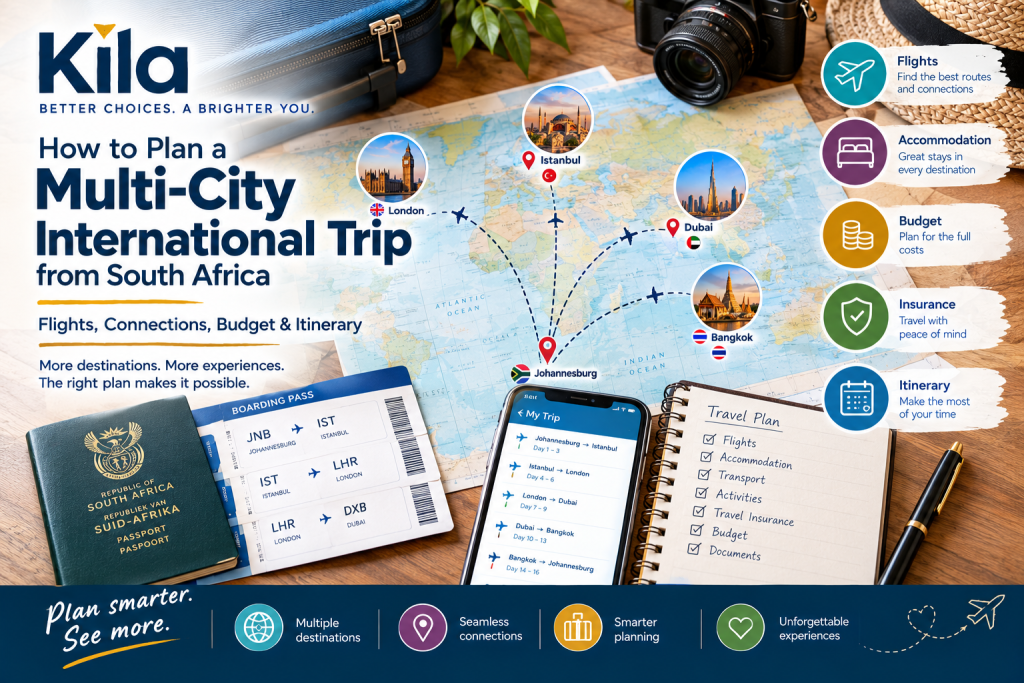
A multi-city international trip can be an excellent way to see more than one destination without having to return home between each stop.
Instead of booking a return flight from South Africa to one destination, you might fly from Johannesburg to Istanbul, continue to London, then travel to Dubai before returning to South Africa.
This type of trip can sometimes be more efficient than organising several separate holidays, but it also requires more planning.
You need to consider flight routes, connection times, accommodation, baggage, visas and entry requirements, travel insurance, transport between airports, budgets and the amount of time you actually want to spend in each destination.
The good news is that you do not need to make the planning complicated.
With a logical approach, you can build a multi-city itinerary that gives you several destinations while keeping the journey manageable.
1. Decide What You Want From the Trip
Start with the experience rather than the flights.
Ask yourself:
- How many destinations do I want to visit?
- How many days or weeks do I have?
- Which destinations are priorities?
- Am I interested in cities, beaches, culture, shopping or sightseeing?
- Do I want a relaxed trip or a busy itinerary?
- How much time am I prepared to spend travelling between destinations?
- What is my overall budget?
A common mistake is trying to fit too many destinations into one trip.
Visiting five cities in 12 days might look exciting on paper, but after flights, airport transfers, hotel check-ins and packing, relatively little time may remain for actually enjoying the destinations.
For many travellers, fewer destinations with longer stays can produce a more enjoyable trip.
2. Choose Your Main Destinations
Once you know what you want from the trip, make a shortlist.
For example, a South African traveller might consider:
Johannesburg → Istanbul → London → Johannesburg
or:
Johannesburg → Dubai → Bangkok → Johannesburg
You can also create longer itineraries such as:
Johannesburg → Istanbul → Bangkok → Dubai → Johannesburg
The important thing is to consider the geographical direction of your journey.
Try to avoid unnecessary backtracking.
If two destinations are relatively close to each other, visiting them consecutively may make more sense than travelling to one, returning in the opposite direction and then travelling back again.
Kila already has destination guides for places including Istanbul Travel Guide for South Africans, Dubai Travel Guide for South Africans: What to Know Before You Go, Bangkok Travel Guide for South Africans: What to Know Before You Go and London Travel Guide for South Africans: What to Know Before You Go.
These can be useful starting points when deciding which destinations belong in your itinerary.
3. Don’t Automatically Choose the Cheapest Destination Combination
It is tempting to build an itinerary entirely around the cheapest flights.
However, this can create a journey that is unnecessarily complicated.
For example, saving R1,500 on airfare may not be worthwhile if it requires:
- An extra hotel night
- A long airport transfer
- A separate domestic flight
- Additional baggage charges
- A very long layover
- An airport change
- A visa or transit requirement
Look at the total cost and complexity of the itinerary, not simply the individual airfare.
The same principle applies when comparing international flights generally. Kila’s How to Choose the Right Flight: Price, Stops, Baggage & Schedule explains what to look at beyond the headline ticket price.
4. Consider an Open-Jaw or Multi-City Flight
One of the most useful options for a multi-city trip is a multi-city or open-jaw booking.
Instead of booking:
Johannesburg → London → Johannesburg
you might book:
Johannesburg → Istanbul
then travel independently:
Istanbul → London
and finally:
London → Johannesburg
Depending on the available fares, this can be more convenient than returning to the original destination between each part of the journey.
When searching for flights, look for a multi-city option rather than automatically selecting a return ticket.
Compare the result against separate one-way tickets.
There is no guarantee that one booking method will always be cheaper, so compare the complete itinerary.
5. Work Out the Order of Your Destinations
The order of destinations can make a major difference.
Suppose you want to visit:
- Istanbul
- London
- Dubai
There are several possible sequences.
The best order depends on:
- Flight prices
- Available routes
- Your preferred activities
- Visa requirements
- Weather
- Accommodation costs
- Flight schedules
Try plotting your destinations on a map.
A geographically sensible route can reduce unnecessary travel.
However, geography should not be the only consideration. A slightly less direct route may still be worthwhile if the flights are significantly cheaper or more convenient.
6. Allow Enough Time in Each Destination
Do not treat each destination as a box to tick.
Consider how long you actually need.
A large city may require several days simply to experience its main attractions.
You also lose time every time you change destinations.
For example:
Day 1: Arrival
Day 2: Sightseeing
Day 3: Sightseeing
Day 4: Travel to next destination
You may technically have four days in a city, but only two full days available for activities.
This is why it is useful to distinguish between calendar days and full sightseeing days.
7. Include Travel Days in Your Planning
Moving between destinations takes time.
A short flight may still consume half a day once you include:
- Getting to the airport
- Check-in
- Security
- Waiting
- Flight time
- Immigration
- Baggage collection
- Transport to your accommodation
- Hotel check-in
For this reason, avoid filling every travel day with major activities.
If you arrive at your next destination in the afternoon or evening, treat the day as primarily a travel day.
This reduces the pressure to rush from one attraction to another.
8. Check Visa and Entry Requirements Before Booking
This is one of the most important parts of planning an international multi-city trip.
Do not assume that because you can enter one country, you can automatically enter another.
Check the current requirements for every destination on your itinerary.
Also check requirements for countries where you are transiting, particularly if you are changing airports or leaving the airport during a long stopover.
Requirements can depend on:
- Passport nationality
- Length of stay
- Purpose of travel
- Transit arrangements
- Airport
- Previous travel
- Required permits or visas
Because entry rules can change, check the relevant official sources before booking non-refundable travel.
Kila’s 10 Things South African Travellers Should Check Before Booking an International Trip also provides a useful pre-booking checklist.
9. Be Careful With Separate Flight Tickets
Separate tickets can sometimes create cheaper and more flexible itineraries.
But they can also introduce additional risk.
For example:
Ticket 1: Johannesburg → Istanbul
Ticket 2: Istanbul → London
If the Johannesburg flight is delayed and you miss the London flight, the second airline may have no responsibility for your missed flight because the tickets were purchased separately.
You may also need to:
- Collect baggage
- Check in again
- Pass through security
- Change terminals
- Meet a new airline’s check-in deadline
If using separate tickets, allow a generous buffer and understand exactly what the connection involves.
10. Don’t Make Every Connection Too Tight
A multi-city itinerary contains several opportunities for delays.
A short connection may look efficient, but a delay on one flight can affect everything that follows.
For important connections, consider allowing additional time.
This is particularly important when:
- You have separate tickets
- You need to collect baggage
- You change airports
- You need to pass immigration
- You are travelling during busy periods
Saving a few hours may not be worth the stress of a connection that leaves almost no margin for error.
11. Consider Your Baggage
Baggage becomes increasingly important as the number of flights increases.
If you travel with a large suitcase, moving it through several airports can become tiring.
Consider whether you really need everything you would normally pack for a single destination.
A lighter suitcase can make:
- Airport transfers easier
- Public transport easier
- Hotel changes easier
- Short connections less stressful
- Multiple flights less complicated
Before booking flights, compare baggage allowances.
A low headline fare can become considerably more expensive when checked baggage is added to several separate flights.
12. Plan Your Accommodation Around Your Itinerary
Once your route is established, look at accommodation.
Try to choose hotels based on:
- Location
- Transport access
- Airport accessibility
- Nearby attractions
- Safety considerations
- Reviews
- Total cost
- Check-in and check-out times
The cheapest hotel is not necessarily the cheapest option overall.
A hotel that is far from public transport may result in significant daily transport costs.
Similarly, a hotel near major attractions may cost more per night but save time and transport expenses.
Kila’s Hotel Booking Guide for South Africans: How to Choose the Right Accommodation covers the main factors to consider when comparing accommodation.
13. Avoid Changing Hotels Too Frequently
Changing hotels every night or two can make a multi-city trip exhausting.
Whenever practical, stay several nights in each destination.
This means:
- Fewer check-ins
- Less packing
- Less transport
- More time exploring
- Less disruption
If a destination deserves four nights, staying in one hotel for all four nights is generally simpler than splitting the stay between two properties.
14. Calculate the Full Trip Budget
Before booking anything, build a realistic budget.
Include:
Flights
- South Africa → first destination
- Destination → destination
- Final destination → South Africa
Accommodation
Calculate:
Nightly rate × number of nights
Also check taxes, resort charges or other mandatory fees where applicable.
Transport
Consider:
- Airport transfers
- Trains
- Buses
- Local public transport
- Taxis or rideshares
Food
Allow a daily amount for meals.
Activities
Include:
- Attractions
- Tours
- Museums
- Excursions
- Entertainment
Insurance
Include the cost of travel insurance.
Other expenses
Allow something for:
- Shopping
- SIM/eSIM
- Currency exchange
- Unexpected costs
A simple spreadsheet can make the entire calculation much easier.
15. Don’t Forget Airport Transfers
Airport location can have a surprisingly large effect on your itinerary.
Before booking accommodation, find out:
- Which airport you arrive at
- How far it is from the city
- How long the transfer takes
- What transport is available
- What it costs
- Whether services operate when you arrive
An airport transfer at 02:00 may be very different from one at 14:00.
This is another reason why arrival time should be considered when comparing flights.
16. Consider the Weather in Every Destination
If your itinerary crosses several countries, the weather can vary considerably.
Check the expected climate during your travel dates.
Consider:
- Temperature
- Rainfall
- Humidity
- Seasonal conditions
- Daylight hours
This affects both your clothing and the types of activities you plan.
For example, packing for Istanbul, Bangkok and London during the same trip may require considerably more thought than packing for one destination.
This is another reason why travelling with a manageable amount of luggage is useful.
17. Plan a Flexible Itinerary
It is good to have a plan, but avoid scheduling every hour.
Create a list of the things you most want to see and then leave some flexibility.
A useful approach is to divide activities into:
Must see
The attractions you would be disappointed to miss.
Would like to see
Interesting places that you can visit if time permits.
Optional
Things you can skip if the weather, transport or energy levels make it impractical.
This gives you structure without turning the holiday into a rigid timetable.
18. Consider Travel Insurance for the Entire Journey
A multi-city trip can involve several flights, hotels and activities.
That means there are more components that could potentially be disrupted.
Before purchasing travel insurance, check whether the policy covers the full itinerary and whether the relevant destinations are included.
Pay particular attention to:
- Medical cover
- Trip cancellation
- Trip interruption
- Missed connections
- Delays
- Baggage
- Emergency assistance
- Policy exclusions
- Excess amounts
Kila’s Travel Insurance for South Africans: What to Check Before You Buy explains some of the important areas to investigate.
19. Think About Currency
A multi-country trip can involve several currencies.
For example, a trip could involve:
- South African rand
- Turkish lira
- British pound
- UAE dirham
- Thai baht
Plan how you will make payments before leaving South Africa.
Consider having:
- A suitable bank card
- A backup card
- Some emergency cash
- Access to banking services
Avoid carrying all of your money in one place.
It is also worth checking the foreign transaction and currency-conversion fees associated with your cards.
20. Keep Important Travel Documents Organised
A multi-city trip produces more travel information than a straightforward return journey.
Keep accessible copies of:
- Passport
- Visas
- Flight confirmations
- Hotel bookings
- Travel insurance
- Transport reservations
- Emergency contact information
Digital copies can be useful, but do not rely exclusively on a single device.
Keep important information accessible in a secure alternative location as well.
21. Consider Your Clothing Carefully
Travelling through several destinations can make clothing selection more complicated.
Rather than packing an entirely different outfit for every day, choose versatile items that can be combined in different ways.
For example:
- Neutral trousers
- Comfortable jeans
- Versatile shirts
- A light jacket
- Comfortable walking shoes
- Suitable underwear and socks
- Weather-appropriate layers
Kila’s How to Build a Versatile Wardrobe Without Overspending has useful advice on creating combinations from fewer clothing items.
Also consider the type of activities you will be doing.
A city sightseeing holiday can involve considerably more walking than a beach holiday.
22. Choose Comfortable Footwear
A multi-city trip often means considerably more walking than an ordinary week at home.
Your footwear should therefore be chosen for the actual trip rather than simply for appearance.
Look for:
- Comfort
- Support
- Appropriate fit
- Breathability
- Weather suitability
- Versatility
Kila’s How to Choose the Right Shoes for Your Lifestyle provides a useful guide to choosing footwear for different requirements.
If you are buying new shoes for a major trip, give yourself enough time to wear them before departure rather than taking completely untested footwear on holiday.
23. Leave Some Space in Your Budget
Do not spend the entire travel budget before you leave.
Unexpected costs can include:
- Transport changes
- Additional baggage
- Meals during delays
- Medical expenses
- Currency differences
- Replacement items
- Unplanned activities
A financial buffer can make the trip considerably less stressful.
It is better to return home with unused emergency funds than to discover halfway through the trip that you have no flexibility.
24. Create a Master Itinerary
Once the major decisions are made, create one simple master itinerary.
For example:
| Date | Destination | Transport | Accommodation |
|---|---|---|---|
| 1 | Johannesburg → Istanbul | Flight | Istanbul hotel |
| 2 | Istanbul | Local transport | Istanbul hotel |
| 3 | Istanbul | Local transport | Istanbul hotel |
| 4 | Istanbul → London | Flight | London hotel |
| 5 | London | Local transport | London hotel |
| 6 | London | Local transport | London hotel |
| 7 | London → Johannesburg | Flight | — |
Keep your booking references and confirmation details alongside the itinerary.
This makes the trip considerably easier to manage.
25. Build the Itinerary in the Right Order
A useful sequence is:
Step 1: Choose destinations
Decide where you want to go.
Step 2: Check entry requirements
Make sure the proposed route is practical for your passport.
Step 3: Check flight routes
Look at the available connections and approximate fares.
Step 4: Decide the order
Choose the most practical sequence.
Step 5: Calculate the total budget
Include all major costs.
Step 6: Book the major flights
Once you are satisfied with the route.
Step 7: Book accommodation
Choose locations that work with the itinerary.
Step 8: Arrange transfers and important activities
Pre-book anything that genuinely needs to be reserved.
Step 9: Purchase suitable travel insurance
Make sure the policy covers the full trip.
Step 10: Prepare your documents
Keep the entire itinerary organised before departure.
This approach reduces the chance of booking one part of the journey that creates problems for everything else.
26. Don’t Try to See Everything
One of the biggest advantages of a multi-city holiday is variety.
One of the biggest disadvantages is the temptation to do too much.
You do not need to visit every famous attraction.
Choose the experiences that matter most to you.
Allow time for:
- Sitting in a café
- Walking around
- Exploring local neighbourhoods
- Shopping
- Resting
- Unexpected discoveries
Some of the most enjoyable parts of a holiday are not necessarily the attractions listed in a guidebook.
27. A Practical Multi-City Trip Checklist
Before booking your trip, check:
☐ Destinations selected
☐ Order of destinations makes sense
☐ Enough days allocated to each destination
☐ Entry requirements checked
☐ Transit requirements checked
☐ Flights compared
☐ Baggage allowances checked
☐ Connection times checked
☐ Separate tickets identified
☐ Airport locations checked
☐ Accommodation researched
☐ Airport transfers considered
☐ Total trip budget calculated
☐ Travel insurance researched
☐ Currency arrangements considered
☐ Important documents organised
☐ Clothing suited to all destinations
☐ Comfortable footwear planned
☐ Emergency budget retained
☐ Master itinerary created
Final Thoughts
A multi-city international trip can give you a much richer travel experience than visiting a single destination, but the success of the trip depends heavily on how well the individual pieces fit together.
Start with the destinations you genuinely want to visit. Then work out the most sensible order, check entry requirements, compare flights and calculate the complete cost.
Do not concentrate only on airfare.
Accommodation, baggage, airport transfers, travel time, local transport, insurance and additional expenses can all affect the actual cost of the journey.
It is also important to leave enough time in each destination. A trip that looks impressive because it includes six cities may be far less enjoyable than one covering three destinations at a comfortable pace.
The best multi-city itinerary is not necessarily the one with the most destinations.
It is the one where the flights, accommodation, budget, travel time and activities work together without making the holiday unnecessarily complicated.
Plan the important details carefully, leave some room for flexibility and give yourself enough time to enjoy each destination.
That can turn a complicated collection of flights and hotels into a genuinely enjoyable international journey.