
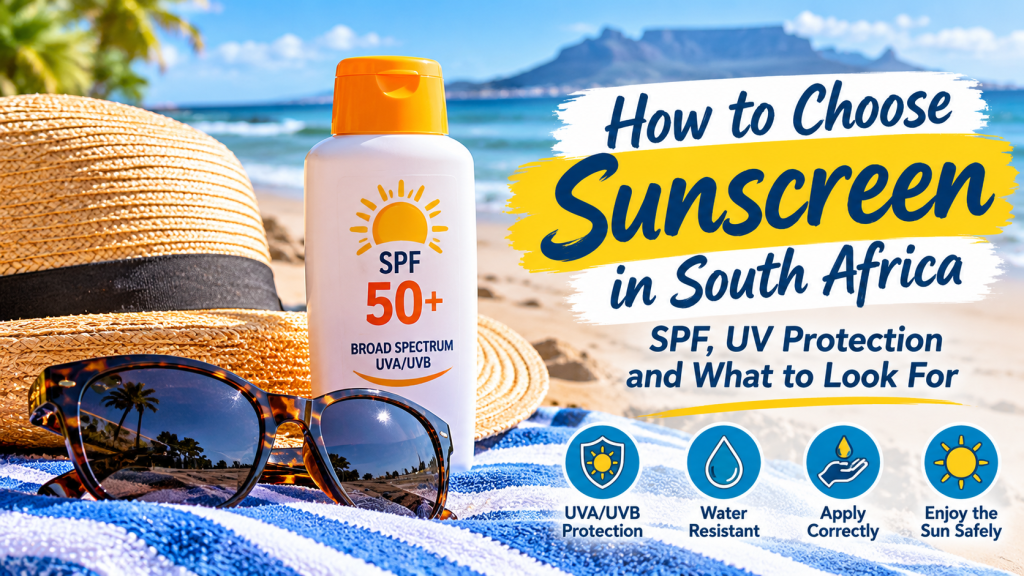
South Africa enjoys plenty of sunshine, but spending time outdoors also means thinking about protecting your skin from ultraviolet radiation.
Whether you’re walking, gardening, driving, relaxing beside the pool or spending a day at the beach, sunscreen can be an important part of your everyday sun-protection routine.
But choosing sunscreen isn’t always straightforward.
Products come in different SPF ratings, formulations and sizes. Some are labelled broad-spectrum, others are water-resistant, and some are designed specifically for the face or sensitive skin.
So what should you actually look for?
The most important considerations are adequate SPF, protection against both UVA and UVB rays, a formulation you are comfortable using and correct application.
This guide explains what the labels mean and what to consider when buying sunscreen in South Africa.
Why Is Sunscreen Important in South Africa?
South Africa experiences relatively high levels of solar ultraviolet radiation, and exposure is not limited to hot summer days.
UV radiation can reach your skin when the weather is cloudy, during cooler months and while you are carrying out ordinary daily activities.
It is also possible to receive considerable exposure without spending an entire day in direct sunshine.
Regular sun protection can help reduce the risk of sunburn and cumulative UV damage. It is also an important part of reducing the risk of certain types of skin cancer.
Your skin colour does not make you completely immune to UV damage. People with darker skin may have a lower risk of some forms of sun damage, but sun protection remains relevant to everyone.
The best approach combines sunscreen with shade, suitable clothing and sensible decisions about how long you spend in direct sunlight.
What Does SPF Mean?
SPF stands for Sun Protection Factor.
It indicates how well a sunscreen protects against UVB radiation under standardised testing conditions.
UVB rays are primarily responsible for sunburn, although both UVA and UVB radiation can contribute to skin damage.
Common sunscreen ratings include:
- SPF 15
- SPF 20
- SPF 30
- SPF 40
- SPF 50
- SPF 50+
For everyday use, a broad-spectrum sunscreen with SPF 30 or higher is a sensible starting point. For extended outdoor exposure, SPF 50 or 50+ may be preferable, particularly when combined with other sun-protection measures.
Is SPF 50 much better than SPF 30?
SPF 50 provides more UVB protection than SPF 30, but the difference is smaller than many people expect.
Approximate laboratory figures are:
| SPF rating | Approximate UVB radiation filtered |
|---|---|
| SPF 15 | 93% |
| SPF 30 | 97% |
| SPF 50 | 98% |
These figures assume the sunscreen is applied correctly and in the amount used during testing.
The difference between SPF 30 and SPF 50 does not mean that SPF 50 allows you to stay in the sun indefinitely. No sunscreen blocks all UV radiation, and protection decreases when too little product is applied or it is not reapplied as directed.
What Is the Difference Between UVA and UVB?
Understanding the difference between UVA and UVB is important when comparing sunscreen products.
UVA radiation
UVA rays penetrate relatively deeply into the skin and contribute to premature skin ageing, including wrinkles and changes in skin pigmentation.
They can also contribute to skin cancer.
UVA exposure occurs throughout the day and can pass through ordinary window glass to some extent.
UVB radiation
UVB rays are more closely associated with sunburn.
They also contribute to skin damage and the development of skin cancer.
UVB intensity varies according to factors such as time of day, season, altitude and geographical location.
Why do you need protection against both?
A sunscreen that protects against both UVA and UVB is known as a broad-spectrum sunscreen.
Do not choose a product based on its SPF number alone. SPF mainly describes UVB protection, so you should also look for clear UVA protection information.
What Does Broad-Spectrum Sunscreen Mean?
Broad-spectrum sunscreen is designed to protect against both UVA and UVB radiation.
When comparing products, look for wording such as:
- Broad spectrum
- UVA and UVB protection
- UVA/UVB
The exact labelling and testing requirements can vary between markets, so check the product information rather than relying on the appearance of the packaging.
A high SPF rating is not, by itself, proof of strong UVA protection.
For South African consumers, it is worth looking for products that comply with applicable South African sunscreen standards and provide clear information about their protection.
SPF 30 vs SPF 50: Which Should You Buy?
Both can be useful, provided the product offers broad-spectrum protection and is applied correctly.
Consider the following:
SPF 30: A practical option for everyday use when combined with appropriate application and other sun-protection measures.
SPF 50 or 50+: Worth considering when you expect extended outdoor exposure, particularly during activities such as beach visits, hiking, gardening or outdoor sport.
The most important point is not to assume that a higher SPF removes the need to reapply sunscreen.
If you regularly spend time outdoors, choose a product that you are comfortable applying generously and frequently enough.
What Types of Sunscreen Are Available?
Sunscreen is available in several formulations. The best choice depends on where you intend to use it and what feels comfortable on your skin.
Sunscreen lotions
Lotions are among the most common sunscreen formulations.
They are generally easy to spread over larger areas and are suitable for everyday use.
They can be a good option for arms, legs, neck and other exposed areas.
Sunscreen creams
Creams are often thicker than lotions.
They may be particularly suitable for the face or for people who prefer a richer moisturising formulation.
Some facial sunscreens are designed to feel lighter and work well under makeup.
Sunscreen gels
Gels often have a lighter feel and may be preferred by people who dislike heavier creams.
Some are designed for oily skin or areas where a less greasy finish is desirable.
Sunscreen sprays
Sprays can be convenient, particularly when applying sunscreen to larger areas of the body.
However, it can be difficult to judge whether enough product has been applied.
Follow the manufacturer’s directions carefully. Avoid inhaling the spray, and do not spray directly onto the face. Spray onto your hands first when applying to the face.
Sunscreen sticks
Sticks are convenient for smaller areas such as the nose, ears and around the eyes.
They can also be useful for carrying in a handbag or travel bag.
Make sure the product is applied evenly and sufficiently to cover the exposed skin.
Chemical vs Mineral Sunscreen: What’s the Difference?
You may see products described as chemical or mineral sunscreens.
These terms refer broadly to the types of UV filters used.
Chemical UV filters
Chemical filters absorb UV radiation and convert it into a small amount of heat.
Different products use different combinations of approved UV filters.
Some formulations are designed to spread easily and leave little visible residue.
Mineral UV filters
Mineral sunscreens commonly use zinc oxide, titanium dioxide or both.
They protect the skin by absorbing and scattering UV radiation.
Some mineral formulations can leave a visible white cast, although this depends on the product and formulation.
Which type is better?
Neither type is automatically best for everyone.
What matters most is that the sunscreen offers appropriate broad-spectrum protection, has a suitable SPF rating and is comfortable enough for you to use consistently.
If you have sensitive skin, you may prefer to compare formulations and test a small amount first. If you experience persistent irritation, seek advice from a healthcare professional.
How to Choose Sunscreen for Your Face
Facial sunscreen is often formulated differently from products intended for the body.
You may prefer a lighter texture that does not feel greasy or interfere with other skincare products.
When choosing sunscreen for your face, consider:
- SPF 30 or higher
- Broad-spectrum UVA and UVB protection
- A texture that suits your skin
- Whether it works comfortably under makeup
- Whether it causes irritation
- Whether it leaves an unwanted white cast
If you have oily skin, you may prefer a lighter gel or fluid formulation.
If your skin is dry, a cream-based product may feel more comfortable.
For sensitive skin, look for a product specifically formulated for that purpose, and check the ingredients.
What About Sunscreen for Darker Skin?
Sunscreen is relevant to people of all skin tones.
Melanin provides some natural protection against UV radiation, but it does not eliminate the possibility of sun damage, pigmentation changes or skin cancer.
Some people with darker skin also find that certain sunscreens leave a visible white residue.
If this is a concern, consider:
- Lightweight formulations
- Tinted sunscreens
- Products designed to minimise white cast
- Formulations that blend easily into the skin
Tinted sunscreens containing iron oxides may also provide additional protection against some visible light that can contribute to pigmentation concerns.
However, the SPF and broad-spectrum protection should remain your first considerations.
What Does Water-Resistant Sunscreen Mean?
Water-resistant sunscreen is designed to maintain its tested level of protection for a specified period while exposed to water.
You may see claims such as:
- Water resistant for 40 minutes
- Water resistant for 80 minutes
These claims do not mean the sunscreen is waterproof.
Swimming, sweating and towel drying can reduce the amount of sunscreen remaining on your skin.
If you are going to the beach, swimming pool or exercising outdoors, choose a suitable water-resistant product and follow its reapplication instructions.
How Much Sunscreen Should You Apply?
One of the most common sunscreen mistakes is applying too little.
A product may have an excellent SPF rating, but using a thin layer can significantly reduce the protection you actually receive.
For the face, the commonly used two-finger method provides a practical starting guide: apply a line of sunscreen along the length of your index and middle fingers.
For the body, use enough product to cover all exposed skin evenly. The amount required will depend on your body size and how much skin is uncovered.
Do not forget areas that are easily missed, including:
- Ears
- Back of the neck
- Hairline
- Exposed scalp
- Tops of the feet
- Hands
- Behind the knees
Follow the manufacturer’s application instructions, as different formulations may have different directions.
When Should You Apply Sunscreen?
Apply sunscreen before going outdoors, following the product’s instructions about how long it needs before sun exposure.
Many products recommend applying approximately 15 minutes before exposure.
Do not wait until your skin begins to feel hot or uncomfortable.
For ongoing protection, reapply at least every two hours when outdoors, and sooner after swimming, heavy sweating or towel drying, in accordance with the product label.
Remember that sunscreen is not a reason to spend longer in direct sunlight.
Do You Need Sunscreen on Cloudy Days?
Yes, UV radiation can still reach your skin when the sky is overcast.
Cloud cover does not eliminate UV exposure, and some UV radiation can pass through clouds.
If you are spending time outdoors, consider the UV Index rather than relying only on how hot or bright the day feels.
The World Health Organization recommends sun-protection measures when the UV Index reaches 3 or above.
This is particularly relevant in South Africa, where UV levels can be high even when the weather does not feel especially hot.
How to Protect Your Skin Beyond Sunscreen
Sunscreen is important, but it should not be your only form of sun protection.
Other useful measures include:
Seek shade
Spend time in the shade where possible, particularly when UV levels are high.
Wear protective clothing
Long sleeves, suitable fabrics and clothing that covers exposed areas can reduce direct UV exposure.
Use a suitable hat
A wide-brimmed hat can help protect the face, ears and neck.
Wear UV-protective sunglasses
Choose sunglasses that provide reliable UVA and UVB protection.
Our guide Aviator vs Cat-Eye vs Rectangle Sunglasses: Which Style Suits You? compares popular sunglasses styles. Remember to check the UV-protection specifications when buying eyewear.
Be careful around reflective surfaces
Water, sand and other surfaces can reflect UV radiation, increasing exposure.
This is particularly important at beaches, swimming pools and outdoor recreational areas.
What Should You Check on a Sunscreen Label?
Before buying, take a moment to check the packaging.
Look for:
- SPF 30 or higher
- Broad-spectrum or UVA/UVB protection
- Water-resistance information if needed
- Directions for application and reapplication
- Expiry date
- Ingredient information
- Manufacturer or responsible supplier details
- Storage instructions
Avoid relying solely on advertising claims or attractive packaging.
A product’s protection should be supported by clear specifications and appropriate testing.
How Much Should You Spend on Sunscreen?
Sunscreen prices vary according to brand, formulation, size and additional features.
A more expensive product is not necessarily more effective than a less expensive one with comparable protection.
When comparing prices, consider:
- SPF rating
- UVA protection
- Water resistance
- Bottle size
- Formulation
- How much product you need to apply
- Whether you will use it regularly
It can also be useful to compare the price per 100 ml rather than looking only at the price of the bottle.
A sunscreen that is affordable and comfortable enough to use properly may be a better choice than an expensive product that you use sparingly.
Common Sunscreen Buying Mistakes
Choosing only by SPF number
A high SPF does not automatically guarantee adequate UVA protection. Look for broad-spectrum protection.
Assuming darker skin does not need sunscreen
All skin tones can experience UV damage. Sun protection remains relevant regardless of skin colour.
Applying too little
Using insufficient sunscreen reduces the protection you receive.
Forgetting to reapply
Swimming, sweating and ordinary activity can remove sunscreen. Follow the product’s reapplication instructions.
Assuming water-resistant means waterproof
Water-resistant sunscreen still needs to be reapplied as directed.
Choosing a product you dislike using
A sunscreen that feels unpleasant may discourage regular use. Find a suitable formulation that you are comfortable applying.
Ignoring the expiry date
Do not rely on sunscreen that is past its expiry date or has been stored incorrectly.
A Simple Sunscreen Buying Checklist
Before purchasing, ask yourself:
- Does it have SPF 30 or higher?
- Does it offer broad-spectrum UVA and UVB protection?
- Is it water-resistant if I need it for swimming or sport?
- Is the formulation suitable for my skin?
- Will I be comfortable applying it generously?
- Have I checked the expiry date?
- Have I read the application instructions?
- Is the bottle size suitable for how often I will use it?
- Does the product provide clear manufacturer and protection information?
Frequently Asked Questions
Is SPF 50 better than SPF 30?
SPF 50 offers slightly greater UVB protection than SPF 30 when both are applied correctly. However, neither blocks all UV radiation. Broad-spectrum protection and correct application remain important.
Should I use sunscreen every day in South Africa?
Daily sunscreen can be useful when you are exposed to daylight, particularly when spending time outdoors. Consider the UV Index and use other sun-protection measures as well.
Can I use body sunscreen on my face?
Some body sunscreens can be used on the face, but they may feel heavier or cause irritation for some people. Facial formulations are often designed to be more comfortable for everyday use.
Do I need sunscreen on cloudy days?
Yes. Clouds do not block all UV radiation. Sun protection may still be necessary when the UV Index is 3 or higher.
How often should sunscreen be reapplied?
A common recommendation is to reapply at least every two hours when outdoors, and after swimming, heavy sweating or towel drying. Always follow the product’s instructions.
Does a dark sunscreen or tanning lotion provide better protection?
The appearance or colour of a product does not determine its SPF. Check the stated SPF and broad-spectrum protection information.
Can sunscreen replace protective clothing?
No. Sunscreen should be used alongside shade, suitable clothing, hats and UV-protective sunglasses.
Final Thoughts
Choosing sunscreen does not need to be complicated.
Start by looking for SPF 30 or higher and broad-spectrum UVA and UVB protection. If you spend extended periods outdoors or go swimming, consider SPF 50 or 50+ and a suitable water-resistant formulation.
Then choose a product that feels comfortable on your skin and that you can afford to use generously and regularly.
Remember that sunscreen is only one part of protecting yourself from the sun. Shade, protective clothing, a suitable hat and UV-protective sunglasses all contribute to a sensible approach.
South Africa’s sunshine is something to enjoy, but it is worth taking a few practical precautions before heading outdoors.
Further Reading
- Aviator vs Cat-Eye vs Rectangle Sunglasses: Which Style Suits You?
- Sunglasses: What UV Protection, Lens Colour and Polarisation Really Mean
- How to Stay Hydrated: Signs of Dehydration and Practical Tips
- How to Build a Balanced Diet on a Budget in South Africa
Suggested External References
- World Health Organization – Ultraviolet radiation: https://www.who.int/news-room/fact-sheets/detail/ultraviolet-radiation
- Cancer Association of South Africa (CANSA): https://cansa.org.za/
- American Academy of Dermatology – Sunscreen guidance: https://www.aad.org/public/everyday-care/sun-protection/shade-clothing-sunscreen