
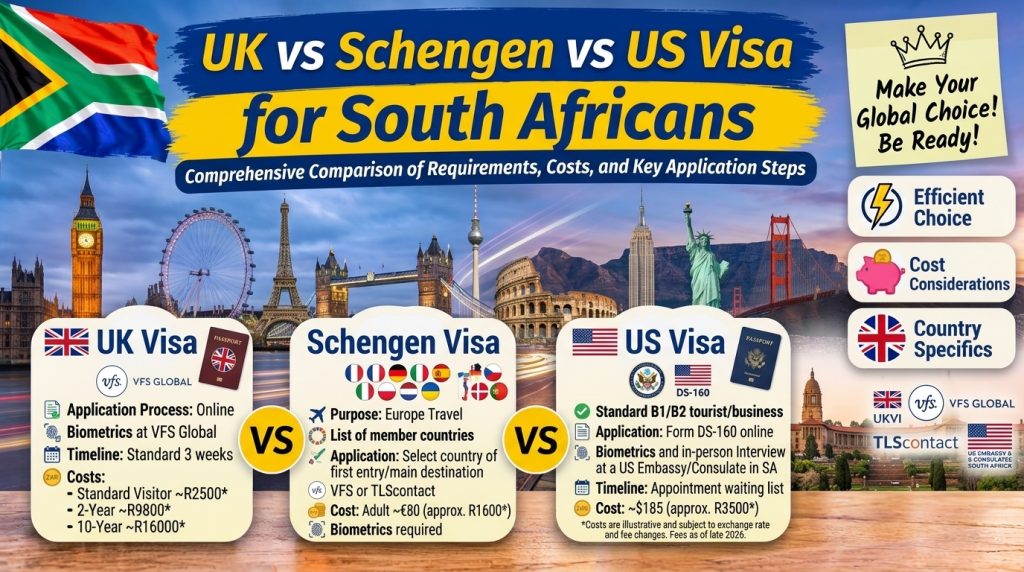
If you are planning an overseas trip, the first question is often “which visa is the hardest?” The UK, the Schengen area (most of Europe) and the United States are three of the most popular destinations for South Africans, and all three require a visa. They are not the same, though. They differ in cost, how long they take, whether you need an interview and what the officials focus on.
This guide compares the three side by side using current 2026 figures in rand, so you can budget, plan the order of your applications and avoid common mistakes. For the full step-by-step process on each, read our detailed guides to the UK visa, the Schengen visa and the US visa.
Quick answers
- Cheapest: The Schengen visa, at about R2,200 per adult including a typical application-centre service charge.
- Most expensive in fees: The UK visa at £135 (about R3,100), with the US close behind at $185 (about R3,050). The US could cost about R7,200 if the $250 Visa Integrity Fee is collected.
- Slowest: The US, mainly because of the wait for an interview slot. The US Embassy advises applying at least three months ahead.
- Interview needed: Only for the US. The UK needs a biometrics appointment and Schengen needs an application appointment, but neither involves a formal interview.
- Longest stay: The UK and the US allow stays of up to six months per visit, while Schengen allows 90 days in any 180.
- Best preparation for all three: Strong bank statements, an employer letter, a clear itinerary and refundable bookings until approval.
UK vs Schengen vs US visa: side-by-side comparison
| UK Standard Visitor | Schengen (Europe) | US B1/B2 visitor | |
|---|---|---|---|
| Visa fee (adult) | £135 (about R3,100) | €90 (about R1,770) | $185 (about R3,050) |
| Extra costs | Application-centre fees and optional extras | Service charge. Czech Republic via VFS is about R413 | A $250 Visa Integrity Fee (about R4,100) has been enacted. Check whether it is being collected |
| Where you apply | Online on GOV.UK, then biometrics at a visa application centre | Embassy or consulate of your main destination, usually via an application centre | Online DS-160, then an interview in Johannesburg or Cape Town |
| Interview? | No | No formal interview. In-person appointment with fingerprints | Yes, almost always |
| Processing time | About 15 working days from biometrics | About 15 calendar days, sometimes 30 to 60 (Czech Republic example) | A few weeks after the interview, but interview slots can take months |
| How early to apply | Up to about 3 months before travel | No earlier than 6 months before travel | At least 3 months before travel, as advised by the US Embassy |
| Length of stay | Up to 6 months per visit | 90 days in any 180-day period | Up to 6 months per entry, set at the border |
| Validity | 6 months, or longer multiple-visit visas of 2, 5 or 10 years | Single or multiple entry, depending on your application | Commonly several years with multiple entries, up to 10 years, at the officer’s discretion |
| Travel insurance | Recommended | Compulsory, at least €30,000 cover | Recommended |
| Refusal | Fee not refunded. No appeal for most visitor refusals | Fee not refunded | Fee not refunded. No formal appeal |
Fees in rand use rough exchange rates of £1 ≈ R23, €1 ≈ R19.60 and $1 ≈ R16.50, so they will move with the currency. Check the current official fees before you apply.
What each visa costs in rand
| Who is travelling | UK | Schengen | US |
|---|---|---|---|
| One adult, fees only | £135, about R3,100 | About R2,180 (€90 plus a typical R413 service charge) | $185, about R3,050 |
| One adult, if the US Integrity Fee applies | n/a | n/a | $435, about R7,200 |
| Family of four (two adults, two children aged 6–11) | £540, about R12,400. Children pay the full fee | About R7,000. Children aged 6–11 pay €45 (about R885) plus the service charge | $740, about R12,200. About R28,700 if the Integrity Fee applies |
Schengen is clearly cheapest for families because children aged 6 to 11 pay half the fee and those under 6 pay nothing. The UK and US charge every applicant the full adult fee. Remember to budget for extras such as courier returns, photos, printing, travel to your appointment and travel insurance, which isn’t included in these figures.
How long each takes
| Visa | When to start | What to expect |
|---|---|---|
| UK | 6 to 8 weeks before travel | Apply online, book biometrics and allow about 15 working days for a decision. Appointment slots can be limited around school holidays |
| Schengen | 6 to 8 weeks before travel, earlier for December and school holidays | Book an appointment, submit your documents and allow about 15 calendar days, with some countries taking longer |
| US | At least 3 months before travel | Complete the DS-160, pay the fee, book your interview and allow time for the wait. A straightforward approval typically follows within a couple of weeks of the interview |
The US is the one to start first. If you want all three in the same year, our advice is to book the US interview as soon as you know your travel window, then do the UK and Schengen applications. Don’t buy non-refundable flights or hotels for any of them until the visa is in your passport. See our guides on choosing the right flight and travel insurance for South Africans.
What each one looks at
All three visas are decided on the same three questions: why are you going, can you afford it, and will you leave when you are supposed to? The way you prove those differs.
| Evidence | UK | Schengen | US |
|---|---|---|---|
| Application form | Online on GOV.UK | Country-specific form | DS-160 online |
| Bank statements | Yes, usually several months | Yes, usually 3 months | Bring them. They may be requested |
| Employer letter or business proof | Yes | Yes | Helpful, to show ties |
| Itinerary and accommodation | Travel plans and where you will stay | Flight and accommodation bookings, ideally refundable | A clear trip plan, explained at the interview |
| Travel insurance | Recommended | Compulsory, at least €30,000 | Recommended |
| Host or invitation letter | If visiting family or friends | If visiting family or friends | Optional but helpful |
| Strong ties to South Africa | Important | Important | The main test at the interview (Section 214(b)) |
Why applications are refused
The same weaknesses cause most refusals across all three:
- Weak or unexplained finances. Large unexplained deposits or too little money for the trip.
- Weak ties to South Africa. Little to show that you will go home, such as no job, no property and no family commitments.
- An unclear purpose. A vague itinerary or one that doesn’t match your circumstances.
- Inconsistent information. Details that don’t match across forms and documents.
- Incomplete paperwork. Application centres can reject files with missing documents.
- Previous immigration problems. Overstays or earlier refusals that weren’t declared.
If you are refused, read the reasons, fix the problem and apply again with stronger evidence. Earlier refusals must be declared on later applications, including for other countries, so always answer honestly.
Which should you apply for first?
| Your situation | A sensible starting point |
|---|---|
| You want a European city break soon | Start with the Schengen visa. See our Schengen guide and city guides such as Paris, Rome and Prague |
| London is your main destination | Apply for the UK visa. See our UK visa guide and London travel guide |
| You are planning a US trip, such as New York | Start the US process first because of the interview wait. See our US visa guide and New York guide |
| You want to visit the UK and Europe together | You need both a UK visa and a Schengen visa. Apply for both well ahead, and check how long each provider keeps your passport |
| You want the easiest paperwork | Consider destinations that need less. See our list of visa-free countries for South Africans, and guides to Japan and South Korea |
Combining trips: sequencing your applications
- Don’t overlap passport submissions. If one visa application centre or embassy holds your passport, you can’t submit it elsewhere at the same time. Ask each provider how long they keep it.
- Start the slowest first. That is usually the US because of interview wait times.
- Keep bookings flexible. Choose refundable flights and hotels until your visas are approved.
- Allow gaps between trips. Check that each visa’s validity dates match your travel dates.
- Use the same consistent story and documents. Your employment, income and travel plans should match across applications.
For a UK and Europe trip, remember the UK visa doesn’t cover Schengen countries, and a Schengen visa doesn’t cover the UK or Ireland. See our guide to planning an international trip from South Africa and the 10 things South African travellers should check before booking.
Common mistakes with all three visas
- Booking non-refundable flights first. A refusal or delay can cost you thousands of rand.
- Using agents and look-alike websites. Use only the official government sites and application centres. Nobody can guarantee approval.
- Leaving it too late. School holidays and December are the busiest times.
- Weak documents. Bring clear, recent and consistent bank statements, employer letters and travel plans.
- Ignoring passport rules. Check validity and blank pages before you apply.
- Not reading country-specific rules. Each Schengen country sets its own checklist, and fees and rules change often.
Planning checklist
- Destination and travel dates chosen
- Passport validity and blank pages checked
- Visa type and the official application route identified for each destination
- Fees and extras budgeted in rand, including insurance
- Bank statements, employer letter and itinerary gathered
- Appointments booked, starting with the slowest process
- Flights and accommodation kept refundable until approval
- Travel insurance arranged
Frequently asked questions
Which is the cheapest visa for South Africans: UK, Schengen or US?
The Schengen visa is cheapest at about R2,200 per adult including a typical service charge. The US visa costs $185 (about R3,050), and the UK visa £135 (about R3,100). Schengen is also much cheaper for families because young children pay less.
Which visa is the hardest to get?
The US visa is usually the most demanding because it requires an in-person interview and the wait for an appointment can take months. All three decisions turn on proving your purpose, finances and ties to South Africa.
Which visa takes the longest?
The US, because of interview waiting times. The US Embassy advises applying at least three months before you travel. The UK takes about 15 working days after biometrics, and Schengen about 15 calendar days, sometimes longer.
Do I need an interview for the UK or Schengen visa?
No. The UK requires a biometrics appointment and Schengen an in-person application appointment, but neither involves a formal interview.
Can I use a Schengen visa for the UK?
No. The UK has its own visa, and it does not cover Ireland or the Schengen area.
How long can I stay on each visa?
Up to six months per visit in the UK, 90 days in any 180-day period in Schengen, and up to six months per entry in the US, set by border officials.
Is the US Visa Integrity Fee being charged?
It has been enacted at $250, but reports differ on whether and where it is being collected. Check the State Department’s visa fee page before you pay.
Should I apply for several visas at once?
You can, but start with the slowest, and don’t let different offices hold your passport at the same time. Keep bookings refundable until each visa is approved.
Does a refusal for one visa affect the others?
A refusal doesn’t automatically cause another refusal, but you must declare earlier refusals on later applications, so answer every question honestly.
Final thoughts
None of these visas is impossible, but each rewards preparation. Schengen is the cheapest and quickest, the UK is a straightforward online process that depends on strong evidence, and the US takes the most planning because of the interview. Start with the slowest, keep your bookings flexible and read the official guidance for every application.
Fees, processing times and procedures change often, so confirm current details on the official government sites before you apply.
More Kila travel guides
- UK Visa for South Africans
- Schengen Visa for South Africans
- US Visa for South Africans
- Visa-Free Countries for South Africans in 2026
- London Travel Guide for South Africans
- All Kila travel guides
Sources and official links
- GOV.UK: Standard Visitor visa
- VFS Global: Czech Republic visa information for South Africa
- U.S. Department of State: Visitor visa
- U.S. Department of State: Visa fees
- Travelstart: US visa situation for South Africans
- Travelstart: UK visa requirements for South Africans
Visa rules, fees and processing times change often. Rand amounts are approximate and based on recent exchange rates. Always confirm current details on the official government websites before you apply. Kila may earn a commission if you buy through some links on our site. See our disclosure policy.