
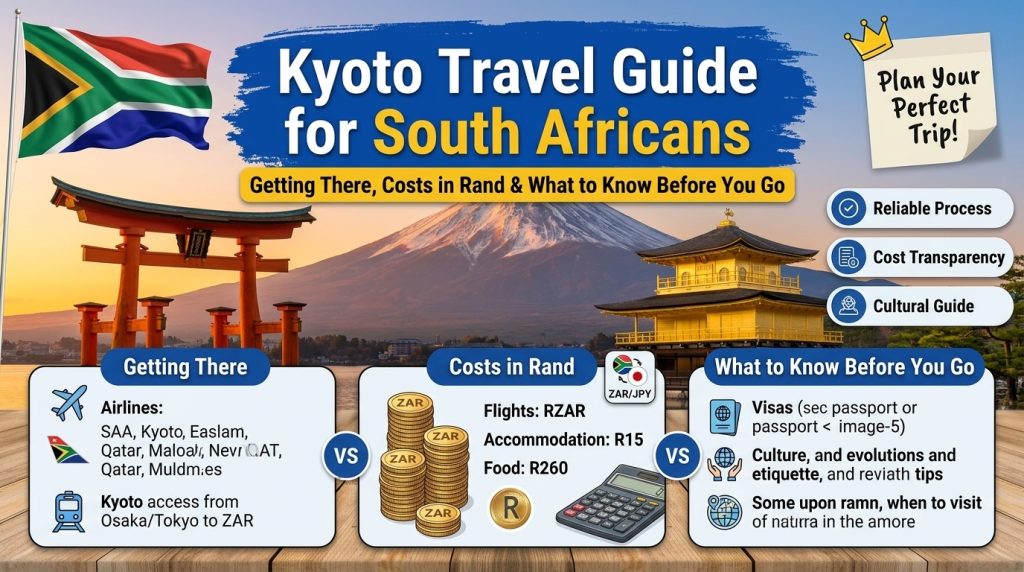
Kyoto is the Japan many South African travellers dream about: wooden temples, lantern-lit streets, tea houses, bamboo groves and gardens that change with the seasons. It is also one of the most visited cities in the country, and 2026 brought some of the biggest changes in years, from a steep new hotel tax to rules protecting residents in the Gion district.
This guide covers what South Africans need to know before they go: the visa, how to get to Kyoto, where to stay, what it costs in rand, how to get around and what to see. It is the companion to our Japan from South Africa guide, which covers the visa, flights and overall costs, and to our Tokyo and Osaka guides.
Quick answers
- Visa: The same as for the rest of Japan. South Africans need a tourist visa, which they can apply for online through the eVisa system. See our Japan guide.
- Flights: There is no airport in Kyoto. Most visitors fly into Osaka (Kansai) or Tokyo, then take a train.
- From Kansai Airport: The Haruka express takes about 75 to 80 minutes and costs about ¥3,060 (about R310) for a non-reserved seat.
- From Tokyo: The Nozomi bullet train takes about 2 hours 10 minutes and costs about ¥13,320 (about R1,330) one way.
- New in 2026: Kyoto’s accommodation tax rose on 1 March 2026 to between ¥200 and ¥10,000 per person per night, depending on the room price.
- How long: Plan on 2 to 3 nights as a minimum, and 4 if you want to include Arashiyama and a day trip.
- Etiquette matters: Private lanes in Gion are off limits to visitors, with fines of up to ¥10,000.
Do South Africans need a visa for Kyoto?
Yes. Kyoto is in Japan, so the same entry rules apply. South Africans need a tourist visa and can apply for it online through Japan’s eVisa system. The single-entry visa costs ¥15,000 (about R1,500) and is valid for up to 90 days. Apply well before you book non-refundable travel, and use only the official eVisa website. Our Japan from South Africa guide explains every step, along with flights and the cost of a full trip. If you’re comparing destinations, see our guide to South Korea from South Africa.
How to get to Kyoto
Kyoto doesn’t have its own airport, so you will arrive by train or bus from another city. The best route depends on where you land.
| From | How | Approximate time | Approximate cost |
|---|---|---|---|
| Kansai Airport (KIX) | JR Haruka limited express to Kyoto Station | About 75–80 minutes | ¥3,060 non-reserved (about R310), ¥3,590 reserved. A discounted tourist fare of about ¥2,200 has been offered to eligible overseas visitors |
| Kansai Airport (KIX) | Airport limousine bus to Kyoto Station | About 85–90 minutes | About ¥2,800 (about R280) |
| Kansai Airport (KIX) | Regular JR trains via Osaka | About 110–120 minutes | About ¥1,860 (about R190) |
| Osaka | JR train or Shinkansen | About 15–30 minutes | Inexpensive. Check the fare for your station |
| Tokyo | Nozomi Shinkansen | About 2 hours 10 minutes | ¥13,320 non-reserved (about R1,330), ¥14,170 reserved (about R1,420) |
Rand amounts use a rough conversion of ¥100 ≈ R10, and fares are the figures published in 2026 travel guides, so check current fares before you travel. If you land at Kansai, you can also stay in Osaka and visit Kyoto as a day trip, which works well for short trips. Our guide to planning a multi-city trip explains how to fly into one city and out of another.
How many days do you need in Kyoto?
- One day (a day trip): Possible from Osaka, but you will only see the highlights, such as Fushimi Inari and Kiyomizu-dera.
- Two to three nights: The ideal first visit. You can see the main temples, Gion and Arashiyama at a relaxed pace.
- Four nights or more: Adds slower neighbourhoods, gardens, a tea ceremony and a day trip to nearby Nara.
Where to stay in Kyoto
Kyoto is spread out, so choose your base carefully. Our hotel booking guide explains how to compare rooms and locations.
| Area | Best for | Notes |
|---|---|---|
| Around Kyoto Station | First-time visitors, transport links, day trips | Convenient for trains and the airport, with many hotels, but less atmospheric |
| Gion and Higashiyama | Old Kyoto atmosphere, temples and evening strolls | Beautiful but expensive and often crowded. Be mindful of residents |
| Kawaramachi and Downtown Kyoto | Food, shopping and nightlife | Central, walkable and good for dining. Close to Nishiki Market |
| Arashiyama | Bamboo grove, riverside scenery and quiet evenings | Peaceful at night, but further from the centre |
| Osaka (as a base) | Cheaper hotels, more nightlife and food | Kyoto is 15 to 30 minutes away by train, so day trips are easy |
Kyoto’s new accommodation tax
From 1 March 2026, Kyoto introduced a five-tier accommodation tax, the highest in Japan, to help fund infrastructure and manage overtourism. It is charged per person per night, based on the room price per person per night. The tax is normally paid directly to your accommodation, and school trips are exempt.
| Room price per person per night | Tax per person per night | About in rand |
|---|---|---|
| Under ¥6,000 | ¥200 | about R20 |
| ¥6,000 to under ¥20,000 | ¥400 | about R40 |
| ¥20,000 to under ¥50,000 | ¥1,000 | about R100 |
| ¥50,000 to under ¥100,000 | ¥4,000 | about R400 |
| ¥100,000 or more | ¥10,000 | about R1,000 |
For most travellers on budget and mid-range stays, the tax adds only a few rand to a few hundred rand a night. Check whether your booking price includes it, because some booking sites show it separately.
What does Kyoto cost in rand?
Kyoto costs about the same as Tokyo and Osaka. Hotel prices spike during cherry blossom season and the autumn leaf season, so book early. The figures use ¥100 ≈ R10 and the same daily ranges as our Japan guide.
| Travel style | Per day on the ground | In rand |
|---|---|---|
| Budget | ¥9,000–¥14,000 | about R900–R1,400 |
| Mid-range | ¥18,000–¥25,000 | about R1,800–R2,600 |
As a rough guide, adding three nights in Kyoto at mid-range to a Japan trip costs about R6,700 to R9,200 per person, including a one-way Shinkansen trip from Tokyo. That is R5,400 to R7,800 on the ground, plus about R1,330 to R1,420 for the train. Flights and the visa are extra. See our Japan guide for those.
Getting around Kyoto
- Trains and the subway: JR trains reach Fushimi Inari and Arashiyama, and Kyoto’s subway covers the north–south and east–west lines. They are fast and reliable, so use them where you can.
- City buses: The bus network reaches most temples, but buses can be very crowded. The official city bus fare is ¥230 for an adult in the flat-fare zone, and the Sightseeing Limited Express buses EX100 and EX101 cost ¥500, as listed in October 2026.
- New Tourist Express Bus: Kyoto has introduced a tourist-focused express bus linking Kyoto Station with the Higashiyama district, to ease crowding on regular buses. Check the current route and timetable.
- Walking and cycling: Many sights in Higashiyama and downtown are close together. Cycling works well on flatter parts of the city.
- Taxis: Useful for groups, early mornings and tired evenings, and often cheaper than expected when split between several people.
- IC cards: A rechargeable transport card (such as ICOCA or Suica) works on most trains, buses and subways and saves buying single tickets.
You will walk a lot, so comfortable shoes matter. See how to choose the right shoes, and for light travel, our guides to luggage and travel backpacks. Large suitcases are awkward on crowded buses, so consider coin lockers or sending bags ahead to your next hotel.
What to see in Kyoto
- Fushimi Inari Shrine: Thousands of red torii gates winding up a forested hill. It’s free and open around the clock, and the early morning is the quietest time.
- Kiyomizu-dera: A hillside temple with a famous wooden terrace and views across the city. The walk up through Higashiyama is half the experience.
- Gion and Higashiyama: Traditional wooden streets, tea houses and shops. See the etiquette notes below before you go.
- Kinkaku-ji (the Golden Pavilion): A gold-leaf covered temple beside a mirror pond.
- Arashiyama: The bamboo grove, Tenryu-ji temple and the river. Go early to avoid the crowds.
- Nishiki Market: A covered food street, good for snacks and souvenirs.
- Nijo Castle and the Imperial Palace: Historic sites in the city centre.
- The Philosopher’s Path: A tree-lined canal walk, especially beautiful in spring and autumn.
- A tea ceremony or kaiseki meal: A good way to experience Kyoto culture. Book ahead.
- Day trip to Nara: Famous for its friendly deer and large Buddha, and an easy trip from Kyoto or Osaka.
Respecting Kyoto: etiquette and the Gion rules
Kyoto has taken action against overtourism, and visitors are expected to be respectful. Here is what to know:
- Stay out of private alleys in Gion. Several lanes are signposted as private roads, and visitors who enter can be fined up to ¥10,000. The main street, Hanamikoji, remains open to tourists.
- Don’t chase or photograph geiko and maiko. Photography and access restrictions apply in parts of Gion. Treat the area as a place where people live and work.
- Be quiet and tidy. Keep your voice down, don’t litter and follow the posted rules in temples and shrines.
- Don’t block narrow streets, and avoid walking and eating in busy lanes where signs ask you not to.
- Follow temple etiquette. Remove shoes where asked and respect no-photography signs.
When to visit Kyoto
Japan’s seasons are the opposite of ours, so your summer holiday is its winter.
| Season | What to expect |
|---|---|
| Late March to early April | Cherry blossom. Gorgeous but the busiest and priciest time |
| May to June | Mild and green, with a rainy spell in June |
| July to August | Hot and humid. The Gion Matsuri festival is in July |
| September to early November | Pleasant weather and gradually building autumn colours |
| Mid-November to early December | Autumn leaves, usually at their best in late November. Very busy |
| December to February | Cold and quieter, with lower prices and a calmer Kyoto, especially after the New Year period |
To avoid the worst crowds, visit major sights early in the morning or late in the afternoon, go on weekdays and book hotels well ahead for the blossom and autumn seasons.
Sample itineraries
Two days in Kyoto
| Day | Plan |
|---|---|
| Day 1 | Early morning at Fushimi Inari, then Kiyomizu-dera and the Higashiyama streets, with an evening stroll in Gion |
| Day 2 | Arashiyama’s bamboo grove and Tenryu-ji, then Kinkaku-ji, and dinner around Kawaramachi |
Three days in Kyoto
| Day | Plan |
|---|---|
| Day 1 | Fushimi Inari, Kiyomizu-dera and Higashiyama |
| Day 2 | Arashiyama, Kinkaku-ji and the Nishiki Market |
| Day 3 | Nijo Castle, the Philosopher’s Path and a tea ceremony, or a day trip to Nara |
Combine Kyoto with Osaka for food and nightlife, and Tokyo for the big city. Many travellers fly into Tokyo, take the bullet train to Kyoto and Osaka, and fly home from Kansai.
Practical tips
- Staying connected: A travel eSIM is usually cheaper than roaming. Start with how eSIMs work and then how to choose one.
- Weather and packing: Layers work year-round. See how to choose the right jacket for cooler months.
- Insurance: See what to check before you buy travel insurance.
- Power: Japan uses a different plug and a lower 100V supply, so pack an adapter and check that your chargers support 100 to 240V.
- Cash and cards: Cards are accepted in most places, but small restaurants, temples and market stalls often prefer cash.
- Tax-free shopping: Japan changed its system on 1 November 2026. You now pay the full price and claim the tax back at departure, so keep your receipts and your purchases in your hand luggage.
Before-you-go checklist
- Japan eVisa approved
- Passport valid with blank pages
- Flights booked after the visa is approved
- Kyoto hotel booked early for peak seasons
- Transfer from Kansai Airport or Tokyo planned
- Transport IC card ready
- eSIM installed
- Travel insurance arranged
- Cash in yen for temples and markets
- Gion and temple etiquette read
Frequently asked questions
Do South Africans need a visa for Kyoto?
Yes. South Africans need a Japan tourist visa, which can be applied for online through the eVisa system. The single-entry visa costs ¥15,000, about R1,500.
How do I get from Kansai Airport to Kyoto?
The JR Haruka express takes about 75 to 80 minutes and costs about ¥3,060 for a non-reserved seat. A limousine bus costs about ¥2,800, and regular JR trains via Osaka cost about ¥1,860 and take longer.
How do I get from Tokyo to Kyoto?
The Nozomi bullet train takes about 2 hours 10 minutes and costs about ¥13,320 for a non-reserved seat.
How many days should I spend in Kyoto?
Two to three nights is ideal for a first visit, and four if you want to add Arashiyama, a tea ceremony and a day trip.
What is Kyoto’s accommodation tax?
From 1 March 2026, Kyoto charges between ¥200 and ¥10,000 per person per night, depending on the room price. Most budget and mid-range stays pay ¥200 to ¥1,000.
Can I walk around Gion?
Yes, but not in private lanes, which are signposted and carry fines of up to ¥10,000. The main street, Hanamikoji, remains open to visitors.
When is the best time to visit Kyoto?
Spring for cherry blossom and mid-November to early December for autumn leaves are the most beautiful, and also the busiest and most expensive. Winter is cheaper and quieter.
Is Kyoto expensive?
It costs about the same as Tokyo and Osaka. Budget travellers can manage on about R900 to R1,400 a day on the ground, and mid-range travellers on about R1,800 to R2,600, excluding flights.
Should I stay in Kyoto or Osaka?
Stay in Kyoto for atmosphere and early mornings at the temples. Stay in Osaka for cheaper hotels and nightlife, since Kyoto is only 15 to 30 minutes away by train.
Final thoughts
Kyoto rewards visitors who plan ahead and travel respectfully. Get your eVisa early, choose a base that suits your plans, visit the busiest sights at the quietest times and follow the local rules. Do that and you will see why Kyoto is one of the most loved cities in Japan.
Fares, taxes and local rules change often, so confirm current details before you travel.
More Kila travel guides
- Japan from South Africa: Visa, eVisa, Flights and Cost in Rand
- Tokyo Travel Guide for South Africans
- Osaka Travel Guide for South Africans
- Seoul Travel Guide for South Africans
- How to Plan an International Trip from South Africa
- All Kila travel guides
Sources and official links
- Time Out Osaka: Kyoto to increase hotel tax by up to 900 percent
- The Star (Kyodo): Western Japan cities hike tourism-linked fees
- Japan Guide (GLT): Kansai International Airport to Kyoto
- Japan Guide (GLT): Getting from Kyoto to Tokyo
- Japan Train: Kyoto Station transport guide (fares checked October 2026)
- Arigato Japan: 10 new things to know before visiting Kyoto
Fares, taxes and rules change often. Rand amounts are approximate and use a rough conversion of ¥100 ≈ R10. Always confirm current details with official sources before you travel. Kila may earn a commission if you buy through some links on our site. See our disclosure policy.