
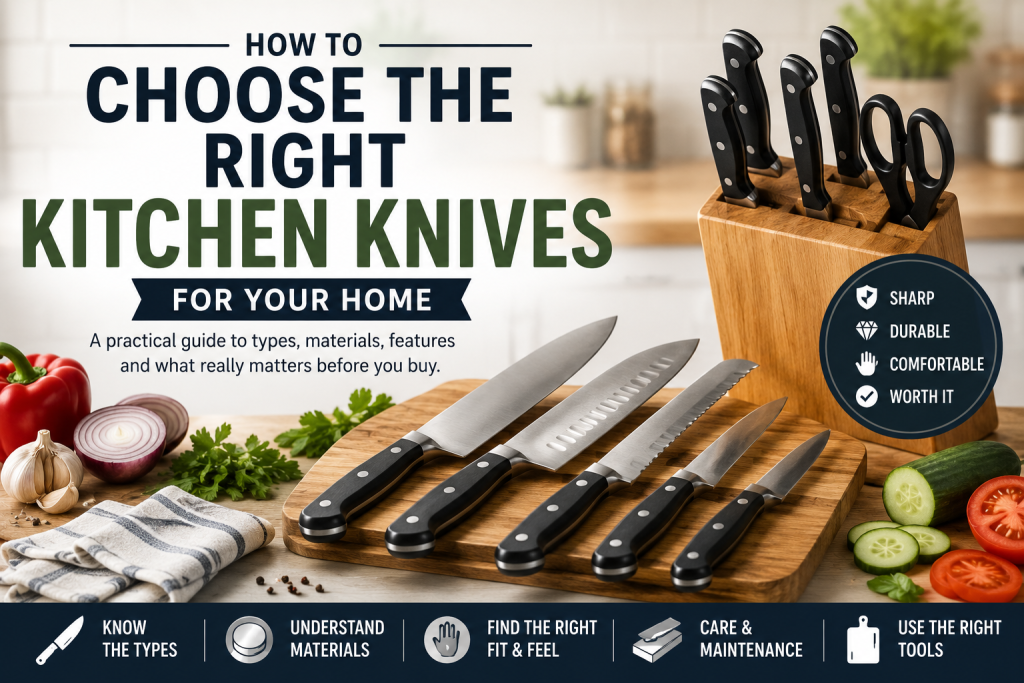
A good kitchen knife is one of the most useful tools you can own.
Whether you’re chopping vegetables, preparing meat, slicing bread or simply making dinner after a long day, the right knife can make preparation easier and more enjoyable. Using a good knife significantly improves the cooking experience.
But buying kitchen knives isn’t as simple as choosing the sharpest-looking blade.
There are different types of knives, different blade materials, different handle designs and a surprisingly large range of prices.
You can buy a basic knife for relatively little money or spend considerably more on a premium knife.
So what should you actually look for?
The answer depends on what you cook, how frequently you cook and which tasks you perform most often.
This guide explains the main types of kitchen knives and what to consider before buying.
Do you need a complete knife set?
One of the first decisions you’ll face is whether to buy individual knives or a complete set.
A knife set can be convenient because it provides several different knives at once.
However, many home cooks don’t regularly use every knife included in a large set.
A typical set might contain:
- Chef’s knife
- Paring knife
- Utility knife
- Bread knife
- Santoku knife
- Carving knife
- Kitchen scissors
- Sharpening steel
- Knife block
That’s a lot of equipment.
For many households, three or four good knives may be considerably more useful than a large collection.
The essential kitchen knives
If you’re building your kitchen from scratch, you don’t necessarily need ten different knives.
A practical starting collection could include:
Chef’s knife
The main all-purpose kitchen knife.
Paring knife
Useful for smaller preparation tasks.
Bread knife
Designed to cut through bread without crushing it.
Utility or Santoku knife
Useful when you want something between a chef’s knife and a small paring knife.
These four can cover a surprisingly large proportion of everyday kitchen preparation.
The chef’s knife
For many kitchens, the chef’s knife is the most important knife to buy.
It is designed for general preparation and can be used for tasks such as:
- Chopping vegetables
- Slicing meat
- Cutting herbs
- Preparing fruit
- Dicing ingredients
- General food preparation
Chef’s knives commonly have blades around 20 cm long, although different sizes are available.
The important thing is to choose a size that feels comfortable in your hand.
A larger knife isn’t automatically better.
Chef’s knife versus Santoku knife
A Santoku knife is another popular all-purpose option.
The two knives have somewhat different designs and handling characteristics.
A Santoku typically has a shorter, wider blade and a different cutting profile.
It can be particularly comfortable for:
- Vegetables
- Fish
- Meat
- General chopping
Some people strongly prefer a chef’s knife, while others find a Santoku more comfortable.
If possible, handle both before buying.
The paring knife
A paring knife is a small knife designed for detailed preparation.
It’s useful for tasks such as:
- Peeling
- Trimming
- Cutting small fruits
- Removing seeds
- Preparing small ingredients
A paring knife complements rather than replaces a chef’s knife.
Its small size gives you more control for delicate jobs.
The bread knife
Bread can be surprisingly difficult to cut cleanly with a conventional kitchen knife.
A bread knife typically has a serrated blade designed to cut through the crust without compressing the soft interior.
It can also be useful for:
- Cakes
- Pastries
- Soft fruit
- Other foods with a firm exterior and soft interior
If your household regularly buys or makes bread, a bread knife can be a worthwhile addition.
The utility knife
A utility knife sits between a chef’s knife and a paring knife in size.
It can be useful for:
- Sandwiches
- Smaller vegetables
- Fruit
- Cheese
- General preparation
Whether you need one depends on how you use your other knives.
Some people find it extremely useful.
Others rarely use one because their chef’s and paring knives already cover these jobs.
What about a carving knife?
A carving knife is designed for slicing cooked meat.
It can be particularly useful for:
- Roast beef
- Roast lamb
- Turkey
- Chicken
- Large joints
If you regularly prepare Sunday roasts or entertain family and friends, a carving knife may be worth adding to your collection.
If not, it’s probably not an essential purchase.
What is a boning knife?
A boning knife is designed for separating meat from bones.
It generally has a relatively narrow blade that allows for greater precision.
It may be useful if you regularly prepare:
- Whole chickens
- Large cuts of meat
- Fish
- Meat that requires trimming
For people who buy mostly prepared meat, it may be unnecessary.
Serrated versus straight-edge knives
Knife blades can broadly be divided into straight and serrated edges.
Straight edge
Useful for:
- Vegetables
- Meat
- Herbs
- General preparation
Serrated edge
Useful for:
- Bread
- Cakes
- Tomatoes
- Some soft fruits
A serrated knife doesn’t need to be limited to bread.
Its teeth can grip foods with slippery or delicate surfaces without requiring the same downward pressure as a straight blade.
What makes a good kitchen knife?
Several characteristics are worth considering.
Sharpness
A sharp knife is generally easier to control than a dull one.
A knife that requires excessive pressure can make preparation frustrating.
However, sharpness isn’t simply about how sharp a knife is when you first remove it from its packaging.
The ability to maintain the edge is equally important.
Blade material
Kitchen knives are commonly made from different types of steel.
The exact composition affects properties such as:
- Edge retention
- Toughness
- Corrosion resistance
- Sharpening requirements
- Price
Stainless steel is popular because it provides good resistance to corrosion and is relatively easy to maintain.
Higher-end knives may use specialised steels designed to improve particular characteristics.
You don’t necessarily need premium steel for everyday cooking.
A well-made knife using conventional stainless steel can perform extremely well.
Hardness matters
You may see knife specifications referring to hardness, sometimes using the Rockwell scale.
Harder steels can hold an edge for longer.
However, greater hardness isn’t automatically better.
Very hard blades can be more difficult to sharpen and may be more susceptible to chipping if treated incorrectly.
For most home cooks, a sensible balance between edge retention, toughness and ease of maintenance is more useful than simply choosing the hardest steel available.
Full tang versus partial tang
The tang is the portion of the blade that extends into the handle.
A full-tang knife extends through much of the handle.
This can provide:
- Strength
- Balance
- Durability
- A solid construction
However, don’t assume that every knife without an obvious full tang is poorly made.
Construction quality varies considerably.
Look at the overall design rather than using one feature as the sole measure of quality.
The handle matters
A knife may have an excellent blade but still be uncomfortable to use.
When choosing a knife, consider:
- Handle shape
- Grip
- Weight
- Balance
- Handle material
- Overall comfort
If possible, hold the knife before buying.
The same knife can feel very different to different people.
Knife balance
Balance refers to how the weight of the knife is distributed.
Some people prefer a blade-heavy knife.
Others prefer a handle-heavy design.
There is no universally correct balance.
What matters is whether the knife feels controlled and comfortable during normal use.
How heavy should a kitchen knife be?
Again, personal preference matters.
A heavier knife can feel substantial and may work well for certain chopping tasks.
A lighter knife can be easier to manoeuvre.
If you’re buying online and can’t handle the knife first, pay attention to the listed weight and dimensions.
How long should a chef’s knife be?
There isn’t one perfect length.
A common home chef’s knife is around 20 cm, but shorter and longer versions are available.
Consider:
- Your hand size
- Your preparation space
- What you normally cook
- Whether you prefer precision or larger cutting strokes
If you’re new to quality kitchen knives, a medium-sized chef’s knife is generally a sensible starting point.
Should you buy expensive kitchen knives?
Not necessarily.
A more expensive knife may offer:
- Better steel
- Better construction
- Improved balance
- Better edge retention
- More refined finishing
But price doesn’t guarantee that the knife will be right for you.
A moderately priced knife that fits your hand and cooking style may be a better purchase than an expensive knife that you find uncomfortable.
How much should you spend?
Think about knives as tools rather than status items.
If you cook regularly, investing in a few good knives can make sense.
You don’t necessarily need to buy the entire collection at once.
You could start with:
- Chef’s knife
- Paring knife
- Bread knife
Then add specialist knives if you discover that you actually need them.
Are knife sets good value?
They can be.
A set makes sense if:
- You need several knives
- You like the included designs
- The set represents genuine value
- You have suitable storage
But don’t buy a set simply because it contains more pieces.
A ten-piece set isn’t automatically better than three excellent knives.
Knife blocks versus magnetic storage
You’ll need somewhere to store your knives safely.
A traditional knife block can:
- Protect blades
- Keep knives organised
- Make them easily accessible
A magnetic knife strip can save counter space and make individual knives easy to access.
However, knives should be stored in a way that prevents accidental contact with the blade and keeps them safely out of reach of children.
Why you shouldn’t throw good knives loose into a drawer
Loose knives in a kitchen drawer can be difficult to retrieve safely and can also allow blades to knock against other utensils.
This can:
- Damage knife edges
- Damage other utensils
- Increase the risk of accidental cuts
If drawer storage is necessary, consider a suitable knife organiser or protective blade covers.
How to keep kitchen knives sharp
A good knife eventually becomes less sharp through normal use.
Maintaining the edge is therefore part of owning quality knives.
Options include:
- Honing steels
- Manual sharpeners
- Pull-through sharpeners
- Whetstones
- Professional sharpening services
The correct method depends on the knife and manufacturer’s recommendations.
Honing versus sharpening
These terms are often confused.
Sharpening removes material from the blade to create a new edge.
Honing is generally used to realign an existing edge.
A honing tool therefore isn’t necessarily a substitute for sharpening.
Understanding the difference can help you maintain your knives properly.
Do you need a whetstone?
A whetstone can provide excellent control over sharpening.
However, it requires practice.
For someone who enjoys maintaining their kitchen tools, it can be worthwhile.
For a casual home cook, a quality sharpening service or suitable sharpening system may be simpler.
Follow the knife manufacturer’s recommendations because different steels and blade geometries can require different approaches.
What about dishwasher cleaning?
Putting knives into a dishwasher may seem convenient, but it isn’t always the best option.
Dishwasher conditions can expose knives to:
- Heat
- Moisture
- Detergents
- Contact with other utensils
These conditions may affect the blade or handle over time.
For quality kitchen knives, hand washing and careful drying is generally the safer approach unless the manufacturer specifically states that dishwasher cleaning is suitable.
Never leave knives soaking in the sink
This is worth emphasising.
A knife hidden beneath soapy water is difficult to see and can cause an accidental injury when someone reaches into the sink.
Clean knives individually and store them safely after drying.
Cutting boards matter too
A good knife can be damaged by the wrong cutting surface.
Very hard surfaces such as glass, stone or ceramic can be harsh on knife edges.
A suitable wooden or food-safe synthetic cutting board is generally a better choice.
This is an example of why kitchen equipment should be considered as a system rather than buying individual products in isolation.
[INTERNAL LINK: How to Choose the Right Cookware for Your Kitchen — link this phrase to the published cookware article.]
Don’t use your kitchen knife as a general-purpose tool
Kitchen knives are designed for food preparation.
Avoid using them to:
- Open packaging
- Cut through hard non-food materials
- Pry objects apart
- Chop bones unless the knife is specifically designed for it
Using a knife outside its intended purpose can damage the blade and create unnecessary safety risks.
What makes a knife suitable for South African kitchens?
There isn’t a special type of kitchen knife that every South African household needs.
The better approach is to consider your actual cooking habits.
For example, if you regularly prepare:
- Braai meat
- Fresh vegetables
- Bread
- Fruit
- Family meals
- Large roasts
you may want a somewhat broader knife collection.
For someone who mainly prepares simple meals, a chef’s knife, paring knife and bread knife may be sufficient.
Kitchen knives for outdoor cooking
As Kila’s Kitchen & Cooking section expands into outdoor cooking, good knives become an important part of the equipment.
A suitable chef’s knife can handle much of the preparation involved in outdoor cooking.
You may also find a carving knife useful for larger cuts of meat.
However, avoid buying specialist knives simply because they’re marketed for braai or outdoor cooking.
Choose tools based on what you actually prepare.
What about kitchen scissors?
Kitchen scissors are often overlooked.
A good pair can be useful for:
- Herbs
- Packaging
- Poultry preparation
- Cutting food
- Opening packets
Some kitchen knife sets include scissors.
If buying a set, check whether the included scissors are actually useful rather than simply adding to the piece count.
A practical kitchen knife collection
For many households, a useful collection might look like this:
Basic
- Chef’s knife
- Paring knife
- Bread knife
More versatile
- Chef’s knife
- Paring knife
- Bread knife
- Santoku or utility knife
- Kitchen scissors
Serious home cook
- Chef’s knife
- Paring knife
- Bread knife
- Santoku
- Utility knife
- Carving knife
- Boning knife
- Kitchen scissors
You don’t need the third option unless you genuinely have a use for those additional knives.
Common kitchen knife buying mistakes
Buying a huge set
More knives don’t necessarily mean a better kitchen.
Choosing only by appearance
A beautiful knife still needs to feel comfortable and perform well.
Buying the hardest steel available
Hardness is only one characteristic.
Ignoring the handle
Comfort matters when preparing large quantities of food.
Forgetting storage
Good knives should have a safe storage solution.
Buying specialist knives you don’t need
A knife that spends most of its life in a drawer isn’t money well spent.
Neglecting maintenance
Even an expensive knife eventually needs its edge maintained.
A simple kitchen knife buying checklist
Before buying, ask:
- What do I cook most often?
- Do I need individual knives or a set?
- Do I need a chef’s knife or Santoku?
- Do I need a paring knife?
- Do I need a bread knife?
- Do I need a carving knife?
- What type of steel is used?
- Is the knife comfortable to hold?
- Does the weight feel right?
- Is the balance comfortable?
- How will I store it?
- How should it be sharpened?
- Is it dishwasher-safe?
- Is the manufacturer reputable?
- Is there a warranty?
- Can replacement or sharpening services be obtained locally?
Final thoughts
You don’t need a drawer full of expensive knives to have a well-equipped kitchen.
For most households, a few carefully selected knives will cover the majority of everyday cooking tasks.
A good chef’s knife or Santoku can become your main preparation tool.
A paring knife handles smaller jobs.
A bread knife is invaluable if you regularly buy or bake bread.
From there, you can add specialist knives according to your cooking habits.
The most important things to consider are comfort, construction, blade material, intended use, maintenance and storage.
Don’t buy a knife simply because it is expensive or because a large set appears to offer exceptional value.
Choose the knives that you’ll actually use.
And remember that buying good knives is only part of the equation. A suitable cutting board, safe storage, and regular maintenance can help those knives remain useful for years.