
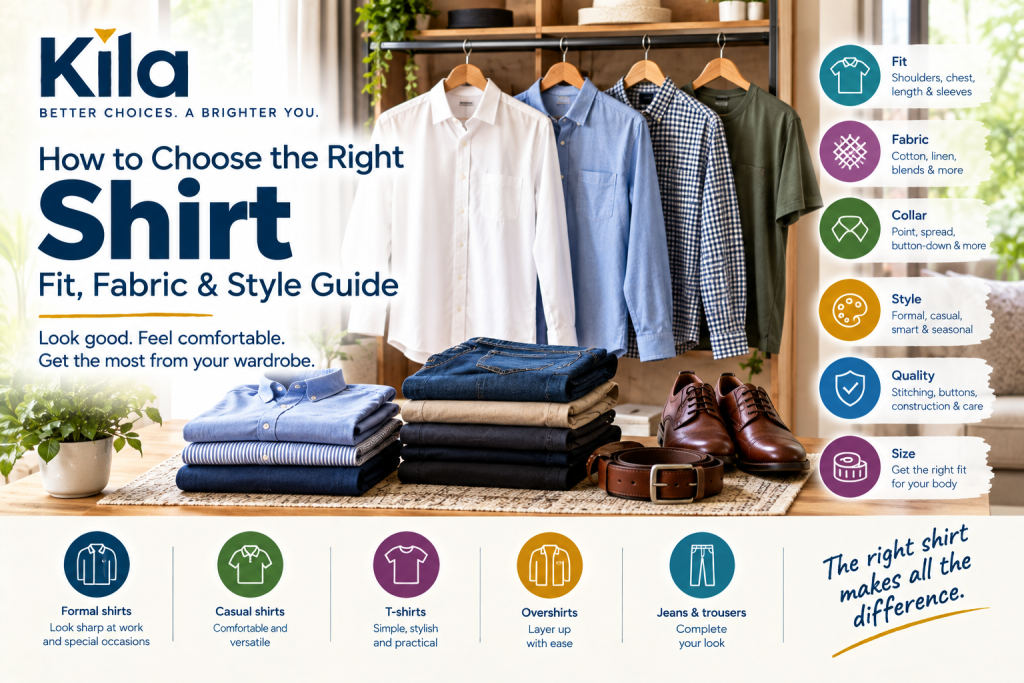
A good shirt is one of the most useful pieces of clothing you can own.
Whether you are dressing for work, going out for dinner, travelling or simply putting together a comfortable everyday outfit, the right shirt can make the rest of your wardrobe much easier to use.
But choosing a shirt is not simply a matter of finding a colour you like.
The fit, fabric, collar, sleeve length, construction, care requirements and intended use all affect whether a shirt will be comfortable and practical.
There is also a huge variety of choices available. You can choose from cotton, linen, denim, flannel, blends and synthetic fabrics, as well as formal shirts, casual button-downs, polo shirts, overshirts and T-shirts.
So how do you choose the right one?
The best approach is to start with how you intend to wear it and then work through fit, fabric, style and quality.
1. Start With How You Will Wear the Shirt
Before choosing a shirt, think about where and when you will wear it.
For example, you may need shirts for:
- Work
- Business meetings
- Smart-casual occasions
- Social events
- Weekend wear
- Holidays
- Travel
- Outdoor activities
- Everyday casual wear
A formal office shirt has different requirements from a casual weekend shirt.
Likewise, a lightweight shirt that works beautifully in hot weather may not be the best choice for a cold climate.
Think about the role the shirt needs to play in your wardrobe before you start shopping.
If you are trying to create a wardrobe where individual pieces work together, Kila’s How to Build a Versatile Wardrobe Without Overspending provides useful guidance on choosing clothing that can be used in multiple combinations.
2. Get the Fit Right
Fit is arguably the most important factor when choosing a shirt.
A shirt that is made from excellent fabric can still look and feel wrong if it is too large or too small.
Look at:
- Shoulder position
- Chest
- Waist
- Sleeve length
- Shirt length
- Collar
- Armholes
The shoulder seam should generally sit close to the natural edge of your shoulder.
If it extends significantly beyond your shoulder, the shirt may be too large.
If it sits noticeably inside your shoulder, it may be too small.
The chest should provide enough room to move comfortably without excessive fabric bunching.
3. Don’t Confuse Slim Fit With Better Fit
“Slim fit” is a style description, not a guarantee of a good fit.
A slim-fit shirt can look excellent on someone whose proportions suit it, but it can be uncomfortable if it restricts movement.
Likewise, a regular or relaxed fit can look perfectly polished when it is correctly sized.
The objective is not to buy the narrowest shirt available.
The objective is to find a shirt that:
- Fits your proportions
- Allows comfortable movement
- Sits correctly on the shoulders
- Does not pull across the chest
- Does not have excessive material around the waist
4. Understand Common Shirt Fits
Retailers may use different terminology, but common descriptions include:
Slim fit
Usually cut closer to the body.
Often chosen for a more streamlined appearance.
Regular fit
Provides more room through the chest and body.
This is often a versatile everyday option.
Relaxed fit
Provides additional room and generally creates a more casual appearance.
Oversized
Designed intentionally to be substantially larger and looser.
This is a specific fashion style rather than simply wearing the wrong size.
When shopping online, check the retailer’s size chart rather than assuming that “medium” or “large” will be the same everywhere.
5. Check the Shoulder Seam
The shoulder is one of the easiest places to identify an unsuitable fit.
The seam connecting the sleeve to the body should generally sit around the natural shoulder edge.
If the seam is far down the arm, the shirt may be too large.
If it sits well inside the shoulder, the shirt may be too small.
This is particularly useful when buying clothing online because you can compare the measurements with a shirt you already own that fits well.
6. Check the Shirt Length
Shirt length depends partly on the intended style.
A formal shirt designed to be tucked in will generally be longer than a casual shirt designed to be worn untucked.
Before buying, consider whether you intend to wear it:
- Tucked in
- Untucked
- Layered
- Open over a T-shirt
A shirt that is too short may come untucked constantly.
A shirt that is excessively long when designed to be worn untucked can look untidy.
7. Choose the Right Fabric
Fabric has a major effect on comfort, appearance and durability.
Cotton
Cotton is one of the most versatile shirt fabrics.
It can be:
- Comfortable
- Breathable
- Easy to wear
- Available in many weights and finishes
Cotton shirts are suitable for everything from formal clothing to casual everyday wear.
Linen
Linen is particularly attractive in warm weather.
It is known for being:
- Lightweight
- Breathable
- Comfortable in hot conditions
One characteristic of linen is that it wrinkles relatively easily.
Some people like the relaxed appearance of linen, while others prefer a more structured look.
Cotton-linen blends
These can combine some of the characteristics of both fabrics.
They may provide a balance between breathability, comfort and reduced wrinkling compared with some pure linen garments.
Polyester and synthetic fabrics
Synthetic fibres can provide useful characteristics such as durability, quick drying and resistance to wrinkles.
However, breathability and feel vary significantly between fabrics and garment constructions.
Blended fabrics
Blends combine different fibres to achieve particular characteristics.
A blend may provide a useful compromise between comfort, durability, stretch, wrinkle resistance and price.
8. Think About the Climate
Your local climate should influence your choice of shirt.
For hot weather, consider:
- Lightweight fabrics
- Breathability
- Loose or comfortable fits
- Short sleeves
- Linen or lightweight cotton
For cooler weather, consider:
- Heavier cotton
- Flannel
- Layering
- Overshirts
- Long sleeves
If you travel between different climates, versatile layering can be particularly useful.
For more travel clothing considerations, Kila’s How to Choose the Right Jacket: Fit, Fabric & Style Guide covers outerwear and weather protection.
9. Choose the Right Collar
The collar can change the appearance of a shirt considerably.
Common styles include:
Point collar
A traditional and versatile choice.
Spread collar
The collar points sit farther apart and can create a more formal appearance.
Button-down collar
The collar points attach to the shirt using small buttons.
This can create a more relaxed appearance while still looking relatively polished.
Mandarin or band collar
A collar without traditional pointed collar tips.
This creates a distinctly modern or minimalist appearance.
Cuban or camp collar
Usually associated with casual and warm-weather shirts.
It is often worn open at the neck.
Choose a collar that suits both the occasion and your personal style.
10. Think About Sleeve Length
The obvious choice between short and long sleeves depends on the occasion and climate, but there are additional considerations.
Long-sleeve shirts can provide:
- More formal styling
- Greater versatility
- Additional protection from the sun
- Easier layering
Short-sleeve shirts can be useful for:
- Hot weather
- Casual occasions
- Holidays
- Everyday wear
A long-sleeve shirt can also be rolled up for a more relaxed appearance.
11. Check the Cuffs
For long-sleeve shirts, look at the cuffs.
Common options include:
- Button cuffs
- French cuffs
- Adjustable cuffs
- Barrel cuffs
For most everyday situations, a simple button cuff is versatile and practical.
More formal cuff styles can be appropriate for business or formal occasions.
12. Choose Colours That Work With Your Wardrobe
A shirt does not exist in isolation.
Think about the trousers, jeans, jackets and shoes you already own.
Versatile colours include:
- White
- Light blue
- Navy
- Grey
- Black
- Beige
- Olive
These can be relatively easy to combine with other clothing.
Once you have a useful foundation of neutral colours, you can introduce stronger colours and patterns.
For example, a patterned shirt may work particularly well when combined with simple trousers or jeans.
Kila’s How to Choose the Right Jeans: Fit, Rise, Denim & Style Guide can help when deciding which shirts and jeans to combine for everyday outfits.
13. Don’t Ignore Patterns
Shirts are available in countless patterns.
Common choices include:
- Checks
- Stripes
- Florals
- Geometric patterns
- Prints
- Plain colours
Patterns can add personality to an outfit.
However, if you are building a versatile wardrobe, plain shirts and subtle patterns can be easier to combine with other pieces.
A large or bold pattern may become the main visual feature of the outfit, so keep the rest of the clothing relatively simple if you want the shirt to stand out.
14. Consider the Occasion
The same shirt is not necessarily suitable for every situation.
Formal
Consider:
- Structured fabrics
- Conservative colours
- Long sleeves
- Traditional collars
- Minimal patterns
Business casual
There is more flexibility.
Oxford-style shirts, subtle patterns and button-down collars may work well depending on the workplace.
Smart casual
This allows considerable choice.
A well-fitted casual button-down shirt can work with jeans, chinos or smart trousers.
Casual
Comfort and personal style become more important.
T-shirts, casual button-downs, polos and relaxed shirts can all work.
15. T-Shirts Deserve the Same Attention
T-shirts are often treated as basic clothing, but fit and fabric still matter.
Look at:
- Neckline
- Shoulder width
- Sleeve length
- Body length
- Fabric weight
- Stretch
- Construction
Common necklines include:
- Crew neck
- V-neck
- Scoop neck
- Henley-style
A simple, well-fitting T-shirt can be one of the most versatile pieces in a wardrobe.
16. Consider Fabric Weight
Fabric weight affects how a shirt feels and hangs.
Lightweight fabric may be:
- Cooler
- More comfortable in hot weather
- Easier to pack
- More prone to showing wrinkles
Heavier fabric may:
- Feel more substantial
- Hold its shape well
- Provide more warmth
- Be more durable in some circumstances
Neither is automatically better.
Think about the season, climate and intended use.
17. Check the Stitching and Construction
Quality is about more than the fabric.
Look closely at:
- Seams
- Stitching
- Buttons
- Buttonholes
- Collar construction
- Cuffs
- Hem
- Pocket attachment
The stitching should appear consistent and secure.
Buttons should be firmly attached.
Buttonholes should be neatly finished.
If buying online, use the available product photographs to inspect these details where possible.
18. Check the Buttons
Buttons can be a small detail that makes a noticeable difference.
Look for:
- Secure attachment
- Even spacing
- Appropriate size
- Suitable material
- Good finishing
A shirt with high-quality fabric but poorly attached buttons may become frustrating to maintain.
Replacement buttons are possible, but strong original construction is preferable.
19. Consider Care Requirements
Before buying a shirt, check how it needs to be washed and maintained.
Some garments may require:
- Cold washing
- Gentle cycles
- Hand washing
- Air drying
- Ironing
- Dry cleaning
If you want a shirt for everyday use, a garment requiring extensive maintenance may not be practical.
For travel, easy-care fabrics can be particularly useful.
Always follow the manufacturer’s care instructions.
20. Think About Wrinkling
Some fabrics naturally wrinkle more than others.
This is especially relevant when travelling.
If you regularly pack shirts into luggage, consider:
- Wrinkle-resistant fabrics
- Blends
- Easy-care cotton
- Garments that can be rolled rather than folded
If you enjoy the relaxed appearance of linen, wrinkles may not be a problem.
If you need a consistently crisp appearance for work, wrinkle resistance may be more important.
21. Buying Shirts Online
Buying clothing online can be convenient, but sizing requires additional attention.
Before ordering, check:
Size chart
Never rely solely on the letter or number shown for the size.
Compare the retailer’s measurements with a shirt you already own.
Garment measurements
Look for measurements such as:
- Chest
- Shoulder
- Sleeve
- Length
Fabric composition
Check exactly what the garment is made from.
Product photographs
Look at the shirt from different angles.
Customer reviews
Reviews may reveal whether the garment:
- Runs small
- Runs large
- Shrinks
- Feels comfortable
- Matches the advertised colour
- Has good construction
Return policy
Make sure you understand the retailer’s rules for returning clothing that does not fit.
This is particularly important when buying online.
For broader online shopping advice, Kila’s What to Look for When Buying Fashion Accessories Online covers several useful checks before ordering fashion products online.
22. Be Careful With Online Sizing
Different brands can have very different sizing systems.
A medium from one retailer may not fit like a medium from another.
This is why measurements are more useful than labels.
If possible, measure a shirt you already own and like.
Measure:
- Chest
- Shoulder width
- Sleeve length
- Overall length
Then compare those measurements with the retailer’s size guide.
This can substantially reduce the risk of ordering the wrong size.
23. Consider Shrinkage
Some natural fabrics can shrink depending on how they are processed and washed.
Before buying, check whether the garment is:
- Pre-shrunk
- Machine washable
- Suitable for tumble drying
Even when a garment is designed to resist shrinkage, following the recommended care instructions remains important.
A shirt that fits perfectly when new may become less comfortable if it is repeatedly washed or dried incorrectly.
24. Think About Transparency
Light-coloured shirts can sometimes be more transparent than expected.
This is particularly relevant with:
- Lightweight white shirts
- Thin cotton
- Linen
- Some synthetic fabrics
If this matters to you, look at product photographs carefully and consider the fabric weight and colour.
For formal or professional clothing, this can be particularly important.
25. Consider Pockets
Shirt pockets are both functional and stylistic.
A chest pocket can be useful for small items, but it also changes the appearance of the garment.
A formal shirt may have no visible pocket or a very subtle one.
A casual shirt may have one or more prominent pockets.
Think about whether you actually use shirt pockets.
If you don’t, you can choose based on appearance rather than functionality.
26. Don’t Automatically Choose the Most Expensive Shirt
Price and quality are related in some cases, but they are not identical.
When comparing shirts, consider:
- Fabric quality
- Construction
- Fit
- Brand
- Durability
- Care requirements
- Intended use
A premium shirt may be worthwhile if you appreciate the material and construction and expect to wear it frequently.
But a less expensive shirt may be perfectly suitable for casual use.
The objective is not to find the most expensive shirt.
It is to find the shirt that provides the right combination of fit, quality, comfort and value.
27. Build a Useful Shirt Collection
If you are starting or rebuilding your wardrobe, don’t feel that you need dozens of shirts.
A relatively small collection can provide considerable flexibility.
For example, you might build around:
- A white shirt
- A light-blue shirt
- A casual patterned shirt
- A neutral casual shirt
- A comfortable T-shirt
- A darker shirt
- A seasonal shirt
The exact combination depends on your lifestyle.
The goal is to have shirts that can be combined with several pairs of trousers, jeans, jackets and shoes.
This is more useful than owning a large collection of clothing that rarely gets worn.
28. Think About Your Shoes and Other Accessories
An outfit works as a whole.
Consider how your shirts work with:
- Jeans
- Trousers
- Shoes
- Belts
- Jackets
- Watches
- Sunglasses
For example, a casual shirt may work well with jeans and casual shoes, while a formal shirt may require smarter footwear and a belt.
Kila’s How to Choose the Right Shoes for Your Lifestyle and How to Choose the Right Belt: Size, Material and Style can help when coordinating the rest of the outfit.
29. A Simple Shirt-Buying Checklist
Before buying a shirt, check:
☐ I know where I intend to wear it
☐ The shoulder fit is correct
☐ The chest provides enough room
☐ The shirt length suits how I will wear it
☐ The sleeve length is appropriate
☐ The collar suits the intended occasion
☐ The fabric suits the climate
☐ The colour works with my existing wardrobe
☐ The pattern suits my personal style
☐ The fabric-care requirements are practical
☐ The construction looks good
☐ The size chart has been checked
☐ I have compared measurements where possible
☐ I have checked customer reviews
☐ I understand the return policy
☐ The price represents good value
Final Thoughts
Choosing the right shirt becomes much easier when you stop thinking of it as simply another item of clothing.
A good shirt needs to fit your body comfortably, suit the occasion, work with the rest of your wardrobe and match the climate and lifestyle in which you will wear it.
Start with the basics: fit, fabric and purpose.
Then consider the details such as collar, sleeves, colour, pattern, construction and care requirements.
If you are shopping online, pay particular attention to measurements. Clothing sizes are not consistent enough between brands for a simple “medium” or “large” to tell you whether a shirt will fit.
Most importantly, buy with your existing wardrobe in mind.
A shirt that works with several pairs of jeans or trousers and can be worn with different shoes and jackets will generally provide more value than one that only works with a single outfit.
The right shirt does not need to be expensive or fashionable for one season. It needs to be comfortable, useful, well suited to your lifestyle and something you will actually want to wear.