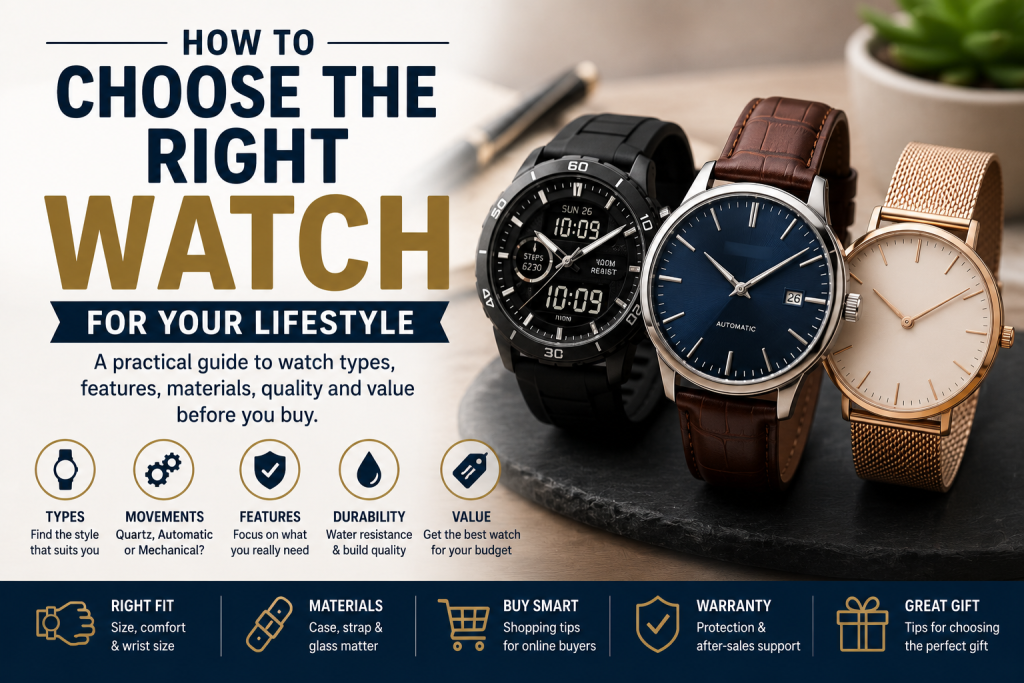
A watch can be much more than something that tells you the time.
It can be a practical everyday fashion accessory, an important part of a work wardrobe, something you wear for special occasions or simply a personal style choice.
With thousands of watches available at dramatically different prices, however, choosing the right one can be surprisingly difficult.
Should you buy a traditional analogue watch or a digital model? Is quartz better than automatic? How important is water resistance? Does an expensive watch necessarily offer better value?
The answer depends largely on how you intend to use the watch.
Rather than choosing based purely on appearance or brand name, it makes sense to consider your lifestyle, the features you actually need, the quality of construction and how much you are prepared to spend.
Start With How You Will Use the Watch
The first question to ask is simple:
When and where will I wear it?
Your answer can narrow down the choices considerably.
You might want a watch for:
- Everyday use
- Work
- Formal occasions
- Travel
- Outdoor activities
- Sport
- Casual wear
- Collecting
- A special gift
A watch designed for a formal occasion may not be the best choice for hiking or outdoor activities.
Likewise, a rugged sports watch may look out of place with formal clothing.
The best watch is therefore not necessarily the most expensive or fashionable one. It is the one that fits your actual lifestyle.
Everyday Watches
For many people, an everyday watch is the most useful option.
An everyday watch should ideally be:
- Comfortable
- Reliable
- Durable
- Easy to read
- Versatile
- Appropriate for a range of clothing
A relatively simple design can have an advantage because it can work with casual clothing as well as smart-casual outfits.
If you only want to own one watch, versatility should be one of your main considerations.
Watches for Work
The right work watch depends on your working environment.
For an office environment, a relatively understated analogue watch may work well.
If your job involves physical activity, outdoor work or frequent movement, durability may be more important than appearance.
Consider:
- How formal your workplace is
- How much you move around
- Whether you work indoors or outdoors
- Whether the watch could be exposed to dust or moisture
- How easy it is to clean
- How comfortable it is for extended wear
A watch should complement your work rather than becoming something you have to constantly worry about damaging.
Dress Watches
Dress watches are generally designed to complement formal or smart clothing.
They often have relatively simple designs rather than large displays or numerous functions.
A dress watch may be appropriate for:
- Weddings
- Formal dinners
- Business events
- Special occasions
- Formal work environments
If you’re buying a dress watch, understated design can often provide greater versatility than an overly complicated or oversized model.
Sports and Outdoor Watches
If you’re active outdoors, you may want a watch designed for more demanding conditions.
Depending on the model, useful features can include:
- Increased water resistance
- Stopwatch functionality
- Timers
- Stronger cases
- Durable straps
- High-visibility displays
- Additional outdoor functions
However, don’t pay for features simply because they sound impressive.
If you don’t need them, they may add unnecessary cost and complexity.
Travel Watches
Travel can place different demands on a watch.
If you travel internationally, you may find features such as multiple time zones useful.
Other considerations include:
- Durability
- Easy-to-read display
- Water resistance
- Comfortable strap
- Battery life
- Ease of adjustment
- Weight
A simple, reliable watch may actually be more useful when travelling than a complicated model with features you rarely use.
How to Choose the Right Luggage for International Travel
Analogue or Digital?
One of the first choices you’ll encounter is whether you prefer an analogue or digital display.
Analogue watches
Analogue watches use traditional hands to display the time.
Advantages can include:
- Classic appearance
- Wide range of designs
- Suitable for formal and casual clothing
- No electronic screen
Digital watches
Digital watches display the time numerically.
They can offer:
- Easy-to-read time
- Additional functions
- Stopwatch and timer features
- Practical designs for sport and outdoor activities
Neither is automatically better.
The choice largely comes down to your preferences and intended use.
What Is a Quartz Watch?
Quartz watches use a battery-powered electronic movement regulated by a quartz crystal.
They are popular because they are generally:
- Accurate
- Convenient
- Easy to maintain
- Available at many price points
For someone who simply wants a dependable watch that keeps time without much attention, quartz can be an excellent choice.
What Is an Automatic Watch?
Automatic watches are mechanical watches that wind themselves through the movement of the wearer’s wrist.
They don’t normally require a conventional battery.
Many people appreciate automatic watches because of the mechanical engineering involved and the traditional craftsmanship associated with them.
However, they can require more care and may not keep time with the same level of accuracy as many quartz watches.
An automatic watch can therefore be appealing to someone who appreciates the watch itself as an object, rather than simply wanting the most convenient way to tell the time.
Quartz Versus Automatic: Which Is Better?
There isn’t a universal winner.
Choose quartz if you prioritise:
- Convenience
- Accuracy
- Simplicity
- Low-maintenance ownership
- Value
Consider automatic if you value:
- Mechanical craftsmanship
- Traditional watchmaking
- The movement itself
- Collectability
- The experience of owning a mechanical watch
For everyday practicality, quartz is often the simpler option.
For someone interested in watches as a hobby or collecting, an automatic watch may be considerably more appealing.
What About Mechanical Watches?
Mechanical watches are powered by a wound spring rather than a battery.
There are two broad categories:
- Manual-winding mechanical watches
- Automatic mechanical watches
Manual watches need to be wound periodically by the wearer.
Automatic watches use the movement of the wearer to wind the mechanism.
Mechanical watches can be fascinating pieces of engineering, but they generally require more involvement from the owner than a quartz watch.
Consider the Watch Case
The case protects the internal movement and contributes significantly to the appearance of the watch.
Common materials include:
- Stainless steel
- Titanium
- Aluminium
- Ceramic
- Plastic or resin
Stainless steel is popular because it provides a useful combination of durability and appearance.
Titanium can offer lower weight and is often used in watches where weight is an important consideration.
Plastic and resin cases can be particularly practical for sports and outdoor watches.
What Size Watch Should You Buy?
Watch size is partly a matter of personal preference, but proportion and comfort are worth considering.
A very large watch may feel uncomfortable on a smaller wrist.
A very small watch may not provide the appearance or readability you want.
When shopping online, check the manufacturer’s measurements rather than relying on photographs.
Look for measurements such as:
- Case diameter
- Case thickness
- Lug-to-lug length
- Strap width
These measurements provide a much better indication of the actual size.
Don’t Forget the Strap
The strap can significantly change the appearance and comfort of a watch.
Common options include:
Metal bracelets
Durable and often suitable for work and smart-casual clothing.
Leather straps
Often associated with traditional and dress watches.
Rubber or silicone straps
Useful for sports, outdoor activities and situations where moisture may be encountered.
Fabric or nylon straps
Lightweight and casual, with many designs available.
The strap is also one of the easiest parts of a watch to change, potentially giving the same watch a completely different appearance.
Water Resistance Explained
“Water resistant” does not necessarily mean that a watch can be taken swimming.
This is an important distinction when buying a watch.
Different watches are designed to tolerate different levels of exposure to water.
Before exposing a watch to water, check the manufacturer’s specifications and recommendations.
Consider what you actually need:
- Occasional splashes
- Rain
- Washing hands
- Swimming
- Water sports
- Diving
Don’t assume that a watch is suitable for an activity simply because its description mentions water resistance.
Watch Features: What Do You Actually Need?
Modern watches can have an enormous number of features.
Depending on the model, you might find:
- Date display
- Day display
- Stopwatch
- Timer
- Alarm
- Multiple time zones
- Chronograph functions
- Compass
- Altimeter
- Fitness tracking
- Heart-rate monitoring
- GPS
- Smartphone connectivity
Some of these can be extremely useful.
Others may never be used.
Before paying extra for features, ask:
Will I actually use this?
A simpler watch may be a better purchase if the additional functions don’t provide meaningful value.
Traditional Watch or Smartwatch?
Smartwatches are a separate category worth considering.
They can provide functions such as:
- Notifications
- Fitness tracking
- Navigation
- Calls
- Apps
- Music controls
- Health and activity information
However, they also introduce considerations that don’t apply to traditional watches.
These can include:
- Battery charging
- Smartphone compatibility
- Software updates
- Screen durability
- Device lifespan
If you simply want a reliable timepiece, a traditional watch may be more appropriate.
If you want additional digital functions, a smartwatch may make more sense.
The choice comes down to what you actually want from your watch.
Think About Battery Life
For quartz watches, battery life is worth considering.
For smartwatches, battery life can be considerably more important because the device may require frequent charging.
A watch that needs charging every day may be inconvenient for someone who simply wants something they can put on and forget about.
Watch Accuracy
Accuracy matters if you rely heavily on your watch for timekeeping.
Quartz watches are generally known for very good accuracy.
Mechanical watches operate differently and can gain or lose some time over a period.
If precise timekeeping is particularly important to you, look at the manufacturer’s accuracy specifications rather than assuming that a higher price guarantees better performance.
Does a More Expensive Watch Mean Better Quality?
Not necessarily.
Price can reflect:
- Materials
- Movement
- Craftsmanship
- Brand reputation
- Design
- Production volume
- Finishing
- Heritage
- Exclusivity
Some expensive watches are beautifully made.
But a cheaper watch can still provide excellent value and reliable performance.
The important question is:
Does the watch offer the features, quality and appearance that justify its price for you?
Brand Versus Value
Brand recognition can provide reassurance, particularly when buying an expensive watch.
However, don’t assume that an unfamiliar brand automatically means poor quality.
Look at:
- Movement
- Materials
- Warranty
- Customer reviews
- Retailer reputation
- Replacement parts
- After-sales service
A well-known logo isn’t necessarily a substitute for researching the actual product.
Buying a Watch Online
Buying watches online can provide access to a much wider selection than many physical stores.
You can compare:
- Prices
- Brands
- Specifications
- Materials
- Features
- Customer reviews
- Warranty terms
However, there are some additional things to check before purchasing.
What to Check Before Buying a Watch Online
Before placing your order, check:
- Exact model number
- Case dimensions
- Strap dimensions
- Movement type
- Materials
- Water-resistance rating
- Battery information
- Warranty
- Returns policy
- Delivery costs
- Seller reputation
If you’re buying an expensive watch, authenticity is particularly important.
Buy from a reputable retailer and be cautious about offers that appear dramatically cheaper than comparable products elsewhere.
Read Customer Reviews Carefully
Customer reviews can provide useful information about the ownership experience.
Look for recurring comments about:
- Accuracy
- Comfort
- Strap quality
- Build quality
- Battery life
- Size
- Durability
- Packaging
- After-sales service
Be careful about drawing conclusions from a single review.
A pattern of similar complaints is much more useful.
Consider the Warranty
A warranty can provide valuable peace of mind.
Before buying, check:
- How long the warranty lasts
- What it covers
- Who provides the warranty
- Where repairs are performed
- Whether international purchases have local warranty support
A very cheap watch may not be such a bargain if getting it repaired becomes difficult.
Buying a Watch as a Gift
A watch can be a popular gift because it combines practicality with personal style.
However, choosing one for someone else can be difficult.
Think about:
- Their normal clothing style
- Work environment
- Hobbies
- Preferred colours
- Whether they prefer traditional or modern designs
- Whether they already wear a watch
If you’re uncertain, a versatile and relatively understated design can be safer than something highly specialised.
Don’t Buy Based on Trends Alone
Watch styles can change.
A highly fashionable design may look dated in a few years.
If you’re looking for a watch to wear for a long time, consider whether you still like the design independently of current trends.
Classic, versatile designs can have an advantage in this respect.
Think About Cost Per Use
One useful way to assess value is to consider how often you’ll actually wear the watch.
For example, a moderately priced watch worn almost every day could provide more value than a more expensive watch that is rarely worn.
This is particularly important when choosing between multiple watches.
Ask yourself:
Will this watch become part of my normal routine?
If the answer is yes, spending a little more on something you genuinely like and expect to use frequently may make sense.
How Many Watches Do You Need?
There is no correct number.
One versatile watch may be enough for someone who prefers simplicity.
Another person may enjoy having different watches for:
- Work
- Casual wear
- Formal occasions
- Sport
- Travel
The key is to avoid buying watches simply because they are on sale.
A collection should reflect how you actually live.
Looking After Your Watch
Proper care can help extend the useful life of a watch.
Depending on the type:
- Keep it clean.
- Follow the manufacturer’s care instructions.
- Avoid exposing it to conditions it isn’t designed for.
- Have mechanical watches serviced when appropriate.
- Replace batteries when required.
- Check seals and water resistance according to the manufacturer’s recommendations.
- Store watches safely when they aren’t being worn.
The maintenance requirements vary considerably between watch types.
Common Watch-Buying Mistakes
Buying purely because of the brand
A famous logo doesn’t automatically mean the watch is right for you.
Ignoring size
A watch that looks good online may be much larger than you expect.
Paying for features you won’t use
Extra functions aren’t necessarily extra value.
Assuming water resistance means waterproof
Always check the actual specifications.
Ignoring the strap
Comfort is just as important as appearance.
Buying without checking the warranty
Particularly important for more expensive watches.
Choosing trends over versatility
Consider whether you’ll still like the design several years from now.
Buying purely because of a discount
A discounted watch you never wear isn’t a good bargain.
A Simple Watch-Buying Checklist
Before purchasing, ask:
- What will I mainly use the watch for?
- Do I prefer analogue, digital or smart?
- Do I want quartz, automatic or mechanical?
- What size case suits me?
- Is the watch comfortable?
- Is the strap appropriate?
- Is the material suitable?
- What level of water resistance do I need?
- Which features will I actually use?
- Is the watch versatile enough for my wardrobe?
- Is the price reasonable?
- Is the retailer reputable?
- What does the warranty cover?
- Can I return it if necessary?
- Will I actually wear it regularly?
Final Thoughts
Choosing the right watch is ultimately about matching the watch to your lifestyle rather than somebody else’s.
If you want something simple and dependable, a quartz watch may be an excellent choice.
If you appreciate traditional craftsmanship and mechanical engineering, an automatic or mechanical watch may be more appealing.
If you’re active outdoors, durability and water resistance may be more important.
If you’re looking for something to wear with formal clothing, a simple dress watch may be the better option.
And if you want notifications, fitness features and smartphone integration, a smartwatch may make more sense.
The most expensive watch isn’t necessarily the best watch for you.
Instead, look at purpose, comfort, features, quality, durability and value.
A good purchase is one that suits your lifestyle, fits comfortably, provides the functions you actually need and is likely to be worn regularly.
The best watch is not necessarily the one that costs the most. It’s the one that makes sense for the way you live.
Building a Complete Style Collection
A watch is only one part of a practical collection of fashion accessories.
Handbags, sunglasses, shoes and other accessories can all be chosen using the same basic principle: buy for how you actually live rather than simply following trends.
For example, a versatile handbag can be useful across work, shopping and everyday activities.
How to Choose the Right Handbag: A Practical Buying Guide
Sunglasses are another accessory where practical considerations such as durability, lens characteristics and intended use matter.
How to Choose the Right Sunglasses: A Practical Buying Guide
And when building a wardrobe, choosing versatile pieces can help reduce unnecessary spending.
How to Build a Versatile Wardrobe Without Overspending
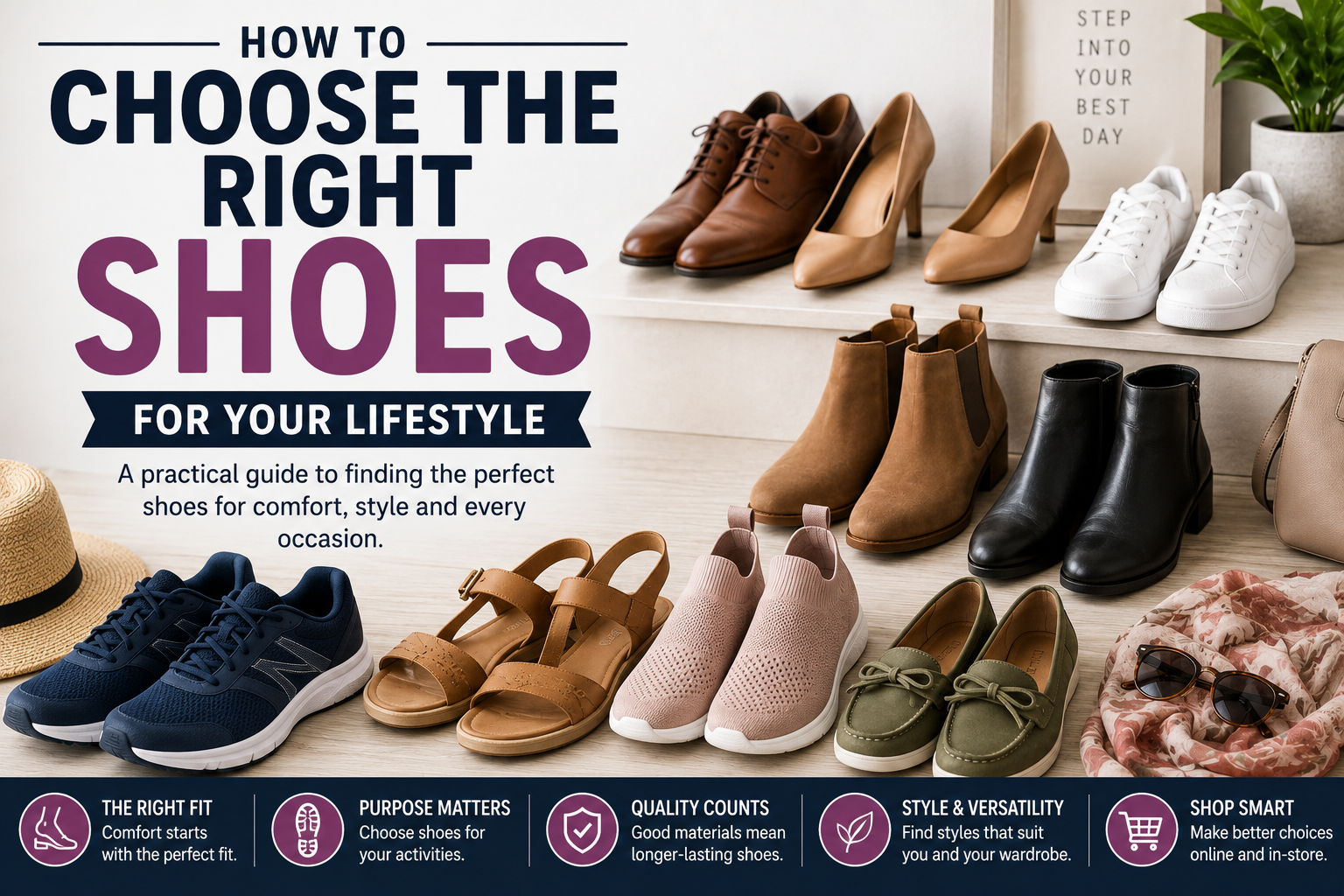
Shoes should also be selected according to your lifestyle, activities and wardrobe rather than simply their appearance.