
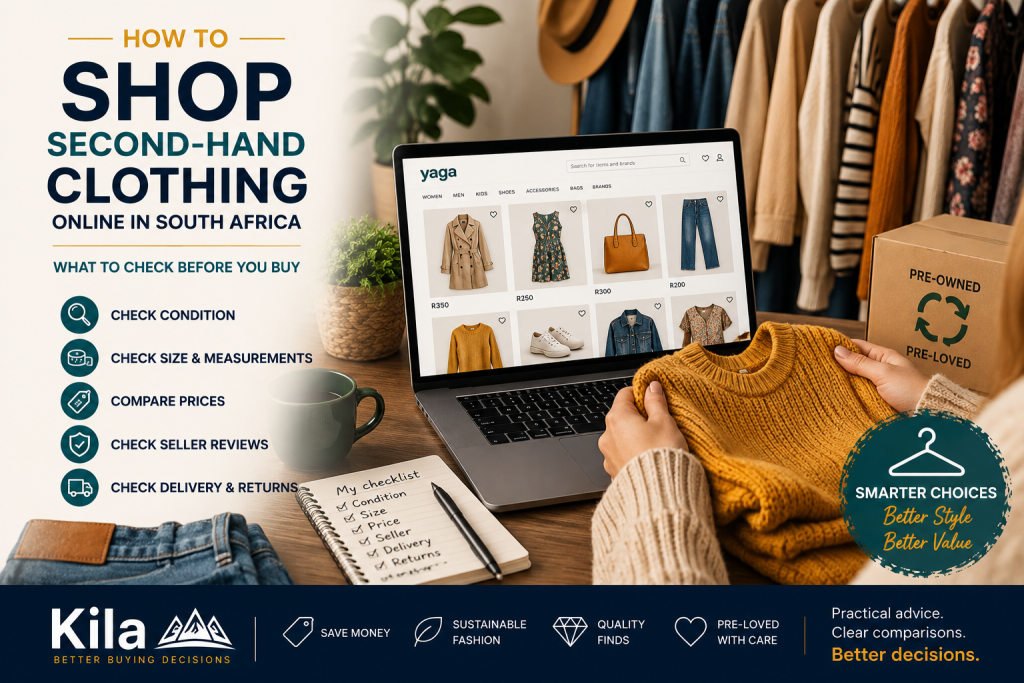
Buying clothing online has become increasingly convenient, but buying second-hand clothing online requires a slightly different approach.
When you purchase something new, you generally know what to expect regarding condition, sizing and availability. With pre-owned clothing, every item is different. Two garments listed as the same size and brand can have very different levels of wear, while a seemingly inexpensive item may not actually be good value once delivery costs are included.
The good news is that buying pre-owned clothing online can be an excellent way to find quality fashion at lower prices, discover items that are no longer available in stores and make better use of clothing that still has plenty of life left in it.
At Kila, our aim is to help South African consumers make better buying decisions in their style and fashion choices. That means looking beyond the photograph and asking whether an item is actually worth buying.
Here is what to consider before placing your order.
1. Don’t judge the item from the photograph alone
A good photograph can make almost any item look appealing.
When shopping second-hand, however, the photograph should be the starting point rather than the deciding factor.
Look carefully for:
- marks or stains
- fading
- pilling
- loose threads
- damaged seams
- missing buttons
- worn cuffs or collars
- stretching
- alterations
- signs of excessive wear
If the photographs don’t show enough detail, check whether the seller provides additional photographs or descriptions.
A seller who clearly documents the condition of an item gives you considerably more information with which to make your decision.
2. Pay close attention to the description
The description is particularly important when buying pre-owned clothing.
Don’t just look for the brand and size. Look for information about:
Condition: Is it new, barely worn, gently used or showing noticeable wear?
Measurements: Are actual garment measurements provided?
Alterations: Has the garment been shortened, taken in or otherwise modified?
Defects: Are there any marks, damaged areas or other problems?
Material: Does the fabric match what you are looking for?
The more complete the description, the easier it is to determine whether the item represents good value.
3. Don’t assume the labelled size will fit
This is one of the biggest mistakes people make when buying clothing online.
A labelled medium from one brand may fit very differently from a medium from another.
This becomes even more important with second-hand clothing because older garments may have different sizing standards, and some items may have been altered.
Where possible, compare the seller’s measurements with a garment you already own that fits you comfortably.
For example, you might compare:
- chest measurement
- waist measurement
- hip measurement
- shoulder width
- sleeve length
- garment length
This takes a little extra effort but can significantly reduce the chance of receiving something that doesn’t fit as expected.
4. Consider the brand — but don’t pay for the name alone
Brand names can be useful indicators of quality, but they shouldn’t automatically determine whether something is worth buying.
A well-known brand doesn’t necessarily make a heavily worn garment a good purchase.
Instead, consider the combination of:
Brand + condition + material + age + price + expected remaining life
A quality garment in excellent condition may represent exceptional value when purchased second-hand.
Conversely, a cheap garment that is already showing significant wear may not be a bargain at all.
5. Compare the second-hand price with the new price
Before buying, take a moment to establish what a similar item would cost if purchased new.
This gives you a useful benchmark.
For example, suppose you find a pre-owned jacket for R450. That might initially appear inexpensive. But if a similar new jacket is currently selling for R600, the saving may not justify buying second-hand.
On the other hand, if the comparable new price is R1,500, the R450 item could represent considerable value.
You don’t necessarily need to find the exact same item. Comparing similar products from the same brand or category can still provide useful context.
6. Remember that delivery changes the real price
Online shopping makes it easy to focus on the advertised price and forget about delivery.
Always consider the total cost:
Item price + delivery = actual purchase cost
This is particularly important when buying inexpensive individual items.
A R150 item with R80 delivery is effectively a R230 purchase.
Sometimes buying several suitable items from the same seller can make the overall transaction more worthwhile, depending on the platform’s delivery arrangements.
7. Check the seller before buying
When purchasing from an online marketplace, you’re not simply evaluating the item — you’re also evaluating the seller.
Look for:
- previous buyer ratings
- reviews
- number of completed transactions
- quality of product descriptions
- quality of photographs
- how long the seller has been active
- whether the seller appears to specialise in particular types of clothing
A seller with a good history and consistently accurate descriptions can provide considerably more confidence than an account with little or no history.
8. Understand the platform’s buyer protections
Before committing to a purchase, understand how the marketplace handles problems.
Look for information about:
- payment protection
- disputes
- items that don’t match the description
- damaged goods
- cancellations
- returns
- refunds
- delivery problems
Don’t assume that buying from an online marketplace works exactly like buying from a conventional retailer.
Understanding the rules before you purchase is much better than discovering them after something goes wrong.
9. Second-hand doesn’t have to mean outdated
One of the attractions of pre-owned fashion is that you’re not restricted to what’s currently hanging on the racks of major retailers.
Second-hand marketplaces can offer:
- previous-season clothing
- discontinued designs
- vintage pieces
- unusual accessories
- designer items
- clothing that is difficult to find in conventional stores
This can make second-hand shopping particularly interesting if you’re looking for something distinctive rather than simply following the latest trend.
10. Consider second-hand fashion as a way to stretch your clothing budget
For shoppers watching their spending, buying pre-owned clothing can make a fashion budget go considerably further.
Instead of spending your entire budget on one new item, you may be able to find several good-quality pre-owned pieces for the same amount.
The key, however, is not to buy simply because something is cheap.
A bargain is only a bargain if you actually want the item and it is likely to get used.
11. Where can you buy second-hand clothing online in South Africa?
There are several ways to shop for pre-owned clothing, including social-media marketplaces, local classified platforms and dedicated online fashion marketplaces.
One platform worth investigating is Yaga, which provides a marketplace specifically focused on buying and selling pre-owned fashion.
Yaga allows shoppers to browse clothing and accessories listed by individual sellers rather than limiting themselves to the ranges currently available from traditional retailers.
12. Don’t forget accessories
Second-hand shopping isn’t limited to clothing.
You can also find pre-owned:
- handbags
- sunglasses
- shoes
- belts
- scarves
- jewellery
- watches
- fashion accessories
Accessories can be particularly interesting because some items can remain in excellent condition even after being owned for several years.
Is buying second-hand clothing online worth it?
It can be — but the best purchases come from buying carefully rather than simply buying cheaply.
Before making a purchase, consider:
✔ Condition
Is the item genuinely in the condition described?
✔ Size
Can you confirm that the measurements are suitable?
✔ Price
Is the saving meaningful compared with buying new?
✔ Seller
Does the seller have a credible history?
✔ Delivery
What will you actually pay after delivery?
✔ Protection
What happens if the item isn’t as described?
✔ Usefulness
Will you actually wear or use the item?
If the answers make sense, second-hand shopping can be an excellent way to find quality fashion while making your clothing budget go further.
Final thoughts
The biggest advantage of buying second-hand fashion online isn’t simply the possibility of paying less.
It’s the ability to shop differently.
Instead of limiting yourself to what is currently available in stores, you can search through a much broader range of brands, styles, previous-season items and accessories.
The trick is to approach every purchase as a buying decision rather than an impulse purchase.
At Kila, that’s exactly what we’re trying to encourage: better choices, based on practical information rather than hype.