
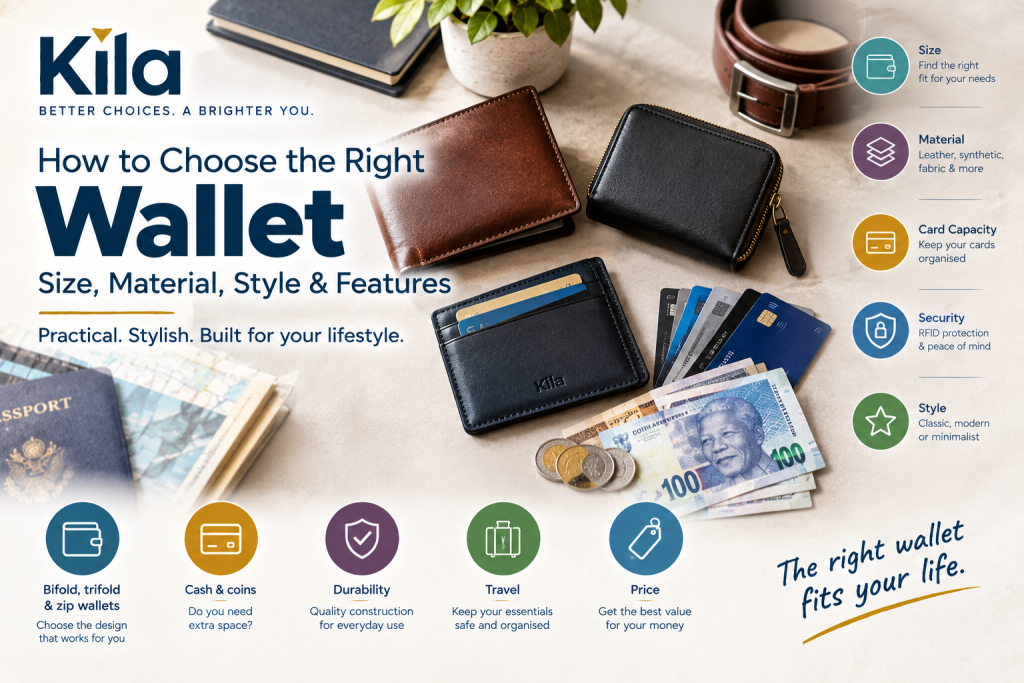
A wallet is one of those everyday accessories that is easy to overlook until the one you own becomes uncomfortable, damaged or simply no longer suits the way you live.
The right wallet should do more than hold your cards and cash. It should fit comfortably into your pocket or handbag, provide enough organisation without becoming unnecessarily bulky, and suit how you actually use it.
There are also more choices than ever. Traditional leather wallets, slim card holders, compact wallets, zip wallets and larger organisers are all readily available, with prices ranging from inexpensive everyday options to premium designer products.
So how do you choose?
The best approach is to start with how you use your wallet, rather than choosing based purely on appearance.
This guide explains the main things to consider when buying a wallet, including size, capacity, material, compartments, security, durability, style and price.
1. Start With How You Use Your Wallet
Before looking at colours, materials or brands, think about what you actually carry.
Do you regularly carry:
- Bank cards?
- Credit cards?
- A driver’s licence?
- Cash?
- Coins?
- Loyalty cards?
- Receipts?
- Business cards?
- Identification?
- Keys or other small items?
A person who mainly uses cards and rarely carries cash may have little need for a large traditional wallet.
Someone who regularly carries cash, coins and several cards may prefer something with more compartments.
This sounds obvious, but it is one of the easiest ways to avoid buying a wallet that is either too large or too small.
2. Choose the Right Wallet Size
Wallet size has a major effect on everyday comfort.
The most common choices include:
Slim card holder
A card holder is designed primarily for bank cards and identification.
It can be an excellent choice if you:
- Rarely carry cash
- Use contactless payments
- Want something that takes up very little space
- Carry your wallet in a small bag or front pocket
The disadvantage is limited storage.
Compact wallet
A compact wallet provides more organisation while remaining relatively small.
It may include:
- Several card slots
- A cash compartment
- A small coin section
- A folding design
This can be a useful compromise between capacity and portability.
Traditional wallet
A traditional wallet generally provides more space for cards, notes and other items.
It can be useful if you carry several cards or cash regularly, but it can also become bulky.
Large organiser wallet
Some wallets are closer to small organisers, with numerous compartments and sometimes a zip-around design.
These can be useful for people who carry many items but are less convenient for a trouser pocket.
3. Don’t Buy More Wallet Than You Need
A common mistake is choosing a wallet with a large number of compartments simply because they are available.
More storage does not necessarily mean a better wallet.
If you only carry four cards and a small amount of cash, a wallet designed for 15 or 20 cards may encourage you to carry unnecessary items.
A smaller wallet can be easier to organise and more comfortable to carry.
The goal is to have enough capacity without unnecessary bulk.
4. Consider Where You Will Carry It
Think about where the wallet will normally live.
Trouser pocket
A slim design is usually more comfortable.
A thick wallet can become noticeable when sitting down and can make one pocket unnecessarily bulky.
Jacket pocket
A larger wallet may be practical, although the additional weight should still be considered.
Handbag
There is generally more flexibility because size is less restrictive.
A larger wallet or organiser may be perfectly practical.
Travel bag
For travel, security and organisation can become more important than minimal size.
You may want additional space for travel-related cards, identification and currency.
5. Choose a Material That Matches Your Lifestyle
Wallets are available in many materials.
Leather
Leather remains one of the most popular wallet materials.
Advantages can include:
- Traditional appearance
- Durability
- Comfortable feel
- Wide range of styles
- Potential to develop character with use
However, leather quality varies considerably.
A wallet described simply as “leather” does not necessarily tell you everything about its construction.
Synthetic materials
Synthetic wallets can be affordable and available in many colours and designs.
Some modern synthetic materials can also be lightweight and highly durable.
They may be worth considering if you want a practical wallet without the price associated with some leather products.
Fabric
Fabric wallets can be lightweight and casual.
They are particularly common in relaxed or outdoor-oriented designs.
Metal
Metal card holders are generally designed for a small number of cards and a minimalist approach.
They can offer a very different look from a traditional leather wallet.
When choosing a material, consider how the wallet will be used rather than assuming one material is automatically better for everyone.
6. Understand Leather Quality
If you are specifically looking for a leather wallet, pay attention to how the product is described.
Terms such as:
- Full-grain leather
- Top-grain leather
- Genuine leather
- Bonded leather
can describe different types of leather or leather construction.
Do not assume that a more expensive wallet is automatically made from better leather.
Check the manufacturer’s description carefully and consider the construction, stitching, lining and hardware as well as the material itself.
If buying online, look at multiple photographs and read the product specifications rather than relying only on the product title.
7. Count the Card Slots You Actually Need
Card capacity is one of the most important practical considerations.
Before buying a wallet, count the cards you regularly carry.
For example:
- Bank card 1
- Bank card 2
- Credit card
- Driver’s licence
- Medical aid card
- Loyalty card
- Other identification
You may discover that you need far fewer slots than you initially thought.
Also consider whether some cards can be stored digitally rather than physically.
Avoid filling every available slot simply because it is there. An overloaded wallet can become difficult to close and uncomfortable to carry.
8. Decide Whether You Need a Coin Pocket
Coins can quickly add weight and bulk.
If you regularly use cash, a coin compartment can be useful.
If you rarely carry coins, however, a wallet without a coin section may be slimmer and simpler.
Consider your everyday spending habits before deciding.
There is little benefit in carrying a large coin compartment if you almost never use it.
9. Think About Cash Storage
Although electronic payments are increasingly common, many people still carry some cash.
If you do, check how the wallet stores banknotes.
Some wallets have a full-length cash compartment, while smaller designs may require notes to be folded.
Consider the currencies you normally carry as well.
This can become particularly important when travelling internationally.
10. Consider RFID Protection
You may see wallets advertised with RFID protection.
RFID refers to radio-frequency identification technology used by some cards and other devices.
Wallet manufacturers may incorporate materials intended to reduce radio-frequency communication between cards and external readers.
If RFID protection is important to you, check that the product specifically states that it provides this feature.
However, don’t let RFID protection distract you from the basic qualities of the wallet.
A wallet still needs to be comfortable, appropriately sized and well constructed.
11. Look at the Stitching and Construction
A wallet’s appearance can be impressive in photographs, but construction quality is what will determine how it performs over time.
Look closely at:
- Stitching
- Edges
- Seams
- Card-slot construction
- Zips
- Buttons
- Buckles
- Lining
- Corners
Pay particular attention to areas that will experience frequent movement.
A wallet that looks attractive but has poorly finished edges or weak stitching may not provide good long-term value.
When shopping online, zoom in on product photographs where possible.
12. Check the Wallet’s Dimensions
Don’t rely on a product photograph to determine size.
Always check the actual dimensions.
For example, two wallets may both be described as “compact” while being noticeably different in size.
Check:
- Width
- Height
- Thickness
- Weight
Thickness is particularly important if you plan to carry the wallet in a trouser pocket.
A wallet that is thin when empty can become substantially thicker when all the compartments are filled.
13. Think About Your Personal Style
A wallet is functional, but it is also a fashion accessory.
Your choice might be:
- Classic
- Minimalist
- Contemporary
- Casual
- Formal
- Sporty
- Colourful
- Understated
A classic black or brown wallet can work well with formal clothing.
A brighter colour or distinctive material may suit a more casual and versatile wardrobe.
The important thing is that the wallet should fit naturally with the rest of your everyday accessories.
14. Match the Wallet to Your Other Accessories
You do not necessarily need every accessory to match perfectly.
However, some coordination can create a more polished appearance.
For example, if you regularly wear a leather belt and leather shoes, a leather wallet in a complementary colour can create a consistent look.
Similarly, a casual fabric wallet may work naturally with casual clothing.
This is especially relevant if the wallet is frequently visible or carried with other accessories.
15. Choose Between Folding and Non-Folding Designs
Traditional bi-fold wallets remain popular because they provide a useful balance of capacity and size.
Other designs include:
Tri-fold wallets
These provide additional organisation but may be thicker.
Card holders
These are compact and minimalist.
Zip wallets
These provide enclosed storage and can be useful for people who want additional security for their cards and cash.
Money clips
These are designed for minimalists who mainly need to carry a few cards and banknotes.
There is no universally correct design.
Choose the format that matches the amount and type of items you carry.
16. Consider a Wallet for Travel
Your everyday wallet may not be the best option for international travel.
When travelling, you may need to carry:
- Passport
- Bank cards
- Foreign currency
- Identification
- Travel cards
- Emergency contact information
However, carrying everything together is not always advisable.
For international travel, consider separating important documents and payment methods rather than keeping everything in one wallet.
A travel wallet can be useful if it provides enough organisation without becoming excessively large.
17. Be Careful With Designer Wallets
Designer wallets can be attractive and may form part of a broader fashion collection.
However, a higher price does not automatically mean that a wallet is more practical or durable.
If you are considering a premium wallet, compare:
- Material
- Construction
- Size
- Capacity
- Design
- Warranty
- Brand reputation
- Price
Consider what you are actually paying for.
A wallet is an everyday functional item, so practicality should remain part of the buying decision.
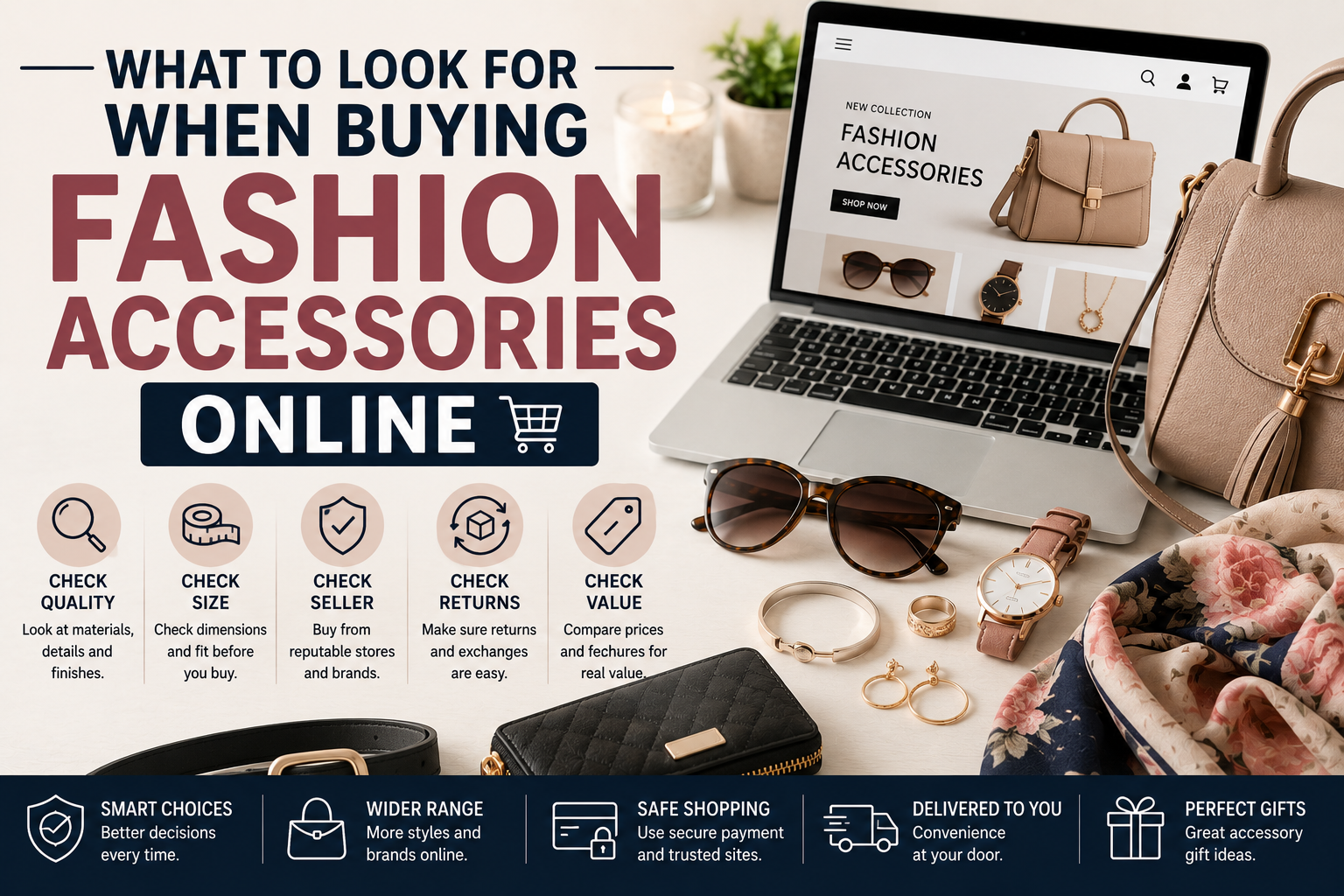
18. Buying a Wallet Online
Buying fashion accessories online can be convenient, but there are several things worth checking.
Before ordering, look for:
Accurate dimensions
Make sure you know the actual size.
Product photographs
Look for photographs showing the wallet open as well as closed.
Interior layout
Check exactly where the cards, cash and other items will go.
Material description
Do not assume a product is genuine leather or another premium material unless the listing clearly states this.
Customer reviews
Look for comments about:
- Actual size
- Material quality
- Stitching
- Durability
- Card capacity
- Colour accuracy
Returns policy
Make sure you understand the retailer’s return conditions before purchasing.
19. Don’t Choose a Wallet Based Only on Appearance
A wallet can look excellent in a product photograph and still be unsuitable for everyday use.
Before buying, ask:
Will it comfortably hold what I carry every day?
Then ask:
Will I actually want to carry it every day?
The best-looking wallet is not necessarily the most practical, and the most practical wallet does not necessarily have to be unattractive.
Try to find the balance between:
- Appearance
- Size
- Capacity
- Comfort
- Construction
- Price
20. How Much Should You Spend?
Wallet prices vary enormously.
You can find basic wallets at relatively low prices, while premium leather and designer models can cost substantially more.
Instead of deciding on a price first, consider how frequently you will use the wallet and how long you expect it to last.
For an everyday wallet, spending a little more on good construction may make sense if it provides better durability.
At the same time, there is no reason to pay a premium simply for a brand name if the additional features and quality do not matter to you.
The best value is not necessarily the cheapest wallet.
It is the wallet that provides the right combination of quality, functionality and price for your needs.
21. A Simple Wallet Buying Checklist
Before buying a new wallet, run through this checklist:
☐ I know what I normally carry
☐ The wallet has enough card slots
☐ It has the right amount of cash storage
☐ I know whether I need a coin compartment
☐ The dimensions are suitable
☐ The thickness is acceptable
☐ The material is clearly described
☐ The stitching and construction look sound
☐ The design suits my personal style
☐ It will fit where I normally carry my wallet
☐ I have checked the reviews
☐ I understand the retailer’s return policy
☐ I have compared the total price with similar options
Final Thoughts
Choosing the right wallet is really about finding the balance between function and personal style.
A good wallet should comfortably accommodate what you actually carry without becoming unnecessarily bulky. It should be made from materials and construction that suit your lifestyle, and it should look appropriate with the clothes and accessories you normally wear.
Before buying, think about your everyday habits first.
Do you carry mostly cards? Do you still use cash regularly? Do you need coins? Do you carry your wallet in a pocket or handbag? Do you want something traditional or minimalist?
Once you answer those questions, choosing the right size, design and material becomes much easier.
And when shopping online, remember that the photographs are only part of the story. Check the dimensions, materials, internal layout, reviews and return policy before making your final decision.
A wallet may be a small accessory, but because you use it so frequently, choosing the right one can make everyday life a little easier.