
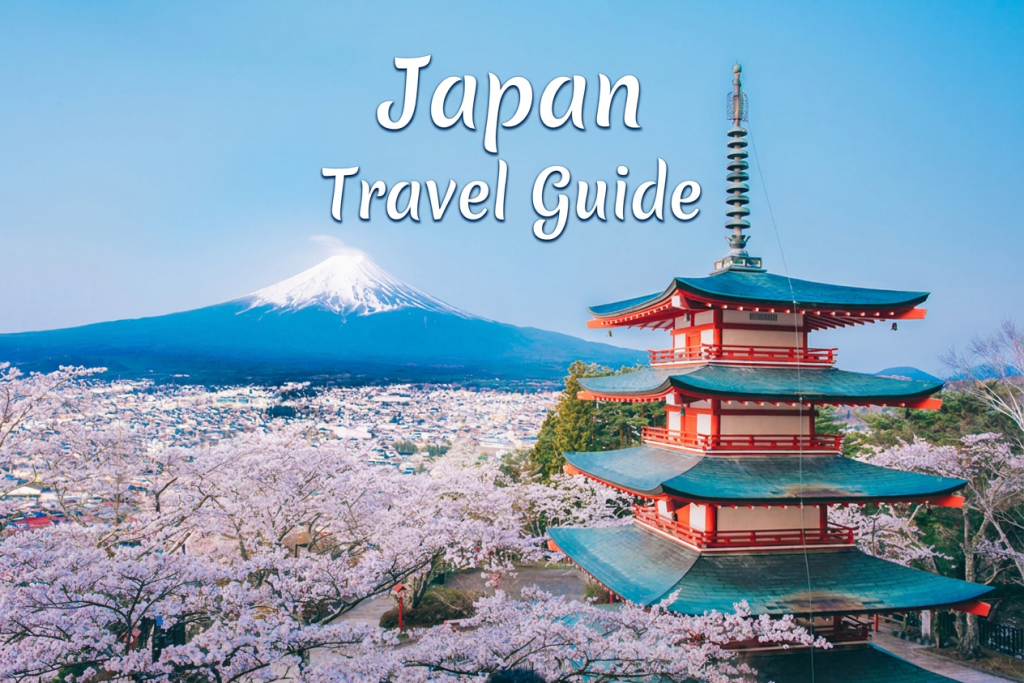
Japan has become one of the most talked-about destinations for South African travellers. Spotless cities, brilliant food, fast trains and a culture unlike anything at home make it a trip many people dream about. But planning it from South Africa raises questions you won’t face on a European city break. Do you need a visa? Why is there no direct flight? And what will it really cost in rand?
This guide answers those questions using the most current information we could find as of November 2026, including three changes that came in this year. Our city guides cover Tokyo and Osaka in detail. This page is the planning hub that ties everything together.
Quick answers
- Visa: Yes. South African passport holders need a visa for tourism and can apply online through Japan’s official eVisa system.
- Visa fee: ¥15,000 for a single-entry visa since 1 July 2026 (about R1,500), up from ¥3,000.
- Length of stay: Up to 90 days on a single-entry tourist eVisa.
- Flights: There are no direct flights. Expect one stop and roughly 19 to 30 hours of travel. Return economy fares of about R14,000 to R18,000 are common outside peak periods.
- Budget: About R27,500 to R36,500 per person for a 10-day budget trip, or R36,500 to R48,500 mid-range, including flights and the visa (details below).
- Cheapest time to go: Mid-January to February. Cherry blossom season, mid-August and Christmas/New Year cost the most.
Do South Africans need a visa for Japan?
Yes. South Africans need a visa to visit Japan as tourists, and since 2026 they can apply for it online. In July 2026, BusinessTech reported that Japan’s Ministry of Foreign Affairs (MOFA) had confirmed South Africa remains the only African country whose citizens can use the Japan eVisa system for short tourist stays. The eVisa is a single-entry visa valid for up to 90 days.
You may come across websites that say South Africans can enter Japan without a visa. Don’t rely on them. The official position is that you apply for a visa before you travel, so always confirm on the Japan eVisa website or with the Embassy of Japan in South Africa before you book.
The Japan eVisa at a glance
| Detail | What to know |
|---|---|
| Who can use it | South African passport holders travelling to Japan for short-term tourism |
| Type of visa | Single entry, up to 90 days |
| How you arrive | By air (the eVisa also covers a couple of scheduled ferry routes from Busan and Shanghai) |
| Fee | ¥15,000 since 1 July 2026 (about R1,500). Charged in local-currency terms, so the rand amount will vary slightly |
| Processing time | Plan for several weeks. Some Japanese embassies quote a minimum of two weeks and warn it can take longer in busy periods |
| When to apply | Applications reportedly open up to three months before travel. Don’t leave it to the last minute |
| Extensions | The eVisa is reported to be non-extendable, so don’t plan to stay longer than your approved period |
| Business, study or work | Not covered by the tourist eVisa. Different visa rules apply |
How to apply for the Japan eVisa
- Check your passport. It should be valid well beyond your planned stay (many sources say at least six months) and have blank pages.
- Plan your trip first. You will usually need an itinerary and accommodation details. Choose flexible or refundable flights until the visa is approved.
- Use the official site only. Start at the Japan eVisa portal. Japanese embassies warn about lookalike websites, and third-party agents add their own fees on top of the government fee.
- Upload your documents. The portal lists what is needed for your nationality. Expect your passport details page, a photo and supporting information about your trip and finances.
- Pay the fee when the portal asks for it. From 1 July 2026 this is ¥15,000 for a single-entry visa.
- Download your approved eVisa and keep a printed copy as well as a digital one, along with your passport.
Prefer to apply in person? You can still lodge a traditional application through the Embassy of Japan in Pretoria.
For the bigger picture of preparing for an overseas trip, see our guide to planning an international trip from South Africa and our checklist of 10 things South African travellers should check before booking.
Flights from South Africa to Japan
There are no direct flights between South Africa and Japan, so every route involves at least one connection. The good news is that several major airlines compete on the route, which keeps fares reasonable.
| Airline | Typical connection | Notes |
|---|---|---|
| Singapore Airlines | Singapore | Popular choice with generally good fares and an easy transfer |
| Qatar Airways | Doha | Frequent connections to Tokyo |
| Emirates | Dubai | Daily service from Johannesburg |
| Etihad | Abu Dhabi | Often competitive on price |
| Ethiopian Airlines | Addis Ababa | Often among the cheapest options |
| Cathay Pacific | Hong Kong | Slightly higher average fares |
| Turkish Airlines | Istanbul | A good option if you want a stopover |
How long does it take? Journey times we found ranged from about 19 to 30 hours with one stop, depending on the layover. Japan is seven hours ahead of South Africa, so expect some jet lag.
What does it cost? Recent fare searches show cheapest return economy fares from Johannesburg to Tokyo of roughly R14,000, with typical prices between about R14,000 and R18,000. Ethiopian and Singapore Airlines are often at the lower end, while Cathay Pacific tends to average a little higher. December is the most expensive month on this route, so expect considerably more for a Christmas trip.
Which airport? Most flights land at Narita or Haneda in Tokyo. Haneda is closer to the city centre. You can also fly into Osaka (Kansai) and out of Tokyo to avoid backtracking. Our guide to planning a multi-city international trip explains how this works.
Make the stopover part of the trip. If your ticket connects through Singapore, Dubai or Istanbul, a few extra days can be a bonus. See our guides to Singapore, Dubai and Istanbul.
For help comparing tickets, read how to choose the right flight for an international trip and our tips for planning a long-haul flight from South Africa.
Is Japan expensive for South Africans? What a trip costs in rand
Japan is cheaper than many people expect, but the flight and visa take a real bite out of the budget before you have spent a yen. The figures below use a rough conversion of ¥100 ≈ R10 (the rand was trading at around ¥9.8 per R1 when we last checked, in July 2026). Exchange rates move, so check the current rate before you budget.
Daily costs on the ground
These per-person figures cover accommodation, meals, local transport and one or two paid attractions. They exclude flights and intercity bullet trains.
| Travel style | Per day (yen) | Per day (rand) |
|---|---|---|
| Budget (hostel or basic business hotel, konbini and casual meals) | ¥9,000–¥14,000 | about R900–R1,400 |
| Mid-range (business hotel, restaurant meals) | ¥18,000–¥25,000 | about R1,800–R2,600 |
| Comfort and luxury | ¥35,000+ | R3,500+ |
Accommodation is the biggest cost. A Tokyo business hotel typically costs roughly ¥12,500 to ¥17,000 per person per night (about R1,300 to R1,700), and mid-range hotels commonly run ¥15,000 to ¥25,000 a night. If you travel as a couple and share a room, your per-person costs drop noticeably.
Sample trip budgets per person
| Trip | Flights (return) | Visa | On the ground | Estimated total |
|---|---|---|---|---|
| 7 days, Tokyo only, budget | R14,000–R18,000 | about R1,500 | R6,300–R9,800 | about R22,000–R29,500 |
| 10 days, Tokyo and Osaka/Kyoto, budget | R14,000–R18,000 | about R1,500 | R11,900–R16,900* | about R27,500–R36,500 |
| 10 days, Tokyo and Osaka/Kyoto, mid-range | R14,000–R18,000 | about R1,500 | R20,900–R28,900* | about R36,500–R48,500 |
*Includes roughly R2,900 for a return bullet-train journey between Tokyo and Osaka at standard fares. Check current fares before you book.
These totals leave out travel insurance, shopping, souvenirs and getting to and from the airport in South Africa. Travel insurance is worth budgeting for. See what to check before you buy travel insurance.
Ways to spend less
- Fly in the quiet months. Mid-January to February is generally the cheapest window for flights and hotels.
- Book early, but stay flexible. Keep tickets refundable until your visa is approved.
- Stay in business hotels rather than central luxury properties, and compare areas on our hotel booking guide.
- Eat like a local. Set lunches, ramen counters, supermarkets and convenience stores (konbini) are cheap, clean and good.
- Work out whether a rail pass pays off. A nationwide pass tends to make sense only on itineraries covering several regions. For a Tokyo-only trip it usually doesn’t, so compare it with point-to-point tickets.
- Use a rechargeable transport card (such as Suica, Pasmo or ICOCA) for trains and buses instead of buying single tickets.
What changed in 2026
Three changes affect South African visitors this year:
- Higher visa fees. On 1 July 2026, Japan raised its single-entry visa fee from ¥3,000 to ¥15,000 and its multiple-entry fee from ¥6,000 to ¥30,000. It was the first increase since 1978. Any blog quoting “about R300” is out of date.
- A higher departure tax. The international tourist tax on leaving Japan rose from ¥1,000 to ¥3,000 (about R300) on 1 July 2026. It is normally included in your airfare, so you won’t pay it separately, but it does push fares up slightly.
- A new tax-free shopping system. Since 1 November 2026, you pay the full price including 10% consumption tax in the shop and claim it back at departure after a customs check, instead of having it removed at the till. The ¥5,000 minimum spend per shop per day still applies. Keep your receipts and carry the items you want refunded in your hand luggage so they can be inspected. Expect queues in the first few months while the system settles in.
When is the best time to visit Japan?
Japan’s seasons are the reverse of ours, so your December summer holiday is their winter.
| Season | What to expect |
|---|---|
| Late March to mid-April | Cherry blossom. Beautiful and the busiest, most expensive period |
| May to June | Mild weather, with a rainy spell in June |
| July to August | Hot and humid. Mid-August is a busy domestic holiday period |
| September to October | Warm, with a chance of typhoons early on, then pleasant autumn weather |
| Mid-November to early December | Autumn colours in Tokyo and Kyoto. Flights start rising toward December |
| December to February | Cold and dry in Tokyo. Cheapest from mid-January. Christmas and New Year are expensive |
Where to go first
For a first trip, most South Africans are best served by a Tokyo base with one or two side trips.
- 7 days: Stay in Tokyo and add day trips. Read our Tokyo travel guide for South Africans for neighbourhoods, transport and what to book ahead.
- 10 days: Tokyo, then the bullet train to Osaka and Kyoto. Our Osaka travel guide covers food, shopping and getting around.
- Want a second country? Combine Japan with Seoul, or break up the journey home in Taipei, Bangkok or Kuala Lumpur.
Staying connected, insured and packed
Mobile data. Roaming from South Africa gets expensive quickly. A travel eSIM installed before you leave is usually the easiest solution. Start with how eSIMs work when travelling overseas and then read how to choose an eSIM for international travel.
Insurance. A tourist visa doesn’t require travel insurance, but medical care abroad can be costly. See what to check before you buy.
Luggage. You will walk and use stairs more than you expect, and Japanese hotel rooms are small. Think carefully about size and weight with our guides to international luggage and travel backpacks.
Footwear and layers. Comfortable walking shoes matter more than anything else you pack. See how to choose the right shoes, and for cooler months, how to choose the right jacket.
Power. Japan uses a different plug shape and a lower voltage (100V) than South Africa. Pack a travel adapter and check that your chargers support 100 to 240V, which most phone and laptop chargers do.
Before-you-go checklist
- Passport valid with plenty of time to spare and blank pages
- Japan eVisa approved, downloaded and printed
- Flights booked (refundable until the visa is approved)
- Accommodation booked for the whole stay
- Pre-register your arrival details through Visit Japan Web if it applies to your trip
- Travel insurance arranged
- eSIM installed while you still have Wi-Fi
- Travel adapter packed
- Some yen in cash, plus a card that works abroad
- Receipts and plan for the tax refund if you shop
Frequently asked questions
Do South Africans need a visa for Japan?
Yes. South African passport holders need a visa for tourism and can apply online through Japan’s official eVisa system for a single-entry stay of up to 90 days.
How much is the Japan visa for South Africans in rand?
The single-entry fee has been ¥15,000 since 1 July 2026, which is about R1,500 at recent exchange rates. The exact rand amount depends on the rate and how the fee is charged.
How long does the Japan eVisa take?
Allow several weeks. Japanese embassies often quote a minimum of about two weeks, and processing can take longer in busy periods. Apply well before you book non-refundable travel.
Are there direct flights from South Africa to Japan?
No. All routes involve at least one stop, typically in Singapore, the Gulf, Addis Ababa, Hong Kong or Istanbul.
How long is the flight from South Africa to Japan?
Expect roughly 19 to 30 hours of total travel time with one stop, depending on the layover.
Is Japan expensive for South Africans?
The flight and visa are the biggest costs, but on the ground Japan can be good value. Budget travellers can manage on about R900 to R1,400 a day, while mid-range travellers should plan on roughly R1,800 to R2,600 a day.
When is the cheapest time to fly to Japan?
Mid-January to February is usually the cheapest window. December and cherry blossom season are the most expensive.
Can I extend my stay in Japan on an eVisa?
The eVisa is reported to be non-extendable, so plan your itinerary to fit within the period approved on your visa.
Do I need travel insurance for Japan?
It isn’t a condition of the tourist visa, but it is strongly recommended because medical treatment abroad can be expensive.
Final thoughts
Planning a trip to Japan from South Africa takes a little more groundwork than a European holiday, but none of it is difficult once you know the order to do things in. Check your passport, apply for the eVisa early, keep your flights flexible until it’s approved, and budget realistically for the flight and visa before you start counting yen.
Get those basics right and the rest of the trip is mostly the fun part: choosing where to eat, what to see and how many days you can stretch your leave. Rules, fees and fares change often, so confirm the details with the official sources below before you commit.
More Kila travel guides
- Tokyo Travel Guide for South Africans
- Osaka Travel Guide for South Africans
- Seoul Travel Guide for South Africans
- How to Plan an International Trip from South Africa
- How to Choose an eSIM for International Travel
- Travel Insurance for South Africans
- All Kila travel guides
Sources and official links
- Japan eVisa (Ministry of Foreign Affairs of Japan)
- Embassy of Japan in South Africa
- Visit Japan Web
- BusinessTech: Some good news for South African passport holders (20 July 2026)
- Anadolu Agency: Japan to raise visa fees for the first time in nearly five decades (20 June 2026)
- Tokyo Cheapo: Japan tax-free shopping change
- Japan National Tourism Organization: Japan’s new tax-free shopping system
- KAYAK South Africa: Johannesburg to Tokyo flights
Prices, fees and entry rules change often. Always confirm current details with the official sources above before you book or travel. Kila may earn a commission if you buy through some links on our site. See our disclosure policy.